
Microsoft-Decision-1 scores options and writes no text
Microsoft-Decision-1 is a small model that answers by putting a probability on each option you give it, and it never writes a sentence. Microsoft announced it on October 9, 2026 on its Command Line blog, in a post by Achint Srivastava, VP of Software Engineering in the Office of the CTO. It runs on Microsoft Foundry and on OpenRouter.
A model that returns probabilities, not text
A decision model takes an input and a closed set of possible answers, then tells you how likely each answer is. A chatbot would write a reply. Decision-1 instead hands back numbers your code can branch on, such as the probability that a support ticket belongs to engineering.
Microsoft pitches it for routing, classification, prioritization, verification and workflow control. It covers yes/no questions, multiple choice and rating scales, and it can grade an AI answer or an agent's next action against a rubric.
Because the probabilities are calibrated, the number doubles as a confidence level. An app can act on its own above a threshold and send the rest to a person.
Built on Qwen3.5-9B, with a planned rebase
Microsoft did not start from one of its own models: Decision-1 is Qwen3.5-9B, post-trained to score a decision in a single pass. Qwen is Alibaba Cloud's open-weight model family. Microsoft says it will soon move Decision-1 onto other bases, including its own MAI models and OpenAI's, without saying why.
Jev, from TypeSafe AI, opened this category in mid-September, so Microsoft arrives about four weeks behind it. By October 10 The Register counted more than 100 decision models, among them OpenAI's Decisions API, Cloudflare's Clef and H2O-Lightning-4B. For background, see Jev maker TypeSafe AI raises $870M at $7.5B and Cloudflare Clef vs Jev: decision model benchmarks, which covers another Qwen-based entry.
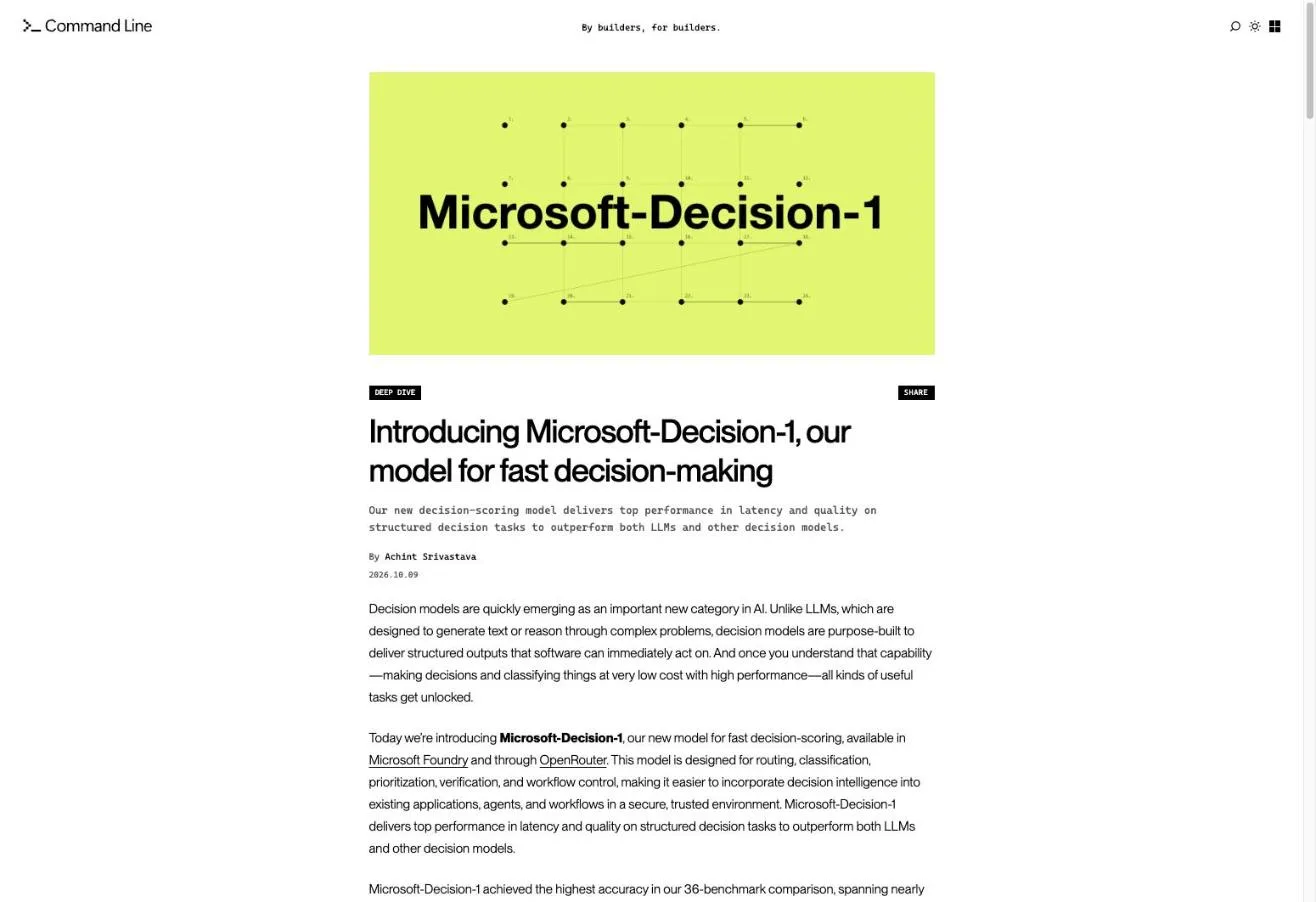
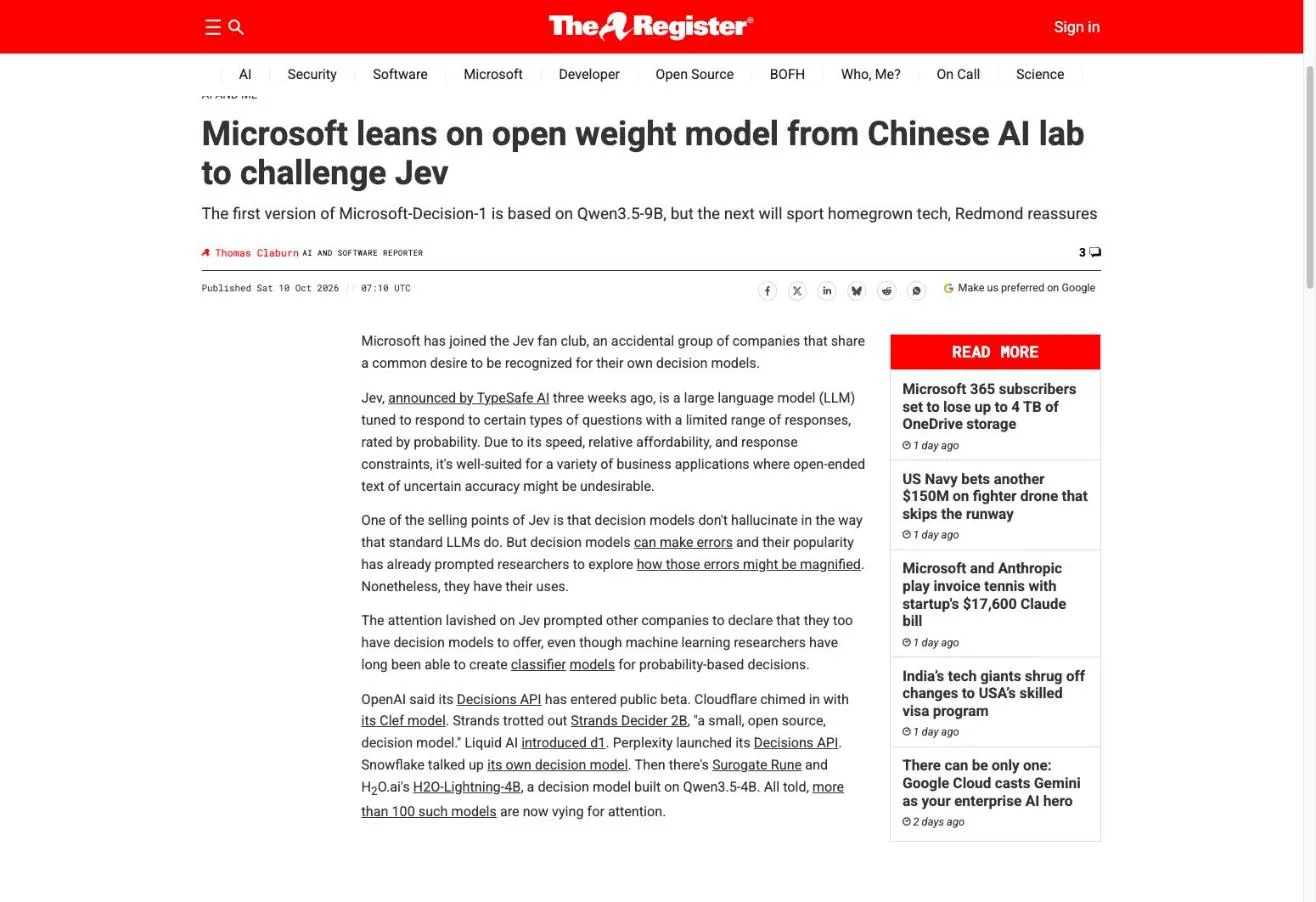
To build Microsoft-Decision-1, we post trained Qwen3.5-9B for fast, single-pass decision scoring and will soon rebase it on other models, including Microsoft AI (MAI) and OpenAI. When given a fixed set of answer options, Microsoft-Decision-1 provides a calibrated probability score for each option. The model supports yes/no, multiple-choice, and rating options, as well as rubric-based grading of AI responses and agent actions, all through a simple structured API call. — From the section on how Microsoft-Decision-1 worksView official source →
The Qwen model family is developed by Alibaba Cloud, the cloud computing arm of Chinese tech giant Alibaba. Microsoft, for reasons not disclosed, said it will soon rebase the Decision-1 on its models and those from OpenAI. — From the passage on the Qwen base and the planned rebaseView official source →
The three question types: noul, choice and score
Every request carries a state, which is the text or JSON being judged, and one or more typed questions about it. The type you pick fixes the shape of the answer.
Question types in Microsoft-Decision-1 (Microsoft Learn)
| Type | Question it answers | What comes back |
|---|---|---|
| noul | Is this true? | A probability from 0 to 1 |
| choice | Which option is it? | One chosen option plus a probability for each option |
| score | How much? | A value on an ordered scale plus a probability for each level |
Yes/no, pick-one and graded answers in one request
Use noul to gate or filter, choice to route, and score to rank or grade. For score, the returned value is the probability-weighted average of the level numbers. With four levels the value runs from 0 to 3 and can land between two levels.
Questions about the same state can share one call. Learn's example routes a ticket to a team, rates its severity on four levels and checks whether the customer has written before, all at once:
{
  "model": "<deployment-name>",
  "state": { "message": "Checkout is down again. This is my third request.", "customer_contact_count": 3 },
  "questions": {
    "team": { "type": "choice", "instructions": "Which team should handle this request?",
      "criteria": { "billing": "Charges, invoices, and refunds", "engineering": "Bugs, errors, and outages", "support": "How-to and account questions" } },
    "severity": { "type": "score", "instructions": "How severe is this issue?", "criteria": ["Cosmetic", "Minor", "Major", "Critical"] },
    "repeat_contact": { "type": "noul", "instructions": "Has the customer contacted support before?" }
  }
}
The answers come back under the same question names, so there is no free text to parse. Learn adds that bundling related questions cuts the number of calls and has every answer judge the same context.
Pairing it with a generative model
Decision-1 cannot draft, summarize or explain, so any step that needs words still goes to a generative LLM. Microsoft suggests using the two together: let Decision-1 route or block a request first, then pass only the approved ones to the generative model.
The cost gap shows up even before any generative step is added. In Microsoft's Xbox Research trial, sorting more than 10,000 pieces of player feedback into fixed themes matched GPT-6 Sol on quality, ran over 14 times faster and cost one two-hundredth as much.
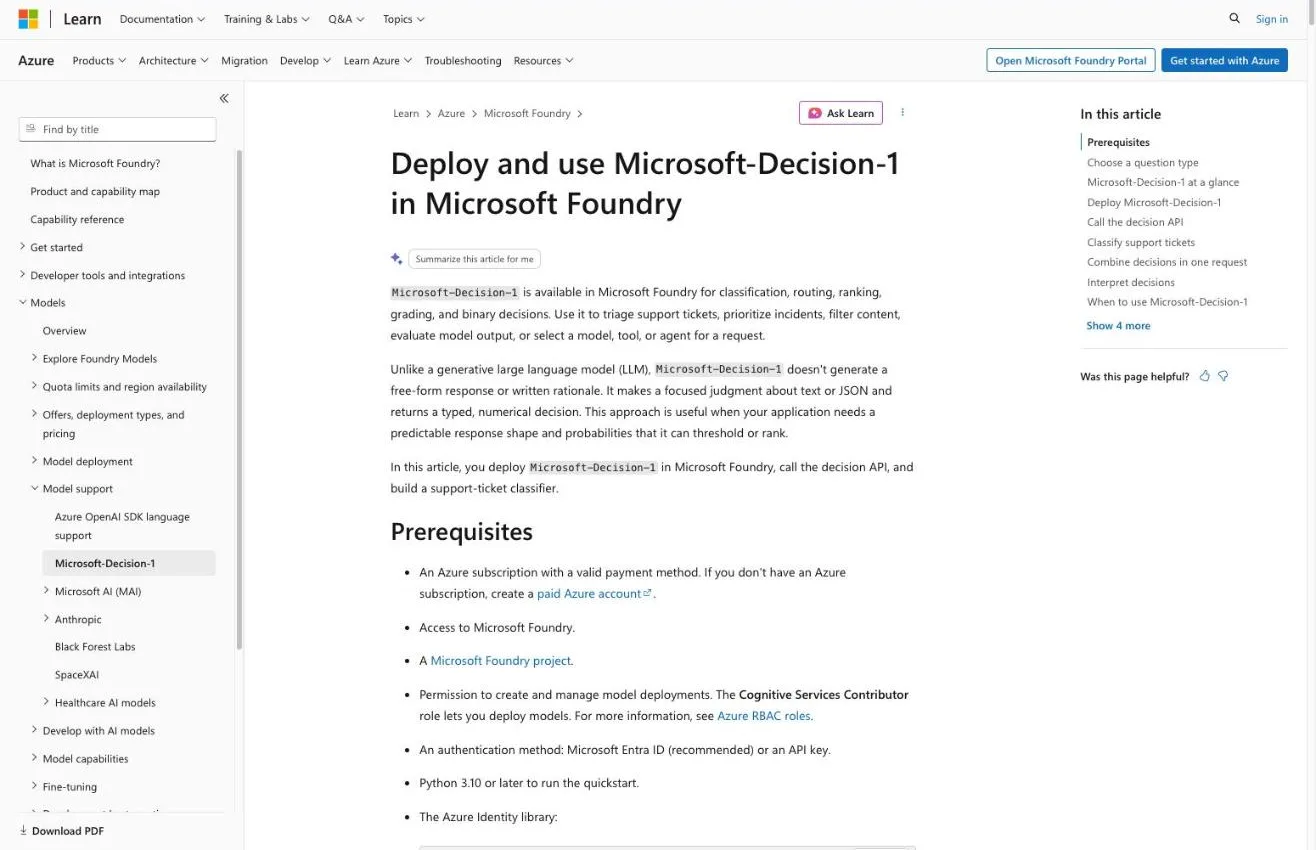
Unlike a generative large language model (LLM), Microsoft-Decision-1 doesn't generate a free-form response or written rationale. It makes a focused judgment about text or JSON and returns a typed, numerical decision. / Use a generative LLM instead when the application needs to create, summarize, rewrite, or explain content. You can also combine the two approaches. Use Microsoft-Decision-1 to route or gate a request, and then send approved requests to a generative model. — From the introduction and the section on when to use Microsoft-Decision-1View official source →
Where Decision-1 wins and loses against Jev
Decision-1 costs exactly what Jev costs, and Microsoft's own tests put it ahead of Jev on accuracy and speed but behind on calibration. Every number in this section comes from Microsoft's post.
Same price as Jev at $0.042 per million input tokens
Input costs $0.042 per million tokens and output tokens are free, matching Jev to the cent. So Microsoft's case rests on its accuracy and speed numbers.
Microsoft's cost example puts the gap with a large general model in dollars. Classifying one million items would cost about $2,434 with GPT-6 Sol and about $11 with Decision-1, by its estimate.
Top accuracy in Microsoft's tests, Jev ahead on calibration
Across 36 benchmarks and 147,137 questions held out from training, Decision-1 had the highest average accuracy, 83.5%, against 82.3% for Jev 1.13.0. The spread among the top three is under two points, so on accuracy alone the lead is narrow.
Average accuracy on 36 benchmarks (Microsoft's measurement)
Bar height is accuracy on a 0–100 scale. Strands-Decider 2B (54.8%, 23 of 36 benchmarks) is left out. Source: Microsoft Command Line.
 Decision-1
 Jev 1.13.0
 GPT-6 Luna Decisions
Speed is where the gap is widest. Microsoft uses the median (p50), the time within which half of all responses arrive.
Median latency, lower is faster (Microsoft's measurement)
Bar height is relative to the slowest value shown (deck-31B at 400 ms = 100). GPT-6 Sol, at 3,010 ms, is off the scale. Source: Microsoft Command Line.
Decision-1Jev 1.13.0GPT-6 Luna DecisionsThat makes Decision-1 2.5 times faster than the runner-up, H2O-Lightning-4B, and 35 times faster than GPT-6 Sol. Microsoft argues the milliseconds add up: 100 ms extra on each of 20 chained decisions is two seconds lost.
Calibration is the one chart Decision-1 does not top. A calibration score of 100 means the stated confidence always matches how often the answer is right.
Calibration score (Microsoft's measurement)
| Model | Calibration |
|---|---|
| Jev 1.13.0 | 93.7 |
| Quyet-1.0-Large | 93.1 |
| Microsoft-Decision-1 | 92.2 |
| Surogate Rune 26B-A4B | 91.8 |
| H2O-Lightning-4B | 91.8 |
| GPT-6 Luna Decisions | 89.9 |
| deck-31B | 83.5 |
Jev's accuracy and calibration rows were added after the post went up, per an editor's note. The Register, reporting from the earlier version, described Decision-1 as second on calibration behind Quyet. With Jev included, it is third.
Microsoft also checked whether the answer holds when a request is phrased differently. Rewording or reordering the same request in eight ways changed the decision 1.3% of the time on average, and never when only the option order or option descriptions changed.
Microsoft-Decision-1 achieved the highest accuracy in our 36-benchmark comparison, spanning nearly 150,000 questions across benchmarks kept blind from training. And in our benchmarking, it was the fastest measured: 2.5 times quicker than H2O-Lightning-4B v1.1, the runner-up, and 35 times quicker than GPT-6 Sol. / Editor’s note: This post was updated from the original to add benchmarks for Jev on accuracy and calibration. / Microsoft-Decision-1 changes its decision on 1.3% of perturbations on average with zero flips when option descriptions are paraphrased or when options are reversed or shuffled. — From the summary, the editor's note and the section on robustnessView official source →
Microsoft's numbers next to the JevBench run
The first outside measurement came a day after launch, and its median latency is more than five times the one Microsoft published. The two tests differ in method, so neither cancels the other.
The 85 ms figure was measured inside Foundry
Microsoft timed Decision-1 through Foundry in the same region, while the rival latencies come from JevBench v1.6.1's adjusted medians, checked on October 7. The 85 ms and the 240 ms for Jev were therefore not taken in one setup.
Microsoft also reported a p95 of 125 ms, the time within which 95% of its responses arrived. The p95 shows the slow tail that a median hides, and it is the number to compare when a chain has many steps.
JevBench measured 459 ms and ranked it sixth
On October 10, Benchmark Heaven added Decision-1 to the JevBench API board after running 1,200 sealed and 300 public items through native Azure Foundry. Its median latency on a 124-request timing subset was 459 ms.
The overall score, Composite A, was 69.11, sixth of 27 hosted offerings. Capability scored 70.78 and calibration 84.40. Composite A weighs intelligence, calibration, speed and cost equally, so it is not an accuracy figure.
Two caveats sit in the changelog. Decision-1 hit the context limit 21 times, and those failures stay in the denominator as wrong answers. The other rows keep their earlier measurement dates and were not re-run alongside it.
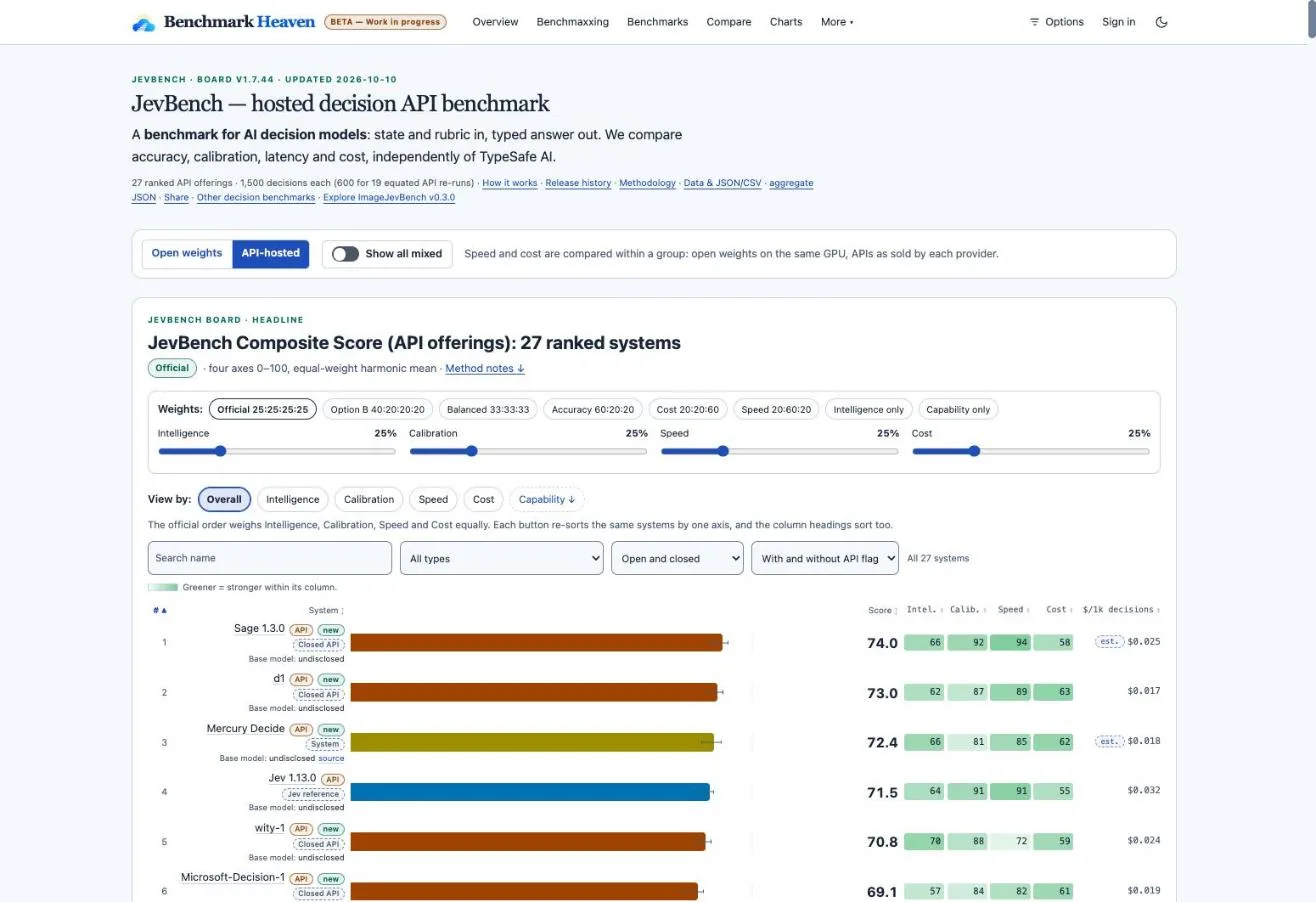
v1.7.31 (2026-10-10): Microsoft-Decision-1 joins the hosted API board after a native Azure Foundry measurement on 1,200 sealed plus 300 public observations: Capability 70.78, Calibration 84.40 and Composite A 69.11. Its 21 context-limit failures remain in the scored denominator. Native median latency is 459 ms on the 124-request speed subset. — From the v1.7.31 entry in the release historyView official source →
How to call Decision-1 on Foundry or OpenRouter
You can deploy Decision-1 in your own Foundry project or call it on OpenRouter at the same price. Deploying it yourself needs an Azure subscription with a payment method, a project and the Cognitive Services Contributor role.
Deploying in Foundry and calling the systemone endpoint
After deploying, you POST to /providers/microsoft/v1/systemone on your Foundry resource and set model to your deployment name, not the model name. Sign in with Microsoft Entra ID, which Learn recommends, or use an API key.
Learn lists two deployment types: DataZoneStandard in some regions and GlobalStandard. On OpenRouter the model takes text only and has a 32,768-token context window, so long documents need trimming before they go in the state.
If you are building against the docs, saving the Learn page as Markdown keeps the request examples easy to search and paste. The page also includes a short Python script that measures accuracy and median latency on your own labeled tickets.
Limits Microsoft sets for decisions about people
Microsoft Learn says not to use Decision-1 as the only decision-maker in consequential decisions about people, such as credit, employment, housing, healthcare or legal matters. Keep a human review step in those flows.
Learn names other limits too. Scores can shift with the wording or order of questions and options, calibration is strongest on familiar task types, and the model gives no explanation for its answers. Its advice is to set confidence thresholds from the cost of false positives and false negatives, and to offer an abstain option such as "cannot tell".

The request's model value is your deployment name, not the underlying model name. / Wording sensitivity: Scores can change based on how you phrase or order questions and options. Poorly framed questions still return scores. / For consequential decisions about people, such as decisions involving credit, employment, housing, healthcare, or legal matters, use the model for decision support with meaningful human review. Don't use it as the sole decision-maker. — From the sections on calling the decision API and on known limitationsView official source →
Microsoft-Decision-1 has a 32,768 token context window. — From the FAQ on the model pageView official source →
Try Decision-1 on Azure, keep Jev for calibration
Try Decision-1 if you already run on Azure or want a second decision model at the same price, and stay on Jev if top calibration matters most. Microsoft's own chart has Jev ahead there.
- Already on Azure or Foundry: Decision-1 keeps the calls inside your existing account
- Need the best-calibrated confidence for automatic actions: Jev, per Microsoft's chart
- Speed-sensitive chains: test both, because Microsoft measured 85 ms and JevBench measured 459 ms
Both charge $0.042 per million input tokens, so running a sample of your own labeled requests through each costs very little. Compare accuracy and latency on that sample before you switch anything in production.
FAQ
- How much does Microsoft-Decision-1 cost?
- Input costs $0.042 per million tokens and output is free, the same rate TypeSafe charges for Jev. OpenRouter lists it at that price too.
- Can Decision-1 write a summary or explain its answer?
- No. It returns only numbers: a probability, a chosen option or a score. For summaries or explanations, Microsoft points you to a generative model, which you can call after Decision-1 has filtered the request.
- How long a text can I send to Decision-1?
- OpenRouter lists a 32,768-token context window, text input only. Images are not accepted.
Related articles
 Jev maker TypeSafe AI raises $870M at $7.5BTypeSafe AI raised $870M at a $7.5B valuation 24 days after launching Jev. Five days later Jev 1.14 added images, box and long context as experiments.
 Cloudflare Clef vs Jev: decision model benchmarksCloudflare Clef is an open-weight decision model that speaks Jev's API and reads images, at about 6x Jev's price. Its benchmark lead is still self-reported.
 North Korean hackers embed AI in their operationsMicrosoft rated eight North Korean hacking groups on AI use on October 29, 2026. Three run AI across entire operations, from fake recruiters to malware.
 Microsoft offers buyouts to about 60,000 employeesMicrosoft offers voluntary buyouts to staff at level 70 and below in four countries. CNBC says about 60,000 are eligible; those who accept leave Dec. 31.