
Three of eight North Korean groups run AI across operations
Every one of the eight groups Microsoft assessed has adopted AI, and none is still at the experimental stage. Microsoft Threat Intelligence, the company's security research team, laid out the findings in a blog post on October 29, 2026. It judged AI use across North Korea's hacking groups as a whole to be high.
Microsoft gives North Korean groups names ending in "Sleet." For this report it looked at eight groups with the biggest impact and placed each on a four-stage scale based on how they use generative AI and agentic AI, meaning AI that carries out multistep tasks on its own once given instructions.
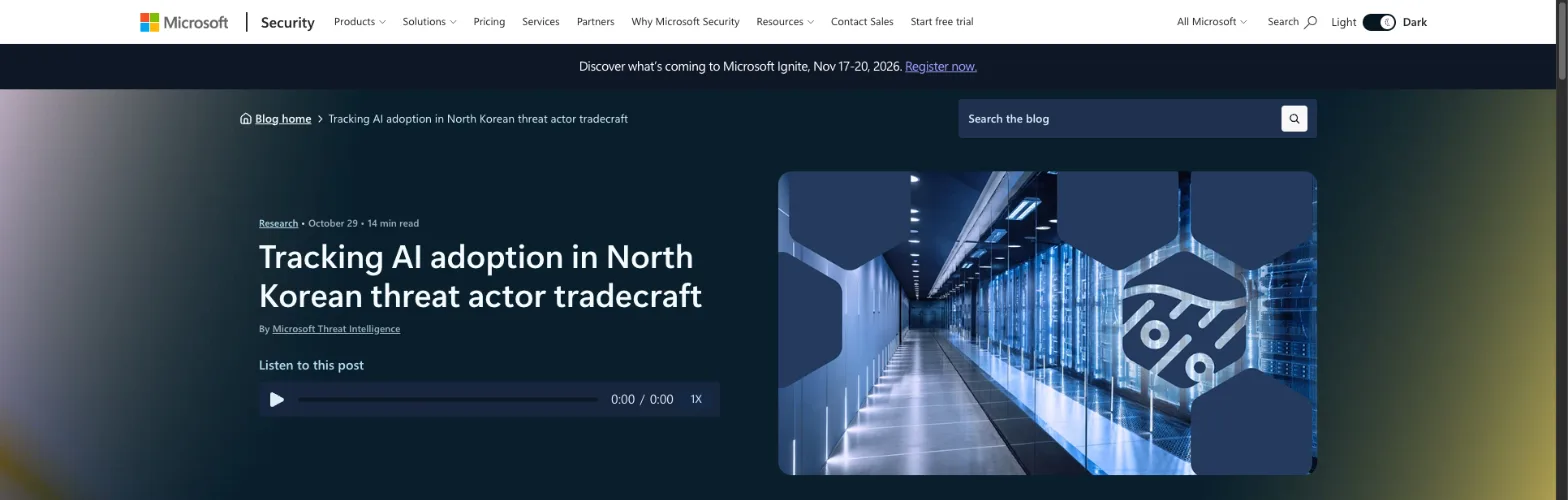
"Microsoft Threat Intelligence assesses the overall adoption of AI across North Korean threat actors as high" / "Based on identified AI use, Microsoft Threat Intelligence assesses high-impact North Korean threat actors across four stages of adoption: emerging, expanding, accelerating, and operationalized."View official source →
Jade Sleet, Coral Sleet and Jasper Sleet reach the top stage
The other five groups split between the accelerating stage, with four groups, and the expanding stage, with Emerald Sleet alone. Jade Sleet, Coral Sleet and Jasper Sleet sit at the top, a stage Microsoft calls operationalized. The table below shows how Microsoft defines each stage and which groups fall into it.
Microsoft's four stages of AI adoption and the North Korean groups in each
| Stage | What it means | Groups |
|---|---|---|
| Operationalized | AI is part of everyday work and built into existing processes | Jade Sleet, Coral Sleet, Jasper Sleet |
| Accelerating | AI is spreading quickly across several functions | Diamond Sleet, Onyx Sleet, Pearl Sleet, Sapphire Sleet |
| Expanding | AI is used in some activities but not yet across wider workflows | Emerald Sleet |
| Emerging | AI use is limited or experimental | None |
The three top-stage groups often run attacks that depend on tricking people and impersonating someone else. Microsoft says AI speeds these up by tailoring lures and fake personas to each target. For Emerald Sleet, it found signs of AI in some workflows but not the level of adoption or impact seen in the other groups.
"Microsoft Threat Intelligence assesses that the North Korean threat actors Jade Sleet, Coral Sleet, and Jasper Sleet have operationalized AI across their entire operations, which frequently encompass identity-based attacks built on deceptive social engineering." / "Microsoft Threat Intelligence assesses that Diamond Sleet, Onyx Sleet, Pearl Sleet, and Sapphire Sleet are at the accelerating stage of AI adoption." / "At this time, Microsoft Threat Intelligence has not assessed any North Korean threat actors as operating at the emerging stage."View official source →
Humans still direct every AI-enabled operation
North Korea's goals have not changed, and AI mainly helps the same operations run faster and at a larger scale. Under heavy international sanctions, the country's hackers chiefly raise money for the regime and gather strategic intelligence, and some also aim to disrupt or destroy systems for political reasons.
Microsoft sees AI as a boost to those existing aims rather than a change in motive. The groups most often go after four kinds of organizations:
- Cryptocurrency and financial firms
- IT companies and software supply chains
- Government agencies
- Schools and other education-related organizations
Their core methods are also the same as before: social engineering, malware delivery and misuse of legitimate software. Microsoft adds that these AI-assisted operations are still run by people and have not become fully autonomous.
"AI adoption by North Korean threat actors therefore largely supports existing goals and targeting priorities rather than representing a shift in actor motivations." / "Despite threat actors’ adoption of AI, Microsoft Threat Intelligence assesses that AI-enabled operations remain human-directed and have not become fully autonomous."View official source →
Fake recruiters and fake applicants are built with AI
The groups use AI to produce everything from job ads and resumes to interview answers, deceiving both job seekers and the companies that hire. According to Microsoft, Sapphire Sleet, Jade Sleet and Coral Sleet pose as employers and run fake hiring processes to reach people and organizations, while Jasper Sleet uses stolen or invented identities to get real remote jobs.
In each case, AI makes the fake messages and personas more convincing and helps the attackers avoid raising suspicion during conversations. Microsoft lists these uses:
- Writing phishing, recruiter and investment lures aimed at specific people
- Translating messages and adjusting tone so impersonation in a foreign language reads naturally
- Drafting resumes, career histories and answers for job interviews
- Getting through coding tests and juggling several fake worker identities
- Editing profile photos, video, voice and backgrounds
"For example, Sapphire Sleet, Jade Sleet, and Coral Sleet use employment- and interview-themed social engineering to target users and organizations, while Jasper Sleet uses fraudulent identities to obtain legitimate remote employment." / "Produce tailored phishing, recruiter, and investment lures" / "Translate content and adjust tone to support foreign-language impersonation and more natural communications" / "Build resumes, biographies, and realistic interview responses" / "Support coding assessments, job-related tasks, and the management of multiple worker personas" / "Alter profile images, video, voice, and backgrounds"View official source →
Jade Sleet posed as three front companies in one week
Its targets worked at cybersecurity, AI, blockchain and talent recruitment companies. Microsoft observed the activity between June 8 and June 12, 2026. Jade Sleet pretended to be hiring software engineers for a made-up firm that claimed to use AI for blockchain analysis, and it set up interviews with people who replied.
To look credible, the group registered matching domains, built social media profiles and showed knowledge of the industry. In the same short window it ran the same kind of outreach under two more front companies, which are fake businesses set up to hide who is really behind them. Microsoft reads that pace as a sign that generative AI helped Jade Sleet learn each industry quickly and widen its reach.
Front companies are not unique to Jade Sleet. Since August 2026, Diamond Sleet has created fake communications technology firms, complete with websites and staff personas, to approach telecom companies as would-be business partners.
"For example, between June 8 and June 12, 2026, Microsoft Threat Intelligence identified Jade Sleet conducting job-themed targeting against individuals across various organizations, including those involved in cybersecurity, AI, blockchain, and talent recruitment companies." / "Within this short time frame, Jade Sleet conducted similar job-themed targeting using two additional front companies, supported by comparable infrastructure and relevant domain knowledge." / "Further, Diamond Sleet has created fake communications technology companies, complete with supporting websites and tailored personas, to target telecommunications companies under the guise of legitimate business partnerships."View official source →
Jasper Sleet uses AI to land remote jobs
Over the past year it has prepared fake personas faster and in greater numbers, and it uses fraudulent identities to hold remote jobs. Microsoft believes the group now relies on generative and agentic AI to write resumes, which has also made each persona a closer fit for the job it applies to.
Jasper Sleet has built reusable tooling to send out more applications and to come across as a genuine candidate during hiring. Once hired, it uses AI to keep the tone and quality of work consistent across several fake workers.
"The actor’s suspected use of generative and agentic AI-assisted resume workflows demonstrates an improvement in the speed, scale, and relevance of persona preparation over the past year." / "For example, Jasper Sleet’s AI tooling helps maintain consistent communication and performance across multiple fraudulent worker personas."View official source →
Microsoft says AI coding tools helped build malware
Because AI coding tools let the groups rebuild their tools quickly, blocking one version no longer stops them for long. Microsoft found evidence that North Korean groups use AI-powered software to help write malware.
According to Microsoft, faster rebuilds make it easier to slip past detection and blocking. It believes Jade Sleet, Coral Sleet, Pearl Sleet and Sapphire Sleet used AI coding assistants such as Cursor for the following work:
- Generating, converting, debugging and rewriting code
- Writing scripts and commands, plus code that keeps malware running on a machine and hides what it does
- Tracking down errors and working out why their tools behave a certain way
- Porting features to other programming languages, libraries and environments
In August 2026, Sapphire Sleet likely used AI in a software supply chain attack aimed at Rust developers. The malware it deployed compiled .NET code on the fly after the break-in, most likely to avoid detection.
"These tools include AI-assisted development platforms, such as Cursor, which have likely enabled Jade Sleet, Coral Sleet, Pearl Sleet, and Sapphire Sleet to:" / "Additionally, AI-enabled development cycles further allow threat actors to circumvent detection and blocking efforts, as AI platforms streamline retooling, helping enable threat actors to rapidly pivot in reaction to defensive measures." / "For example, Microsoft Threat Intelligence has identified evidence indicating that Sapphire Sleet, who has conducted several supply chain attacks, likely incorporated AI during the August 2026 Rust software compromise." / "as the malware used dynamic .NET compilation during post-exploitation, most likely for defense evasion."View official source →
Coral Sleet has trojanized private GitHub repos since April
Microsoft says the technique Coral Sleet has run since April 2026 was highly likely built with an AI development platform. Coral Sleet plants malware in private GitHub repositories, the access-restricted spaces where developers store and share source code, and has wired that step into its existing infection chain. Microsoft points to how broad the technique is, how large it has grown and how fast it appeared.
"And, since April 2026, Coral Sleet has operationalized a workflow to trojanize private GitHub repositories, integrating them into their existing malware chain. This new capability, its breadth and scale, and its rapid implementation were highly likely engineered using an AI-enabled development platform."View official source →
Onyx Sleet produced dozens of PDF lures in minutes
In August and September 2026, Onyx Sleet created more than 100 target-specific PDF lures and used them to phish users in South Korea. A lure here is a document written to get a particular person to open it. File metadata showed the group turning out dozens of these PDFs back to back within minutes, which Microsoft calls highly likely to be AI output.
Because new lures can be generated or tweaked so quickly, Microsoft warns the campaigns may be harder to disrupt and detect. Since late October 2026, Onyx Sleet and Pearl Sleet have also been using ARTEX, an open-source penetration testing tool driven by AI agents.
"Microsoft Threat Intelligence has identified over 100 PDF lure files attributed to Onyx Sleet that were created in August and September 2026 with target-specific details. Metadata indicated that the actor created dozens of files at a time in rapid succession within minutes, highly likely to be the output of an AI platform." / "This automation supports the actor’s high-volume phishing campaigns against South Korean users and could make disruption and detection efforts more difficult given the rapid regeneration or modification of additional lures." / "Since late October 2026, Microsoft Threat Intelligence has identified Onyx Sleet and Pearl Sleet leveraging open-source agentic AI penetration testing ARTEX in operations, highlighting how North Korean threat actors are adopting new AI technologies as they become available."View official source →
What hiring companies and recruited employees can do
Companies should confirm that the people they hire are who they claim to be, and employees should not open job offers or code from strangers on the spot. Fake applicants like Jasper Sleet's land on the desks of companies that hire staff or contractors. Fake recruiters like Jade Sleet's reach individual employees, who then become the way in.
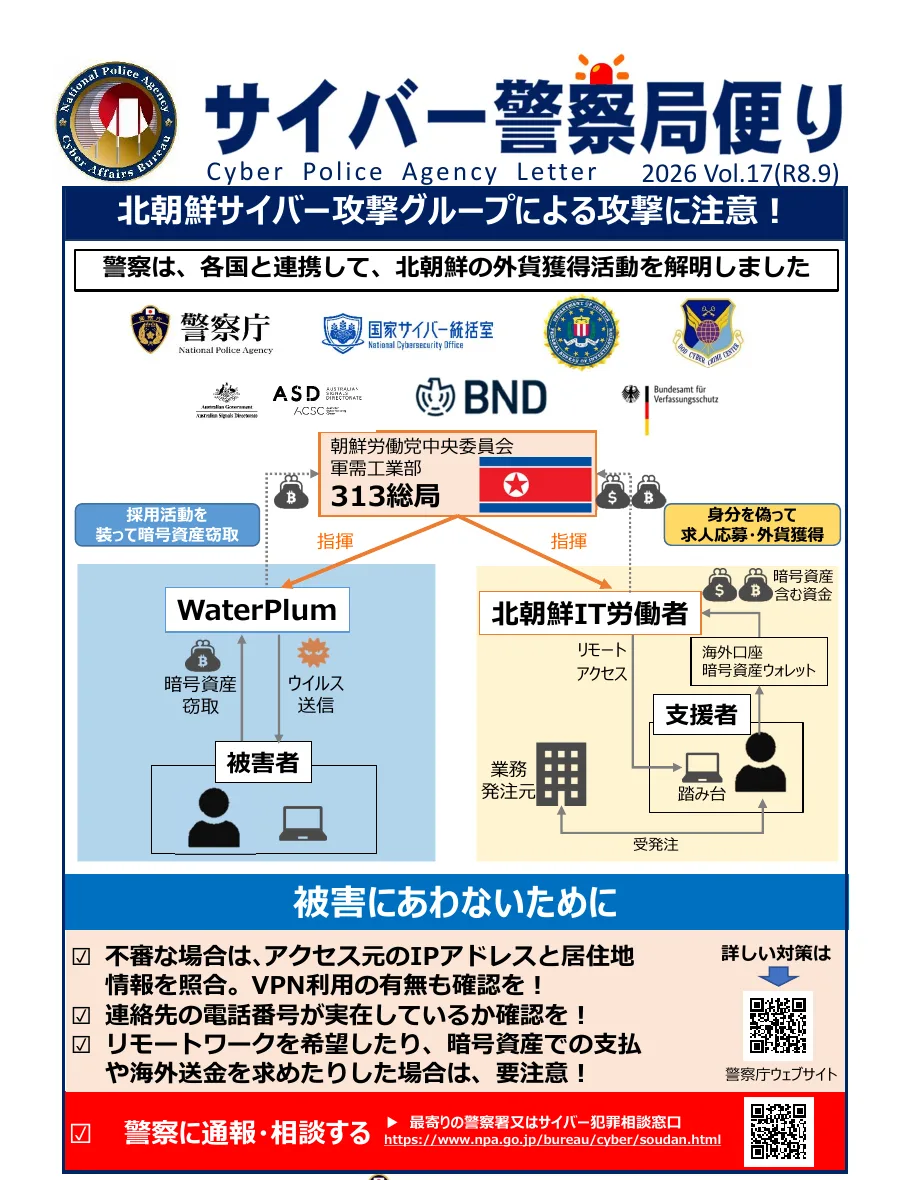
Japanese authorities have issued guidance on the same tactics. For companies, there is a July 31, 2026 joint advisory on North Korean IT workers from the National Police Agency (NPA) and four ministries, plus the NPA's Cyber Police Agency Letter 2026 Vol.17.
For employees, there is a December 24, 2024 advisory on the group TraderTraitor from the NPA, Japan's national cybersecurity center and the Financial Services Agency. Below are three steps for each side.
Companies: verify who you hire or contract
A candidate who avoids video meetings and asks to be paid in cryptocurrency shows the warning signs of a North Korean IT worker. The joint advisory says these workers pose as citizens of other countries to win jobs and lean on AI to hide who they are.
It also flags awkward or machine-translated profiles, rates well below the market and contacts that change depending on the time of day. Here are three checks a company can run.
Hold several video interviews and match faces to IDs
The advisory treats mismatches during video calls as a warning sign, such as a face that does not match the photo ID or footage that looks altered or AI-generated. Refusing to join video meetings at all is another sign.
Microsoft gives similar advice. Make sure the candidate appears on camera across several sessions, and treat repeated claims of camera or microphone trouble as a red flag.
Check phone numbers and IP addresses against the application
In the September 2026 issue of its Cyber Police Agency Letter, the NPA explains what to check when a candidate seems suspicious. Compare the IP address they connect from with where they say they live, and check whether they are using a VPN, which can make a connection appear to come from somewhere else.
The NPA also says to confirm that the contact phone number actually exists. Microsoft likewise suggests checking that a candidate has a home address, social media accounts and a real phone number rather than an internet-based VOIP line.
Treat requests for crypto or overseas payment as a red flag
The joint advisory lists a request to be paid in cryptocurrency as a warning sign. The NPA letter adds that candidates who insist on remote work or ask for crypto payments or transfers to overseas accounts deserve extra caution.
Paying a North Korean IT worker can break domestic law and lead to fines, even if the company does not know who the worker is. The advisory says that contracting with these workers and paying for their services may violate the laws of many countries, including Japan, so confirm identity before signing with anyone who wants to be paid in unusual ways.
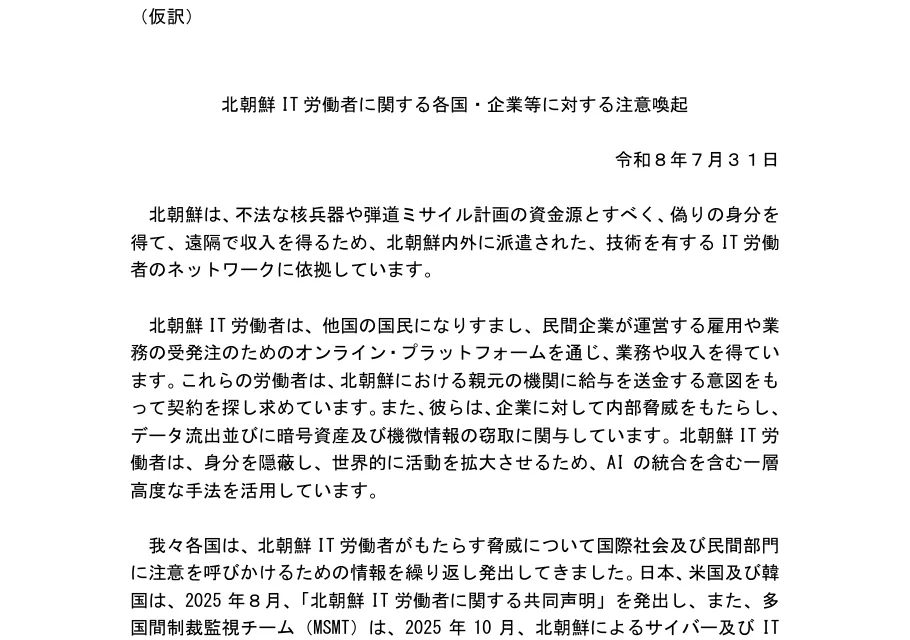
"働者は、身分を隠蔽し、世界的に活動を拡大させるため、AI の統合を含む一層" / "写真付き身分証との不一致や、改ざん又は人工生成されたようにみえる" / "テレビ会議形式の打合せへの参加を拒否する。" / "暗号資産での支払いを要求する。" / "北朝鮮 IT 労働者と契約を交わし、サービス提供の対価を支払う行為は、日本、米国及び韓国等を含む多くの国の国内法に違反し、法的責任を問われる又は罰金を課されるおそれもあります。"View official source →
"VPN利用の有無も確認を!" / "連絡先の電話番号が実在しているか確認を!" / "や海外送金を求めたりした場合は、要注意!"View official source →
"Ensure the potential employee is seen on camera during multiple video telecommunication sessions. If the potential employee reports video and/or microphone issues that prohibit participation, this should be considered a red flag." / "This includes a real phone number (not VOIP), a residential address, and social media accounts."View official source →
Employees: be wary of job offers and code from strangers
Japanese authorities warn that attackers approach people on social media and get them to run code by asking for help with a bug. On December 24, 2024, the NPA and two other agencies identified TraderTraitor as the group that stole roughly 48.2 billion yen worth of cryptocurrency from the Japanese exchange DMM Bitcoin.
According to the advisory, TraderTraitor borrows other people's names and photos to pose as company executives and tailors its pitch to each target's background and skills. Employees can protect themselves with three habits.
Ask for a video call when approached on social media
The advisory tells employees to ask for a video call when someone reaches out on social media, and to treat repeated refusals as suspicious. It also suggests saving screenshots of the person's profile and your messages. The Jade Sleet campaign Microsoft described followed the same pattern, with fake recruiters contacting software engineers and booking interviews.
Read code before you run it
In the scenario the advisory describes, the attacker shares a program on GitHub, claims it has a bug and asks the target to run it, which infects the target's computer. Pressure to review or run code quickly is itself a warning sign.
The advisory says not to run code without checking it first and to open it in a code editor instead. Coral Sleet's habit of hiding malware in private repositories shows that a shared repository is no guarantee of safety either.
Test unfamiliar code in a virtual machine, not on a work PC
A virtual machine is a separate computer simulated inside your own. According to the advisory, attackers steal the credentials and session cookies stored on an infected PC and then impersonate the victim to get into work systems.
Running unfamiliar code on a work PC can expose saved credentials and give attackers a path into company systems. For that reason the advisory recommends running unfamiliar code on a computer other than your work PC, or inside a virtual machine.

"約 482 億円相当の暗号資産を窃取したことを特定したと公表しました。" / "攻撃者は、第三者の名前や顔写真を悪用し、企業幹部を装うなどして" / "SNS でアプローチを受けた際は、ビデオ通話を要求する。" / "ソースコードの確認や実行を急がせる兆候があれば、不審性を考慮する。" / "内容を確認せずにコードを実行せず、コードエディタで開いて、折り返し表示に" / "攻撃者は、マルウェア感染させた PC に保存されている認証情報や、セッションクッキー等を窃取し、標的対象者になりすまして" / "コードを実行する際は、業務用 PC を使用しない、または仮想マシンを使用する。"View official source →
FAQ
- Are North Korean hackers running attacks entirely with AI?
- No. Microsoft says AI-assisted operations are still directed by people and have not become fully autonomous. The groups use AI to speed up and scale familiar work, such as writing fake job offers and resumes and building malware.
- Can a company get in trouble for hiring a North Korean IT worker by mistake?
- Yes. Japan's July 31, 2026 joint advisory says contracting with North Korean IT workers and paying for their services may violate the laws of many countries, including Japan, and can bring legal liability or fines. Before hiring or contracting, hold video interviews, compare faces with photo IDs and confirm that the phone number is real.
- A recruiter sent me code to test. How should I handle it?
- Japanese authorities advise opening the code in an editor and reading it before running anything. If you do run it, use a computer other than your work PC or a virtual machine. Treat any pressure to run the code quickly as a warning sign.
Related articles
 Storm-0940 used ARTEX AI agents on ConnectWiseMicrosoft says China-aligned Storm-0940 used the ARTEX AI pentest tool on hundreds of organizations and tried 2,250+ tenants through ConnectWise apps.
 PayPay security and passkeys in 10 Japan pay appsPayPay security compared with 9 other Japanese payment apps: passkeys, extra checks to send or pay, and fraud compensation deadlines.
 Akamai: online scams double and overtake phishingAkamai's fraud report says online scams doubled to about 6.4 million and passed phishing in Q1 2026, while phishing sites now last 22 days instead of 48.
 Japan foreign ministry leak may hit 3,600 recordsJapan's foreign ministry says names and email addresses in about 3,600 records may have leaked, including 900 outsiders. No classified or passport data.