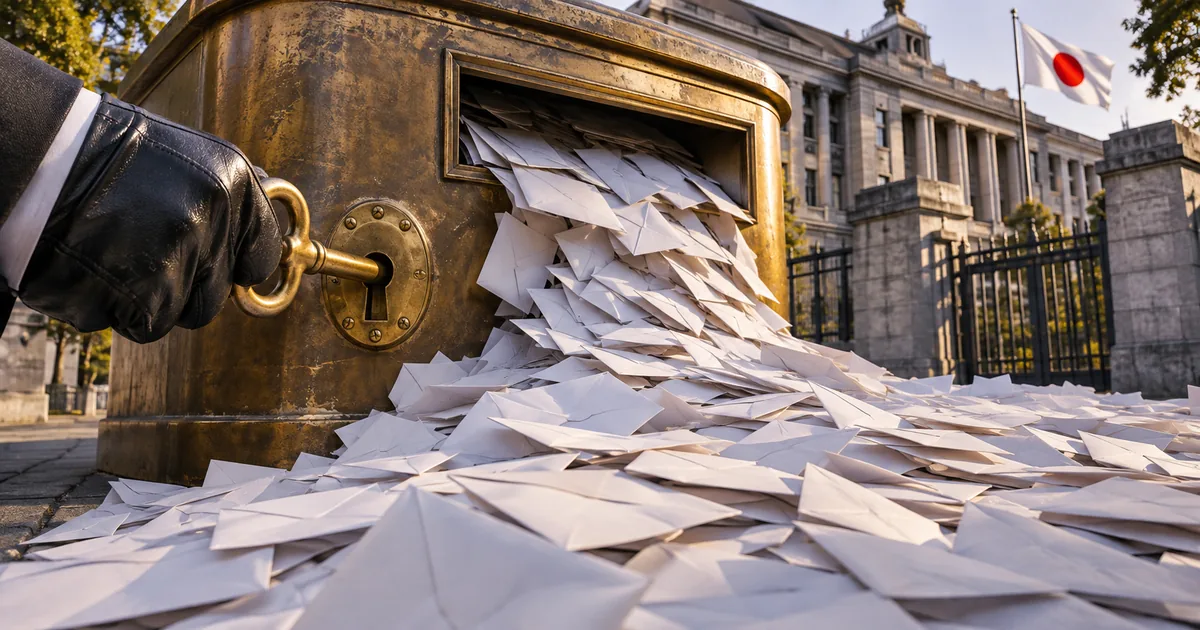
What the foreign ministry breach may have exposed
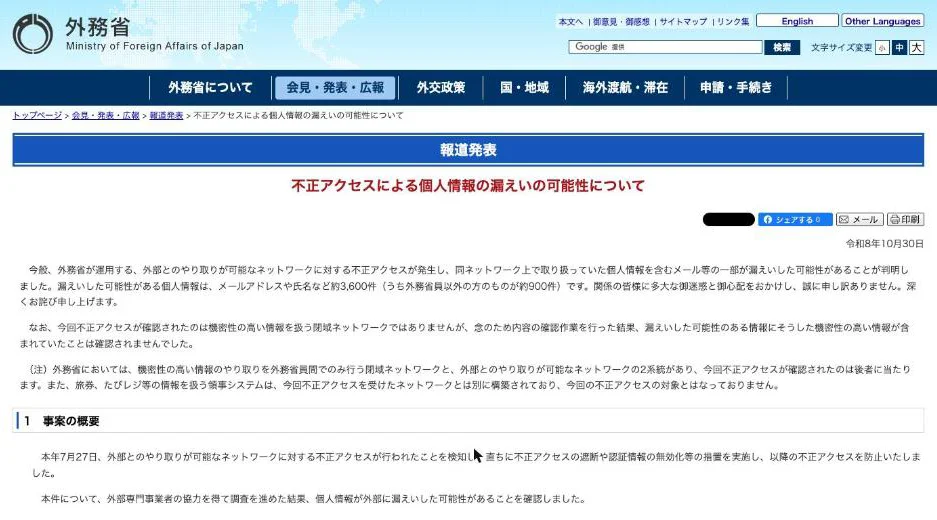
About 3,600 records with names and email addresses may be affected, and about 900 of them belong to people outside the ministry. Japan's Ministry of Foreign Affairs announced in a press release on October 30, 2026 that someone had gained unauthorized access to the network it uses to communicate with outside parties.
Some of the email and other data on that network, including personal information, may have leaked. The ministry apologized to the people involved for the trouble and worry this has caused.
Leaks like this have been piling up in Japan this year, as Japan's data leaks hit 260 million since April shows. Japan data breach list: cases by date and cause compares the disclosed counts and causes.
Names and email addresses, including about 900 outsiders
The ministry has named only email addresses and names, and has not said what else is in the data or how many emails were involved. The release describes the data as "email addresses, names and so on" and stops there. It does not say whether job titles, phone numbers or the text of emails are included.
It also does not describe who the roughly 900 outsiders are. The 3,600 figure covers records that may have leaked; it is not a confirmed count.
"漏えいした可能性がある個人情報は、メールアドレスや氏名など約3,600件(うち外務省以外の方のものが約900件)です。" — from section 2 of the releaseView official source →
Classified data and passport records are not included
Confidential information sits on a separate closed network, and passport and Tabi-Regi data sit in a separate consular system, so neither was hit. The ministry runs two networks. One is a closed network that ministry staff use among themselves for highly confidential information, and the other can exchange data with outside parties.
The intruder got into the second one. A precautionary review of the possibly leaked data found no highly confidential information. Passport records and Tabi-Regi, the ministry service that sends safety alerts to travelers who register their trip, are handled in a consular system built separately from the affected network.
"なお、今回不正アクセスが確認されたのは機密性の高い情報を扱う閉域ネットワークではありませんが、念のため内容の確認作業を行った結果、漏えいした可能性のある情報にそうした機密性の高い情報が含まれていたことは確認されませんでした。" / "また、旅券、たびレジ等の情報を扱う領事システムは、今回不正アクセスを受けたネットワークとは別に構築されており、今回の不正アクセスの対象とはなっておりません。" — from the opening of the releaseView official source →
How the ministry responded after detecting the access
The ministry blocked the access on the day it found it, investigated with an outside firm, and announced the possible leak about three months later. It spotted the intrusion on July 27, and the press release came out on October 30.
From detection to announcement (per the ministry's release)
| Date | What the ministry did |
|---|---|
| July 27 | Detected the unauthorized access, blocked it and invalidated credentials |
| After July 27 | Investigated with an outside specialist firm and found the data may have leaked |
| October 30 | Announced the possible leak and said it will contact affected people |
Access cut off and credentials invalidated on July 27
The ministry says invalidating credentials stopped any further access, and it plans to review how staff sign in. Credentials here means the IDs and passwords used to prove who is logging in.
After the intruder was cut off on July 27, no further unauthorized access took place, according to the release. The ministry's plan to prevent a repeat names three steps: a review of access controls and authentication methods, closer monitoring, and renewed security training for staff.
"本年7月27日、外部とのやり取りが可能なネットワークに対する不正アクセスが行われたことを検知し、直ちに不正アクセスの遮断や認証情報の無効化等の措置を実施し、以降の不正アクセスを防止いたしました。" / "外務省では、アクセス制御や認証方法の見直し、監視の強化、情報セキュリティ教育の再徹底を含むセキュリティ対策の更なる強化に努め、再発防止に取り組んでまいります。" — from sections 1 and 3 of the releaseView official source →
Attacker, method and the three-month gap are not explained
The release confirms only a possible leak and leaves out the attacker, the method and the reason for the three-month gap. After blocking the access, the ministry brought in an outside specialist firm, and the investigation found that personal information may have left the network.
The release itself says nothing about how the intruder got in. According to The Japan Times, a senior ministry official said a third party had taken the login credentials for an email service. Nothing in the release accounts for what happened between July 27 and October 30.
"本件について、外部専門事業者の協力を得て調査を進めた結果、個人情報が外部に漏えいした可能性があることを確認しました。" — from section 1 of the releaseView official source →
What people who emailed the ministry should watch for
No misuse has been confirmed, but the leaked names and addresses could be used in spoofed emails, so treat messages that claim to be from the ministry with care. As of the announcement, the ministry had not seen any secondary harm such as misuse of the data. It still warns that the information could turn up in spoofed emails and phishing emails, which imitate a real sender to trick people into typing passwords or card numbers on a fake site.
What not to do with messages that claim to be from the ministry (per its release)
| Channel | Do not |
|---|---|
| Email and SMS | Open links or attachments in a message you did not expect |
| Email, phone and SMS | Give or type in passwords, other credentials or credit card details |
The ministry will not ask for passwords or card numbers
An email or call that claims to be from the ministry and asks for a password or card number is fake. The ministry states that it does not request login credentials or credit card details by email or phone.
The warning covers suspicious emails, calls and text messages that pose as the ministry or its staff. People should leave links and attachments in unfamiliar emails unopened and should not type in credentials or card details. A ministry name in the sender field does not change that.
"また、外務省からパスワードなどの認証情報、クレジットカード情報等の個人情報をメールや電話でお伺いすることはありません。" — from section 2 of the releaseView official source →
Affected people will be contacted individually
The ministry will contact each affected person, and questions can go to its Information Systems Management Division by email. It will first identify everyone whose personal information may have leaked. It has not said when the contact will happen or by what means.
Fake messages may arrive before the real one does. If you are unsure whether a message is genuine, do not reply to it; write to the address in the press release instead.
Where to send questions (per the ministry's release)
| Office | Contact |
|---|---|
| Information Systems Management Division, Minister's Secretariat, Ministry of Foreign Affairs | contact-ismd@mofa.go.jp (email) |
"今後漏えいした可能性がある個人情報の対象となる方を特定の上、個別に御連絡を差し上げます。" — from section 2 of the releaseView official source →
What companies and staff who email government offices can do
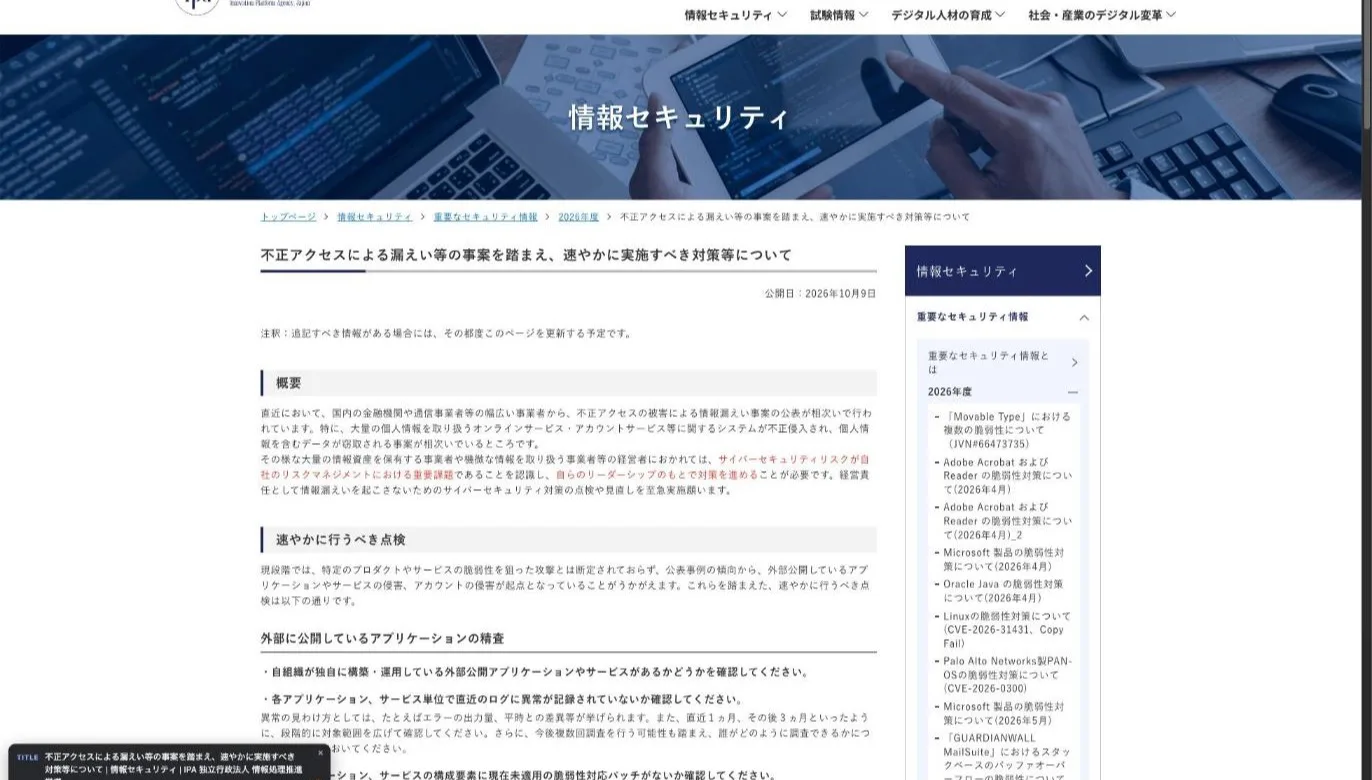
Companies can review the sign-in methods and logs of their external services, and staff can delete unexpected emails that name a business partner or agency. In this case, the network that exchanges email with outside parties was the one compromised, and records of about 900 outsiders were caught up in it. Japan's Information-technology Promotion Agency (IPA), the government body that issues security guidance, published a notice for businesses on October 9 and one for individuals on October 26.
Companies: check external services, logs and sign-ins
IPA asks organizations to list every external service, check logs from the last month and then three months, and strengthen sign-in with multi-factor authentication. Looking at recently disclosed cases, IPA says break-ins tend to start with a compromised public-facing service or a compromised account.
List every external service you use
IPA asks organizations to identify all the outside services they rely on, such as cloud storage and VPNs. Some departments sign up for tools on their own, so the list needs to cover the whole company.
Check logs from the last month, then three months
For each service on the list, look through the logs for anything unusual, such as a jump in errors or activity that looks different from usual. IPA suggests starting with the last month and then widening the check to three months.
Turn on multi-factor authentication and remove unused accounts
As follow-up steps, IPA lists stronger authentication and a regular review of which accounts exist. Multi-factor authentication asks for a second proof, such as a code sent to a phone, on top of the password, so stolen credentials alone are not enough to sign in.
"自組織が利用している外部サービスをすべて洗い出してください。" / "直近1ヵ月、その後3ヵ月といったように、段階的に対象範囲を広げて確認してください。" — from the section on urgent checksView official source →
Staff: delete unexpected emails without opening them
Leaked names and email addresses can end up on scam mailing lists, so IPA advises treating unexpected emails as scams and deleting them. IPA says leaked email addresses and names are sometimes gathered into lists and sold on dark web sites.
Treat unexpected emails as scams
IPA's advice is to assume that an email or text you were not expecting is a scam, ignore it and delete it. Staff who have exchanged email with the ministry may get messages using its name or the name of someone they dealt with there.
Your name in an email does not prove it is real
Because the data that may have leaked includes names, a fake email can greet you by your real name. IPA warns about exactly this and says not to tap links in such emails.
Check with the sender through its official site
If the leaked address is your work address, the fake emails will land in the same inbox as your everyday business mail. When a message in the name of a partner or agency asks you to sign in or pay, contact that organization using contact details you look up yourself, not the ones in the message.
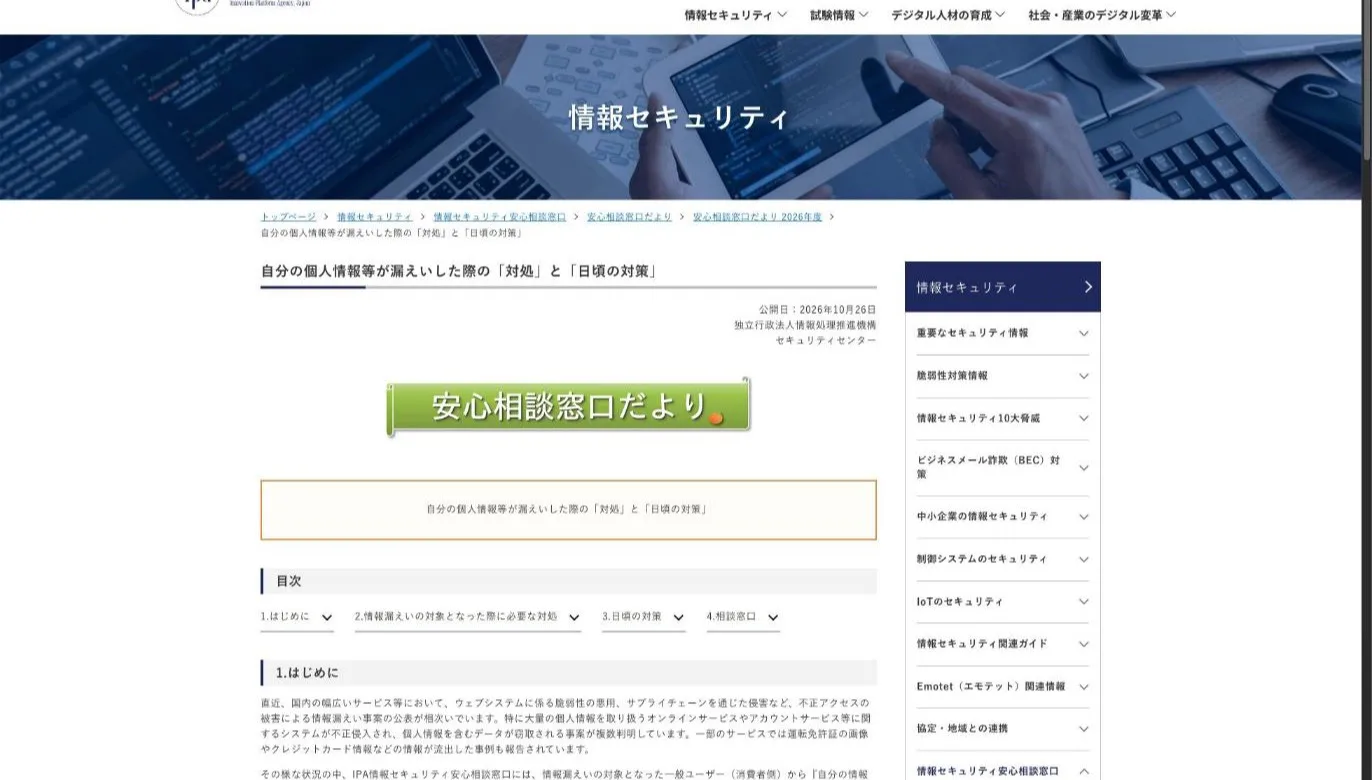
"メールアドレス、電話番号、住所、氏名等が漏えいすると、それらの情報がリスト化され、闇サイト等で販売される可能性があります。" / "偽メール等の文面に漏えいした自分の氏名が記載されているといった状況も考えられます。" / "突然に送られてくるメールやSMSは基本的には全て詐欺の偽メールだと考えて、無視して削除する。" — from section 2.4 on leaked email addresses, phone numbers, addresses and namesView official source →
FAQ
- Was passport data exposed in the Japanese foreign ministry breach?
- No. The ministry says the consular system that holds passport and Tabi-Regi data is built separately from the network that was accessed, and was not a target. A precautionary review also found no highly confidential information in the data that may have leaked.
- I have emailed Japan's foreign ministry. How will I know if my data was affected?
- The ministry says it will identify the people whose personal information may have leaked and contact each of them individually. It has not said when or how. Questions go to the Information Systems Management Division at contact-ismd@mofa.go.jp.
- What should I do if an email from Japan's foreign ministry asks for my password?
- Delete it without opening links or attachments. The ministry says it never asks for passwords, other login credentials or credit card details by email or phone, so a message that does is fake.
Related articles
 Japan's data leaks hit 260 million since AprilJapan's privacy regulator says unauthorized access affected data on a cumulative 260 million people from April to mid-October, with 830 reports in October.
 GMO's Onamae.com Desktop Cloud hacked, data leakedAttackers broke into Onamae.com Desktop Cloud, GMO Internet's VPS for FX trading, stole trading logins and leaked data after GMO refused a ransom.
 Japan data breach list: cases by date and causeThis Japan data breach list sorts disclosed cases newest first. Skyticket (14.64M records) and KDDI (12.23M users) lead. See what leaked, why, and what to do.
 Japan's METI warns firms after a spate of breachesAfter a spate of data breaches, Japan's trade ministry (METI) told companies on October 9 to put top executives in charge of security and move to zero trust.