
What Mizuho announced on October 15
Mizuho Financial Group, the Japanese banking group, has moved its Mizuho AI Bootcamp from pilot to full operation. The program is aimed at employees who understand banking work but are not engineers, and it trains them to build AI applications.
The headline claim is speed: Mizuho says it has cut a path that usually takes about a year and a half down to three months. The release frames this as reskilling in one-sixth of the time. It credits the change to combining basic study and real project work in a single program.
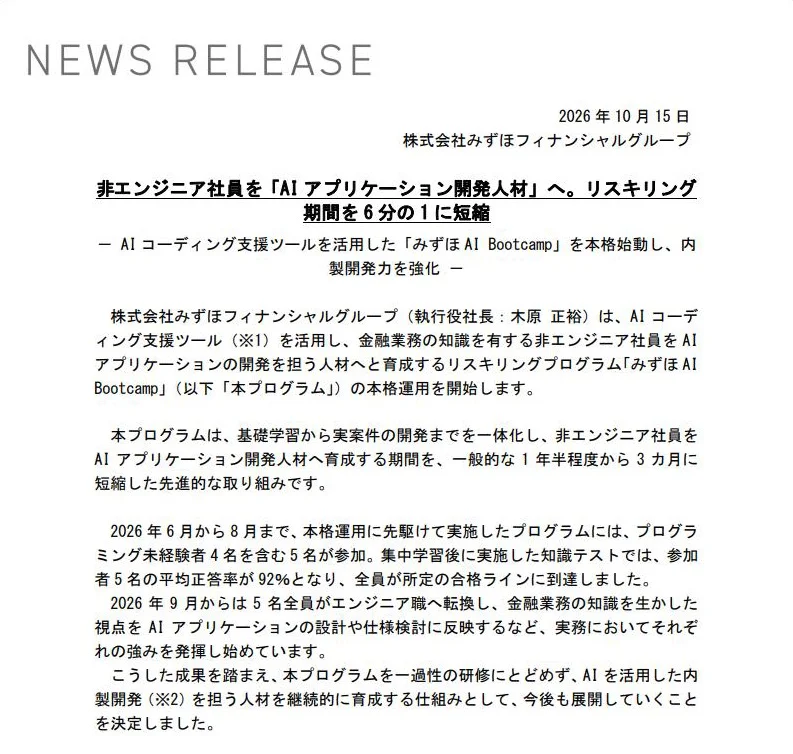
"本プログラムは、基礎学習から実案件の開発までを一体化し、非エンジニア社員をAIアプリケーション開発人材へ育成する期間を、一般的な1年半程度から3カ月に短縮した先進的な取り組みです。" — Mizuho Financial Group news release よりView official source →
Official targets vs the Nikkei's several thousand
Most English coverage led with "thousands." That number is not in Mizuho's release. According to SBS News, citing the Nikkei, Mizuho will draw volunteers from all 50,000 employees across its banks and securities firms and aims to reach several thousand converted staff over the next decade.
Mizuho's own numbers are smaller and come sooner: about 20 participants in the cohort starting in November, then about 100 developers as a first target. After that, the release says, the program will widen step by step into a group-wide scheme. The two sets of figures compare as follows.
| Mizuho's release | Nikkei (via SBS News) | |
|---|---|---|
| Next cohort | About 20 people, from November 2026 | Not stated |
| Near-term target | About 100 developers | Not stated |
| Long-term scale | Group-wide, expanded step by step | Several thousand within ten years |
| Who is eligible | Non-engineer staff with banking knowledge | All 50,000 employees, volunteers first |
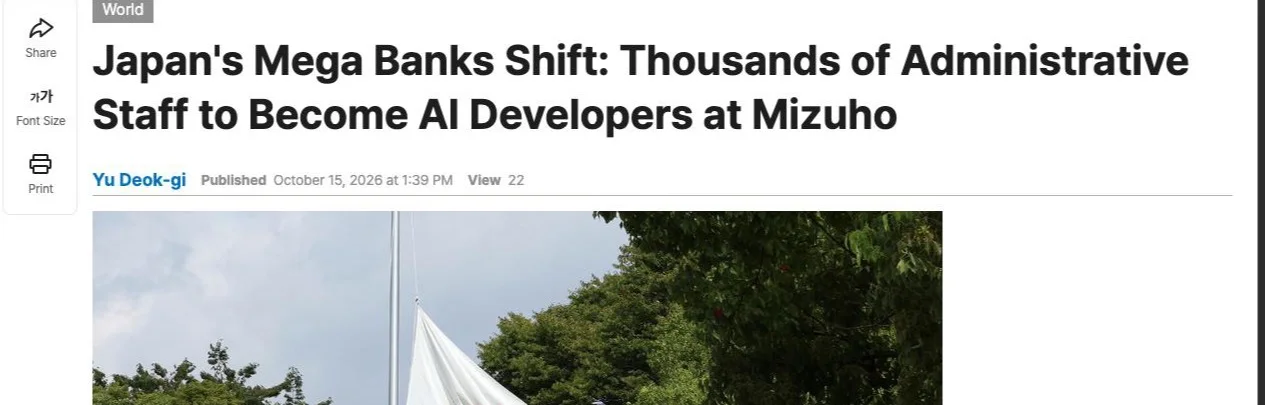
"Beginning next month, Mizuho plans to sequentially start this transition for employees across its group banks and securities firms, aiming to expand the number of converted employees to a scale of several thousand over the next decade." — SBS News よりView official source →
How the three-month bootcamp works
The course has two parts. Trainees spend the first month studying how to develop software with AI coding tools, then two months on real projects as on-the-job training.
Mizuho AI Bootcamp: three months
Projects are picked so trainees can apply what they already know about banking. They are expected to handle the whole job, from understanding requirements to building with AI and then testing and improving the result, rather than just writing code.
"本プログラムでは、AIコーディング支援ツールを活用した開発手法を1カ月間集中的に学んだ後、2カ月間にわたる実案件でのOJTを通じて実践的なスキルを身につけます。" — Mizuho Financial Group news release よりView official source →
Claude Code and Codex are the named tools
Mizuho's release names two tools: OpenAI's Codex and Anthropic's Claude Code. Both are AI coding tools, meaning you describe what you want in plain language and the tool writes, edits or extends the code. Trainees use them to prototype AI agents, which are AI systems that carry out multi-step tasks on their own, and to build and test applications.
The work runs on Mizuho's in-house development lab and a shared platform called Mizuho Wiz Base, which the bank already uses to build AI apps for tasks that off-the-shelf services handle poorly. For another large company putting Claude Code to work, see Samsung Claude Code: chip verification in 2 days.
"〈みずほ〉は、全社の内製開発を支える専門部隊「内製開発ラボ」を設置し、AIアプリケーションの開発・運用を支える共通基盤「みずほWiz Base」を構築しています。" — Mizuho Financial Group news release よりView official source →
Trainees must review the code the AI generates
Generated code is not shipped as is: the release says trainees check it against business requirements, quality and security before it is used. That puts the trainee in the reviewer's seat, even though the AI produces the code.
"生成されたコードは、参加者が業務要件、品質、セキュリティなどを確認したうえで利用します。" — Mizuho Financial Group news release よりView official source →
All five pilot trainees moved into engineering roles
Before the full launch, Mizuho ran the same course as a pilot from June to August 2026. Five employees took part, and four of them had never programmed before.
Pilot results
After the intensive month, the group averaged 92% on a knowledge test and everyone cleared the pass mark. Since September, all five have worked as engineers, and Mizuho says they bring their banking perspective to app design and specifications. Five people is a small sample, and the November cohort of about 20 will be the first larger test.
"集中学習後に実施した知識テストでは、参加者5名の平均正答率が92%となり、全員が所定の合格ラインに到達しました。" — Mizuho Financial Group news release よりView official source →
Why Mizuho wants AI skills in-house
Mizuho points to an AI discussion paper that Japan's Financial Services Agency (FSA), the country's banking regulator, published on March 3, 2026. The paper lists AI talent and in-house training among the issues for financial firms, and warns that relying on outside vendors can keep know-how and intellectual property from building up inside the firm. Mizuho says the bootcamp will run as an ongoing pipeline, not a one-off course, and that it eventually wants each department to design and build AI agents for its own work.
"また、AIの開発・運用を外部事業者に依存する場合は、ノウハウや知的財産が組織内に蓄積されにくく、内部人材の育成が進まない可能性があることなども、論点の一つとして示されています。" — Mizuho Financial Group news release よりView official source →
What Mizuho has not disclosed
Neither the release nor the coverage says how pay or job grade will work for people who switch roles. Selection is also vague beyond the Nikkei's mention of volunteers, and no tools other than Codex and Claude Code are named. Anyone planning a similar program should watch for these details in Mizuho's next update.
The skill being taught is judging AI output, not typing code
Put two facts from the release together and the job Mizuho is training for becomes clear: deciding what to build and judging whether the AI's output is fit to use. The release says better AI coding tools let trainees study and work on real projects at the same time, which is how the course got shorter, yet trainees must still check the generated code against requirements, quality and security. That fits what the pilot trainees reportedly contribute: input on design and specifications rather than raw coding.
The official and reported numbers also diverge at a specific point. Mizuho has defined the program up to about 100 people. The step to several thousand volunteers from 50,000 staff is where selection and pay come into play, and those are the parts it has not yet described.
FAQ
- Is Mizuho really turning thousands of employees into AI developers?
- Not officially, at least not yet. Mizuho's release plans a cohort of about 20 people starting in November and sets a first target of about 100. The Nikkei reported that Mizuho aims for several thousand over the next decade, drawing volunteers from its 50,000 employees.
- Which AI tools does the Mizuho AI Bootcamp use?
- The release names Codex and Claude Code as examples of the AI coding tools trainees use. They use them to prototype AI agents and to build and test applications, and they check the generated code before it is used.
- Could trainees with no coding background pass?
- Yes, in the pilot. Four of the five people who took the June to August pilot had never programmed. The group averaged 92% on the knowledge test, all five passed, and all moved into engineering roles in September.
Related articles
 Claude Code rule blocks recreating existing gamesA server-side rule stops Claude Code on Opus 5.5 from recreating existing games. Anthropic confirmed it on X, and a wargame studio says paid work stopped.
 EMBRACE flaws hit 5 AI coding tools, 2 unpatchedForever Security found flaws in the built-in browsers of Cursor, Copilot, Codex, VS Code and Claude Desktop. Codex and VS Code were unpatched at publication.
 REA: AI Reverse Engineering MCP for Claude CodeREA is a free AI reverse engineering MCP server for Claude Code and Codex. One npx command sets it up, and Ghidra, IDA or Hopper reads apps without source.
 Claude Code hooks: 5 types and the node spawn costClaude Code hooks come in five types, from command to agent. As command hooks, one Edit launched 17 node processes, and hooks drove 47–87% of node launches.