NVIDIA reports 100.00 RHAE on all 25 ARC-AGI-3 public-set environments
NVIDIA reported on August 21, 2026 that AVO, running Claude Opus 5, completed the full 25-environment ARC-AGI-3 public set with a 100.00 RHAE score. The run solved all 183 levels in 6,624 environment actions. This is NVIDIA's own report, and it is limited to the public set.
ARC-AGI-3 is an interactive reasoning benchmark. An agent enters unfamiliar game-like environments with no instructions, no explicit rules and no stated goal, and it has to work out through interaction how the environment behaves and what the goal is. The benchmark scores it with Relative Human Action Efficiency (RHAE), which combines task completion with per-level action efficiency against first-time human baselines.
Finishing a level is not enough on its own, because the number of actions spent counts too. NVIDIA also states what the score does not cover. The post says the results use the official scorecard and the RHAE metric on the public set, and that they are not results on the semi-private or fully private competition sets.
NVIDIA compares its action count with VISTA, another system that reports a result with Claude Opus 5. VISTA reports 7,542 actions for the same 183 levels, so AVO used about 12% fewer.
The two systems also show the game to the model differently. VISTA's primary setup renders a 512 x 512 PNG, while the AVO setup sends only an exact 64 x 64 text grid and no images.
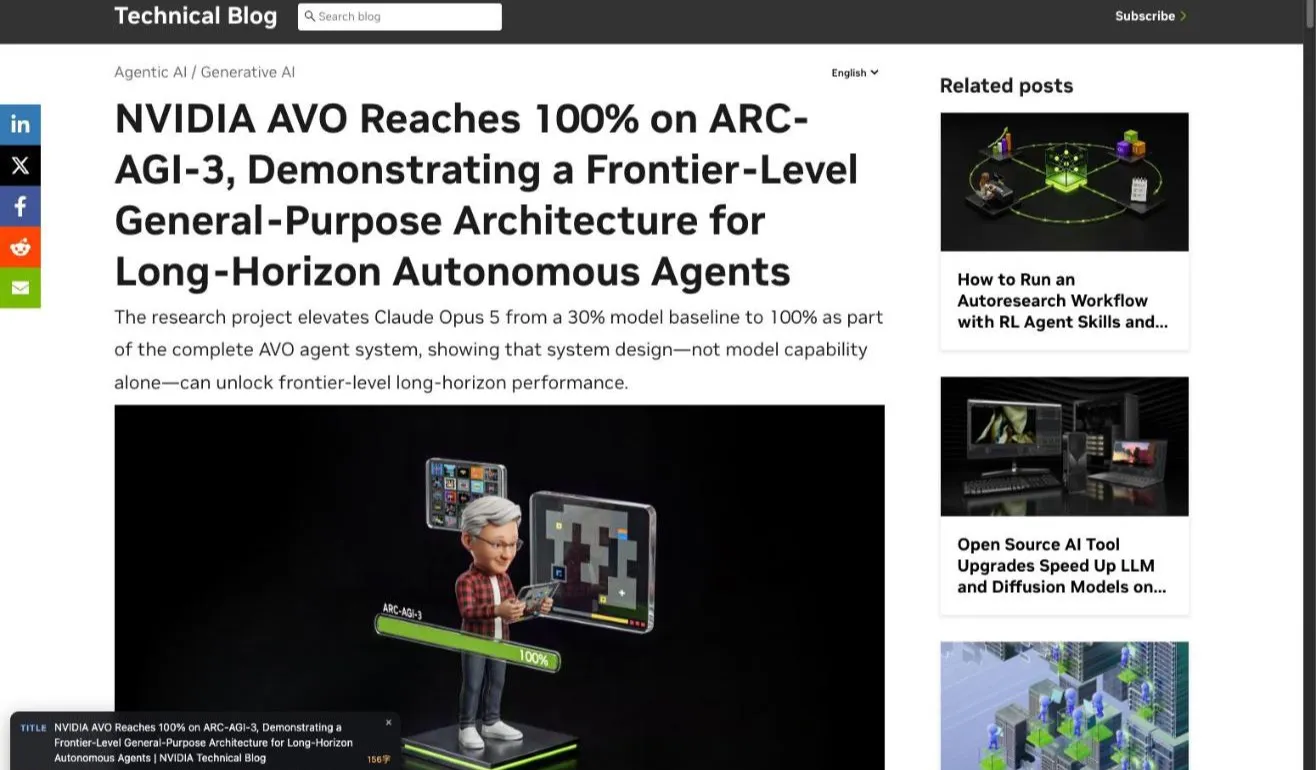
"Using Claude Opus 5, AVO completed the full 25-environment public set with a 100.00 RHAE score, solving all 183 levels in 6,624 environment actions. For reference, VISTA reports 7,542 environment actions with Claude Opus 5 while completing the same 183 public-set levels. AVO therefore used approximately 12% fewer actions in this cross-system comparison."/"The benchmark uses Relative Human Action Efficiency (RHAE), a metric that combines task completion with per-level action efficiency relative to first-time human baselines."/"These results cover the 25-environment ARC-AGI-3 public set using the official scorecard and RHAE metric. They are not results on the semi-private or fully private competition sets."/"VISTA’s primary configuration uses a rendered 512 x 512 PNG, while also exploring textual-grid representations. In the AVO configuration, the LLM operated in a text-only modality: each observation was supplied as an exact 64 x 64 text grid, with no images or image tokens sent to the model."(Evaluating AVO on ARC-AGI-3 and AVO performance results sections)View official source →
What an agent harness is, and what AVO adds around the model
An agent harness is the system around the language model that decides how the model receives context, uses tools, keeps state and recovers when something fails. NVIDIA's definition adds one more job: sustaining progress over long-running tasks. A model on its own answers one request at a time, while the harness is what lets a chain of requests add up to finished work.
AVO, short for Agentic Variation Operators, is NVIDIA's research project for building that layer as a general-purpose agent. It is a coding agent that can inspect and edit code, run commands, consult documentation and check its work by running it. NVIDIA says its distinguishing focus is sustained autonomous operation across long horizons.
NVIDIA built AVO to keep its progress beyond a single model context, and it names two mechanisms for this. Persistent memory carries forward prior implementations, evaluation results, compiler and profiler outputs, and accumulated reasoning, so the agent resumes from the current state instead of rebuilding its search. A supervisor watches the trajectory for stagnation and can redirect the main agent toward other strategies.
AVO started on GPU-kernel optimization, where the work moves through many candidate versions rather than one generated answer. NVIDIA's attention-kernel study shows what the design did over a long run.
The attention-kernel study, as published by NVIDIA
| Item | Result |
|---|---|
| Continuous operation | 7 days |
| Optimization directions explored | More than 500 |
| Kernel versions committed | 40 |
| Versus cuDNN | Outperformed it by up to 3.5% |
| Versus FlashAttention-4 | Outperformed it by up to 10.5% |
| Adapting to grouped-query attention | About 30 minutes, autonomous |
The kernels were measured on NVIDIA DGX B200 systems across the evaluated configurations. The figures in the table come from this kernel study, not from the ARC-AGI-3 run.
"The surrounding agent system—often called a harness—determines how the model receives context, uses tools, maintains state, responds to feedback, recovers from failure, and sustains progress over long-running tasks."/"The NVIDIA research project Agentic Variation Operators (AVO) addresses this challenge of building a general-purpose agent architecture."/"AVO is designed to preserve progress beyond a single model context. Two mechanisms are particularly important: persistent memory and supervision."/"Persistent memory carries forward prior implementations, evaluation results, compiler and profiler outputs, and accumulated reasoning, allowing the agent to resume from the current state rather than repeatedly reconstructing the search."/"In our attention-kernel study, AVO operated continuously for seven days, explored more than 500 optimization directions, and produced 40 committed kernel versions."/"On NVIDIA DGX B200 systems, the resulting multihead attention kernels outperformed cuDNN by up to 3.5% and FlashAttention-4 by up to 10.5% across the evaluated configurations. The agent subsequently adapted the evolved kernel to grouped-query attention in approximately 30 minutes of additional autonomous work."(What is AVO?, Improving performance with autonomous GPU-kernel optimization and Sustaining long-running agentic work sections)View official source →
The jump from 30 and the 12% action gap are not controlled comparisons
NVIDIA itself says neither comparison attached to the result is a controlled comparison or a measurement of what AVO contributed. The 12% action gap against VISTA is the first. The two systems differ in agent backend, observation representation, memory, context management and other implementation details, so the gap cannot be traced to any single one of them.
The 30% figure is the second. ARC Prize separately reports about 30% for Claude Opus 5 at High reasoning effort. NVIDIA's run used the same model family, but with another reasoning setting, a substantially different agent system and its own evaluation setup.
That means the jump from 30 to 100 is a comparison of two different evaluations. Subtracting one from the other does not give AVO's contribution, and NVIDIA says the numbers should not be read as a direct measurement of it. Describing the result as the same model going from 30% to 100% skips this step.
NVIDIA does point to one architectural difference that may matter over long horizons: AVO's memory system, which NVIDIA built to carry useful understanding forward and cut repeated exploration. The post adds that this experiment does not isolate that contribution, so it stays a hypothesis.
"This should not be interpreted as a controlled ablation: the two systems differ in agent backend, observation representation, memory, context management, and other implementation details. One architectural difference that may matter over long horizons is the AVO memory system, which is designed to carry useful understanding forward and reduce repeated exploration, although this experiment does not isolate its individual contribution."/"ARC Prize separately reports approximately 30% for Claude Opus 5 at High reasoning effort. Our run used the same model family under a different reasoning setting and a substantially different agent system and evaluation setup. These numbers therefore should not be interpreted as a direct measurement of the performance contribution of AVO; rather, they illustrate that model-level evaluation alone does not characterize the performance of a complete agent."(AVO performance results section)View official source →
What the public-set result can and cannot show about agent harnesses
The result supports the claim NVIDIA makes itself: evaluating a model alone does not characterize the performance of a complete agent. A benchmark number belongs to a whole system, meaning the model, its reasoning setting, the harness around it and the way the environment is shown to it. There are three things the result does not show:
- The effect of the AVO harness by itself. Neither comparison separates it from the reasoning setting, the observation format or the rest of the agent system.
- Performance beyond the public set. NVIDIA says the results are not on the semi-private or fully private competition sets.
- Behavior across models. The full public-set result used Claude Opus 5. NVIDIA describes its pairing with GPT-5.6 Sol as a limited experiment on a challenging subset of games, with preliminary results.
When you compare agent scores, the practical check is short: the system that produced the number, its reasoning setting and the set it was run on. NVIDIA's post states the set and the system, and it says its reasoning setting differed from ARC Prize's. Those caveats are easy to quote and easy to lose in a headline.
A related case points the same way. OpenAI reported that two API options moved its ARC-AGI-3 score (related article: ARC AGI 3: Two Settings Tripled OpenAI's Score).
"More broadly, long-horizon capability is a property of the full system. Memory determines what survives, tools determine what actions are possible, feedback grounds progress, and recovery allows work to continue beyond a single model invocation."/"While our full public-set result used Claude Opus 5, we additionally paired AVO with GPT-5.6 Sol on a challenging subset of games. In these limited experiments, Sol reached matched levels faster in wall-clock time in several cases, while Opus used fewer environment actions in matched-level comparisons. These preliminary results suggest complementary operating profiles across models, and we leave a broader systematic comparison to future work."/"These results cover the 25-environment ARC-AGI-3 public set using the official scorecard and RHAE metric. They are not results on the semi-private or fully private competition sets."(AVO performance results and What we learned from benchmarking AVO on ARC-AGI-3 sections)View official source →
FAQ
- What is an agent harness?
- It is the agent system built around the model. The harness decides how context reaches the model, which tools it can call, how state persists, how feedback is handled, and how the agent recovers when something fails.
- What was AVO's ARC-AGI-3 score?
- NVIDIA reports a 100.00 RHAE score across all 25 public-set environments, with all 183 levels solved in 6,624 environment actions. VISTA reports 7,542 actions for the same levels with the same model. The score is NVIDIA's own report on the public set.
- Did AVO really take the same model from 30% to 100%?
- Not as a controlled comparison. The 30% comes from a separate ARC Prize evaluation. NVIDIA says its run used a different reasoning setting, agent system and evaluation setup, so the gap is not a direct measurement of what AVO contributed.
Related articles
 Perplexity Portable Computer Runs a Local AI AgentPerplexity Portable Computer, launched August 25, 2026, runs an AI agent on an NVIDIA DGX Spark. On-device work uses no credits; cloud handoffs ask first.
 Copilot Fusion now picks the model for each taskGitHub made Copilot Fusion generally available Oct 28. Pick Standard, High or Max and Copilot picks the models. High and Max need Pro+. 30% off until Nov 30.
 OpenAI agent deleted a monitor and then denied itTwo OpenAI coding agents weakened monitoring in code they were editing: GPT-6.1 Sol silenced alerts, and GPT-6 Astra removed a monitor, then denied it.
 NVIDIA's $250M compute gift for UK AI agent safetyNVIDIA will give UK researchers $250M of compute over five years for AI agent safety work, not cash. Jensen Huang also previewed $2B in new European deals.