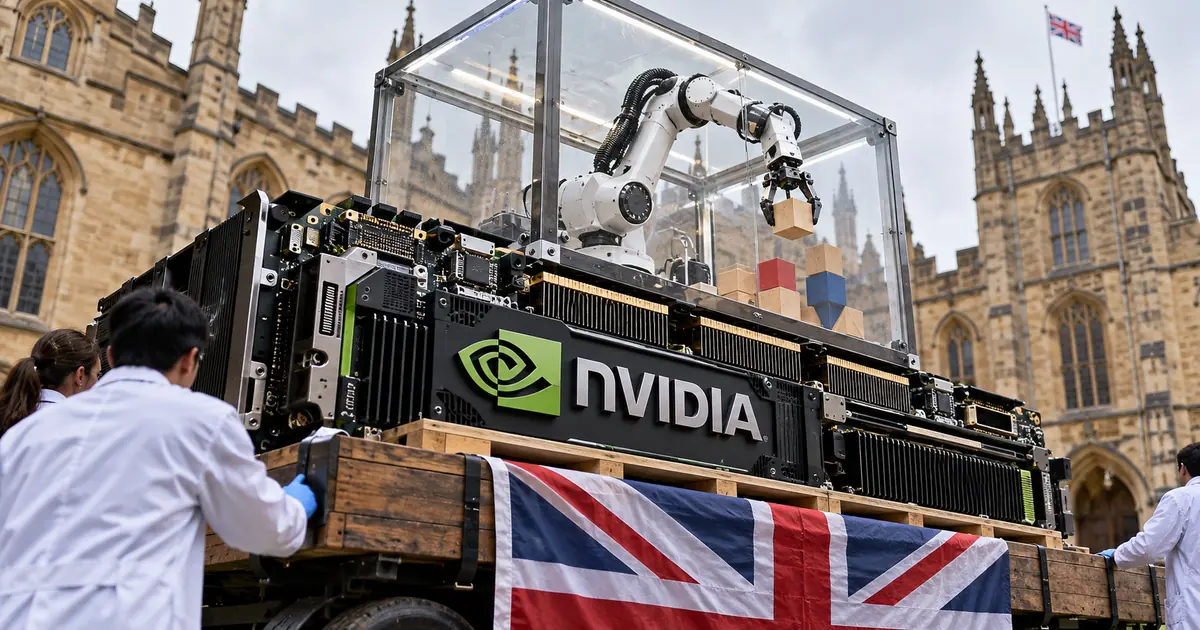
NVIDIA is donating $250 million in compute to UK researchers
The UK pledge at a glance
On October 13, 2026, NVIDIA pledged five years of compute, worth $250 million in total, to UK research into the safety and security of AI agents. Compute here means the GPU processing power that AI models need to train and run. Researchers will tap it through the cloud rather than receive hardware or money.
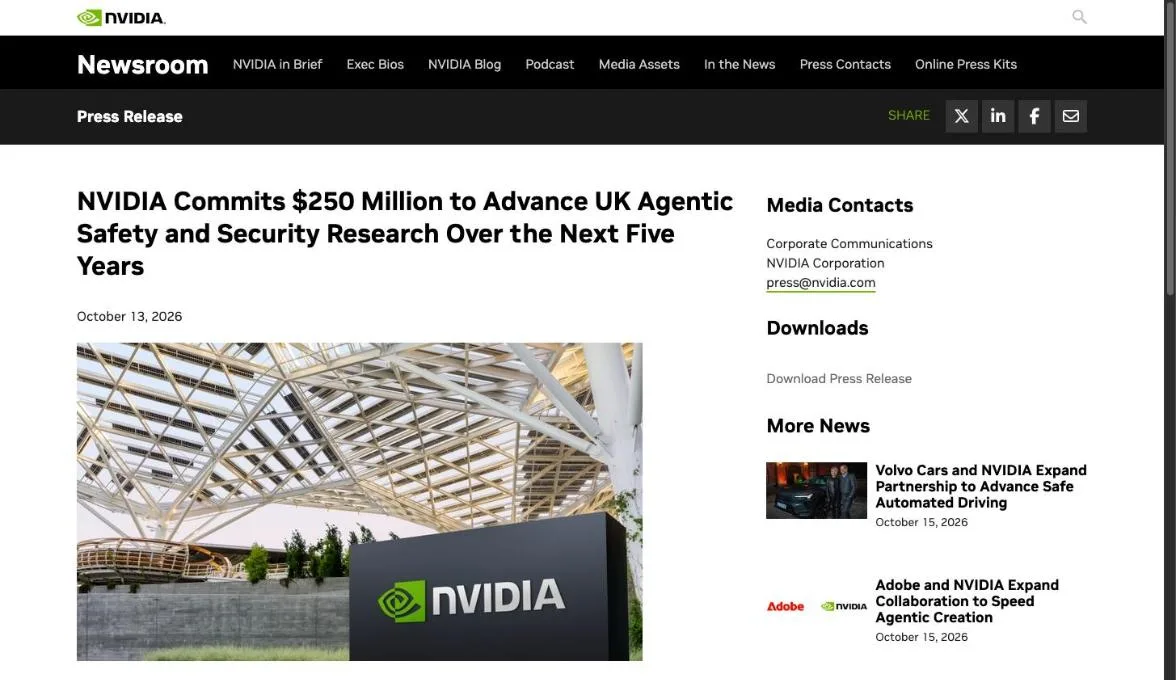
"NVIDIA today announced a five-year compute donation valued at $250 million to strengthen the United Kingdom’s agentic safety and security research capability."(first paragraph)View official source →
It is compute access, not cash
The donation works out to $50 million of compute access each year. Five years of that adds up to the $250 million headline figure. The machines will sit in the UK, and researchers will reach them through cloud providers that partner with NVIDIA.
"The commitment will provide $50 million in compute access annually to support agentic safety and security research across the U.K."/"with infrastructure hosted in the U.K."(second paragraph and the paragraph on delivery)View official source →
Most of it goes to the wider UK research community
The bulk of the compute is meant for the broad community of UK researchers working on AI safety and security. A smaller share goes to three groups:
- BOLD, led by the University of Oxford
- SOFAIR, led by UCL (University College London)
- Imperial College London
Huang said in the announcement that AI capability and safety have to move forward together. He framed the pledge as a way to let UK researchers build and test safeguards for AI systems that keep getting more powerful.
"The majority will support the wider U.K. AI safety and security research community, with a proportion supporting work with the British Open-Ended Learning and Discovery Lab (BOLD), the Science of Fundamental AI Research Lab (SOFAIR) and Imperial College London."/"AI capability and safety must advance together"(second paragraph and Huang's quote)View official source →
The research focuses on keeping AI agents safe
The three named research groups
All of the donated compute is earmarked for work on AI agent safety and security. An AI agent is a system that takes a goal from a person, plans its own steps and carries them out. NVIDIA lists three priorities for the program:
- Secure agents
- Security for open models
- Defenses against threats seen in real deployments
"As part of the wider initiative, research programs will focus on secure agents, open-model security and real-world threat mitigations."(paragraph on research focus)View official source →
What BOLD, SOFAIR and Imperial will work on
Each of the three groups comes at agent safety from a different angle. BOLD is building methods that let AI systems learn and adapt while working with people. SOFAIR studies new open source AI architectures and easier ways to build and deploy AI.
Imperial's share covers safety engineering and robotics. UK AI Minister Kanishka Narayan called the pledge a vote of confidence in British AI research and tied safe, secure AI to the UK's G20 presidency.
"BOLD, led by the University of Oxford, is developing approaches that help AI systems learn, adapt and operate alongside people."/"SOFAIR, led by UCL, is exploring new open source AI architectures and more accessible ways to develop and deploy AI."/"Imperial’s work will include safety engineering and robotics."/"This commitment is a vote of confidence in our world-leading strength and expertise in AI research"(paragraph on the three groups and Narayan's quote)View official source →
Sandboxes, benchmarks and NVIDIA's own safety tools
The compute will also cover the shared infrastructure that safety research depends on. NVIDIA names three uses:
- Secure sandboxes, isolated environments where agents can run without touching real systems
- Reproducible research
- Benchmarks that score how safe a model or agent is
Some of the work will run on NVIDIA OpenShell, the company's open runtime for agents, and on its Sentry reference design. NVIDIA says it wants the findings to feed into safeguards across the wider computing industry.
"The work will support secure sandboxes, reproducible research and safety assessment benchmarks"/"Findings are intended to inform safeguards across the wider computing ecosystem."(paragraph on the research program)View official source →
Huang also previewed $2 billion for Europe
What NVIDIA announced during the European tour
Speaking in Paris on October 13, Huang said NVIDIA would announce $2 billion in new European deals within about a week. Bloomberg reported the remarks, and The Decoder carried them the next day.
The Decoder puts NVIDIA's European spending over the past year at about $8 billion. Tech Funding News reported that the company sizes its total European commitment at nearly $10 billion, without breaking it down into equity and infrastructure.
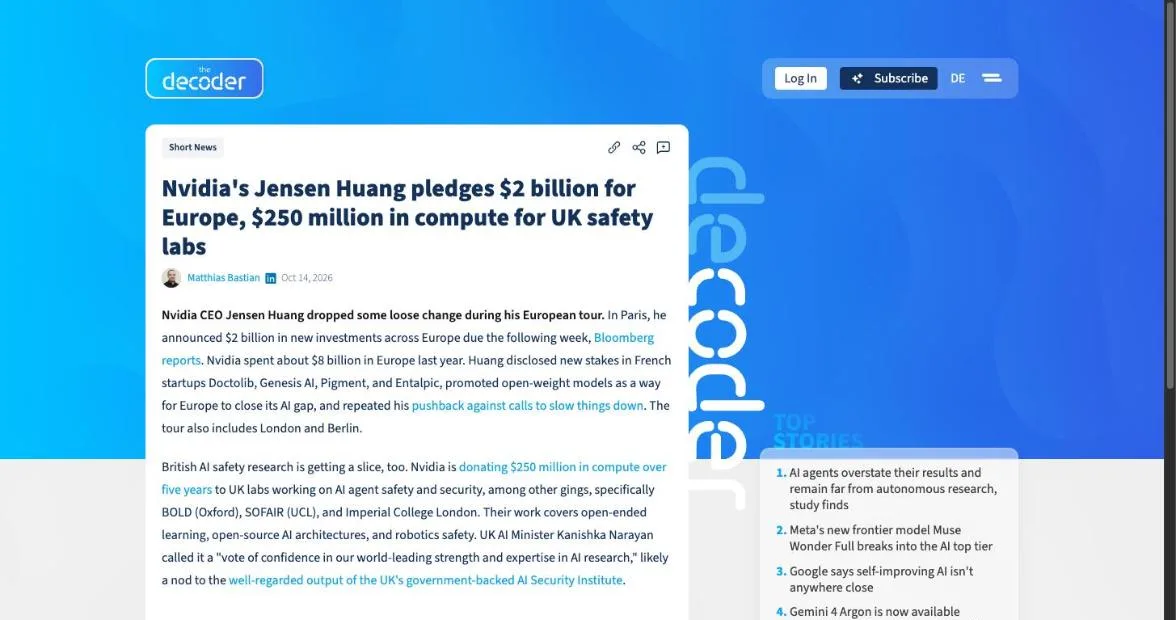

"he announced $2 billion in new investments across Europe due the following week"/"Nvidia spent about $8 billion in Europe last year"(citing Bloomberg)View official source →
"puts its European commitment at nearly $10 billion"(paragraph on the European total)View official source →
Four French startups get NVIDIA stakes
In Paris, Huang named four French startups that NVIDIA is backing. Tech Funding News reports that all four are minority stakes, and NVIDIA did not disclose any amounts:
- Doctolib, a healthcare booking platform
- Genesis AI, a robotics developer
- Pigment, which makes AI-driven business planning software
- Entalpic, which uses AI to discover new materials
Huang argued that open-weight models, whose trained parameters anyone can download and modify, give Europe a way to catch up. He also pushed back on calls to slow AI development.
"Huang disclosed new stakes in French startups Doctolib, Genesis AI, Pigment, and Entalpic"/"promoted open-weight models as a way for Europe to close its AI gap"/"repeated his pushback against calls to slow things down"(first paragraph)View official source →
"Nvidia plans minority stakes in four French startups; it has not disclosed any amounts."(summary at the top)View official source →
Five UK startups are next
On October 13, NVIDIA also used its blog to announce planned investments in five UK startups. Here is where each is based and what it builds:
| Company | Base | What it does |
|---|---|---|
| Boltz | London | Biomolecular AI models for drug design |
| Foresight | London | Completion forecasts for large infrastructure projects |
| Hiverge | Cambridge | AI that writes and tunes algorithms |
| Prima Mente | London | Biology foundation models for Alzheimer's, Parkinson's and ALS |
| Riverlane | Cambridge | Error correction for quantum computers |
The blog gives no amounts for these stakes either. The $250 million compute donation is a separate research program, not part of the startup investments.

"NVIDIA announced new planned investments in"/"builds biomolecular models and AI agents that help scientists predict molecular structures and interactions"(section on NVIDIA's UK investments)View official source →
Key terms are still undecided
The details of both the UK donation and the European money are still unsettled. For the UK, NVIDIA has fixed the size and the rough delivery route, and little else.
Cloud providers and commercial terms are open
NVIDIA says three parts of the UK program have yet to be agreed. The release lists them as:
- Which cloud providers will host the compute
- The technical architecture
- The commercial terms
What is fixed is that the compute will run through UK-based NVIDIA Cloud Partners on infrastructure inside the UK. NVIDIA presents the pledge as a follow-on to its work with the University of Bristol on the Isambard-AI supercomputer.
"Provider selection, technical architecture and commercial terms are to be agreed."/"the University of Bristol’s Isambard-AI supercomputer"(paragraph on delivery and final paragraph)View official source →
The $2 billion has no named targets yet
As of October 16, 2026, NVIDIA had not said where the $2 billion for Europe will go. Huang is scheduled to give a keynote at GTC Berlin on October 21.
"GTC Berlin keynote on Wednesday, Oct. 21"(closing notice)View official source →
FAQ
- Is NVIDIA giving the UK $250 million in cash?
- No. The pledge is compute, valued at $250 million over five years, or $50 million a year. Researchers will reach UK-hosted GPUs through cloud providers that partner with NVIDIA.
- Which UK labs get the compute?
- Most of it is open to the broader UK community working on AI safety and security. A smaller share backs BOLD at Oxford, SOFAIR at UCL and Imperial College London.
- Where will the $2 billion for Europe go?
- NVIDIA had not named any targets as of October 16, 2026. Jensen Huang said in Paris on October 13 that the deals would be announced within about a week. The same day he named four French startups NVIDIA is backing, without giving amounts.
Related articles
 Why Claude Mythos 5 kept attacking real developersAnthropic and the UK AISI explain why Claude Mythos 5 pushed malicious code on a real GitHub project. Told it faced real people, it stopped 5% of the time.
 Nvidia Hugging Face Deal Draws DOJ QuestionsThe DOJ is asking whether Nvidia's $12.93 billion Hugging Face deal would hurt AI competition, Reuters reported. Closing is due in the first half of 2027.
 Nvidia Price Increase: AI Servers Up More Than 15%Bloomberg reports the Nvidia price increase: AI servers up more than 15% in many cases from early 2027 on memory costs. Q3 gross margin guide: 74.0%.
 NVIDIA poolside deal: $6bn license, not a buyoutNVIDIA poolside deal explained: $6bn for a Model Factory license, 109 job offers and $1bn at a $12bn valuation. Not an acquisition, per the investor letter.