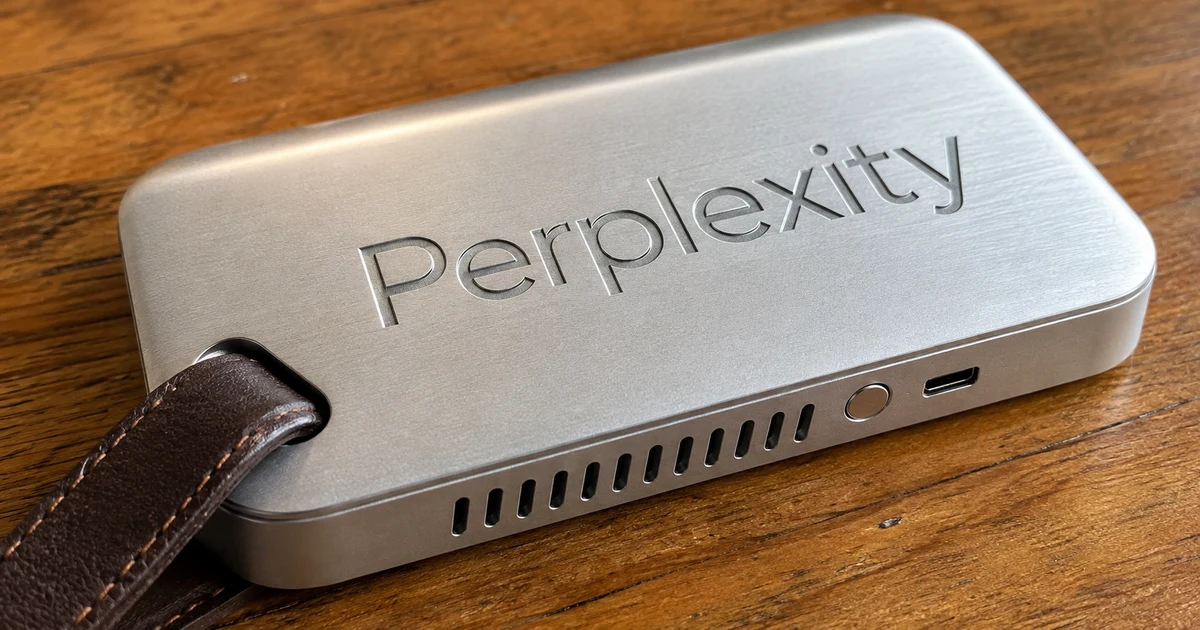
What Perplexity Portable Computer keeps on your machine
Portable Computer keeps private data and the agent's working parts on your machine, and on-device work does not consume credits. Launched on August 25, 2026, it is a version of Perplexity Computer that runs entirely on a local machine. Perplexity built it with NVIDIA for the DGX Spark, NVIDIA's desktop-sized AI computer.
The post opens by noting that some of the most valuable work for AI agents involves data people would rather keep on their own machines, such as private codebases or confidential material. On the device, users can analyze data, synthesize files and run complex workflows.
The model is not the only part that stays local. The orchestrator, planner, tool router, scheduler, durable task queue and local search index all run on device as well. Perplexity adds that owning the compute makes high-volume tasks practical, because work handled by the local models has no per-credit charge.
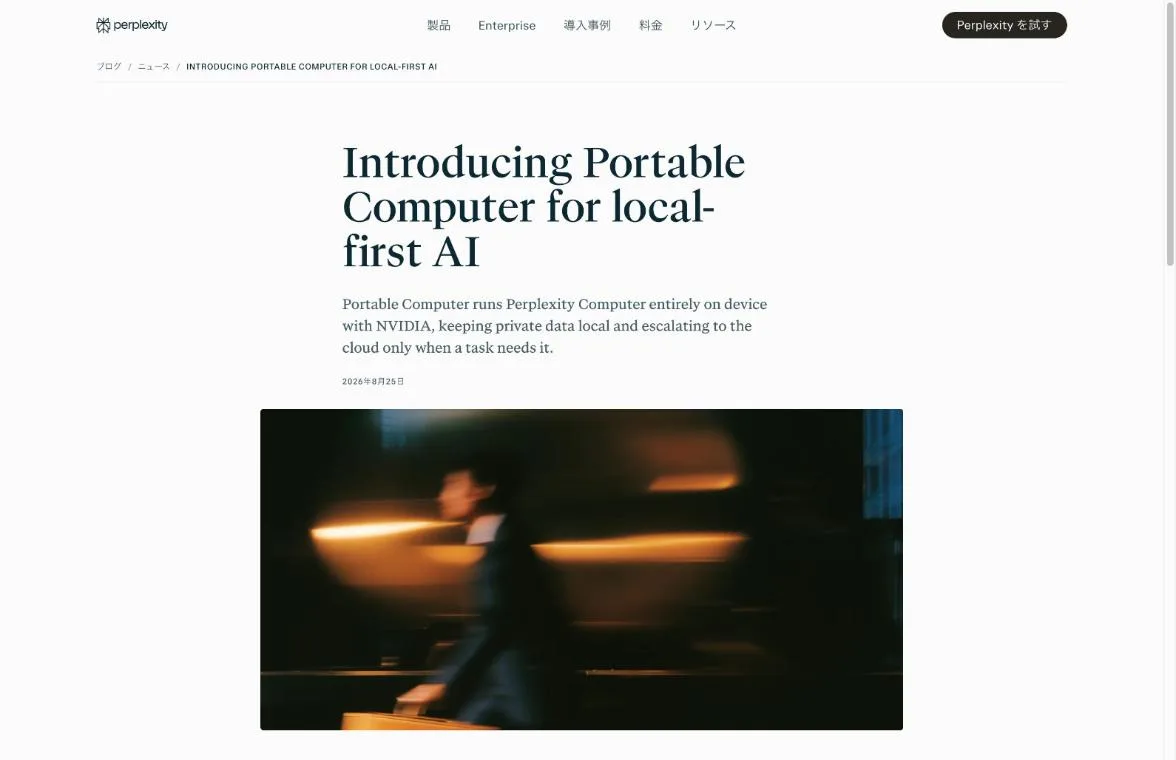
"Portable Computer lets users run Perplexity Computer entirely on device, analyzing data, synthesizing files, and running complex workflows. Private data stays local and on-device work doesn’t consume credits."/"The orchestrator, planner, tool router, scheduler, durable task queue, and local search index all run on device."/"Owning the compute makes high-volume AI tasks practical to run because work handled by the local models has no per-credit charge."(Introduction and Local-first AI stack sections)View official source →
Which models run locally on the DGX Spark?
Portable Computer runs Qwen 3.8 27B or PPLX 27B, a post-trained version of the Qwen model, on the DGX Spark. NVIDIA Nemotron 3.5 Lightning, a 30B open model, is listed as coming soon to the model picker. Dictation also runs locally, using the NVIDIA Nemotron 3.5 ASR Model.
The post says the Qwen model is post-trained to complete as much of each task locally as possible and to escalate to the cloud when the task needs it. It reads local files, searches across documents and code, takes actions on the device and keeps jobs running. The table below sets out each model and its status.
Models named in the launch post
| Model | Status in the post | Where it appears |
|---|---|---|
| Qwen 3.8 27B | Runs on the DGX Spark | Local-first AI stack |
| PPLX 27B | Runs on the DGX Spark; a post-trained version of the Qwen model | Local-first AI stack |
| NVIDIA Nemotron 3.5 Lightning (30B open model) | Coming soon to the model picker | Local-first AI stack |
| NVIDIA Nemotron 3.5 ASR Model | Runs dictation locally | Search and dictation |
The post attributes the local-first post-training to the Qwen model, so it does not single out PPLX 27B. It gives no date for Nemotron 3.5 Lightning. With dictation, the transcription and the actions on files stay on the machine, and the audio does not touch the cloud.
"Portable Computer runs on the NVIDIA DGX Spark with Qwen 3.8 27B or with PPLX 27B, a post-trained version of the Qwen model. NVIDIA Nemotron 3.5 Lightning, a 30B open model, is coming soon to the model picker."/"The Qwen model is post-trained to complete as much of each task locally as possible and to escalate to the cloud when the task needs it."/"Dictation mode also runs locally with the NVIDIA Nemotron 3.5 ASR Model."(Local-first AI stack and Search and dictation sections)View official source →
How cloud escalation works and when it asks first
When a task needs to send content from the device to a cloud service, Portable Computer asks the user for permission before moving forward. The post says the tool handles the majority of tasks locally, while some jobs benefit from the web or from frontier reasoning in the cloud. Its example is a term sheet: a user might keep the confidential details local but escalate to the cloud for current market comps or recent precedent deals.
The local orchestrator can escalate a task to the cloud for current information, browser use, connected apps, or one of more than 15 frontier models for advanced reasoning. For outside information, Portable Computer can also run Perplexity search or wide or deep research. The user gets cited findings from the web while everything else still runs locally.
App connectors cover Google Drive, Gmail, Slack and GitHub. In Perplexity's example, a user can triage new GitHub issues against overnight bug reports in Gmail on device, then send a Slack message about the top three issues with suggested owners by morning. Code and tool execution run in isolated sandbox environments with controlled access to files and connected apps, and security matches the cloud version of Perplexity Computer.
"Portable Computer’s local orchestrator can escalate a task to the cloud for current information, browser use, connected apps, or one of 15+ frontier models for advanced reasoning."/"Through app connectors, Portable Computer works with Google Drive, Gmail, Slack, and GitHub."/"When a task needs to send content from the device to a cloud service, Portable Computer asks the user for permission before moving forward."(Escalation to cloud section)View official source →
Hardware, plan and operating system you need
Portable Computer is available to Pro and Max subscribers on the NVIDIA DGX Spark, and the first release is on Linux. RTX GPU PCs and Windows support are both listed as coming soon.
The DGX Spark is built around the Grace Blackwell GB10 platform, which pairs a 20-core Arm CPU with an NVIDIA GPU and 128 GB of unified memory. Installation is a one-click setup in the Perplexity app. The table sets out each requirement as the post states it.
Requirements as published
| Item | Requirement | Where it appears |
|---|---|---|
| Machine | NVIDIA DGX Spark; RTX GPU PCs coming soon | Introduction and closing section |
| DGX Spark specification | Grace Blackwell GB10, 20-core Arm CPU and NVIDIA GPU, 128 GB unified memory | Closing section |
| Plan | Pro or Max subscription | Closing section |
| Operating system | Linux in the first release; Windows coming soon | Closing section |
| Setup | One-click setup via the Perplexity app | Closing section |
Pro and Max are the only plans the post names. It gives no date for Windows or for RTX GPU PCs.
"Portable Computer is available to Pro and Max Subscribers on the NVIDIA DGX Spark. The first release is available on Linux, with Windows support coming soon."/"The NVIDIA DGX Spark is built around the Grace Blackwell GB10 platform: a 20-core Arm CPU and NVIDIA GPU with 128 GB of unified memory. Portable Computer can be installed with a one-click setup via the Perplexity app."(Closing sections)View official source →
What the launch post leaves unsaid
The August 25 post gives no price, no VRAM figure and no dates for Windows or RTX GPU PCs. The only hardware numbers it gives are for the DGX Spark: a 20-core Arm CPU and 128 GB of unified memory. Anyone weighing a purchase has to look to other sources for the rest.
The post links a separate research blog, A Local-First Agent for Private and Cost-Effective Knowledge Work, which Perplexity says details the development behind Portable Computer and its outperformance across benchmarks for accuracy, speed and credit efficiency. The launch post itself gives no figures for those claims.
"Our research blog, A Local-First Agent for Private and Cost-Effective Knowledge Work, details the development behind Portable Computer and its outperformance across benchmarks for accuracy, speed, and credit efficiency."(Closing section)View official source →
FAQ
- What is Perplexity Portable Computer?
- It is a version of Perplexity Computer that runs entirely on a local machine. Users can analyze data, synthesize files and run complex workflows on the device. Private data stays local, and on-device work does not consume credits.
- Which models run locally?
- Qwen 3.8 27B or PPLX 27B, which is a post-trained version of the Qwen model, run on the NVIDIA DGX Spark. NVIDIA Nemotron 3.5 Lightning, a 30B open model, is coming soon to the model picker.
- What hardware and plan do you need?
- An NVIDIA DGX Spark and a Pro or Max subscription. The first release is available on Linux, with Windows support coming soon. The post also says RTX GPU PCs will follow, without giving a date.
Related articles
 NVIDIA AVO Scores 100 on the ARC-AGI-3 Public SetNVIDIA AVO scored 100.00 RHAE on all 25 ARC-AGI-3 public-set environments, NVIDIA says. It credits the harness, and the jump from 30 isn’t a controlled test.
 Liquid AI LFM2.5-2.6B: Fast Agents, Not for CodingLiquid AI LFM2.5-2.6B is a small model for local agents. It decodes 220 tokens/s on an M5 Max in under 2.5GB. Liquid AI says not to use it for coding.
 AI fact check: only 40% of cited stats hold upAI fact check: Trakkr traced 1,285 stats cited by ChatGPT, Perplexity, Gemini, Claude and AI Overviews. Only 40% led to a matching study. How to check one.
 Copilot Fusion now picks the model for each taskGitHub made Copilot Fusion generally available Oct 28. Pick Standard, High or Max and Copilot picks the models. High and Max need Pro+. 30% off until Nov 30.