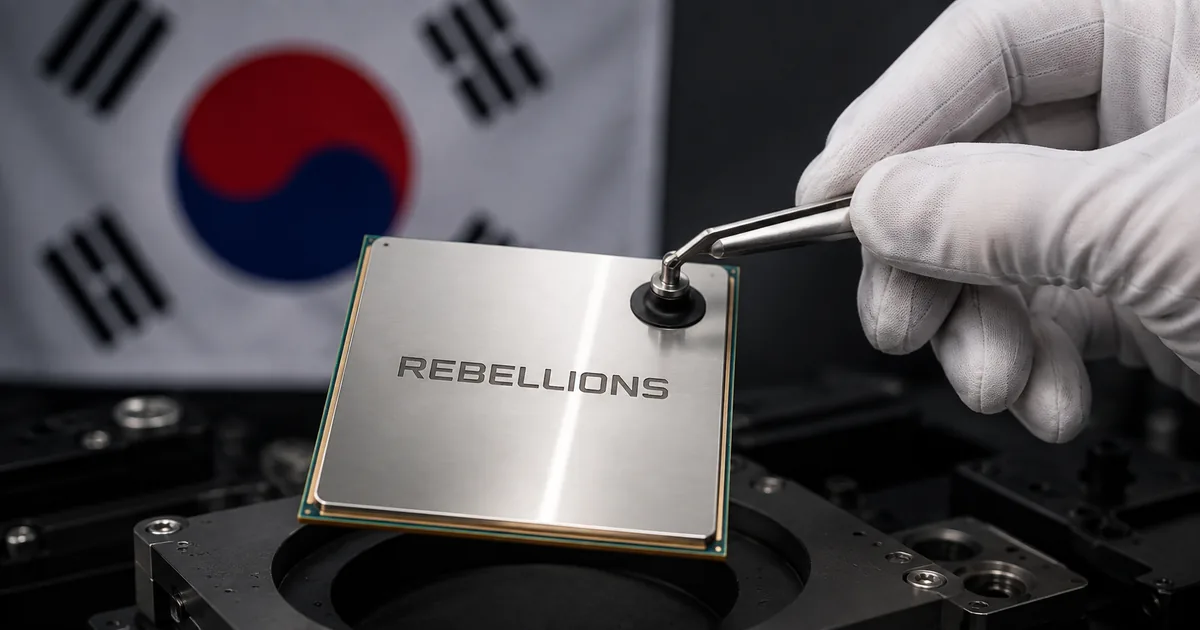
Nvidia and Rebellions are in early talks
Bloomberg, as relayed by The Next Web, reported on 21 August 2026 that Nvidia is in early talks with Rebellions, a Korean chip designer, about a technical partnership, an investment or possibly an acquisition. Jensen Huang met Rebellions co-founder and chief executive Sunghyun Park at Nvidia's Santa Clara headquarters that week, according to people familiar with the matter. They asked not to be named because the information is not public.
What has been reported about the talks
| Item | Detail |
|---|---|
| Reported by | Bloomberg, 21 August 2026 |
| Options under discussion | Technical partnership, investment, or acquisition |
| Who met | Jensen Huang (Nvidia) and Sunghyun Park (Rebellions) |
| Where | Nvidia's Santa Clara headquarters |
| Stage | Preliminary; may not produce a deal |
| On the record | Nvidia did not respond; Rebellions declined to comment |
| Not reported | Structure, price and stake |
| Status on 11 October 2026 | No agreement and no collapse reported |
Beyond the meeting and the stage of the talks, no terms have been reported. Nvidia did not answer the questions put to it, and a Rebellions representative declined to comment.
EE Times, in a piece published after the Bloomberg report, described Nvidia as pushing further into inference chips. That is the outlet's reading, not a stated Nvidia plan.
"Nvidia is in early talks with the Korean AI chip designer Rebellions about a technical partnership, an investment or possibly an acquisition, Bloomberg reported on Friday."/"Jensen Huang met Rebellions co-founder and chief executive Sunghyun Park at Nvidia’s Santa Clara headquarters this week, people familiar with the matter told the news agency."/"The talks are preliminary and may not produce a deal. Nvidia did not respond to Bloomberg’s questions. A representative for Rebellions declined to comment."(The Next Web, citing Bloomberg・body)View official source →
Rebellions AI funding, backers and the $2.3bn valuation
Rebellions has raised roughly $850m from SK Hynix, Samsung Ventures and Arm, and The Next Web gives its most recent valuation as around $2.3bn. It was founded in 2020 and is based in Bundang, south of Seoul. It designs neural processing units (NPUs, chips built for AI workloads) for data centers, tuned for inference.
Inference is the work of running an AI service after the model has been trained. Each query takes less compute than training does, but across all users the total is far larger.
The company also holds a direct investment from the Korean government. In September 2025 Rebellions announced a Series C round, with Arm and Samsung Ventures taking part, according to Tech Times via Zaikei.
Rebellions timeline from its own site
| Date | Event |
|---|---|
| September 2020 | Founded in Korea |
| June 2022 | ATOM chip taped out (design finished and sent to manufacturing) |
| May 2023 | ATOM first shipped, to kt cloud |
| November 2024 | REBEL chip taped out |
| December 2024 | Merger with SK Sapeon |
| February 2025 | Rebellions Japan established, the first overseas office |
| August 2025 | Saudi Arabian subsidiary established |
"Rebellions has raised roughly $850mn from SK Hynix, Samsung Ventures and Arm. It also holds a direct investment from the Korean government. Its most recent valuation was around $2.3bn."(The Next Web・body)View official source →
"Established in Korea to push beyond the limits of general-purpose hardware, Rebellions began with a mission to design inference-first silicon from the ground up."/"The merger unified Korea's Al semiconductor capabilities and deepened our supply chain through SK hynix's HBM leadership"(Rebellions official site・the Our Story entries for September 2020 and December 2024 — locale-dependent page at one URL/ロケール別表示)View official source →
Is Rebellions public? A pre-IPO round, no listing date
Not as of the latest reports: Rebellions raised more than $400m in March 2026 in a round it called pre-IPO, and no listing date has been disclosed. Tech Times via Zaikei reports that the round was led by Mirae Asset Financial Group and the Korea National Growth Fund.
Chief financial officer Sungkyue Shin said a year before the 21 August report that going public was the "master plan". The company launched two rack-scale products with the March round, RebelRack and RebelPod. The Next Web adds its own view that a license from Nvidia would give the company cash without a listing.
"Chief financial officer Sungkyue Shin said a year ago that going public was the “master plan”."/"In March the company raised more than $400mn in a round it described as pre-IPO, and used the moment to launch two rack-scale platforms called RebelRack and RebelPod. No listing date has been disclosed."(The Next Web・body)View official source →
Where Rebellions chips are deployed
ATOM and the higher-performance ATOM-Max entered mass production in 2023, and The Next Web cites DataCenterDynamics as reporting that customers in Japan, Saudi Arabia and the United States have deployed them. EE Times lists Korea Telecom's NPU-as-a-service among four deployments and says the chips also run in Saudi Arabia's sovereign AI infrastructure.
In Korea, SK Telecom said in September 2026 that Rebellions NPUs serve four of its services, including call summaries, and handle more than 14 million AI requests a day. In Japan, Tomen Devices started a trial with the AI-infrastructure operator Tomorrow Net in July 2026, testing throughput, response time, power efficiency and cost under realistic load.
In September 2026 Rebellions announced a partnership with the Japanese AI platform company ai&, which is starting to deploy RebelRack in a Tokyo data center and aims to scale to 100 or more units. That is a plan, not a completed rollout.
"Its Atom and Atom Max NPUs entered mass production in 2023, and DataCenterDynamics reported that customers in Japan, Saudi Arabia and the United States have deployed them."(The Next Web・body)View official source →
"entered mass production in 2023 and secured four deployments, including Korea Telecom’s NPU-as-a-service infrastructure."/"These inference chips have also been deployed in Saudi Arabia’s sovereign AI infrastructure."(EE Times・Rebellions’ inference value proposition section)View official source →
Rebel100 pairs 144GB of HBM3e with Samsung's 4nm process
Rebel100 is Rebellions' data-center inference chip, and it carries 144GB of HBM3e on a Samsung 4nm process. HBM3e is high-bandwidth memory, stacked memory chips that sit next to the processor. Rebellions publishes the specification on its home page.
Rebel100 published specification
| Property | Value |
|---|---|
| Compute (dense) | 2 PFLOPS (FP8), 1 PFLOPS (FP16) |
| On-chip SRAM | 512MB at 192TB/s |
| HBM3e | 144GB at 4.8TB/s |
| UCIe interface | 4TB/s (3 × 1TB/s channels per chiplet) |
| Chip-to-chip | 1.6TB/s Ethernet (I/O die due 1Q 2027) |
| Process | Samsung 4nm |
Tech Times via Zaikei says Rebel100 links four chiplets (small chips inside one package) over UCIe, an industry standard for that connection. The software supports PyTorch, vLLM and Triton. Zaikei describes Rebellions' design view as follows: for large language model inference, how fast the model's weights can be read from memory affects throughput as much as raw compute does.
EE Times says the design is memory-centric. Its compute chiplets carry large on-chip SRAM for the memory-heavy decode stage, while prefill runs elsewhere. EE Times adds that Rebellions co-designs custom HBM with Samsung and SK Hynix.
A RebelRack holds 32 Rebel100 cards, with a stated 64 PFLOPS of FP8 compute and a maximum power draw of 28kW. Those are the maker's specifications. Jon Peddie Research praises the design but says independent performance comparisons are still scarce.
"Compute (Dense) 2PFLOPS (FP8), 1PFLOPS (FP16)"/"On-Chip SRAM 512MB (192TB/s)"/"HBM3e 144GB (4.8TB/s)"/"Technology Samsung 4nm"(Rebellions official site・Rebel100 specification block on the home page — locale-dependent page at one URL/ロケール別表示)View official source →
"its compute chiplets carry significant on-chip SRAM to handle the memory-intensive decode stage, while prefill runs elsewhere."/"It has forged custom HBM co-design relationships with Samsung and SK Hynix"(EE Times・Rebellions’ memory-centric inference paragraph)View official source →
Nvidia's Groq deal: a $20bn license, a $3.5bn valuation
The Next Web describes the pattern in Nvidia's recent deals: buy a license, hire the engineers, take a stake, and leave the company standing. The Next Web calls this structure license-and-hire. If the Rebellions talks produce a deal, it would be the fourth arrangement of this shape in under a year.
Nvidia's license-and-hire arrangements and the Rebellions talks
| Company | Structure | Reported terms |
|---|---|---|
| Groq | Non-exclusive license | $20bn; most of the engineering talent absorbed; Groq kept operating |
| Enfabrica | Similar arrangement | Reported by The Decoder |
| Poolside | License plus hiring | $6bn for the model factory; 109 staff hired |
| Rebellions | Under discussion | Partnership, investment or acquisition; undecided |
For Groq, the reports cover what happened next. Nvidia paid $20bn for a non-exclusive license and took most of Groq's engineers. Nvidia said it was not an acquisition because Groq continues to run its cloud business independently.
Groq then raised $650m for what remained. In August 2026 it closed $350m at a $3.5bn valuation, with Nvidia joining the round. Silicon Republic noted that the valuation fell by nearly half at that round.
Nvidia unveiled the Nvidia Groq 3 language processing unit (LPU, an inference chip) at its GTC conference in March 2026 and said it ships in the second half of the year. The Next Web says Rebellions designs the same class of part. The outlet draws that parallel itself, and it is not a forecast for Rebellions.
"It would be the fourth arrangement of this shape in under a year. Nvidia has spent that year buying access to rival chip and model designs rather than buying the companies outright."/"The structure Bloomberg describes is one Nvidia has used repeatedly. Buy a licence, hire the engineers, take a stake, and leave the company standing."/"Nvidia valued the licence at $20bn. Groq then raised $650mn for what remained."/"Silicon Republic noted that the valuation fell by nearly half at that round."(The Next Web・body)View official source →
Poolside and Enfabrica used the same structure
In the same week as the Rebellions report, Nvidia agreed to pay $6bn to Poolside for its model factory and to hire 109 of its staff. NVIDIA poolside deal: $6bn license, not a buyout covers those terms, and The Decoder reported the Enfabrica arrangement. The Next Web adds that rivals are moving the same way, citing AMD's purchase in August of Taalas, a startup that etches models into silicon.
"Nvidia agreed to pay Poolside $6bn for its model factory and hire 109 of its staff."/"AMD bought Taalas, a startup that etches models into silicon , in August."(The Next Web・body)View official source →
Antitrust review and Seoul could complicate a deal
The Next Web points to two possible complications: US antitrust review and the Korean government's view of advanced chips. Bloomberg noted that Nvidia's share of frontier-training chips is large enough that it has to watch for antitrust scrutiny, and sizeable technology acquisitions usually need US Department of Justice clearance. The Next Web's view is that the license-and-hire structure sidesteps the review a purchase would trigger.
Seoul is the second issue. The Next Web says the Korean government treats advanced semiconductors as strategic national assets, and Samsung and SK Hynix work closely with it on investment projects. SK Hynix is also a Rebellions shareholder.
"Nvidia’s share of the chips used to train frontier models is large enough that it has to watch for antitrust scrutiny, Bloomberg noted, and sizeable technology acquisitions usually need clearance from the US Department of Justice."/"The licence-and-hire structure sidesteps the review a purchase would trigger."/"Seoul treats advanced semiconductors as strategic national assets, and Samsung and SK Hynix work closely with the government on investment projects. SK Hynix is a Rebellions shareholder."(The Next Web・body)View official source →
What is still not established
As of 11 October 2026, no agreement had been reported, and the sources leave four points open. They are:
- Bloomberg's sources said the talks may not lead to a deal.
- No structure, price or stake has been reported.
- Neither company has commented on the record.
- Neither has said what a partnership would cover if it stopped short of an investment.
Nor had a collapse of the talks been reported by that date. Whether a deal would be a license, a minority investment or a purchase is the question the sources did not answer.
Each report cited here is a web page that can change after publication, so saving the whole page, for example as Markdown, lets you check a figure later. The Rebellions pages also show different text by language.
To turn a page URL into plain text with its headings and tables, try the tool that converts a web page into Markdown. The reports cited above are good pages to start with.
"No deal exists. Bloomberg’s sources described the discussions as preliminary and said they may not lead to a transaction. No structure, price or stake has been reported."/"Neither company has commented on the record. Nor has either said what a partnership would cover if it stopped short of an investment."(The Next Web・body)View official source →
FAQ
- Can I buy Rebellions stock?
- Not on a public market as of the latest reports. Rebellions raised more than $400m in March 2026 in a round it called pre-IPO, and no listing date has been disclosed.
- Is Nvidia acquiring Rebellions?
- Undecided. The reported talks cover a technical partnership, an investment or an acquisition, they are described as preliminary, and they may not produce a deal. Nvidia did not answer questions and Rebellions declined to comment.
- What happened to Groq after Nvidia's deal?
- Nvidia paid $20bn for a non-exclusive license and took most of Groq's engineers. Groq kept operating, raised $650m for what remained, then closed $350m at a $3.5bn valuation in August 2026, with Nvidia joining the round.
Related articles
 Nvidia's Jensen Huang close to alleged Chinese spyThe NYT says US officials judged Megaspeed's Alice Huang, close to Nvidia CEO Jensen Huang, a Chinese intelligence asset. Nvidia calls it normal business.
 NVIDIA's $250M compute gift for UK AI agent safetyNVIDIA will give UK researchers $250M of compute over five years for AI agent safety work, not cash. Jensen Huang also previewed $2B in new European deals.
 Microsoft to deploy Maia 300 AI chips from 2027Microsoft will put its Maia 300 AI chip into production in 2027. It expects 40% more tokens per megawatt than leading GPU systems but has not named them.
 Nvidia Hugging Face Deal Draws DOJ QuestionsThe DOJ is asking whether Nvidia's $12.93 billion Hugging Face deal would hurt AI competition, Reuters reported. Closing is due in the first half of 2027.