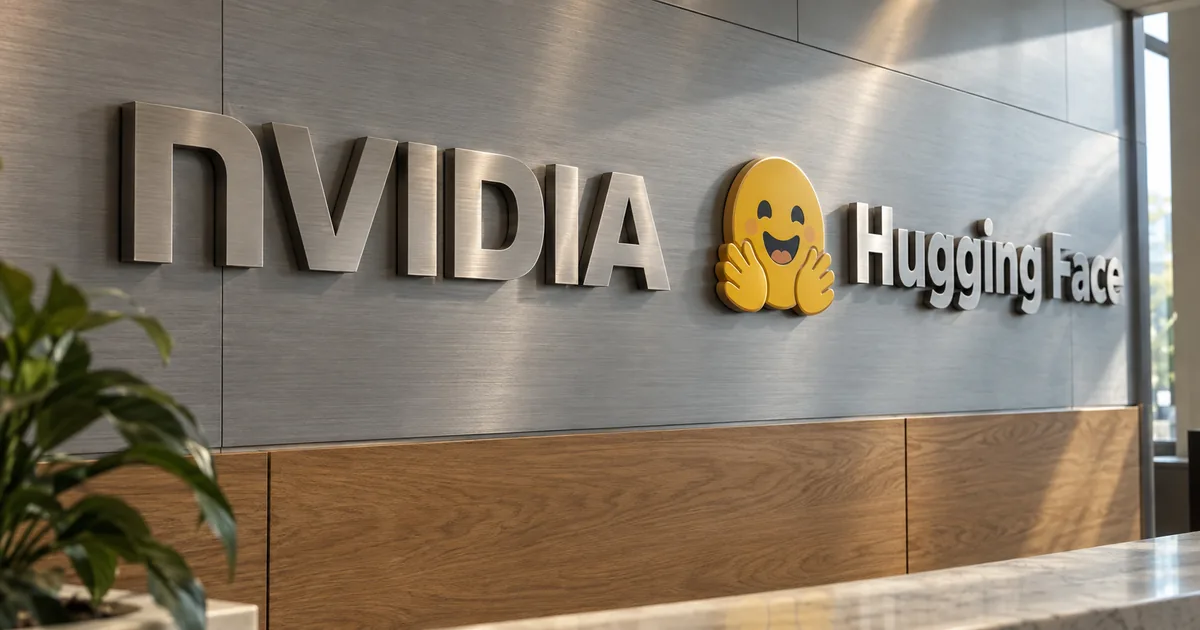
The DOJ is asking how the deal affects AI competition
What the October 28 report says
The Justice Department has made inquiries about how the Hugging Face deal would affect competition in AI, Reuters reported on October 28, 2026. The report rests on two people familiar with the matter, and CNBC later confirmed the inquiry with a source of its own.
Officials asked whether Nvidia would control a key AI hub
The central question is whether owning Hugging Face would let Nvidia capture a fundamental distribution point for AI. Hugging Face is where most open-weight models are published and downloaded, and roughly 18 million developers, researchers and creators use it.
Officials are also asking how Nvidia might use the platform to hurt rivals and whether owning it would give Nvidia more bargaining power. According to Reuters, they have asked about Hugging Face's competitors as well.
The DOJ has also looked at Groq, Run:ai and SchedMD
The Hugging Face questions sit inside a broader, years-long look at Nvidia's conduct that began under President Joe Biden. That probe covers Nvidia's acquisitions, investments and sales practices, and whether it has pressured customers.
According to Reuters, the DOJ has also examined the 2025 deal to license Groq's technology and hire its engineers, the Run:ai acquisition, and the December 2025 purchase of SchedMD. On Groq, officials explored whether Nvidia offered customers bigger AI chip allocations if they also bought its networking gear and Groq processors.
The DOJ, Nvidia and Hugging Face did not comment
None of the three parties has said anything about the substance. A DOJ spokesperson cited a longstanding policy of not discussing matters before the department, Nvidia declined to comment, and Hugging Face did not respond to Reuters.
Reuters adds that a government investigation is not evidence of wrongdoing and does not necessarily lead to a lawsuit. Nvidia still expects the deal to close in the first half of 2027.
"On Hugging Face, Justice Department officials have asked whether the deal would let Nvidia capture a fundamental distribution point for AI, the people said."/"Government investigations are not evidence of wrongdoing and do not necessarily result in lawsuits."View official source →
Nvidia is paying $12.93 billion in two ways
What each of the two documents tells you
Nvidia announced on September 3, 2026, that it has agreed to acquire Hugging Face. The post is bylined by CEO Jensen Huang and gives the price to the dollar instead of rounding it. Coverage that rounds it to $12.9 billion or $13 billion is describing the same total.
$11.9 billion goes to Hugging Face stockholders
The single price tag is really two payments. Nvidia set out the split in the Form 8-K it filed with the SEC on September 2: about $11.9 billion goes to Hugging Face's stockholders, and the filing adds that the figure can still move before closing.
The blog post never mentions that split. If you only read the announcement, you get the total and the openness commitments and none of the mechanics.
Up to $1 billion in stock goes to staff who join Nvidia
The second line item is paid in equity, not cash, and $1.0 billion is the upper limit rather than a set amount. It is a retention program for the Hugging Face employees who join Nvidia.
Huang writes that the Hugging Face team will join Nvidia and that the hugging-face emoji remains the brand. He also says Clément Delangue, Hugging Face's CEO, approached him while weighing what the company should do next.
"The transaction includes an approximately $11.9 billion purchase price payable to Hugging Face stockholders, subject to certain adjustments, and an equity-based retention program of up to approximately $1.0 billion for Hugging Face employees joining NVIDIA."View official source →
18 million people use Hugging Face for open-weight models
Open weights means the trained numbers inside a model are published for download, not hidden behind an API you call. Anyone can download those numbers and run the model on hardware they choose. Hugging Face is where most of that publishing and downloading happens.
The platform holds 3 million models and 500,000 datasets
By Nvidia's count, the platform also holds a million applications on top of those models and datasets. Roughly 18 million developers, researchers and creators publish and download that material.
Those numbers are why a change of ownership reaches past the two companies. If distribution terms move, the effect lands on everyone who downloads weights rather than on one vendor's customers.
200,000 companies discover and deploy AI on the platform
More than 200,000 companies use Hugging Face to discover, evaluate, customize and deploy AI, according to the same post. For those companies the site is a supply line for the models they put into production, not just a place to experiment.
Nvidia presents itself as an existing contributor rather than a newcomer. It says it has released more than 500 models and more than 250 open datasets on the platform, and calls itself the largest contributor of open models and data there.
"More than 18 million developers, researchers and creators use Hugging Face to share more than 3 million models, 500,000 datasets and 1 million applications. More than 200,000 companies use the platform to discover, evaluate, customize and deploy AI."View official source →
You will not need Nvidia chips to use Hugging Face
Nvidia sells GPUs, and it is buying the place where the models that run on them get published. The first worry is that the platform might stop treating rival companies' chips the same as Nvidia's own.
You still choose which chips and clouds you run on
The post rules out a hardware requirement outright. You keep picking the model, the framework, the cloud and the inference provider yourself.
Nvidia also says it will keep supporting work that spans several clouds and several kinds of chips, because builders should be able to use the hardware that fits what they are doing. If you run on another company's chips today, the announcement says that will not change.
Open-source and open-weight models stay supported
Nvidia says it will keep supporting open-source and open-weight models from every builder in the ecosystem. That covers competitors' models as much as the projects close to its own stack.
Huang argued for open weights before this deal existed. He signed an open letter with other industry leaders, and its point was that published weights broaden access to AI and keep AI leadership spread across companies, institutions and communities.
"Hugging Face will remain an open platform for the entire AI ecosystem. Developers will choose the models they want, the frameworks they want, the clouds and inference service providers they want and the computing platforms they want. NVIDIA compute will not be required to build on or deploy through Hugging Face."/"Joined by leaders from across the industry, we made a simple point: open weights broaden access to AI and help ensure that AI leadership is distributed across companies, institutions and communities."View official source →
Closing is expected in the first half of 2027
Signing and closing are two different events, and only the signing has happened. Until the deal closes, the announcement changes nothing about what you do on the platform.
No change to downloading or publishing has been announced
The post covers the agreement and the openness commitments, and says nothing about pricing or how the site works. Nothing in it touches the way you get models in or out.
You do not have to take the commitments on trust either. Two things will be visible from the outside: whether models for non-Nvidia chips stay available, and whether other vendors' models keep the same treatment as Nvidia's own.
Regulatory approval is a condition of closing
Those closing conditions have to be satisfied or waived before the deal closes, and the required regulatory approvals are among them. Neither the timing nor the conditions appear in the blog post; both come from the 8-K. Separately, Reuters reported on October 28 that the DOJ is already asking how the deal would affect AI competition.
The same filing flags a risk for anyone who depends on the platform. Regulatory controls could limit which products and services Nvidia may provide for models that come out of certain countries, China among them, and the filing says that would materially affect both Hugging Face's platform and Nvidia's own business.
What is fixed today is the price: $12,930,300,000, announced on September 3, 2026. Nvidia has also put in writing that its own chips are not required to use Hugging Face, and whether that holds once the deal closes is the part to watch.
"The transaction is expected to close in the first half of 2027, subject to the satisfaction or waiver of customary closing conditions, including receipt of required regulatory approvals."View official source →
FAQ
- Is the DOJ investigating Nvidia's Hugging Face deal?
- The Justice Department has been asking how the deal would affect competition in AI, Reuters reported on October 28, 2026, citing two people familiar with the matter. Officials want to know whether Nvidia would gain control of a fundamental distribution point for AI. The DOJ and Nvidia declined to comment, and an inquiry like this is not a finding of wrongdoing.
- How much is Nvidia paying for Hugging Face?
- $12,930,300,000. Nvidia's SEC filing splits that into roughly $11.9 billion for Hugging Face stockholders, a figure the filing says can still be adjusted, plus up to $1.0 billion of stock for the Hugging Face employees who move to Nvidia. Headlines that round to $13 billion are describing the same total.
- Do I need Nvidia hardware to keep using Hugging Face?
- No. The announcement says Nvidia chips are not needed either to build on Hugging Face or to deploy through it, and that you keep picking your own models, frameworks, clouds and inference providers. Nvidia also says it will keep supporting setups that run across several clouds and several kinds of chips.
- Has the acquisition actually happened yet?
- Not yet. Nvidia signed a definitive agreement on September 2, 2026, but the transaction is expected to close in the first half of 2027. Closing depends on customary conditions being satisfied or waived, and those conditions include receiving the required regulatory approvals.
Related articles
 NVIDIA's $250M compute gift for UK AI agent safetyNVIDIA will give UK researchers $250M of compute over five years for AI agent safety work, not cash. Jensen Huang also previewed $2B in new European deals.
 Nvidia Price Increase: AI Servers Up More Than 15%Bloomberg reports the Nvidia price increase: AI servers up more than 15% in many cases from early 2027 on memory costs. Q3 gross margin guide: 74.0%.
 modelmap: An LLM VRAM Calculator That Maps Modelsmodelmap is an LLM VRAM calculator that also maps a model's architecture. Paste a Hugging Face model ID, pick a GPU and see weights, KV cache and activations.
 NVIDIA poolside deal: $6bn license, not a buyoutNVIDIA poolside deal explained: $6bn for a Model Factory license, 109 job offers and $1bn at a $12bn valuation. Not an acquisition, per the investor letter.