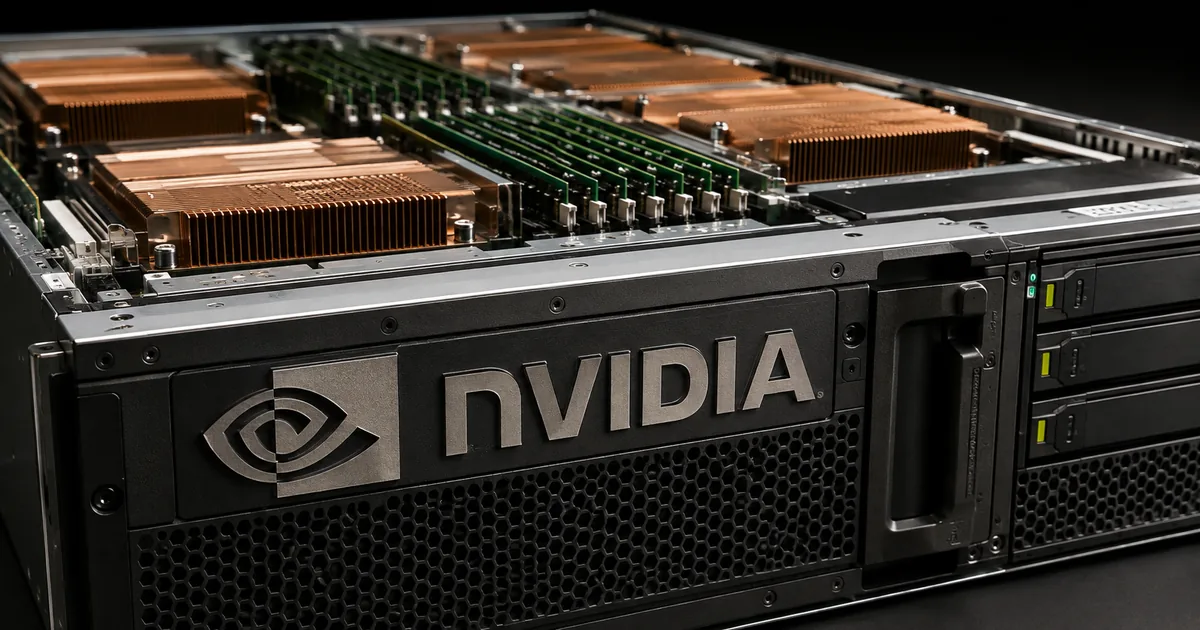
Nvidia price hike on Vera Rubin and Grace Blackwell servers
Bloomberg reported on 22 August 2026 that some of Nvidia's biggest customers have been told that prices of servers containing its AI chips will rise more than 15% in many cases. The report ties the increase to soaring memory chip costs.
The increases will take effect on systems shipped in early 2027 and will affect systems including those with the flagship Vera Rubin and Grace Blackwell chips. The sources add that the size of each increase will depend on the generation of Nvidia chips and the memory configurations.
This is a report, not an Nvidia announcement. Bloomberg's sources are people familiar with the process, who asked not to be identified because the communications have not yet been made public.
According to them, companies that build servers under contract for large data center operators such as Microsoft, Google and Oracle have recently notified their customers of the forthcoming increases. Bloomberg adds that Nvidia representatives did not respond to requests for comment.
"Some of Nvidia Corp.’s biggest customers have been told that the prices of servers containing its artificial intelligence chips are going up more than 15% in many cases with memory chip costs soaring."/"The price hikes will go into effect on systems shipped early next year and will impact systems including those with the flagship Vera Rubin and Grace Blackwell chips, according to people familiar with the process, who asked to not to be identified commenting on communications that haven’t yet been made public."/"The increases will depend on the generation of Nvidia chips and the memory configurations, they said."/"Companies who build the servers under contract for large data center operators such as Microsoft Corp., Alphabet Inc.’s Google and Oracle Corp. have recently notified their customers of the forthcoming increases, the people said. Nvidia representatives didn’t respond to requests for comment."(article body)— Fortune/BloombergView official source →
DRAM prices and the memory shortage behind the hike
DRAM, short for dynamic random access memory, is the working memory an AI processor is paired with. Bloomberg says Nvidia's accelerators are central to computers that create and run AI software, and that how well they perform depends on how much DRAM comes with them.
Three companies make most of that memory: Samsung Electronics, SK Hynix and Micron Technology. Bloomberg says they account for most of the world's DRAM production and have been raising output, but have not yet caught up with the surge in demand for AI infrastructure.
Bloomberg says the industry's most dominant company has been unable to keep prices steady or absorb growing costs, which shows how much bargaining power memory chip makers have. It adds that Apple and Qualcomm have recently said chip shortages forced them to charge more for their products.
Amazon, Microsoft, Google and Meta are each pursuing in-house chip programs, according to Bloomberg, and each still depends on purchases from Nvidia for its data center build-out. Bloomberg adds that how far they can move toward greater independence will also depend on their access to supply from Samsung, SK Hynix and Micron.
"The inability of the industry’s most dominant company to hold the line on prices or absorb growing costs shows how much leverage makers of memory chips – Samsung Electronics Co., SK Hynix Inc. and Micron Technology Inc. – have amid a surge in demand for AI infrastructure."/"Major technology companies including Apple Inc. and Qualcomm Inc. have recently said they’ve been forced to charge more for their products because of chip shortages."/"Nvidia’s accelerator processors are the heart of computers that create and run AI software. Their effectiveness depends on how much dynamic random access memory, or DRAM, they are paired with. The two Korean companies and Micron account for most of the world’s production of that type of chip. While they’ve been increasing output, they still haven’t caught up with surging demand."/"Major customers like Amazon , Microsoft, Google and Meta are all pursuing their own in-house chip programs but are still dependent on purchases from Nvidia for their data center build-outs. Their ability to push forward with greater independence will also depend on their access to supply from Samsung, SK Hynix and Micron."(article body)— Fortune/BloombergView official source →
Nvidia Q2 earnings: gross margin and Q3 guidance
Nvidia published its second-quarter results on 26 August 2026, four days after the Bloomberg report. Gross margin is the share of revenue left after the direct cost of what was sold, and guidance is the forecast a company gives for its next quarter.
For the quarter ended 26 July 2026, revenue was $96.2 billion, up 18% from the previous quarter and up 106% from a year ago. Data Center revenue was $89.0 billion, up 117% from a year ago. GAAP and non-GAAP gross margins were both 75.0%.
For the third quarter, Nvidia expects revenue of $108.0 billion, plus or minus 2%. It expects GAAP and non-GAAP gross margins of 74.0%, plus or minus 50 basis points, which is half a percentage point either way. The outlook assumes no Data Center compute revenue from China.
The release also says Vera Rubin is in full production. It does not mention the reported price notices, and neither source says that one caused the other.
To keep a report like Bloomberg's for later, use the URL to Markdown tool, which converts a web page into Markdown from its address. Paste the URL and copy the result.
"NVIDIA (NASDAQ: NVDA) today reported revenue for the second quarter ended July 26, 2026, of $96.2 billion, up 18% from the previous quarter and up 106% from a year ago. For the quarter, GAAP and non-GAAP gross margins were both 75.0%."/"Second-quarter revenue was $89.0 billion, up 18% from the previous quarter and up 117% from a year ago."/"Revenue is expected to be $108.0 billion, plus or minus 2%. NVIDIA is not assuming any Data Center compute revenue from China in its outlook."/"GAAP and non-GAAP gross margins are expected to be 74.0%, plus or minus 50 basis points."/"The AI infrastructure buildout is at full steam. Vera Rubin, now in full production, was built to power exactly this moment."(press release)— NVIDIA newsroomView official source →
FAQ
- How big is the Nvidia price increase?
- More than 15% in many cases, according to Bloomberg. Its sources say the increases will depend on the generation of Nvidia chips and the memory configurations.
- Which systems and which shipments are affected?
- Systems shipped in early 2027, including those with the flagship Vera Rubin and Grace Blackwell chips. Bloomberg says companies that build servers under contract for large data center operators such as Microsoft, Google and Oracle have notified their customers.
- What do Nvidia's Q2 results say about gross margin?
- Nvidia reported a 75.0% gross margin for the second quarter, on both GAAP and non-GAAP measures, and expects 74.0% for the third quarter, plus or minus 50 basis points. The release does not mention the reported price notices.
Related articles
 Flash prices up 5x on AI, eroding Apple's leverageAI demand made flash 5x pricier in a year, the WSJ reports. Cloud giants now buy twice as much as Apple, and doubling iPhone 17 Pro storage costs Apple $66.
 NVIDIA's $250M compute gift for UK AI agent safetyNVIDIA will give UK researchers $250M of compute over five years for AI agent safety work, not cash. Jensen Huang also previewed $2B in new European deals.
 PC shipments fell 20.1% in Q3 as prices stay highIDC says worldwide PC shipments fell 20.1% to 62.7 million in Q3 2026 after a first-half stock-up. AI data center demand keeps prices high, and HP fell 30.9%.
 Nvidia Hugging Face Deal Draws DOJ QuestionsThe DOJ is asking whether Nvidia's $12.93 billion Hugging Face deal would hurt AI competition, Reuters reported. Closing is due in the first half of 2027.