OpenAI announces three AI results in math, CS and physics
OpenAI's announcement covers three results its internal models produced: one each in harmonic analysis, complexity theory and quantum field theory. None has been peer reviewed. OpenAI calls the AI-written manuscripts "a form of raw research data" and has asked outside experts to help turn them into results other researchers can trust.
The three results OpenAI announced
| Field | What OpenAI says its AI produced | AI output released? |
|---|---|---|
| Math (harmonic analysis) | A proof of the local smoothing conjecture in every dimension | Yes |
| Computer science (complexity theory) | A refutation of the Exponential Time Hypothesis (ETH) | Yes, with a review group |
| Physics (quantum field theory) | An existence proof for 4D theories including QCD | No; the expert group is holding it back |
Math and CS outputs are public; physics is up to experts
OpenAI released the AI output for the math and computer science results, and left the physics release to an outside group. The experts OpenAI asked to "shepherd" the results recommended a different approach for each field:
- Math: publish the AI output and let researchers organize their own efforts to explain it
- Computer science: form an outside group to explain the result, and publish the AI output so anyone can examine it
- Physics: form an outside group and let it decide what to release
The computer science group chose to publish the natural-language proof and the Lean formalization right away, and OpenAI put both on GitHub. Lean is a programming language that checks every step of a mathematical proof by machine; formalization means rewriting a human proof so Lean can check it.
The physics group went the other way. It is holding back the AI-produced material and writing up the result itself. OpenAI says it doesn't yet know which of the three approaches will work best.
OpenAI says it won't seek academic credit
OpenAI says it won't take academic credit for what its models found, and it set four principles for the outside groups. The groups, not OpenAI, get credit for the explanations they write.
OpenAI's four principles for the collaborations
OpenAI also concedes a weakness in the setup. Choosing the first shepherds decides who gets in early, and that "creates asymmetry of information," in OpenAI's words. Separately, OpenAI has committed $5 million to a new Simons Foundation initiative that will fund workshops, conferences and programs for researchers studying AI-produced results.
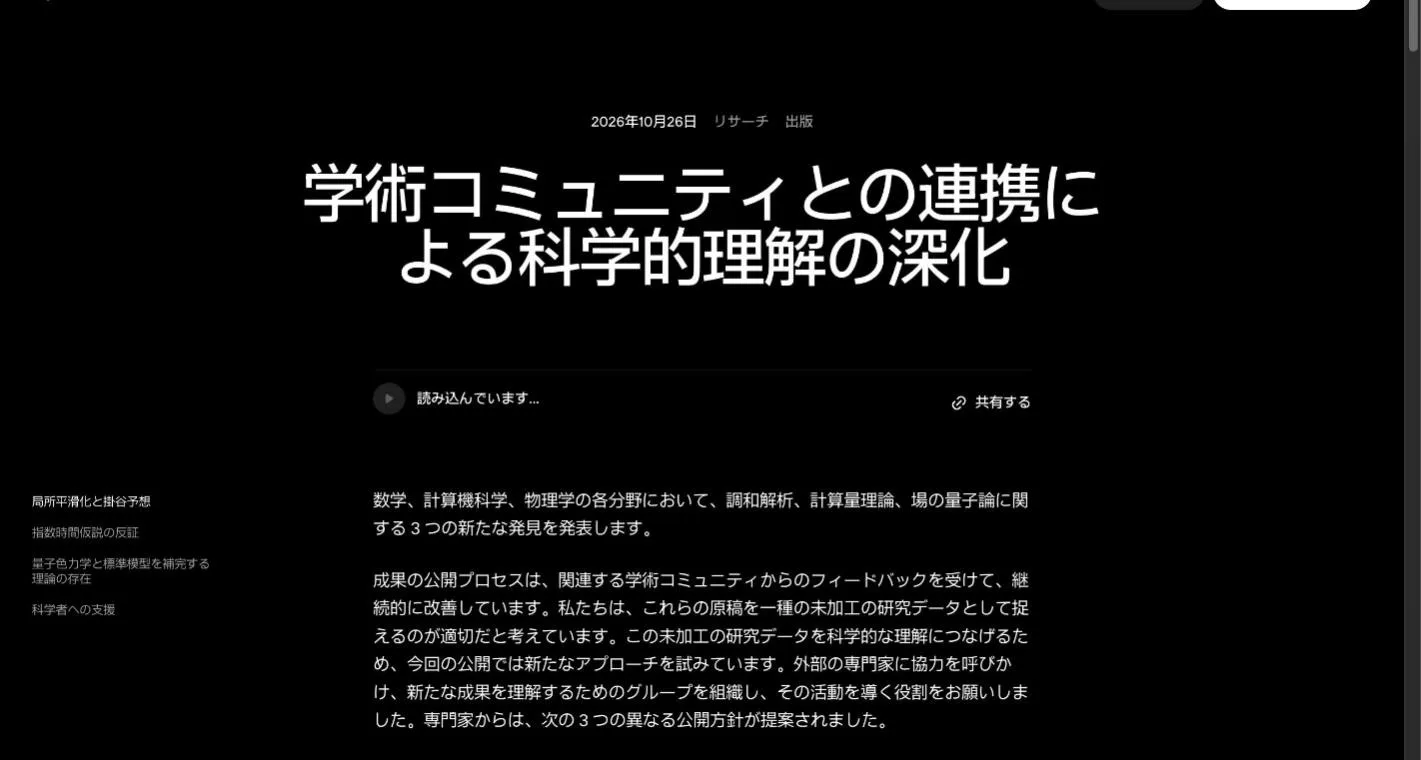
We are announcing three new discoveries in mathematics, computer science, and physics about harmonic analysis, complexity theory, and quantum field theory. / In our view, these manuscripts are best understood as a form of raw research data. / For the math result, release the AI output, leaving researchers free to organize their own efforts to explain the result. / For the computer science result, form an external group of collaborators to explain the result, while making the AI output publicly available for anyone to examine and build on. / For the physics result, form an external group of collaborators and defer to them on the release of materials. / We do not seek academic credit for the discoveries produced by our internal models. / Participation is voluntary and unpaid. / On the other hand, choosing initial shepherds necessarily shapes who gets involved first and creates asymmetry of information. — From the sections on the three results, release strategies and collaboration principlesView official source →
What the Exponential Time Hypothesis says
The Exponential Time Hypothesis (ETH) says some logic problems can't be solved without exponential time, however clever the algorithm. OpenAI's preprint claims it is false.
Hundreds of hardness results assume ETH
Most complexity theorists believe ETH, and OpenAI says hundreds of papers use it to argue that certain problems can't be solved quickly. ETH is about SAT, which asks whether a formula's variables can be set to true or false so the whole formula comes out true. 3-SAT is the version where each clause has at most three variables. In its standard form, ETH says 3-SAT on n variables takes exponential time in the worst case, so, roughly, each extra variable multiplies the running time by a constant factor.
Russell Impagliazzo, Ramamohan Paturi and Francis Zane first proposed it. Researchers in graph theory, computational biology, databases and computational geometry have proved results of the form "this problem is hard, assuming ETH." If ETH is false, those conditional results no longer show the problems are hard.
The preprint counts SAT solutions in subexponential time
OpenAI's preprint describes a deterministic algorithm that counts every satisfying assignment of a k-CNF formula in subexponential time. Subexponential time grows more slowly than any exponential function. The bound claimed here still grows faster than any polynomial, and the algorithm needs only a polynomial amount of memory.
Counting is at least as hard as deciding: if the count is above zero, the formula is satisfiable. So an algorithm that counts 3-SAT solutions in subexponential time also decides 3-SAT in subexponential time, which is exactly what ETH rules out.
The preprint, titled "The Exponential Time Hypothesis is False" and credited to OpenAI, is dated October 17, 2026, and was revised on October 25. It also claims subexponential algorithms for counting graph colorings and perfect matchings.
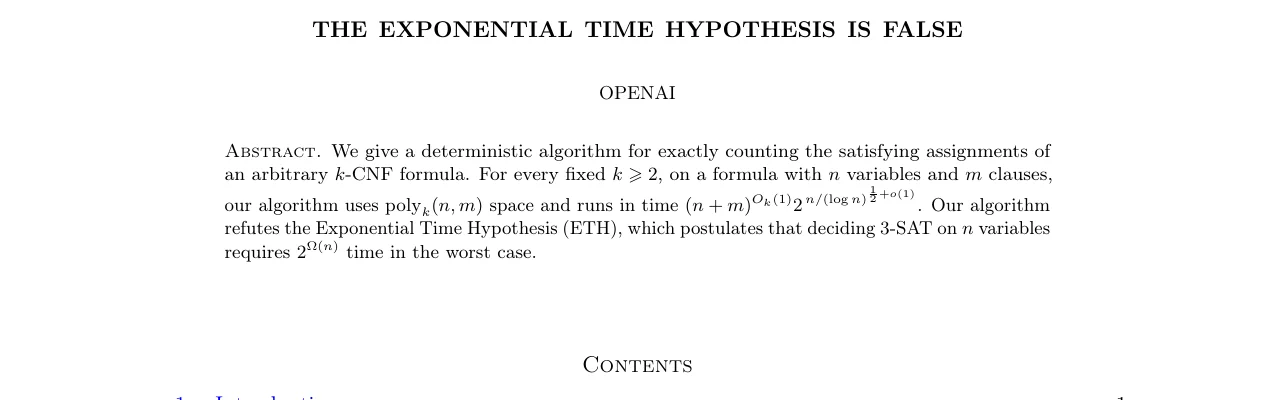
The ETH has been widely believed to be true, and has been used in hundreds of papers to derive conditional computational hardness results across a wide variety of fields including graph theory, computational biology, databases, computational geometry, and more. / Impagliazzo and Paturi, along with Francis Zane, are the original proposers of the Exponential Time Hypothesis — From the section on the computer science resultView official source →
We give a deterministic algorithm for exactly counting the satisfying assignments of an arbitrary k-CNF formula. / Testing #F > 0 also decides satisfiability. / However we do obtain subexponential time algorithms for counting graph colorings and perfect matchings. — From the abstract and introductionView official source →
The ETH disproof isn't confirmed yet
No one outside OpenAI has confirmed the ETH refutation yet. According to OpenAI, its AI found a natural-language disproof on October 16, 2026, and OpenAI formalized it in Lean the next day. Two of the three researchers checking it, Impagliazzo and Paturi, also co-proposed ETH.
Who is checking the ETH claim
Lean checked a weaker bound than the main theorem
The Lean proof covers a weaker running-time bound than the preprint's main theorem. OpenAI's note on the scope of the formalization says Lean proves a running time of 2 raised to n(log log n)²/√log n, while the October 25 manuscript claims the sharper 2 raised to n log log n/√log n. Both are subexponential, which is why OpenAI says the ETH refutation itself was verified in Lean.
The sharper main theorem has not been machine-checked. Whether it holds is for the review group and other experts to judge by reading the paper.
Anthropic published its own ETH refutation
Anthropic has published a separate refutation of ETH, found by an internal research Claude model, with a paper and a Lean 4 formalization. It sits in the eth folder of Anthropic's formal-math repository on GitHub, and the README says the algorithm solves 3-SAT in 2^o(n) time (time that grows more slowly than any exponential).
The same README is blunt about what the machine check does not cover. Lean verifies the proofs, but no machine checks that the formal statement says what the paper says, so a person still has to compare the two.
Real-world SAT solving isn't affected yet
Even if ETH is false, practical SAT solvers won't get faster any time soon. Anthropic's README says its result "is purely asymptotic and says nothing about solving formulas in practice." OpenAI writes that turning the theory into practical gains "will require significant further research."
OpenAI's preprint also says the result does not mean general NP problems have subexponential algorithms, so P vs. NP is untouched. OpenAI has pulled AI-generated work before: on October 7, it withdrew three math preprints after a sign error surfaced, a day after posting them (OpenAI math papers withdrawn over one sign error).


Surprisingly, our system has recently proved that the ETH is false, a result that was subsequently verified in Lean. / Finding such algorithms, and turning theoretical advances into practical improvements, will require significant further research. / This work will be verified and shepherded by a group led by Russell Impagliazzo (UC San Diego), Ramamohan Paturi (UC San Diego), and Ryan Williams (MIT). / Our AI found its natural language disproof for the ETH on October 16th, 2026 and then subsequently we formalized the result in Lean on October 17th, 2026 — From the section on the computer science resultView official source →
Lean proves that a deterministic machine exactly counts satisfying assignments / the October 25 manuscript gives the sharper time bound — From the Scope sectionView official source →
The result is purely asymptotic and says nothing about solving formulas in practice. / The result was discovered by an internal research Claude model. This folder holds the paper and its Lean 4 formalization, which was written by AI models. / Lean checks the proofs, but no machine checks that this file says what the paper says — From the READMEView official source →
our result does not imply that general NP problems admit subexponential time algorithms — From the introductionView official source →
OpenAI also claims Kakeya and Yang–Mills results
OpenAI announced a math result and a physics result on the same day as the ETH claim, and both are claims awaiting expert review. The math claim would settle the Kakeya conjecture in every dimension. The physics claim is about whether the theory of the strong nuclear force exists in a rigorous mathematical sense.
Local smoothing proved in every dimension
According to OpenAI, its models produced a proof of Christopher Sogge's 1991 local smoothing conjecture that works in any number of dimensions. Roughly, the conjecture says focused waves can't stay at their most concentrated for long. A correct proof would also resolve the Kakeya conjecture and Stein's restriction conjecture in every dimension.
Until now, only low-dimensional cases had been proved. The 2D case of local smoothing fell to Guth, Wang and Zhang in 2019, and Wang and Zahl settled 3D Kakeya in 2025.
OpenAI got the AI output on October 18, 2026, and had it formalized in Lean the following day. On an expert's advice, it released the output as is, the same way it handled its October 6 batch of math manuscripts.
The physics group is holding back the AI output
On the physics side, OpenAI says its models proved that certain interacting quantum field theories in four dimensions, QCD among them, exist in a mathematically rigorous sense. QCD (quantum chromodynamics) describes the strong force that binds quarks and gluons. Part of the claim is that pure Yang–Mills theory exists, which is one piece of a Clay Mathematics Institute Millennium Prize problem.
According to OpenAI, its models produced the Yang–Mills existence proof on September 9 and the QCD proof on September 18. Because the work is long and complex, OpenAI held off on announcing it until the Lean formalization of Yang–Mills existence finished on October 16.
David Gross, who shared the 2004 Nobel Prize in Physics, leads the group shepherding the physics result, with Michael Douglas, Arthur Jaffe, Igor Klebanov and Nikita Nekrasov. Unlike the math and computer science results, the physics AI output is not being released for now.
In 1991, Sogge proposed the local smoothing conjecture, which concerns the behavior of waves as they become focused. In particular, the conjecture states that the most extreme focusing must be short-lived. / Our models produced a proof of the local smoothing conjecture in every dimension and therefore also resolve the Kakeya conjecture and Stein’s restriction conjecture in all dimensions. / We obtained our AI output on October 18th, 2026, which was formalized in Lean the following day / As a subproblem, this work also includes a proof of the existence of pure Yang–Mills theory / Our models produced a natural language proof for Yang–Mills existence on September 9th, 2026, and then subsequently produced a proof for QCD on September 18th, 2026. / David Gross will lead a group including Michael Douglas, Arthur Jaffe, Igor Klebanov, and Nikita Nekrasov that will shepherd this work. / For the physics collaboration, the group has decided to hold off on releasing the AI-produced artifacts and instead work on writing it up themselves. — From the sections on the math and physics resultsView official source →
What OpenAI's ETH claim means for now
A Lean check doesn't settle the ETH claim; the review group's reading of the paper will. Lean verified a weaker bound than the paper's main theorem, and no machine checks that a formal statement matches the paper it comes from. Because OpenAI and Anthropic each published a refutation, reviewers have two separate write-ups to compare.
Access also differs by field. Anyone can read the AI output for the math and computer science results today. The physics result has a finished Lean formalization of Yang–Mills existence, but outsiders won't see the material until David Gross's group publishes its own write-up.
FAQ
- What is the Exponential Time Hypothesis?
- The Exponential Time Hypothesis (ETH) is a conjecture in complexity theory that 3-SAT on n variables cannot be solved in subexponential time in the worst case. Russell Impagliazzo, Ramamohan Paturi and Francis Zane proposed it, and OpenAI says hundreds of papers use it to show that other problems are hard.
- Has OpenAI's ETH disproof been verified?
- Not fully. OpenAI says the refutation was checked in Lean, but Lean covers a weaker bound than the preprint's main theorem, and the preprint has not been peer reviewed. A group led by Russell Impagliazzo and Ramamohan Paturi (UC San Diego) and Ryan Williams (MIT) is examining it.
- Does disproving ETH make SAT solvers faster?
- No. The result is about how running time grows as the number of variables goes to infinity. Anthropic, which published its own refutation, notes that the result says nothing about solving formulas in practice, and OpenAI says practical gains will take significant further research.
Related articles
 OpenAI math papers withdrawn over one sign errorOpenAI math papers: 3 of 722 AI-written papers were pulled a day after release. One sign error broke a proof two others relied on. About 42% are Lean-checked.
 OpenAI Astra: ten math proofs, no release dateOpenAI Astra, an internal version of its next major model, resolved or advanced ten open math problems. Lean 4 proofs are on GitHub; no release date is named.
 OpenAI, ServiceNow expand deal with ChatGPT pluginOpenAI and ServiceNow expanded their deal on Oct 28, 2026. A ServiceNow MCP plugin for ChatGPT is live now; Codex, security and voice tools follow in 2027.
 AI crawler training opt-out in one robots.txt ruleAI crawler training opt-out now takes one robots.txt rule. OpenAI, Google and Microsoft will honor it, Microsoft from Feb. 1, 2027. Until then, name each bot.