OpenAI math retraction pulls three Hodge conjecture papers
Three of the 722 papers are gone, a small share, but they disappeared barely a day after release. That speed is why the episode has become a test of how far AI-written proofs can be trusted.
From release to withdrawal in the openai/math repository
- Oct 6OpenAI posts 722 manuscripts from an internal model to GitHub
- Oct 7A sign error is found in one paper; it and two dependent papers are withdrawn and 14 others are revised
- As of Oct 10719 manuscripts remain while Lean formalization and fixes continue
722 AI math preprints on unsolved problems, three withdrawn
The manuscripts describe results on open research problems. According to the repository's README, most of them came out of the same pipeline using an unreleased OpenAI model.
On average, each result took three hours of ChatGPT Pro thinking compute. The model was given roughly 4,000 problems in all.
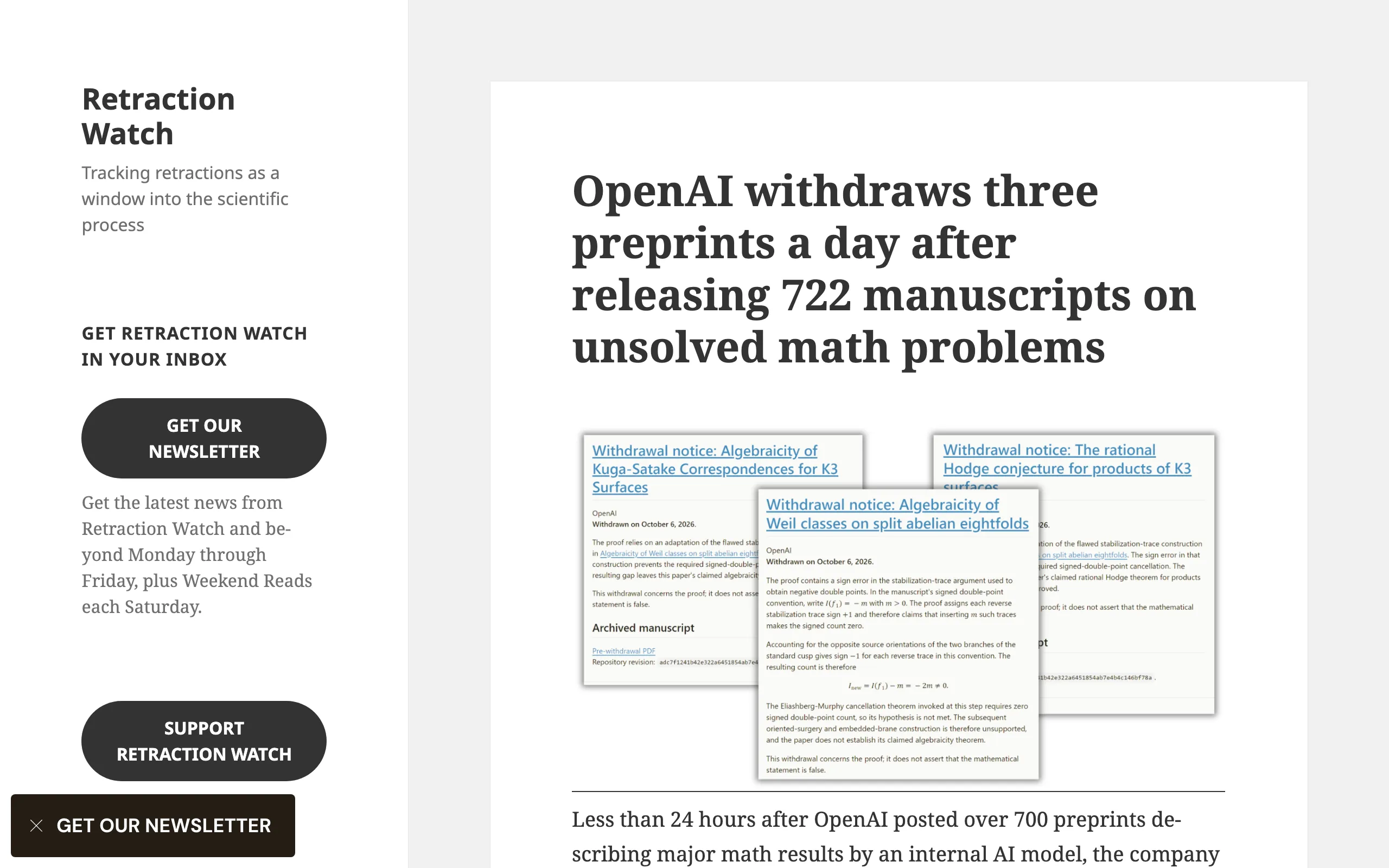
OpenAI says it moved to open problems because its models were already scoring near the top of its existing math benchmarks. On October 7 it pulled three of the papers. Retraction Watch noted the withdrawal came less than 24 hours after the release and described the 722 documents as preprints, meaning they had not been through journal peer review.
The withdrawn papers on the Hodge conjecture and K3 surfaces
All three titles point to algebraic geometry. One deals with Weil classes on abelian eightfolds, and the other two with K3 surfaces, including a paper on the rational Hodge conjecture for their products.
| Withdrawn paper | Reason |
|---|---|
| Algebraicity of Weil classes on split abelian eightfolds | Contains the sign error |
| Algebraicity of Kuga–Satake Correspondences for K3 Surfaces | Reused the construction above |
| The rational Hodge conjecture for products of K3 surfaces | Reused the construction above |
You don't need to know what a K3 surface is to follow this story; what matters is which paper depended on which. Each withdrawn paper now has a notice explaining the gap and a link to the archived manuscript.
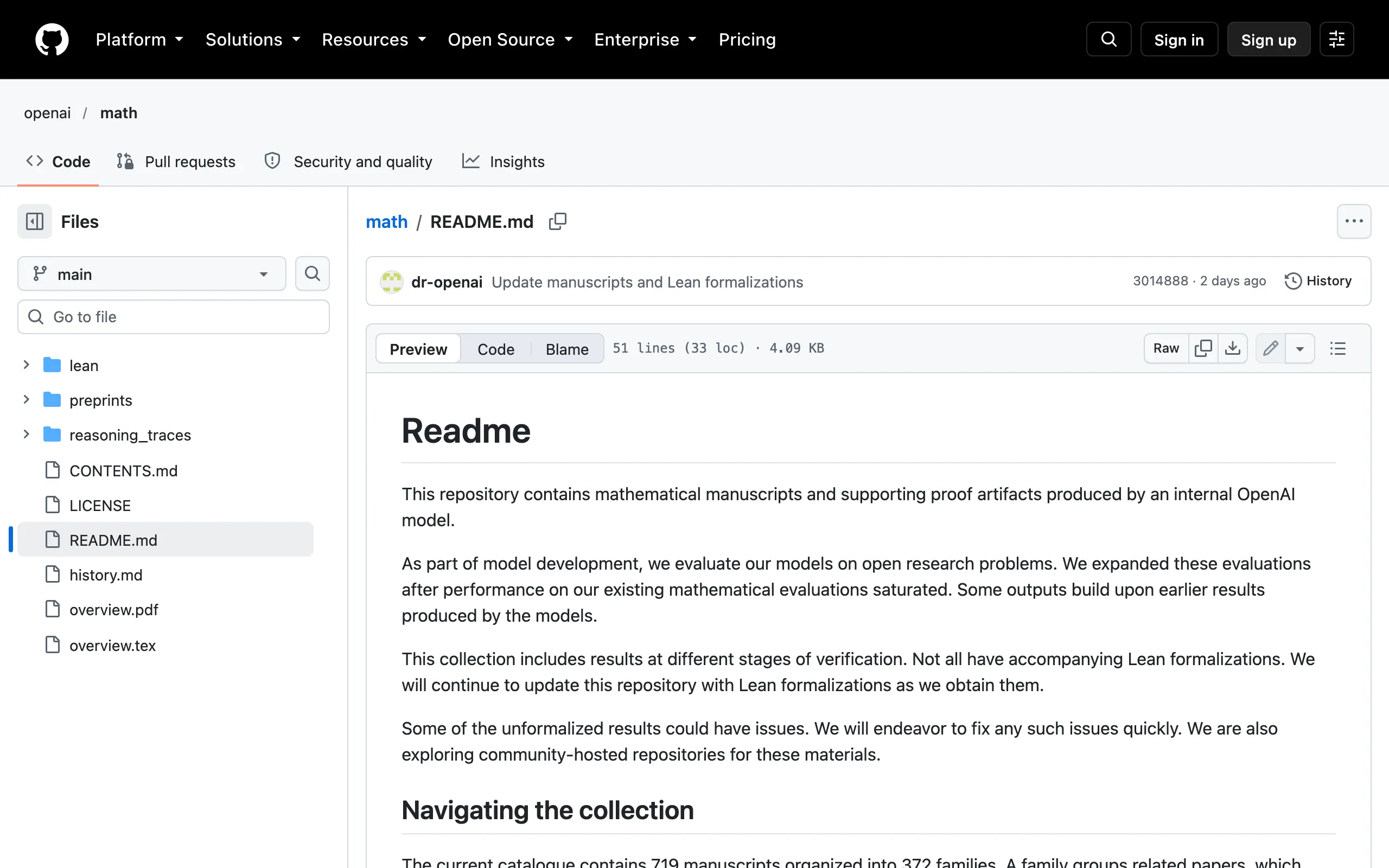
We expanded these evaluations after performance on our existing mathematical evaluations saturated. / The vast majority of results were obtained with the same procedure using an unreleased internal OpenAI model. On average, each result used three hours of ChatGPT Pro thinking compute with that model. Over the course of the evaluation, the model was posed approximately 4,000 problems. — From the description of how the results were producedView official source →
Less than 24 hours after OpenAI posted over 700 preprints describing major math results by an internal AI model, the company has withdrawn three of the manuscripts for errors. — From the opening of the reportView official source →
One sign error broke three math proofs through dependencies
The three fell together because the two K3 manuscripts were built on the construction in the first one. When papers reuse each other's results, a single mistake carries over to every paper that relies on it.
How a single sign error led to three withdrawals
- ErrorThe eightfolds paper counts each reverse stabilization trace as +1; its own convention requires −1
- Paper 1The signed count is no longer zero, so the cancellation theorem it relies on cannot be applied
- Papers 2 and 3The two K3 papers adapted that construction, so their proofs no longer hold
- WithdrawalAll three are withdrawn, each with a notice and a link to the archived version
A sign error in the first AI math proof
The flawed paper is "Algebraicity of Weil classes on split abelian eightfolds." Its withdrawal notice explains that the proof gave a sign of +1 to a step that, under the paper's own conventions, should carry −1. With the correct sign, a count the argument needs to be zero comes out nonzero, so the cancellation theorem the proof invokes no longer applies.
Each step in a proof uses what earlier steps established. If one step fails, every later step that relies on it is left unproved. OpenAI's spokesperson told Retraction Watch the company caught the errors during an audit.
Two dependent preprints lost their proof as well
The two K3 papers had adapted the same construction. When the first proof failed, theirs did too. The README notes that some of the model's outputs build on its own earlier results, so the 722 manuscripts are not all independent of each other.
Alex Townsend, an associate professor of mathematics at Cornell, told Retraction Watch that an error spreading to three papers was not surprising and that he expects more to surface. He added that OpenAI should have announced the Lean-verified manuscripts first.
Retraction covers the math proof, not the claim itself
The notices for the eightfolds paper and the K3 products paper carry the same caveat. OpenAI is not saying the theorems are wrong, only that these proofs do not establish them. The claims go back to being unproved until someone fixes the argument or finds another route.
That distinction matters for anyone reading headlines about "retracted" AI math. The withdrawals show that three specific proofs failed, which is different from showing that the model's mathematics is unreliable across the board.
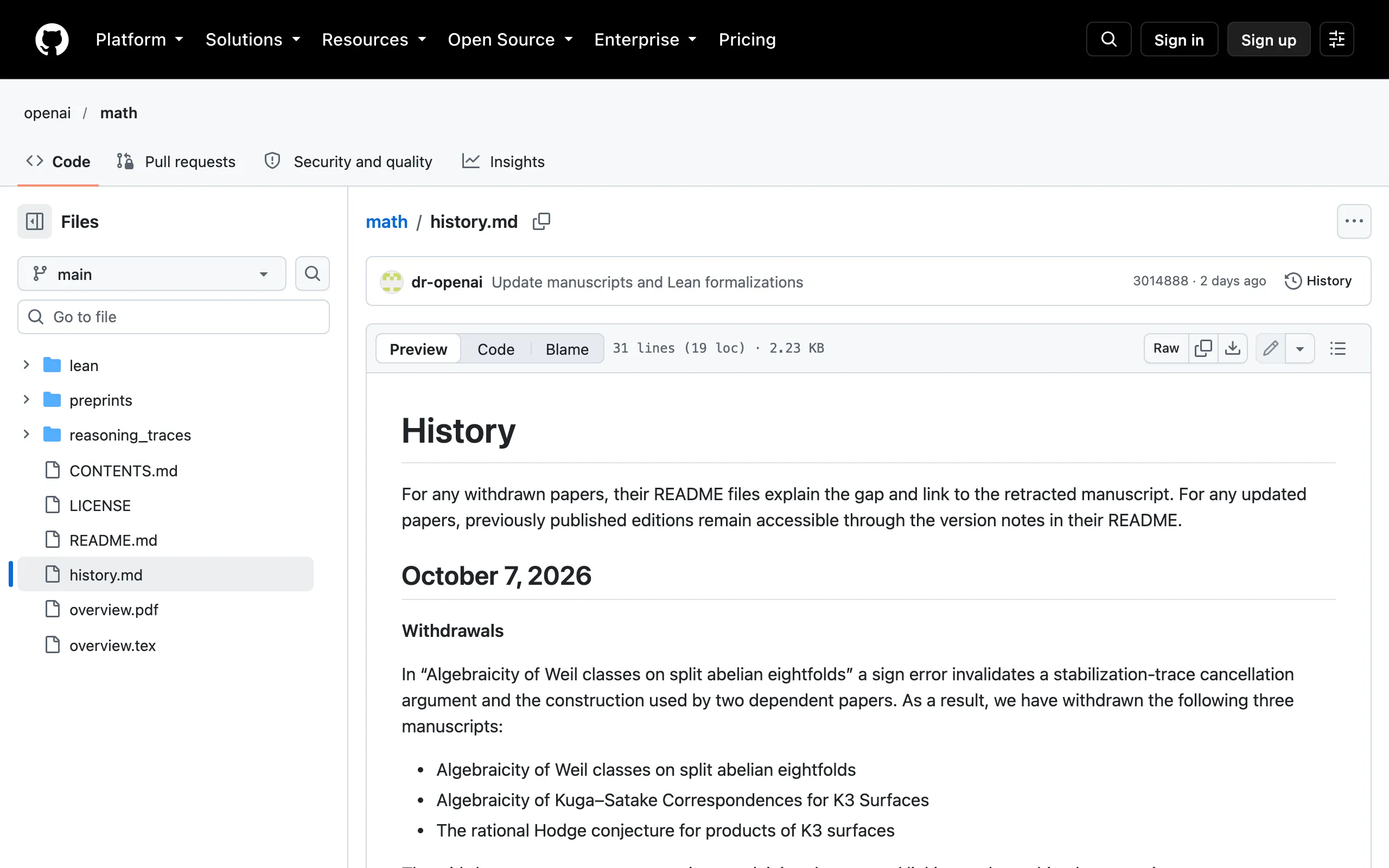
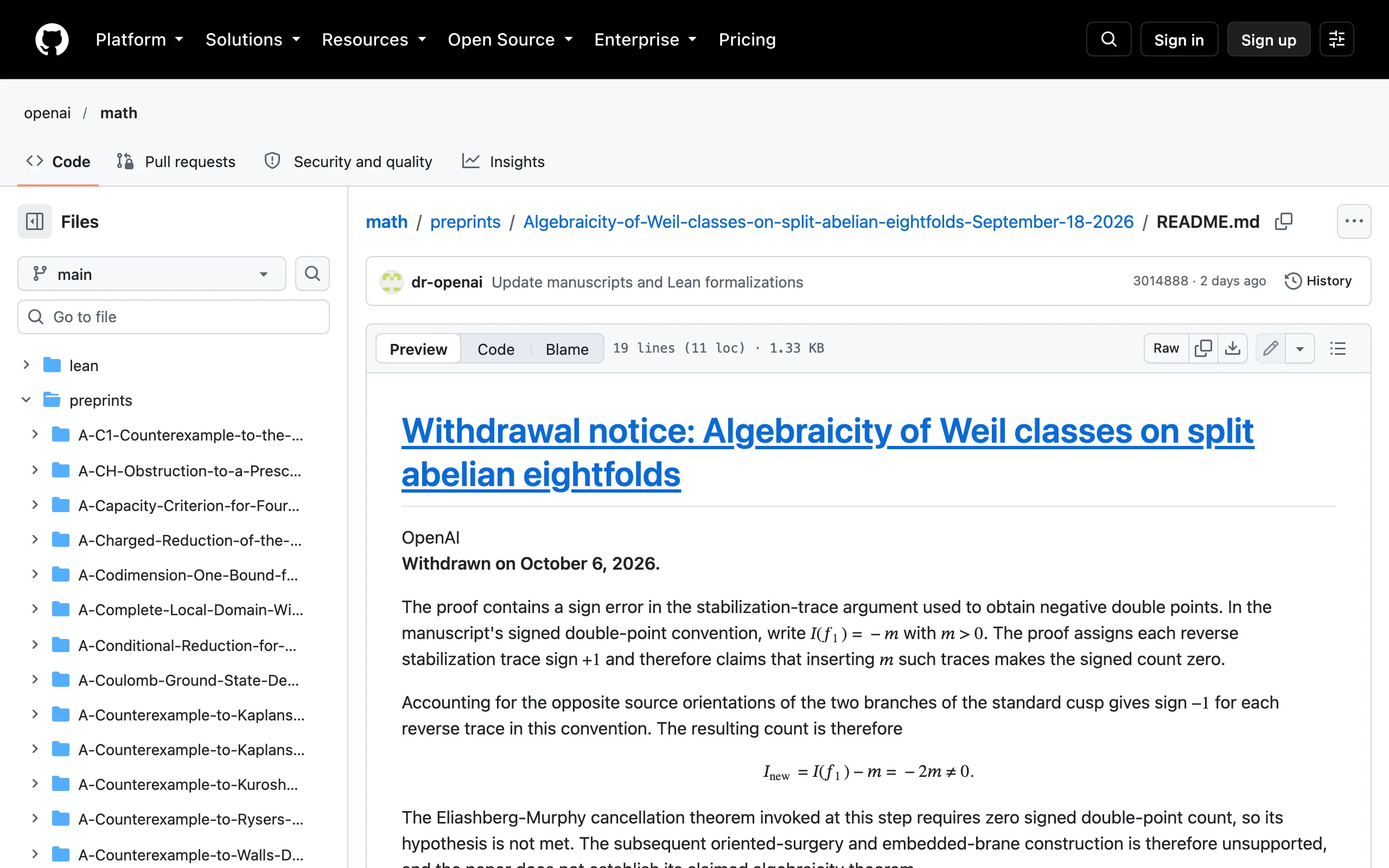
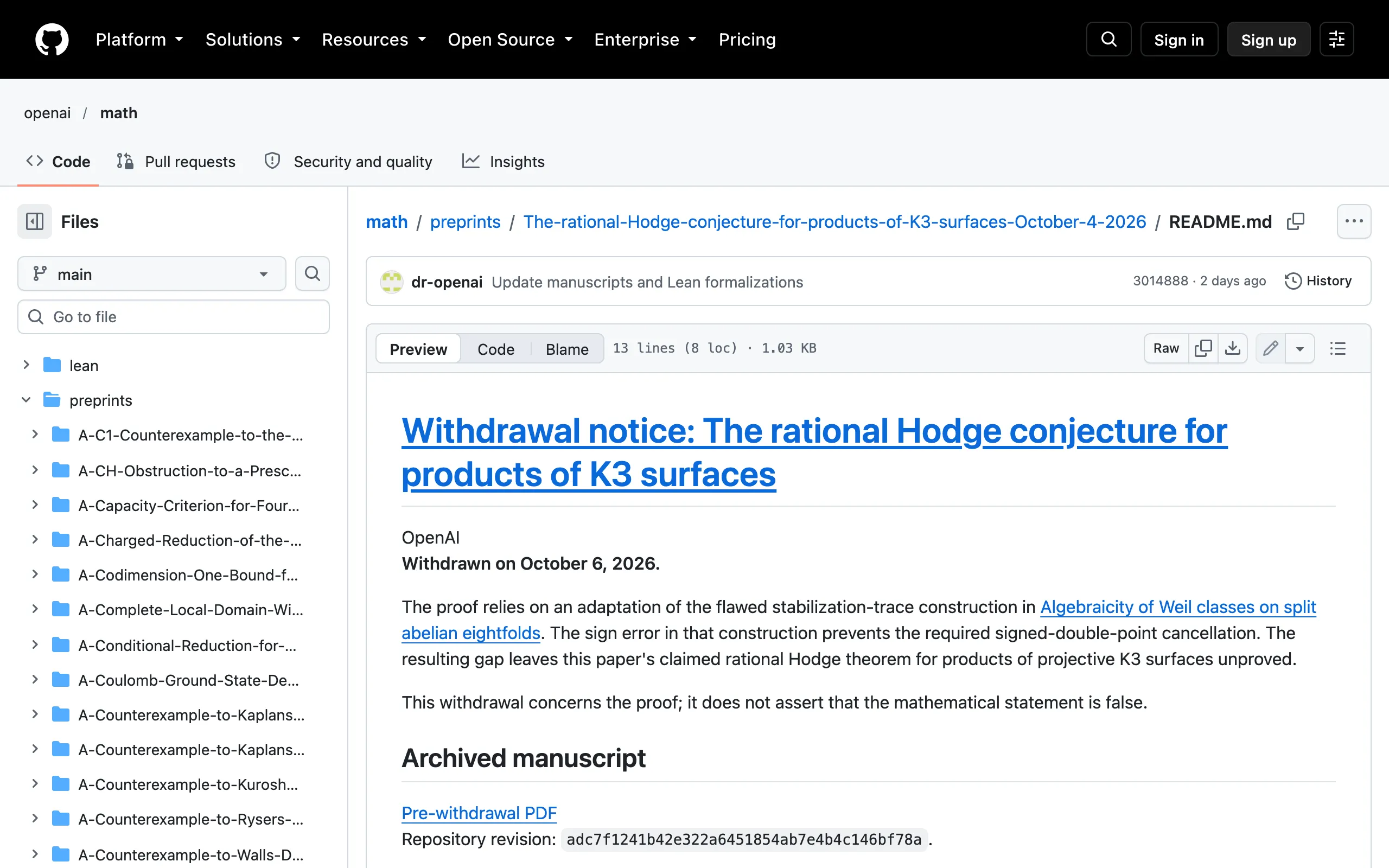
In “Algebraicity of Weil classes on split abelian eightfolds” a sign error invalidates a stabilization-trace cancellation argument and the construction used by two dependent papers. As a result, we have withdrawn the following three manuscripts: / Algebraicity of Weil classes on split abelian eightfolds / Algebraicity of Kuga–Satake Correspondences for K3 Surfaces / The rational Hodge conjecture for products of K3 surfaces — From the October 7 withdrawal entryView official source →
The proof assigns each reverse stabilization trace sign $+1$ and therefore claims that inserting $m$ such traces makes the signed count zero. / Accounting for the opposite source orientations of the two branches of the standard cusp gives sign $-1$ for each reverse trace in this convention. / The Eliashberg-Murphy cancellation theorem invoked at this step requires zero signed double-point count, so its hypothesis is not met. / This withdrawal concerns the proof; it does not assert that the mathematical statement is false. — From the explanation of the errorView official source →
The proof relies on an adaptation of the flawed stabilization-trace construction in Algebraicity of Weil classes on split abelian eightfolds. / The resulting gap leaves this paper's claimed rational Hodge theorem for products of projective K3 surfaces unproved. — From the explanation of the dependencyView official source →
That an error cascaded into three of the OpenAI manuscripts is not surprising, said Alex Townsend, an associate professor of mathematics at Cornell University in Ithaca. He suspects there will be more errors found, he said. / “Given the skepticism of AI in the mathematics community, I think that OpenAI should have announced the manuscripts that were lean verified first,” Townsend told us / A spokesperson for OpenAI told us the company identified the errors during an audit. — From Townsend's comments and the spokesperson's accountView official source →
Lean checks cover 42% of the remaining OpenAI math results
The 719 papers left in the repository have not all been checked. The October 7 update that withdrew the three also revised other papers and added formalizations.
What the October 7 update changed
AI math repository revises 14 preprints and 13 citations
OpenAI revised 14 manuscripts with proof repairs, corrected statements and clearer hypotheses, and updated 13 more so they cite the revised versions. Earlier editions stay available through the version notes in each paper's README, so readers can see what changed.
How much of the AI math work has formal verification
Formal verification here means rewriting a proof in Lean, a programming language whose checker confirms every step mechanically. With six new formalizations, 300 of the 719 top-line results, about 42%, are now formalized. For everything else, people have to read the proofs, and OpenAI's README concedes that some unformalized results could have issues.
A Lean check is strong evidence, but it depends on the checker itself being sound. We covered a case where a kernel bug let a bogus proof through in "Collatz Conjecture Proof: Why Lean Accepted a Fake."
For any updated papers, previously published editions remain accessible through the version notes in their README. / We have revised 14 other manuscripts with proof repairs, corrected statements, clearer hypotheses and dependencies, and one correction to an obsolete citation. / Also, as a consequence of these fixes we updated 13 additional manuscripts to cite the revised editions of companion papers. / We have added an additional 6 formalizations and 5 other additions covering supporting results. This brings the total percentage of top-line results formalized to 300 / 719 = ~42%. — From the October 7 entry on revisions and formalizationsView official source →
This collection includes results at different stages of verification. Not all have accompanying Lean formalizations. / Some of the unformalized results could have issues. We will endeavor to fix any such issues quickly. — From the note on verification statusView official source →
AI math proofs skipped peer review, and verifiers disagree
Peer review, where experts read a paper for errors before a journal publishes it, did not happen before these 722 manuscripts went public. The people involved disagree about whether that was acceptable and who should do the checking now.
Positions on verifying AI-written math proofs
AGMAI: its advice was no endorsement of AI math proofs
AGMAI, the Advisory Group on Mathematics and Artificial Intelligence, is a group of mathematicians that advised OpenAI on how to release the results. In an October 6 statement, it said its role should not be read as a verdict on the results or an endorsement of how OpenAI obtained them. It called the release the beginning of human understanding rather than its completion.
AGMAI also said it is up to the mathematical community to judge whether its recommendations were followed. OpenAI's spokesperson gave Retraction Watch a different emphasis: AGMAI had recommended publishing without waiting for full formalization, and roughly half of the results went out unconfirmed.
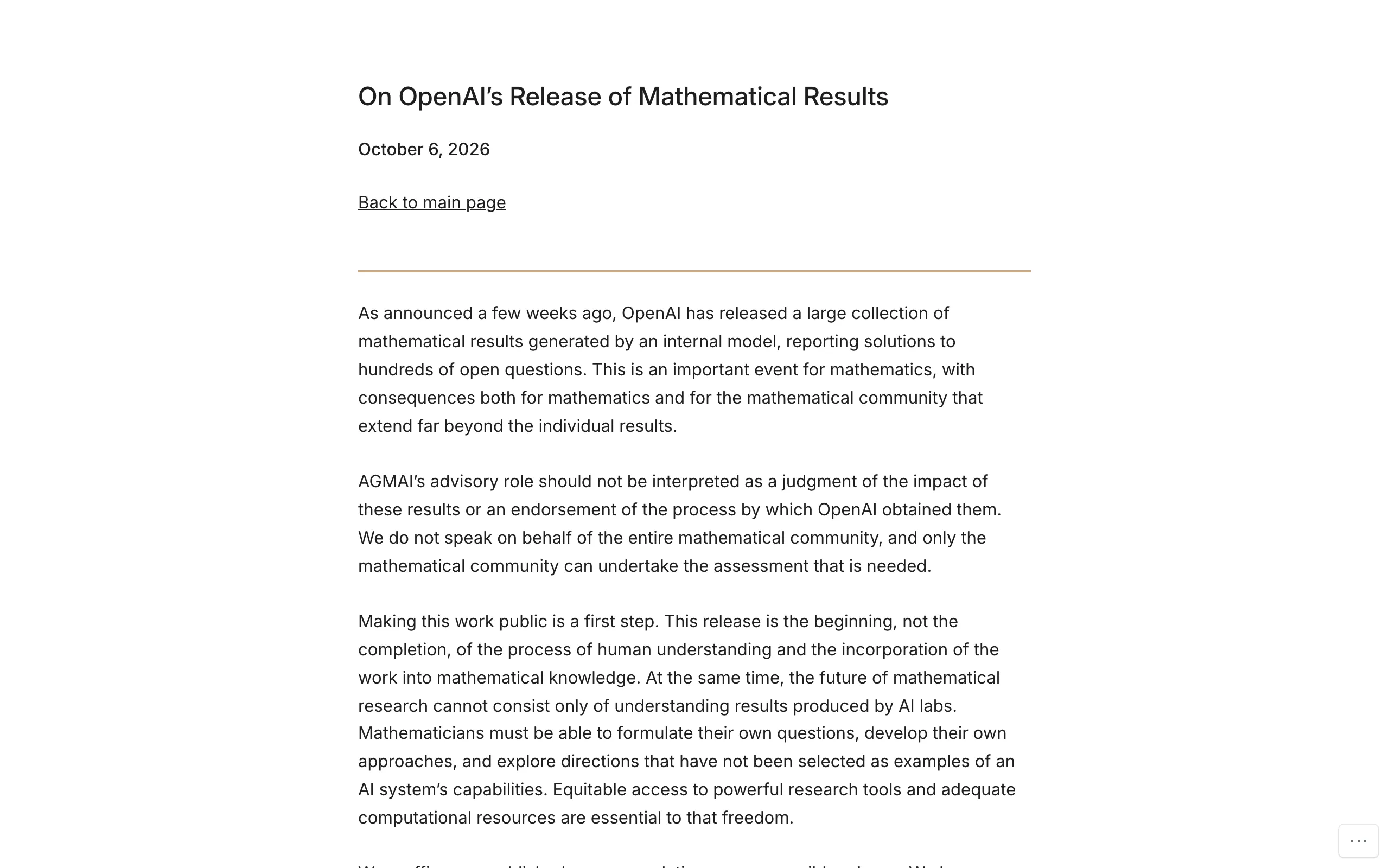
AGMAI’s advisory role should not be interpreted as a judgment of the impact of these results or an endorsement of the process by which OpenAI obtained them. / This release is the beginning, not the completion, of the process of human understanding and the incorporation of the work into mathematical knowledge. / it is ultimately up to the mathematical community to assess the extent to which our recommendations were followed successfully, and whether there are others we should suggest. — From the statement on AGMAI's roleView official source →
The OpenAI spokesperson told us the company’s collaborators at the Advisory Group on Mathematics and Artificial Intelligence recommended releasing the results without waiting for “full formalization,” and that roughly 50% of the results were released unconfirmed. — From the spokesperson's account of the releaseView official source →
Mathematicians split over the AI math preprint release
The Association for Human Mathematics, a group of mathematicians, said on October 7 that releasing more than 700 files at once was a show of power rather than scholarship. It urged mathematicians to stop working with OpenAI.
That is one group's position, not a consensus. Andrew Sutherland, a senior research scientist in mathematics at MIT, credited OpenAI with acting quickly and called the withdrawals the responsible thing to do.
Sutherland also said many mathematicians are unhappy with how OpenAI has behaved, pointing in particular to its September 8 announcement that an AI system had solved the Navier–Stokes problem. In his view, regaining trust will take much more than corrections. For its part, OpenAI's spokesperson said the company will fix errors where it can and withdraw papers where it cannot.
“Where errors are identified, we will work to correct them promptly and withdraw papers if no fixes can be found. / Andrew Sutherland, a senior research scientist in the department of mathematics at the Massachusetts Institute of Technology, said he appreciated OpenAI acting quickly after finding the errors, calling it “the responsible thing to do.” / However, Sutherland emphasized that many mathematicians are “unhappy with how OpenAI has behaved up to this point,” especially in its handling of the Sept. 8 announcement an AI system had solved the Navier-Stokes problem / “I think the withdrawals and corrections will be viewed positively by the mathematics community, but it will take a lot more than that to earn back the trust they have lost,” Sutherland told us. / “Releasing over 700 files at once is not a demonstration of scholarship, but a demonstration of power. We urge mathematicians to discontinue their work with OpenAI and to return to a vision of science that centers human understanding.” — From the spokesperson, Sutherland and the Association for Human MathematicsView official source →
Terence Tao on Math 2.0 beyond unsolved math problems
Fields Medalist Terence Tao posted on Mastodon on October 6, US time. He described "Math 1.0" as a culture that prized being first to solve an open problem. In what he calls "Math 2.0," raw problem solving should count for less, and exposition, community building and opening new directions of study should count for more.
Tao believes AI can help in all of those areas, but says that takes more imagination than pointing an AI agent at a list of open problems. His post was not a response to the withdrawals; it was published before them.
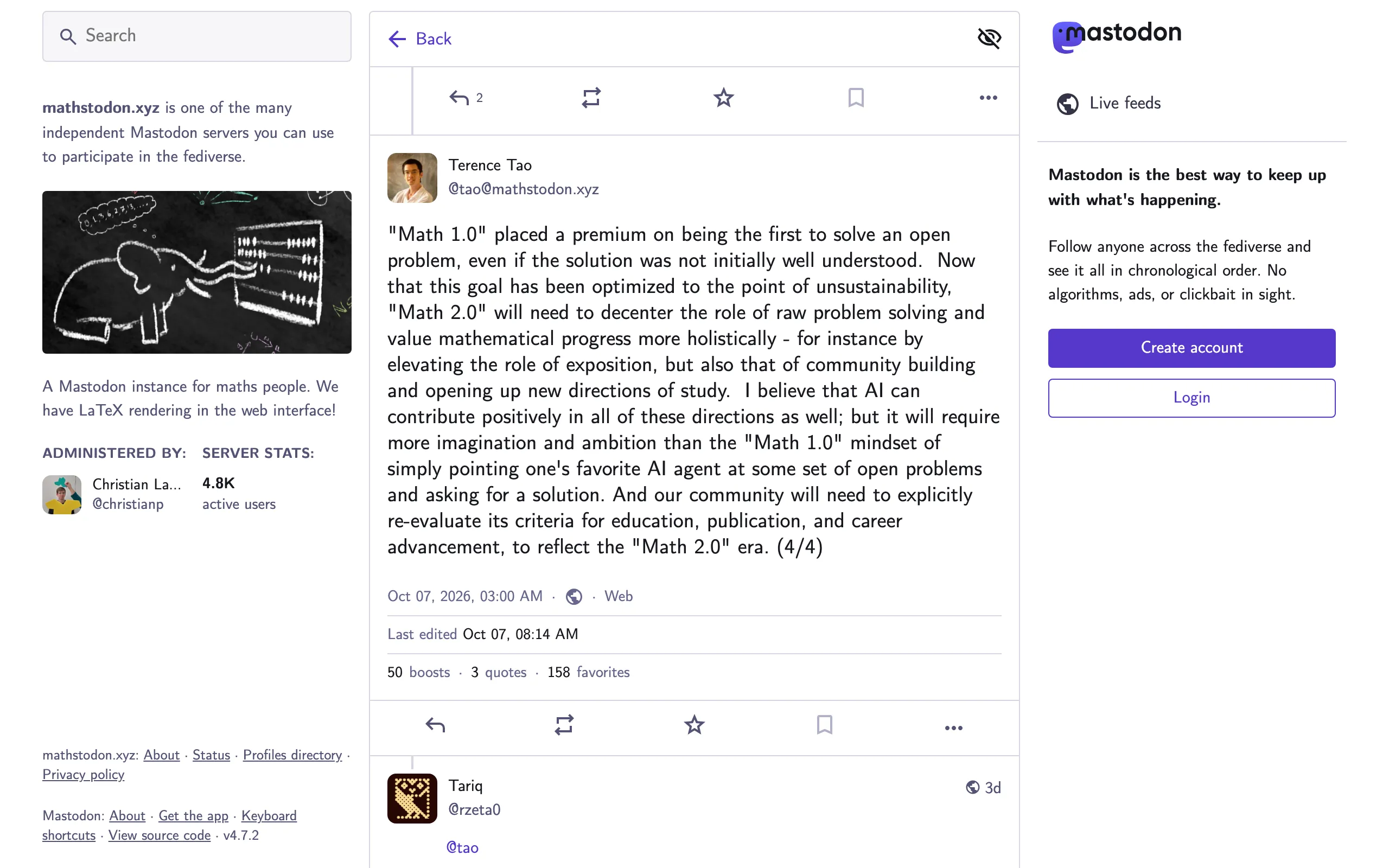
"Math 1.0" placed a premium on being the first to solve an open problem, even if the solution was not initially well understood. Now that this goal has been optimized to the point of unsustainability, "Math 2.0" will need to decenter the role of raw problem solving and value mathematical progress more holistically - for instance by elevating the role of exposition, but also that of community building and opening up new directions of study. / I believe that AI can contribute positively in all of these directions as well; but it will require more imagination and ambition than the "Math 1.0" mindset of simply pointing one's favorite AI agent at some set of open problems and asking for a solution. — From the post contrasting Math 1.0 and Math 2.0View official source →
What the OpenAI math retraction means for AI proofs
Three proofs failed; that does not make the other 719 wrong, and it does not make them right. About 42% are formalized in Lean, and the rest still need people to read them. Because some results build on others, an unchecked error can spread beyond one paper, as this episode showed.
For a case where an AI found a genuine counterexample, see "Jacobian conjecture disproved with Claude Fable 5." OpenAI's earlier Lean-checked work on open problems is covered in "OpenAI Astra: ten math proofs, no release date."
FAQ
- Why did OpenAI withdraw three math papers?
- One proof contained a sign error. In the paper on Weil classes on split abelian eightfolds, a cancellation argument failed, and two papers on K3 surfaces had reused that construction. OpenAI withdrew all three in its October 7 repository update and kept the archived versions online.
- Does the withdrawal mean the Hodge conjecture results are false?
- No. The notices for the eightfolds paper and the K3 products paper say the proofs no longer hold, and that OpenAI is not claiming the mathematical results are false. The claims are simply unproved again until someone repairs the argument or finds a different proof.
- How many of OpenAI's AI math results have been verified?
- After the October 7 update, 300 of the 719 remaining top-line results, about 42%, have Lean formalizations. The rest rely on human reading, and OpenAI's README says some of the unformalized results could have issues.
Related articles
 OpenAI says AI refuted Exponential Time HypothesisOpenAI says an internal AI refuted the Exponential Time Hypothesis. Two of ETH's original proposers lead the review, and Lean verified only a weaker bound.
 OpenAI Astra: ten math proofs, no release dateOpenAI Astra, an internal version of its next major model, resolved or advanced ten open math problems. Lean 4 proofs are on GitHub; no release date is named.
 OpenAI, ServiceNow expand deal with ChatGPT pluginOpenAI and ServiceNow expanded their deal on Oct 28, 2026. A ServiceNow MCP plugin for ChatGPT is live now; Codex, security and voice tools follow in 2027.
 AI crawler training opt-out in one robots.txt ruleAI crawler training opt-out now takes one robots.txt rule. OpenAI, Google and Microsoft will honor it, Microsoft from Feb. 1, 2027. Until then, name each bot.