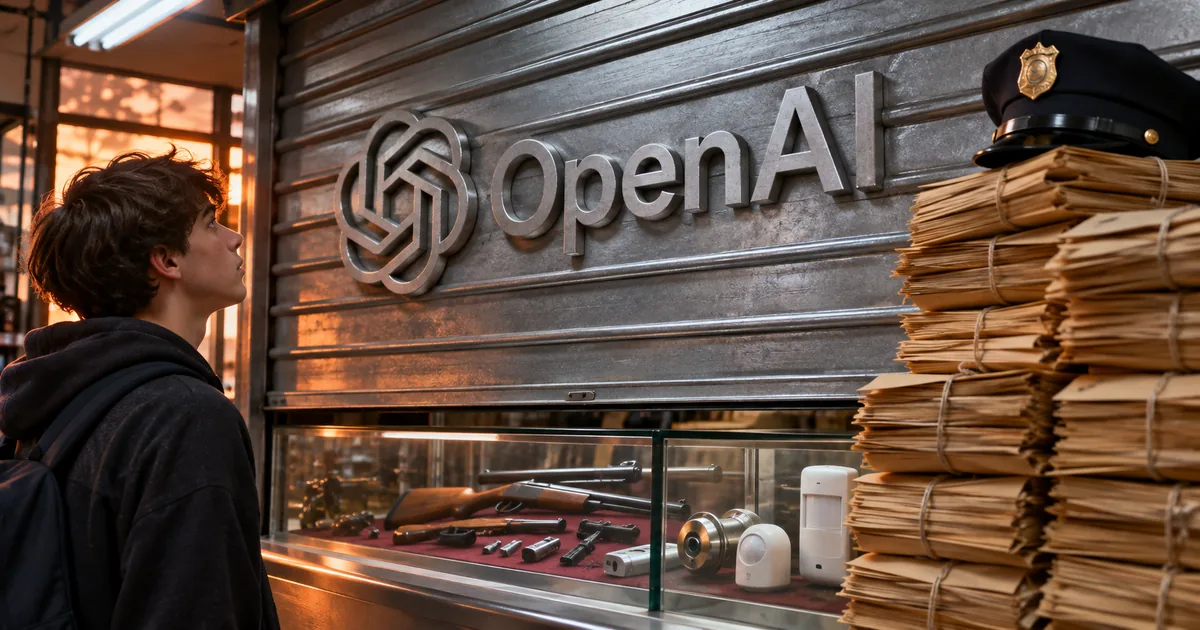
Teens get no practical weapons details, even without violent intent
The change was announced on October 30, 2026, starts rolling out over the next few weeks, and covers every user whom age prediction places in the under-18 experience, even when a prompt looks harmless. OpenAI paired the new limits with a commitment to publish a Community Safety Report.
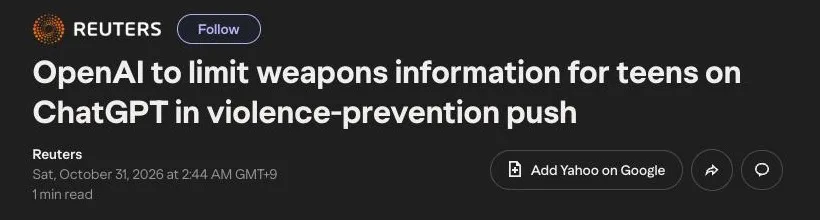
Reuters framed the announcement as part of a wider debate over how chatbots can harm young people and what AI companies should do to catch threats. Reuters also pointed to OpenAI's first report on teen use, released earlier in October, which put average teen time on ChatGPT at under 15 minutes a day.
Weapons and security systems are both covered
OpenAI already barred help with planning violence and limited help for teens trying to find or obtain weapons, and it now also restricts practical details that could be misused for violence. The rule covers two kinds of information: weapons and security systems. OpenAI describes the change as an extension of protections it already had, not a new policy from scratch.
Teens can still get help preventing violence
Teens can keep using ChatGPT to help prevent and de-escalate violence, seek support and reach a trusted adult. Only information that could be misused to carry out violence is limited. Learning to recognize warning signs and to prevent future violence stays open to users of every age.
"We’re extending those protections to restrict practical information about weapons and security systems that could be misused to facilitate violence, even when there’s no sign of violent intent."/"Teens can still use ChatGPT to help prevent and de-escalate violence, seek support, and connect with a trusted adult."/"The safeguards detailed here will begin rolling out in the next few weeks and we will continue to refine them."— from OpenAIView official source →
"The move comes as AI companies face growing scrutiny over the risks chatbots pose to young users and the companies' role in detecting threats of harm."— from ReutersView official source →
Age prediction keeps checking while people use ChatGPT
Because the check repeats during use instead of happening once at sign-up, an account can move into the under-18 experience mid-use, and adults placed there by mistake can confirm their age through Persona. Age prediction estimates whether a user is under or over 18 from signals such as behavior patterns. OpenAI launched it in 2025 and has now strengthened it to keep weighing new signals as people use ChatGPT.
The new weapons limits apply to the users it places in the under-18 experience (related: ChatGPT for Teens: Age Prediction and Study Mode). OpenAI says the Persona check is fast, protects privacy and is available at any time.
"We strengthened our age prediction system to continually assess new signals as people use ChatGPT and move teens into the under 18 experience when appropriate."/"Users who are incorrectly placed in the under 18 experience will always have a fast, privacy-protective way to confirm they are adults and have additional teen protections removed through Persona, our age verification partner."— from OpenAIView official source →
Chats fixated on violence will end automatically for everyone
When a conversation shows someone fixating on violence or on seriously harming another person, ChatGPT will end it regardless of age, and warning signs in recent chats will now make its answers more cautious. OpenAI is building these automated interventions with mental health and violence prevention experts. Ending the chat is meant to break the pattern in the moment.
A request that looks ordinary can mean something else after an earlier conversation. In May, OpenAI explained that ChatGPT keeps short, factual summaries of earlier warning signs so it can answer more carefully in a later chat. Now, when recent chats show warning signs of possible violence, it is also more conservative with information that could be misused.
Repeated endings can pause an account
An account whose chats ChatGPT ends several times over a fixation on violence may be paused, and accounts found to break the rules on violent activity are banned. One ended chat does not trigger a pause by itself. Bans are not new either: OpenAI already bans accounts it finds have broken its rules on violent activity.
Parents may soon hear about paused teen accounts
OpenAI is working on alerts for parents with linked accounts when a teen account is paused for repeatedly discussing violence. Parental controls let a parent link their ChatGPT account to a teen's and manage safety settings together.
Linked parents can already get safety alerts when trained reviewers spot a serious self-harm concern or behaviors tied to disordered eating. Since July, they are also told when a teen account is deactivated for breaking the usage policies on violence.
"When a conversation shows signs that someone is fixating on violence or the idea of seriously harming another person, ChatGPT will be able to automatically end the chat to interrupt that pattern in the moment."/"If ChatGPT ends multiple chats for that reason, we may temporarily pause the account."/"We are working to introduce notifications for parents if we pause their teen’s account for repeatedly discussing violence, as detailed above."— from OpenAIView official source →
Details on past mass attacks are now limited for adults too
ChatGPT will hold back the weapons, equipment, sourcing and scale-of-harm details of past mass attacks even when they are available elsewhere online, whatever the user's age or reason for asking. Comparisons of the scale of harm are on the list because they could add to an attacker's notoriety.
Asking what happened, or how victims and communities were affected, still works. So does learning to recognize warning signs and prevent future violence.
"But we’re tightening our policies to restrict reconstructions of past mass attacks, including details about the weapons and equipment used and how they were obtained, and detailed comparisons on scale of harm that could amplify an attacker’s notoriety."/"These limits apply regardless of a user’s age or reason for asking."— from OpenAIView official source →
OpenAI made over 200 law enforcement referrals in Q3 2026
The referrals concerned imminent threats of violence, difficult cases were assessed with mental health and behavioral experts, and OpenAI says the referrals helped disrupt violent plots. OpenAI says AI companies have a distinct role alongside police, families, mental health professionals and policymakers. It also commits to working directly with the people and agencies best placed to act in the real world.
A Community Safety Report arrives in early 2027
The report will explain how OpenAI trains its systems to detect and respond to safety issues, with anonymized examples, new mitigations and supporting data, starting with the second half of 2026. The first edition comes out in early 2027, and new editions follow every six months. It will also describe policy changes and how well the safeguards are working.
"Our work includes bringing imminent threats of violence to the attention of law enforcement, and we made over 200 law enforcement referrals in Q3 2026."/"We will publish our first report in early 2027, covering the second half of 2026, with updates every six months thereafter."— from OpenAIView official source →
Only linked parents will hear when a teen account is paused
Teen limits need no setup from parents because age prediction applies them, but alerts reach only parents who linked accounts through parental controls, both the deactivation alerts in place since July and the pause alerts still in the works. The weapons limits apply without anyone turning on a setting.
Alerts work the other way around. Without a linked account, a parent will not hear that a teen account was deactivated, and the planned alerts for paused accounts are set to reach linked parents only.
FAQ
- What if ChatGPT wrongly treats me as under 18?
- Confirm your age through Persona, OpenAI's age verification partner. Once you do, the extra teen protections are removed, and you can do it at any time.
- Can I still ask ChatGPT about past mass attacks?
- Yes. You can still ask what happened and how victims and communities were affected. ChatGPT now gives fewer details about the weapons used, how they were obtained and comparisons of the scale of harm.
- When do the new limits start?
- OpenAI said on October 30, 2026 that the safeguards begin rolling out over the next few weeks and will keep being refined after that.
Related articles
 OpenAI, ServiceNow expand deal with ChatGPT pluginOpenAI and ServiceNow expanded their deal on Oct 28, 2026. A ServiceNow MCP plugin for ChatGPT is live now; Codex, security and voice tools follow in 2027.
 ChatGPT and Codex usage limits merge in DecemberFrom December, Plus, Pro and Business plans will share one token-based allowance across ChatGPT and Codex. Instant chat won't count, and no start date is set.
 ChatGPT now works with iCloud Mail and CalendarOpenAI added iCloud Mail and Calendar plugins to ChatGPT on Oct 27 for all plans. You connect with an Apple app-specific password that outlives a disconnect.
 ChatGPT ads add 26 countries, reaching 89 in totalOpenAI added 26 countries to ChatGPT Ads on October 21, for 89 in total, as advertisers topped 100,000. Ads show only on the Free and Go plans.