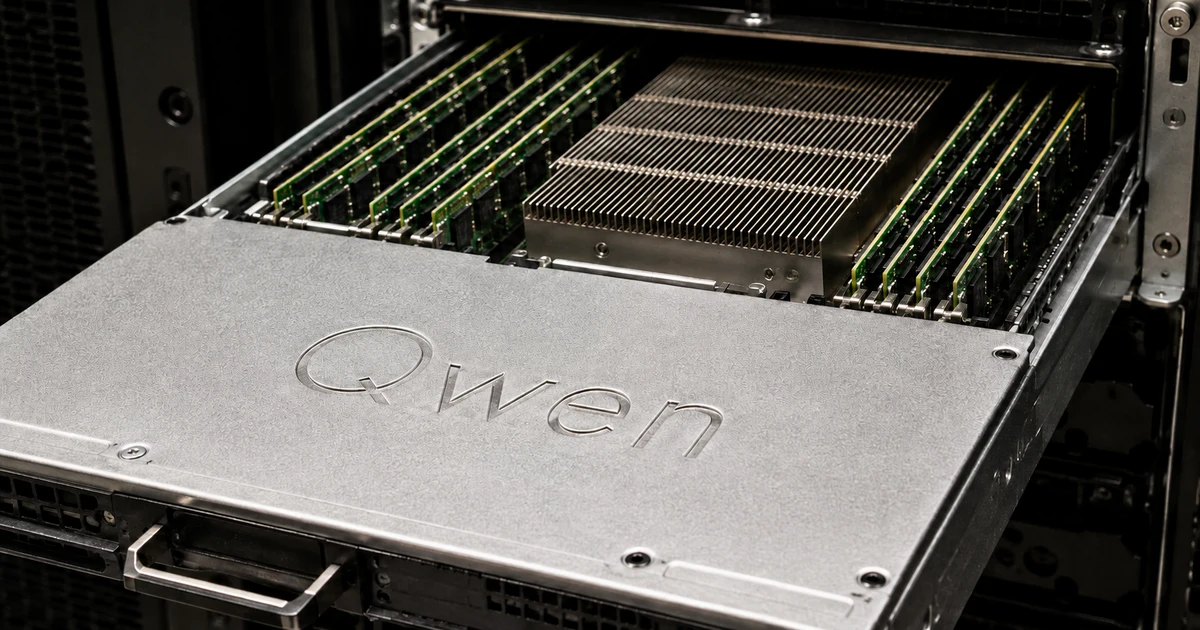
Qwen4 architecture preview with sparse attention: 125B, 6B active
Active parameters are the share of a model's weights that take part in handling each token. Qwen3.8-Flash-Next holds 125B parameters and activates 6B of them per token.
Two further blocks sit outside that count. One is 51B of n-gram embedding, a lookup table keyed by short runs of tokens. The other is 4B of MTP, short for multi-token prediction.
Configuration from the model card
| Item | Value |
|---|---|
| Total parameters | 125B, 6B activated |
| Additional parameters | 51B n-gram embedding, 4B MTP |
| Hidden dimension | 2560 |
| Layers | 48 |
| N-gram embedding | 20,000,000 entries, bigrams and trigrams at layer 2 |
| Experts | 512, with 10 routed plus 1 shared active |
It is a 48-layer model with 512 experts, and each token goes to 10 routed experts plus 1 shared expert. The card lists the type as a causal language model with a vision encoder.
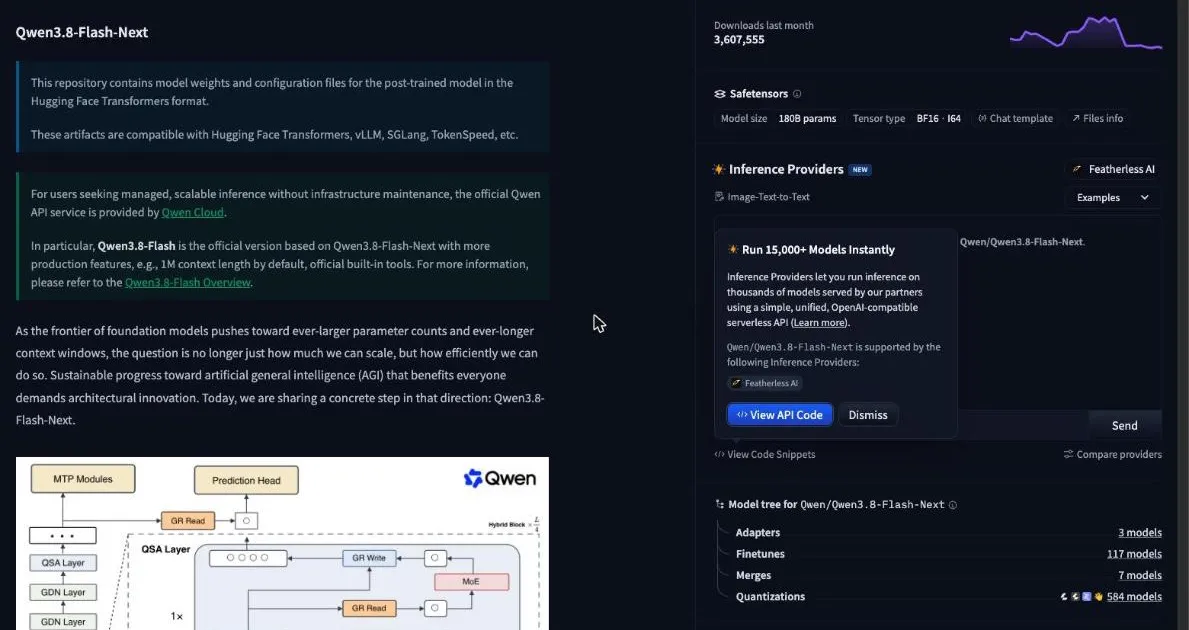
"Type: Causal Language Model with Vision Encoder"/"Number of Parameters: 125B with 6B activated, plus 51B n-gram embedding and 4B MTP"/"Hidden Dimension: 2560"/"Number of Layers: 48"/"N-gram Embedding: 20,000,000 (bigrams/trigrams at layer 2)"/"Number of Experts: 512"/"Number of Activated Experts: 10 Routed + 1 Shared"(Model Overview section)View official source →
Sparse attention at micro-block level in the Qwen4 architecture
Attention is the step where a model looks back over the text so far. Sparse attention looks at only part of it. Qwen's card names four changes that make up the new design:
- Hybrid attention. Gated DeltaNet is now paired with Qwen Sparse Attention (QSA), replacing the earlier pairing of Gated DeltaNet and Gated Attention.
- Gated Residual. A read gate and a write gate control the information flowing through widened residual streams.
- N-gram Embedding. Parameters scale through lookups of short token sequences.
- Training recipe. The Muon and AdamW optimizers are applied to different categories of weights.
Of the four, QSA works on micro-blocks rather than on single tokens. Qwen says this cuts long-context latency significantly and calls that a critical gain, since agentic workloads (a model working through many steps on its own) increasingly dominate real-world usage. The latency claim is Qwen's own.
"The Gated DeltaNet and Gated Attention pairing has been reworked into Gated DeltaNet and Qwen Sparse Attention (QSA)."/"Rather than selecting individual tokens for processing, QSA operates at the micro-block level. This cuts long-context latency significantly, a critical gain as agentic workloads increasingly dominate real-world usage."/"The Muon and AdamW optimizers are applied to specific weight categories to maximize efficiency."(Highlights section)View official source →
Qwen4 architecture context: 262,144 tokens with sparse attention
A token is the word fragment a model reads as one unit. Qwen3.8-Flash-Next takes 262,144 tokens natively, and the card says that can be extended to 1,000,000 tokens.
Going past the native length takes a configuration change, and the card advises modifying the rope_parameters setting only when long contexts are actually needed.
Qwen separates the open weights from the product. The hosted Qwen3.8-Flash is the official version built on Qwen3.8-Flash-Next, with the 1M window on by default and official built-in tools. If you want the long window without touching the configuration, start from that version.
"Context Length: 262,144 natively and extensible up to 1,000,000 tokens."/"In particular, Qwen3.8-Flash is the official version based on Qwen3.8-Flash-Next with more production features, e.g., 1M context length by default, official built-in tools."/"We advise modifying the rope_parameters configuration only when processing long contexts is required."(Model Overview, opening and Best Practices sections)View official source →
Sparse attention benchmarks for the Qwen4 architecture preview
The card publishes a comparison table against other models, and it publishes the conditions behind the numbers. Those conditions decide how far the scores can be trusted.
Published scores for Qwen3.8-Flash-Next
| Evaluation | Score |
|---|---|
| DeepSWE 1.1 | 58.7 |
| SWE-bench Pro | 62.5 |
| SWE-bench Multilingual | 81.0 |
| CoWorkBench | 73.9 |
| IFBench | 81.3 |
| GPQA Diamond | 91.7 |
| LiveCodeBench v6 | 91.9 |
The card attaches conditions to four evaluations. Each footnote limits what the number can be compared with:
- DeepSWE 1.1 ran through two harnesses, Claude Code and mini-SWE-agent, and the "Published scores for Qwen3.8-Flash-Next" table reports the higher score of the two. The card adds that Qwen3.8-Flash-Next did best on mini-SWE-agent.
- SWE-bench Pro ran every model on the Claude Code harness at temp 1.0, top_p 0.95 and a 256K window. The exception is Claude-Opus-4.6 (Max), whose officially published score is used. Problematic tasks were corrected, and all baseline models were re-evaluated on that refined version.
- HLE, which has no row in the card's comparison table, was judged by GPT-4o.
- CoWorkBench is an in-house benchmark for long-horizon office and productivity agent tasks across computer science, finance, law, medicine and other domains.
None of this makes the scores wrong. It does mean they are Qwen's results under Qwen's settings. A figure from another lab that used a different harness or grader would rest on different conditions, so read these scores as claims about this model, not as a ranking against others.
"DeepSWE 1.1: evaluated with the Claude Code and mini-SWE-agent harnesses, temp=1.0, top_p=0.95, 256K context window. We report the highest score across the two harnesses; notably, Qwen3.8-Flash-Next performs best on mini-SWE-agent."/"SWE-bench Pro: except for Claude-Opus-4.6 (Max), for which we report the officially published score, all models are evaluated with the Claude Code harness, temp=1.0, top_p=0.95, 256K context window. Problematic tasks were corrected and all baseline models were re-evaluated on the refined benchmark."/"CoWorkBench: an in-house cowork benchmark for evaluating long-horizon office and productivity agent tasks across computer science, finance, law, medical and other productivity domains."/"HLE: judged by GPT-4o."(Benchmark Results footnotes)View official source →
Open weights: Qwen4 architecture and sparse attention preview
Qwen released the weights and configuration files in the Hugging Face Transformers format. The card shows the license as qwen-community-1.0 and lists Transformers, vLLM, SGLang and TokenSpeed as compatible frameworks.
The card frames the release as a preview, not a finished model. It describes an experimental preview of the architecture that will underpin Qwen4, and it welcomes feedback as Qwen builds what comes next.
For the rest of the series, see Qwen3.8 Open Weights: What You Actually Get. Memory needs for Qwen3.8-27B are covered in Qwen3.8-27B VRAM: 7GB to 56GB by Quant Level, and the choice of quantized files is covered in Unsloth GGUF Dynamic 3.0: Where Small Quants Break.
"This repository contains model weights and configuration files for the post-trained model in the Hugging Face Transformers format."/"These artifacts are compatible with Hugging Face Transformers, vLLM, SGLang, TokenSpeed, etc."/"License: qwen-community-1.0"/"This experimental preview of the architecture that will underpin Qwen4 is built around a fundamental rethinking of how the core components of modern large language models (LLMs) interact at scale."/"We are excited to embark on this next chapter with you and welcome your feedback as we build what comes next."(Model card header and opening)View official source →
FAQ
- How big is Qwen 3.8 Flash Next?
- It holds 125B parameters and activates 6B of them per token, alongside a separate 51B of n-gram embedding and 4B of multi-token prediction. It is a causal language model with a vision encoder.
- How much context does it take?
- 262,144 tokens natively, and up to 1,000,000 when extended. The hosted production version, Qwen3.8-Flash, ships with the million-token window enabled by default.
- Are the benchmark numbers comparable to other labs?
- Not directly. Qwen reports the better of two harnesses on DeepSWE 1.1, ran SWE-bench Pro on a corrected version of the benchmark, had GPT-4o grade HLE, and used an in-house benchmark for CoWorkBench.
Related articles
 Apple Intelligence launches in China with QwenApple Intelligence comes to iPhones in China with iOS 27.3 in December. Alibaba's Qwen handles some Siri and Writing Tools requests, but Siri AI is left out.
 Wan 3.0 API: 30-Second Video from $0.05 a SecondAlibaba's Wan 3.0 makes up to 30 seconds of video in one pass and reads PPT, PDF and spreadsheet files as input. API pricing runs $0.05 to $0.20 per second.
 Qwen Downloads: Checking the 3 Billion FigureQwen downloads passed 3 billion in six months, Bloomberg reports. Hugging Face's own report counts 2,045M on its Hub, a different window and scope.
 Qwen TTS: Audio 3.0 Flash vs Plus, API PricingQwen TTS, shipped as Qwen-Audio-3.0-TTS, comes in Flash and Plus across 16 languages. What its benchmarks mean, how cloning works, and what the API costs.