What is Sakana Aquarium?
Sakana Aquarium is an enterprise platform from Sakana AI for building, running and operating AI agents. An AI agent is an AI system that, given a goal, plans the steps itself and uses tools to carry them out.
Aquarium gives those agents a shared, structured view of a company's knowledge and rules, then lets them check information, make a judgment and act. It is a platform, not a new model.
Sakana AI announced it on October 23, 2026
Sakana AI, the Tokyo AI lab, published the announcement on October 23, 2026. Both the blog post and the platform page are in Japanese only, so English readers have so far relied on secondary coverage. The company's earlier releases include Fugu, a system that combines several AI models to answer one request (related: Sakana Fugu Ultra is not always the best Fugu).
The announcement starts from one premise: every organization makes decisions on its own grounds and through its own steps. Aquarium is meant to turn that organization-specific context into a form an AI can work with.
The name refers to many fish in one tank
Sakana AI named the platform after the image of many fish swimming together in one well-kept tank. The fish are the agents. Other agents can reuse the data connections and ontology a company has already set up, so it can launch one agent per task and manage them all on the same platform.
"整備したデータとオントロジーは別のエージェントでもそのまま使えるため、オペレーションごとのエージェントを素早く立ち上げ、同じ基盤でまとめて管理できます。多くの魚がひとつの水槽で整えられた環境のもとに泳ぐ姿になぞらえ、「Aquarium(水族館)」と名付けました。" — Sakana AIView official source →
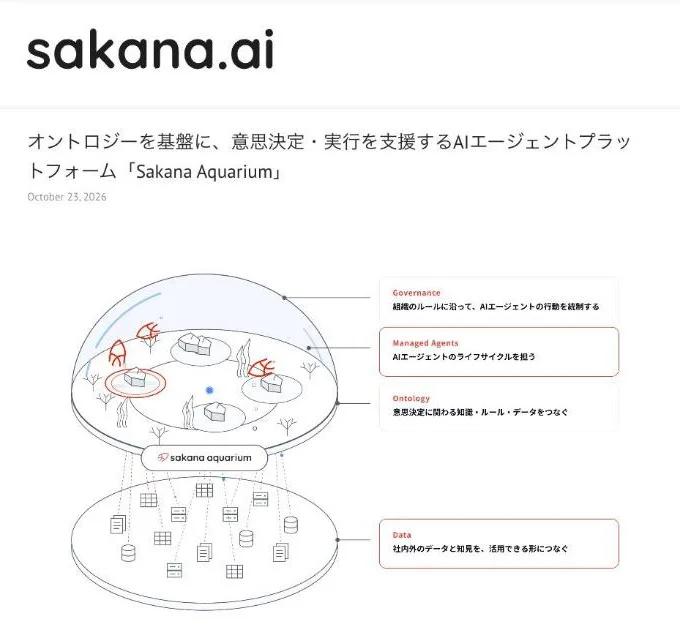
Aquarium runs on three layers
The three layers of Sakana Aquarium
| Layer | Role | Main functions |
|---|---|---|
| Ontology | Defines what the data means | Organizes knowledge, rules and data with their meanings and relationships, and links existing sources in place |
| Governance | Controls what agents may do | Sets access rights and approvals before execution, and records everything from the reasoning to the result |
| Managed Agents | Runs the work | Deploys agents from workflows and manages them from creation through operation |
Aquarium is built from three layers: the ontology prepares the facts, Managed Agents carries out the work, and governance sets the limits. "The three layers of Sakana Aquarium" summarizes the role of each. The platform page also shows a fourth layer, Data, underneath them, which brings internal and external data and know-how together in a usable form.
The ontology links data without moving it
In Aquarium, the ontology is a structured model of the knowledge, rules and data behind a company's decisions, including what each item means and how the items relate. Agents use it to make judgments and run simulations.
Tables, Office documents and existing databases stay in the systems where they are stored. Aquarium links them to the ontology, and Sakana AI designs the connection and sync method for each customer's data platform. When a connected source changes, the ontology picks up the change, and agents act on the updated state instead of an old copy.
Governance sets permissions, approvals and audit logs
Governance is the layer that controls the data, the ontology and the agents. It covers four things:
- Access rights that decide who can use which data
- Approvals a person must give before an agent executes
- A record of each run, from the basis for a judgment to the final result
- Monitoring of execution speed, accuracy and model usage
Because every step is recorded, a team can trace what an agent looked at, what it decided, who approved it and what happened. Sakana AI expects companies to use those records to revise their procedures.
Managed Agents deploys workflows written in YAML
Managed Agents is the layer where agents carry out tasks using the information in the ontology. A team writes a workflow from four kinds of steps, and that workflow alone is enough to deploy the agent into live use:
- Look up information
- Let the AI make a judgment
- Call a function, a prepared piece of code that performs an action
- Ask a person for approval
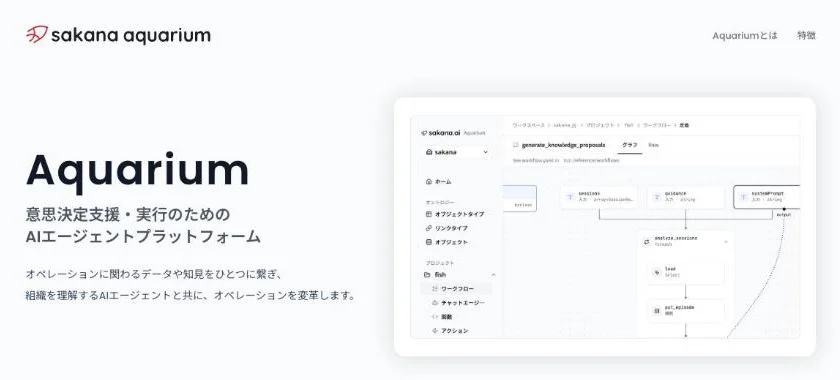
The platform page shows this under the heading "Workflow as YAML." YAML is a plain-text format often used for configuration files.
In the example, a supplier's reply comes in, a load_reply step reads it, an analyze step has the agent judge it, and an approve step waits for a person before execution. Managed Agents also manages each agent's lifecycle, from creation through operation.
"Managed Agents(エージェント実行基盤):オントロジー上の情報をもとに、AIエージェントがタスクを実行します。情報の参照、AIによる判断、関数の実行、人の承認をワークフローとして記述するだけでデプロイでき、エージェントのライフサイクル全体を管理します。" — Sakana AIView official source →
How Aquarium relates to Palantir's ontology
How Sakana AI and Palantir each describe their ontology
| Point | Sakana Aquarium | Palantir |
|---|---|---|
| What the ontology models | Knowledge, rules and data behind decisions, with meanings and relationships | An enterprise's decisions, not just its data |
| Parts named alongside it | Governance and Managed Agents | Data, logic, action and security |
| Who wrote this | Sakana AI's announcement | Palantir's documentation |
Aquarium uses the same central idea as Palantir: an ontology that models how a business makes decisions, which agents then work from. "How Sakana AI and Palantir each describe their ontology" puts each company's own description side by side. Sakana AI itself does not compare Aquarium with Palantir or any other product.
Both model decisions, not only data
Palantir calls its Ontology the system at the heart of its architecture and says it represents an enterprise's decisions, not simply the data. Sakana AI also describes Aquarium's ontology in terms of decisions. It holds the knowledge, rules and data that support decisions, and agents make their judgments from it.
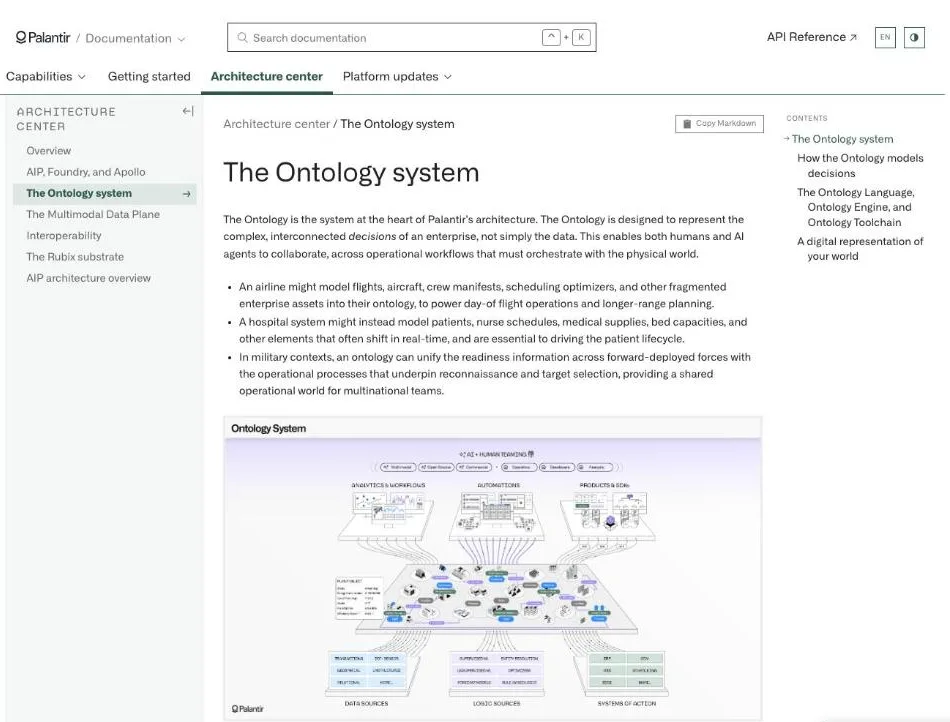
The pieces around the ontology are named differently. Palantir describes decisions as an integration of data, logic, action and security. Aquarium splits the same ground into an execution layer (Managed Agents) and a control layer (governance).
"The Ontology is designed to represent the complex, interconnected decisions of an enterprise, not simply the data." — PalantirView official source →
Former Palantir and Snowflake engineers help build it
Some of the people building Aquarium previously worked on data platforms and data governance at Palantir, Snowflake, Microsoft, AWS and other companies. They work alongside Sakana AI's own engineers who have handled AI deployments for clients. Sakana AI has not said how Aquarium differs from Palantir's products in practice.
Why Sakana AI built Aquarium after its finance projects
Finance projects Sakana AI cites as earlier deployment work
| Partner | Project |
|---|---|
| MUFG Bank | AI lending expert |
| SMBC Group | Automated proposal drafting |
| Daiwa Securities Group | Joint development |
Aquarium grew out of Sakana AI's work putting AI into financial institutions and other fields that demand accuracy and accountability. Since its founding, Sakana AI has researched ways to make AI more capable without simply making models bigger: inference-time scaling, cooperation between several models and self-improvement. Alongside that research, it took on client projects, including the three in "Finance projects Sakana AI cites as earlier deployment work".
Every project repeated the same setup work
In every one of those projects, Sakana AI's team had to connect the data and organize terms and decision criteria again from scratch. That work fell to forward deployed engineers (FDEs), engineers who go on-site with a client to understand its data and procedures. They designed the workflows and handled evaluation and accuracy tuning.
Aquarium packages that repeated setup into a platform the whole organization can share. The design choice that lets one ontology serve many agents is the direct answer to this problem.
"Aquariumは、こうした作業を組織の中で共通して使える基盤にまとめたものです。" — Sakana AIView official source →
MUFG, SMBC and Daiwa are not Aquarium customers
The three finance projects appear in the announcement as Sakana AI's past implementation work, not as Aquarium deployments. A quick read of the announcement could suggest these banks already run Aquarium. The announcement does not say so, and Sakana AI says case studies will be introduced later.
What Sakana AI has not disclosed yet
What Sakana AI has disclosed about access (as of October 29, 2026)
| Question | Official answer |
|---|---|
| Price | Not published |
| General availability date | Not published |
| AI models used | Not published |
| Named Aquarium customers | None yet |
| How to start | Consultation through the platform page |
As of October 29, 2026, Sakana AI has not published Aquarium's price, a general availability date, the AI models it runs on or any named customer. "What Sakana AI has disclosed about access (as of October 29, 2026)" lists what the two official pages do and do not say.
No pricing or release date has been announced
Neither the announcement nor the platform page gives a price or a date when anyone can sign up. The only route the pages offer is a consultation request. That points to a sales-led product, with each deployment scoped together with the customer, rather than self-service.
No word on which AI models it uses
Sakana AI does not say which AI models power Aquarium's agents. The governance layer lets customers monitor model usage, but neither page names a model. They also do not say whether the agents run on Sakana AI's own models or on other vendors' models.
How to get started with Sakana Aquarium
Companies start by sending a consultation request through the contact form on the Sakana Aquarium platform page. Sakana AI says it shapes each consultation around the problem a company wants to solve and its operating conditions. From there, Sakana AI's FDEs build and test the setup together with the customer.
Start with a consultation and one workflow
The rollout begins with one operation and expands across the organization. That matches how the platform is built. The first workflow pays for the data connections and the ontology, and every later agent reuses them.
Two features are still in development
Sakana AI is developing two more capabilities. One takes in corrections and decisions made during daily operation and keeps the ontology and the agents up to date as the organization changes.
The other uses AI to help build the agents themselves. No release timing has been given for either.
"Aquariumは今後も機能の拡充を続けていきます。運用の中で生まれる修正や判断を取り込み、組織の変化に合わせてオントロジーとエージェントを更新し続ける仕組みや、エージェントの構築そのものをAIが支援する仕組みの開発も進めています。" — Sakana AIView official source →
Summary: Sakana Aquarium makes agent setup reusable
Sakana Aquarium is aimed at the preparation that comes before each agent, not at making agents smarter. In its finance projects, Sakana AI connected the data and defined business terms again for every client. Aquarium stores that work in one ontology, governed by one set of rules.
The first workflow pays for the connections and the definitions. Every agent added after it starts from that shared base instead of from zero.
Pricing, availability and the underlying models are still unknown. A team weighing Aquarium can prepare two answers before a consultation: which single workflow to start with, and at which step a person must approve. Those answers are useful on any agent platform, not only this one.
FAQ
- Is Sakana Aquarium available in English?
- Sakana AI has published the announcement and the platform page in Japanese only, as of October 29, 2026. Inquiries go through the contact form on the platform page, and Sakana AI has not said which languages the product itself supports.
- How much does Sakana Aquarium cost?
- Sakana AI has not published a price. Companies describe the problem they want to solve and their operating conditions through the contact form, and deployment is discussed case by case.
- Is Sakana Aquarium the same as Palantir's ontology?
- No. They are separate products from separate companies. Both put an ontology at the center so agents work from defined business meaning, and some of the Aquarium team previously built data platforms at Palantir. Sakana AI does not compare the two.
Related articles
 Sakana Fugu Cyber: 86.9% on CyberGym, How to ApplySakana Fugu Cyber is an orchestration model for cyber defense. Its reported scores are 86.9% on CyberGym and 72.1% on CTI-REALM, and access is review-based.
 Sakana AI API Platform: Fugu with admin controlsSakana AI API Platform entered early access on October 28, 2026, offering Fugu and Fugu Ultra via an OpenAI-compatible API with audit logs and budget caps.
 Sakana Chat's My Fish shows what the AI remembersMy Fish shows what Sakana Chat's memory holds about you. Memory is on by default, opting out of training is separate, and Sakana Chat only works in Japan.
 Sakana AI Signs Japan Defense Deal to Study AISakana AI signed a contract with Japan's Ministry of Defense on July 29, 2026 to study and demonstrate AI for intelligence analysis. Its value is undisclosed.