
What the Sakana API Platform is
Sakana AI's new enterprise platform puts Fugu behind workspaces, roles, audit logs, and budget limits, and it opened for applications on October 28, 2026. The announcement is on Sakana AI's official blog in Japanese and English, and the Early Access program opened the same day.
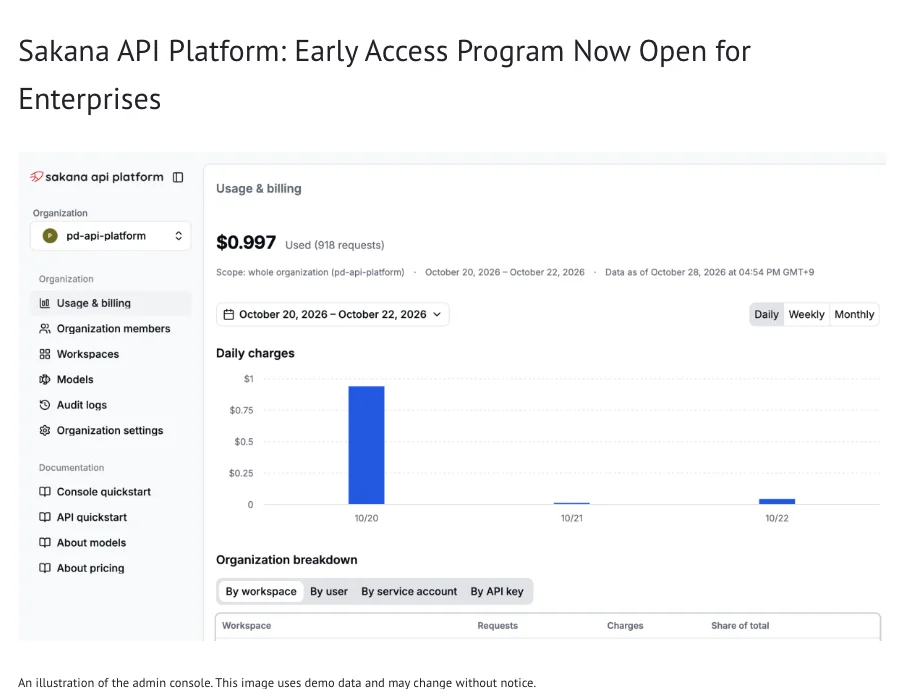
Until now, developers reached Fugu and Namazu through standalone APIs. The new platform keeps the same models but puts them under an organization, so a small team and a large company can run them on one setup. Usage costs and members are tracked per organization and per workspace.
"Until now, the Fugu and Namazu models have been offered as standalone APIs." / "Organizations can manage usage costs and members in one place, by organization and workspace" — from "What is the Sakana API Platform?" and the opening paragraph (locale-specific display)View official source →
Admin controls for workspaces, keys, and spend
The admin features fall into four groups: workspaces, access control and audit logs, data terms, and budget and contracts. The list on Sakana AI's announcement page maps to them as follows.
Admin features listed for Sakana API Platform (Sakana AI blog)
| Group | Features |
|---|---|
| Workspaces | Organization and workspace management, admin console for members, API keys, and usage |
| Access and records | Role-based access control, audit logs with CSV download |
| Data terms | Inputs are not used for training |
| Budget and contracts | Budget limits, invoice payment, MSA and DPA |
Sakana AI says it plans to add more, including finer permission controls at the organization level. The table reflects what was listed at the start of early access.
"We plan to keep expanding these features, including more granular permission controls at the organization level." — from "Key features" (locale-specific display)View official source →
Organizations, workspaces, and the admin console
Admins create workspaces under one organization for each team or environment and see members, API keys, and usage in a single admin console. A workspace is a partition inside the organization with its own settings. Splitting development and production into separate workspaces, for example, keeps each team's request volume and charges apart.
The demo console on the announcement page shows this layout. Its left menu lists Usage and billing, Organization members, Workspaces, Models, and Audit logs, and the usage view breaks charges down by workspace, user, service account, and API key.
"Organization and workspace management, with an admin console (members, API keys, and usage in one place)" / "For management, you can create workspaces under your organization, configure settings for each team or environment, and see how each team is using the platform." — from "Key features" and "What is the Sakana API Platform?" (locale-specific display)View official source →
Role-based access control and CSV audit logs
Each member gets a role that limits what they can do, and the audit log of console activity can be downloaded as a CSV file. Role-based access control means permissions follow the role rather than the individual, so adding a new engineer does not require granting rights one by one.
The CSV export gives security and compliance teams a record they can keep outside the console. The announcement does not list which roles exist.
"Role-based access control" — from "Key features" (locale-specific display)View official source →
Inputs are not used for training
Sakana AI's data handling terms for the platform state that the inputs you send are not used to train its models. For teams that plan to send internal documents or customer data, this condition is part of the terms from the start.
The standalone Namazu API works differently: by default, inputs there may be used for training unless you opt out in the Console settings, as covered in Sakana Namazu API: pricing, setup and EU limits. On the platform, the no-training term appears in the feature list itself.

"Audit logs (CSV download), and data handling terms that state your inputs are not used for training" — from "Key features" (locale-specific display)View official source →
"By default, your inputs may be used to train and improve our models. You can opt out at any time from the Console settings." — from the FAQ (locale-specific display)View official source →
Budget limits, invoices, MSA, and DPA
Admins can cap spending with budget limits, pay by invoice, and sign a master services agreement and a data processing agreement. An MSA sets the general terms of the business relationship, and a DPA sets how the provider processes the data you hand over.
Budget limits put a cap on spending, which helps keep a runaway script from producing a surprise bill. Invoice payment lets finance pay Sakana AI the way it pays other vendors.
"Budget limits, invoice payment, MSA and DPA, and more" — from "Key features" (locale-specific display)View official source →
Fugu and Fugu Ultra now, Namazu and Fugu Max later
Two of the four models named in the announcement are available at launch, and the Japanese-specialized Namazu is not one of them. Fugu and Fugu Ultra come first, and Sakana AI gives no date for Namazu or Fugu Max.
Models on Sakana API Platform and when they arrive (Sakana AI blog)
| Model | What it is | Availability |
|---|---|---|
| Sakana Fugu | Orchestration model (standard) | At launch |
| Sakana Fugu Ultra | Part of the Fugu lineup | At launch |
| Sakana Fugu Max | Part of the Fugu lineup | Later |
| Sakana Namazu | LLM specialized in Japanese | Later |
Fugu is what Sakana AI calls an orchestration foundation model: instead of answering every request alone, it coordinates several frontier models and picks the mix that fits the job. The approach comes from research accepted at ICLR 2026 (Trinity and Conductor), and the lineup has three tiers, of which two are on the platform today. The differences between the tiers are covered in Sakana Fugu Ultra is not always the best Fugu.
Namazu is Sakana AI's LLM specialized in Japanese. Until it joins the platform, teams that need it will keep calling it through its standalone API.
"Sakana Fugu and Sakana Fugu Ultra are available first. Sakana Namazu and Sakana Fugu Max will follow." / "Sakana Fugu is an orchestration foundation model that orchestrates multiple frontier models." / "It builds on research accepted at ICLR 2026 (Trinity and Conductor). The lineup has three models: Fugu (standard), Fugu Ultra, and Fugu Max." / "Sakana Namazu is an LLM specialized in Japanese." — from "What is the Sakana API Platform?" (locale-specific display)View official source →
Moving an OpenAI-compatible app to the platform
Because the API is OpenAI-compatible, an app that already calls an LLM API can move by changing the endpoint rather than rewriting its requests. OpenAI-compatible means the platform accepts requests in the same format as OpenAI's API, so code written with the OpenAI SDK can usually be reused.
What changes when an OpenAI-compatible app moves
Your app's code: request format stays the same
↓
Endpoint and API key: point them at Sakana API Platform
↓
Sakana API Platform: Fugu or Fugu Ultra answers
With OpenAI-compatible APIs in general, that means changing the base URL and the API key, and setting the model name the new provider uses. The announcement does not publish the platform's endpoint URL or model IDs, so those come with access rather than from the blog post.
"The API is OpenAI-compatible: if your applications already call an LLM API, you only need to change the endpoint." — from the opening paragraph (locale-specific display)View official source →
How to apply for early access and what it costs
Access starts with an application on the announcement page, and Sakana AI shares pricing and terms when it contacts each applicant. The announcement's description breaks down into four stages.
From application to access (Sakana AI blog)
Step 1: apply through the link on the announcement page
↓
Step 2: Sakana AI reviews the application
↓
Step 3: Sakana AI contacts you with pricing and terms of use
↓
Step 4: access opens for applicants in turn
Applying does not mean same-day access. Sakana AI admits applicants in turn and has not said how it orders the queue or when general availability begins.
No prices appear on the page, and the announcement does not say whether the platform charges the same as the standalone APIs. Compare the offer with the standalone pricing covered in Sakana Namazu API: pricing, setup and EU limits once you receive it.
"We will offer access to applicants as they become ready, and contact each applicant individually after reviewing their application. Pricing and terms of use will be shared at that time." — from "About Early Access Program" (locale-specific display)View official source →
Standalone Fugu API or Sakana API Platform
The platform does not add new models; it adds the controls a team needs once more than one person is calling Fugu. The models themselves are the same Fugu that the standalone API serves. The difference is workspaces, roles and audit logs, a written no-training term, and budgets with invoicing and contracts, which give organizations the more controlled management the announcement describes.
A single developer testing Fugu can stay on the standalone API. A company that needs shared keys, spending caps, or audit records across departments is the enterprise customer the announcement targets. Three things remain unannounced: pricing, the date of general availability, and when Namazu and Fugu Max arrive.
"Sakana API Platform lets organizations of any size use them under more controlled management, with confidence." — from "What is the Sakana API Platform?" (locale-specific display)View official source →
FAQ
- What is the Sakana API Platform?
- It is an enterprise platform for calling Sakana AI's LLMs through an API with admin features such as workspaces, role-based access control, audit logs, and budget limits. Sakana AI announced it on October 28, 2026 and opened an Early Access program the same day.
- Which models can I use on Sakana API Platform?
- Fugu and Fugu Ultra are available first. Namazu and Fugu Max will be added later, and Sakana AI has not given a date for them.
- How much does Sakana API Platform cost?
- The announcement lists no prices. Sakana AI reviews each application and shares pricing and terms of use when it contacts the applicant.
- Does Sakana AI use my API inputs for training on the platform?
- No. The platform's data handling terms state that inputs are not used for training. This differs from the standalone Namazu API, where inputs may be used for training by default unless you opt out in the Console settings.
Related articles
 Sakana Namazu API: pricing, setup and EU limitsSakana Namazu is Sakana AI's Japanese-tuned build of Kimi K2.6: per-token API pricing, OpenAI-compatible setup, and why it is not offered in the EU or UK.
 Sakana Aquarium: An Enterprise AI Agent PlatformSakana Aquarium is Sakana AI's enterprise AI agent platform, announced Oct. 23, 2026. It maps company data in an ontology and runs agents with human approval.
 Sakana Chat's My Fish shows what the AI remembersMy Fish shows what Sakana Chat's memory holds about you. Memory is on by default, opting out of training is separate, and Sakana Chat only works in Japan.
 Sakana AI Signs Japan Defense Deal to Study AISakana AI signed a contract with Japan's Ministry of Defense on July 29, 2026 to study and demonstrate AI for intelligence analysis. Its value is undisclosed.