Sakana Fugu is one API over a pool of rival models
Each request to Sakana Fugu goes to a team of other companies' models, and one answer comes back. You call it the way you would call any model. Sakana's system then decides which models in its pool work on the request and how they split the job.
That deciding step is called orchestration: a controller picks the models, hands out the sub-tasks, and merges the results. Sakana says Fugu learns to assemble agents, meaning the models in its pool, and to coordinate them through collaboration patterns that are not obvious.
Sakana AI markets Fugu as frontier-level performance without depending on a single vendor. The independence part of that pitch matters when a provider changes its terms, prices or availability under you.
Three models carry the name. Fugu is the everyday default, and Fugu Ultra draws on a deeper pool of agents for hard problems. Fugu Cyber is built for security work and has its own access rules, covered in the access section below.
"Frontier-level performance without single-vendor dependency." / "Fugu learns to dynamically assemble agents from a pool and coordinate them through non-obvious but highly efficient collaboration patterns." (the headline claim and the explanation beneath it) — from the Sakana AI product page, which publishes the English and Japanese originals side by side under one URL(ロケール別表示)View official source →
Fugu Ultra leads 7 of the 12 published benchmarks
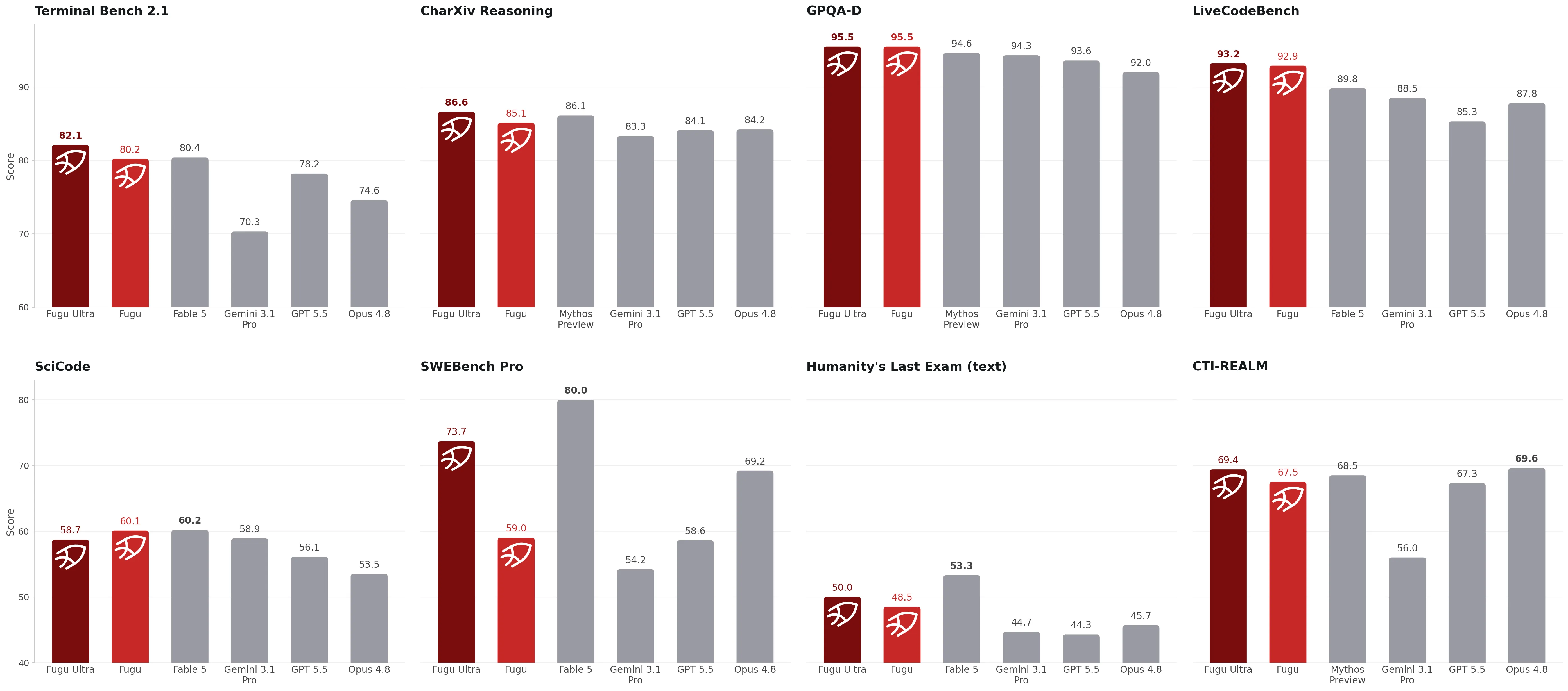
Fugu Ultra holds the top score, or shares it, on 7 of the 12 benchmarks in Sakana's console.(as of September 2026) The comparison also scores Opus 4.8, Gemini 3.1 and GPT-5.5, so each row shows who leads among five systems.
Ultra wins six rows outright: SWE Bench Pro, Terminal Bench 2.1, LiveCodeBench, LiveCodeBench Pro, Humanity's Last Exam and CharXiv Reasoning. It ties a seventh, GPQA Diamond, where it and the standard Fugu both score 95.5. Five rows are left, and the next table lists them next to the seven.
The 12 benchmarks Sakana publishes, and who holds each top score
Ultra holds the top score outright on six rows and ties on a seventh. On the other five, the holder is the standard Fugu three times, GPT-5.5 once and Opus 4.8 once.
| Benchmark | Fugu Ultra | Highest score in the row | Holder |
|---|---|---|---|
| SWE Bench Pro | 73.7 | 73.7 | Fugu Ultra |
| Terminal Bench 2.1 | 82.1 | 82.1 | Fugu Ultra |
| LiveCodeBench | 93.2 | 93.2 | Fugu Ultra |
| LiveCodeBench Pro | 90.8 | 90.8 | Fugu Ultra |
| Humanity's Last Exam | 50.0 | 50.0 | Fugu Ultra |
| CharXiv Reasoning | 86.6 | 86.6 | Fugu Ultra |
| GPQA Diamond | 95.5 | 95.5 | Fugu Ultra and Fugu, tied |
| SciCode | 58.7 | 60.1 | Fugu |
| τ3 Banking | 20.6 | 21.7 | Fugu |
| Long Context Reasoning | 73.3 | 74.7 | Fugu |
| MRCRv2 | 93.6 | 94.8 | GPT-5.5 |
| CTI-REALM | 69.4 | 69.6 | Opus 4.8 |
Two of the five losses go to outside models: GPT-5.5 on MRCRv2, and Opus 4.8 on CTI-REALM by a margin of two tenths of a point. The other three go to the standard Fugu itself, which the next section covers.
On three benchmarks the cheaper Fugu scores higher
On SciCode, τ3 Banking and Long Context Reasoning, the standard Fugu outscores Fugu Ultra. On SciCode the standard Fugu scores 60.1 and Ultra 58.7. On τ3 Banking the scores are 21.7 and 20.6, and on Long Context Reasoning they are 74.7 and 73.3.
Fugu and Fugu Ultra on the three rows where the standard Fugu is ahead
The standard Fugu takes the row at 60.1, and Ultra follows at 58.7.

The standard Fugu scores 21.7 and Ultra scores 20.6.
The standard Fugu reaches 74.7 and Ultra reaches 73.3.
The gaps are no larger than a point and a half, and a benchmark score is not a measurement of your own workload. Still, the direction matters when you pay per token: Sakana's console says Ultra focuses on maximizing performance "for a higher cost", and on these three rows that higher cost comes with a lower score than the standard Fugu's.
"Fugu Ultra coordinates a deeper pool of expert agents to maximize answer quality on hard, high-stakes problems." / "Fugu Ultra focuses on maximizing performance, for a higher cost." (the Fugu Ultra description above the benchmark comparison) — from the Sakana AI consoleView official source →
Fugu Ultra costs $5 in and $30 out per million tokens
A token is a short chunk of text, roughly three-quarters of an English word. Up to 272K tokens of context, Fugu Ultra costs $5 for input and $30 for output per million tokens.(as of September 2026) Cached input, meaning a prompt prefix the service has already processed, costs $0.50 per million, a tenth of the normal input rate.
Past 272K tokens of context, the same three rates become $10 for input, $45 for output and $1.00 for cached input. Input then costs twice as much, and output 1.5 times as much. An agent that keeps appending to its transcript crosses that line without anyone choosing to.
Up to 272K, output costs six times as much as input. A request that sends a long document and gets a short answer is mostly an input bill, while one that writes long code is mostly an output bill. The next section covers a third source, because the rates above also apply to tokens beyond the input you send and the answer you get back.
"Context > 272K" / "Cached input" (the two column headings of the Fugu Ultra token table) — from the Sakana AI consoleView official source →
Orchestration tokens are billed at the same rate
Fugu Ultra and Fugu Cyber bill orchestration tokens at the same rates as input and output. A request to either model uses more than your prompt and the final answer. The orchestration that coordinates the models consumes tokens of its own, and Sakana meters them too.
The response reports those tokens in separate usage fields. One field sums all input tokens used for orchestration, and another counts the output tokens the orchestration produced. Sakana states that they are real token usage outside the input and output totals and are counted in the final price of the request.
That is why an estimate built from two numbers, your prompt and the final answer, comes in low. How low the estimate falls is visible only in the usage fields of your own requests.
Ultra responses carry these fields, so a trial run gives you the data for a correct estimate. The fix is to price from the full usage record: add the orchestration input to your input and the orchestration output to your output, then multiply by the rates in the previous section.
"they represent real token usage outside of the input and output tokens and will be counted in the final price of the request" / "Sum of all input tokens used for orchestration." / "Output tokens from the orchestration." (the note above the usage object and two of the field descriptions) — from the Sakana AI consoleView official source →
Subscriptions start at $20 a month and include both models
Sakana sells three monthly plans at $20, $100 and $200, and each plan includes both Fugu and Fugu Ultra.(as of September 2026) Paying more does not unlock a model that the $20 plan lacks. It buys volume.
Sakana publishes that volume as a multiplier, not as a count. The $20 plan has a baseline allowance, the $100 plan gives ten times that, and the $200 plan gives twenty times. Sakana does not say what the baseline is in tokens, so the plans cannot be converted into a pay-as-you-go figure.
That makes a subscription hard to compare with a per-token estimate before you have run anything. A sensible first step is to start on the $20 plan and see whether your own work stays inside the allowance. If it does not, the $100 plan multiplies that allowance by ten.
"$20/month" / "$100/month" / "$200/month" / "Baseline allowance" / "10x Standard usage" / "20x Standard usage" (the price and usage columns of the subscription table) — from the Sakana AI consoleView official source →
Pay-as-you-go never stacks fees across the agents called
On pay-as-you-go, a request that uses several agents is charged a single rate: the rate of the top-tier model involved. The worry with a multi-agent system is that three models mean three bills. Sakana rules that out directly.
Suppose a run involves two models from different tiers. The run is charged the rate of the higher-tier one, not the sum of both.
The rule limits the rate, not the volume. The orchestration tokens from the previous sections are still counted, so a Fugu Ultra run is billed at one rate but on more tokens than your prompt and answer alone suggest.
Sakana designed pay-as-you-go for heavy production workloads that need maximum reliability. If that describes your service, this is the plan to price first.
"Pay-as-you-go is designed for heavy production workloads that need maximum reliability." / "We never stack model fees." / "You are charged a single rate based on the top tier model involved." (the introduction to pay-as-you-go and the billing rules beneath it) — from the Sakana AI consoleView official source →
Only the base Fugu lets you remove models from the pool
Of the Fugu models, only the standard Fugu offers a way to opt specific agents out of its pool. The control matters to teams that have to keep their data away from particular models.
Sakana's console entry for Fugu says you can opt specific agents out of the pool to meet data, privacy and compliance constraints. If a company approved the API because of that line, the approval rests on the standard Fugu.
The entry for Fugu Ultra has no equivalent line. It describes a deeper pool of expert agents and never mentions excluding any of them.
A team that moves up to Ultra for the benchmark scores therefore cannot assume the same control comes along. If compliance decides your choice, stay on the standard Fugu or ask Sakana to confirm the opt-out in writing before you switch.
"Fugu balances strong performance with low latency, making it the ideal default for everyday work." / "You can also opt specific agents out of its pool to meet data, privacy, and compliance constraints." (the Fugu description and its opt-out line) — from the Sakana AI consoleView official source →
Fugu Cyber and the EU are the two access walls
Two limits can rule Fugu out before price or benchmarks matter: Fugu Cyber needs an approved application, and the EU and EEA are closed to all three models for now. The first applies to one model, and the second applies to all three.
Fugu Cyber, the security-focused model, is available only through pay-as-you-go billing, so a subscription does not reach it. Sakana also requires users to submit an access request form that states the intended use case and gives verified contact information. Its team then reviews each application by hand before granting access to the endpoint.
The second limit is geographic. Sakana says Fugu is not yet available in the EU or EEA while it works toward compliance with GDPR and EU-specific regulations. It gives no date for when that changes.
A team inside the EU can stop the evaluation there, whatever the benchmark table says. A team that wants Fugu Cyber should submit the request early, because each application is reviewed by hand.
"Not yet available in the EU/EEA while we work toward compliance with GDPR and EU-specific regulations." (the availability notice on the product page) — from the Sakana AI product page, which publishes the English and Japanese originals side by side under one URL(ロケール別表示)View official source →
"Fugu Cyber is available only through pay-as-you-go billing." / "Our team will manually review and approve each application before granting access to the endpoint." (the billing restriction and the review step in the Fugu Cyber description) — from the Sakana AI consoleView official source →
Which Fugu to call, and when to call none of them
The standard Fugu is the default, Fugu Ultra is worth pricing for the workloads where it holds the top score, and if you have already settled on a model, you need none of them. Start from the benchmark row that resembles your work, not from the tier name.
Which Fugu to call for which job
Three of the six jobs point to the standard Fugu, and one points to Ultra.
| The job | Call | Why |
|---|---|---|
| Everyday work where response time matters | Fugu | Sakana positions it as the default, and it holds three benchmark rows outright |
| Data, privacy or compliance limits on which models in the pool may see your prompt | Fugu | Only its console entry documents opting agents out of the pool |
| Work like SciCode, τ3 Banking or long-context reasoning | Fugu | It scores higher than Ultra on all three |
| Hard coding and agent tasks like SWE Bench Pro or Terminal Bench 2.1 | Fugu Ultra | It holds both rows and both LiveCodeBench rows |
| Security analysis | Fugu Cyber | It is purpose-built, but needs pay-as-you-go billing and an approved application |
| You already know which model you want | None of them | Calling that model's own API removes the orchestration layer and its billing |
Skip all three when your model choice is already settled. Fugu's job is to choose models for you. If you have picked a model and are happy with it, calling that model's own API also keeps your prompts away from the other models in Fugu's pool.
Choose Fugu or Ultra by the tokens Sakana bills
Fugu Ultra holds or shares the top score on 7 of the 12 published rows, the standard Fugu beats it on three, and the bill includes orchestration tokens beyond the input and output you see. The tier name is not a ranking, so pick by workload rather than by tier.
Ultra costs $5 for input and $30 for output per million tokens, and both rates rise once the context passes 272K. The orchestration tokens are charged at the same rates on top. Use these rules to decide:
- If your work looks like SciCode, τ3 Banking or long-context reasoning, or compliance limits which models may see your data, call the standard Fugu.
- If your work is hard coding or agent tasks where Ultra holds the top score, call Fugu Ultra and budget for orchestration tokens.
- If your team is in the EU or EEA, Fugu is not available yet.
- If you have already picked a model you are happy with, skip Fugu and call that model directly.
FAQ
- What is Sakana Fugu?
- One API that assembles a team of other companies' frontier models for each request and returns a single answer. Sakana's own pitch is frontier-level performance without being tied to one vendor, and Sakana says Fugu learns to assemble that team dynamically from a pool.
- How much does Fugu Ultra cost per million tokens?
- $5 for input and $30 for output, with cached input at $0.50. Past 272K of context those become $10, $45 and $1.00, so input costs twice as much once a conversation grows that long.
- Is Fugu Ultra better than the standard Fugu?
- Not on every row. Across the twelve benchmarks Sakana publishes, Ultra is top or tied on seven, and on SciCode, τ3 Banking and Long Context Reasoning the cheaper Fugu scores higher than Ultra does.
- Can I use Sakana Fugu in the EU or the EEA?
- Not yet. Sakana states that Fugu is unavailable in the EU and EEA while it works toward GDPR compliance, and it publishes no date for when that changes.
- Can I stop Fugu from calling a particular model?
- On the base Fugu, yes. Its console entry says you can opt specific agents out of the pool for data, privacy or compliance reasons, and the Fugu Ultra entry carries no equivalent line.
Related articles
 Sakana AI API Platform: Fugu with admin controlsSakana AI API Platform entered early access on October 28, 2026, offering Fugu and Fugu Ultra via an OpenAI-compatible API with audit logs and budget caps.
 Sakana Aquarium: An Enterprise AI Agent PlatformSakana Aquarium is Sakana AI's enterprise AI agent platform, announced Oct. 23, 2026. It maps company data in an ontology and runs agents with human approval.
 Sakana Chat's My Fish shows what the AI remembersMy Fish shows what Sakana Chat's memory holds about you. Memory is on by default, opting out of training is separate, and Sakana Chat only works in Japan.
 Claude Dynamic Workflows come to Managed AgentsClaude Dynamic Workflows are now in public beta in Claude Managed Agents. One run can start up to 1,000 agents, 64 at a time, billed at each model's rates.