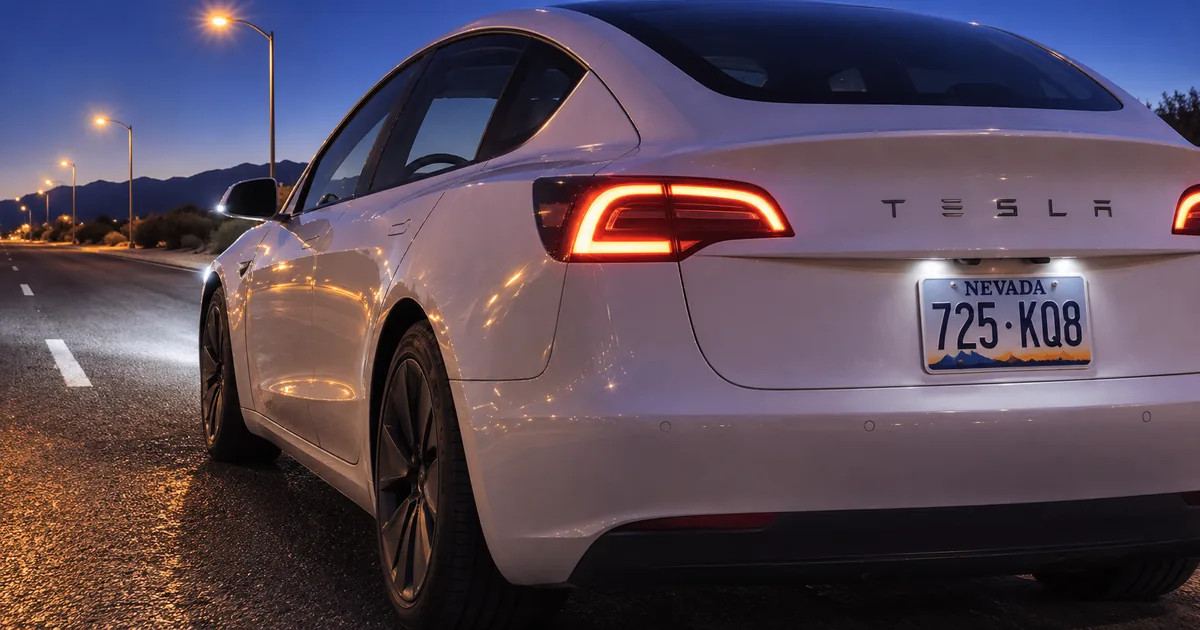
Tesla robotaxi release date: Nevada approval is not a launch
As of the 20 August 2026 approval, nobody can hail a Tesla robotaxi in Las Vegas, because the Nevada approval is permission to start, not a launch. The three approved companies have 120 days to begin operations, and none may offer rides until it meets every requirement set by the Nevada Transportation Authority (NTA).
What the Nevada permit grants Tesla, Waymo and Uber
On 20 August 2026 the NTA unanimously approved three permits that let Tesla, Uber and Waymo run commercial robotaxi services in Clark County, home to Las Vegas. TechCrunch reports that together they would put up to 8,000 robotaxis on county roads over the next 12 months. Nevada calls this license an autonomous vehicle network company (AVNC) permit, and it is what allows a company to run a robotaxi service in the county.
Robotaxi permits in Clark County after 20 August 2026, as reported
| Operator | Ceiling over 12 months | Note |
|---|---|---|
| Tesla | 5,000 vehicles | Largest of the three permits |
| Waymo | 1,000 vehicles | Approved at the same vote |
| Uber | 1,000 vehicles | Operated through Motional and Zoox |
| Zoox (existing) | 100 vehicles | Not part of the vote; holds its own earlier permit |
Uber's 1,000 cars would come from its partners: Motional, a Hyundai subsidiary, and Zoox, whose own 100-vehicle permit predates the vote and is not part of the 8,000. The Tesla, Waymo and Uber ceilings in the table add up to 7,000, while TechCrunch gives a total of 8,000. KTNV names Aviari as the third applicant instead of Uber, while TechCrunch names Uber.
"The Nevada Transportation Authority unanimously approved three permits Thursday that will allow Tesla, Uber, and Waymo to operate commercial robotaxi services in Clark County, home to Las Vegas. Together, these permits would deploy up to 8,000 robotaxis across the county over the next 12 months."/"Tesla’s permit allows it to deploy up to 5,000 robotaxis, while Waymo is allowed operate up to 1,000 autonomous vehicles over the next year. Uber was also approved for 1,000 robotaxis, which it will operate through partnerships with Hyundai subsidiary Motional and Zoox. Zoox already holds an autonomous vehicle network company permit that allows it to operate 100 robotaxis."(TechCrunch, reported by Kirsten Korosec・opening section)View official source →
"On August 20, the Nevada Transportation Authority (NTA) considered applications from Tesla, Waymo, and Aviari "to operate as a Autonomous Vehicle Network Companies in Nevada" during a general session meeting, which the NTA said were unanimously approved."/"For the first 12 months of the permit's issuance, Tesla received authorization for 5,000 autonomous vehicles, and Waymo and Aviari received 1,000 each."(KTNV Las Vegas・opening section)View official source →
The 120-day start window after Nevada approval
Each company must begin operations within 120 days of its permit approval, and none can offer rides until it meets all NTA requirements. The window is an outer limit for starting, so a launch could come earlier once Tesla clears its conditions. KTNV reports both parts of the rule in its coverage of the vote.
"These three companies must begin operations within 120 days of their permit approval, and cannot offer their services until they meet all requirements by the NTA."(KTNV Las Vegas・body)View official source →
Nevada permit history: from ten Tesla vehicles to 5,000
The 5,000 figure is not new: Tesla asked for it in June, and an interim permit held the fleet to ten vehicles until 20 August. The vote came 24 days after the interim order, so the jump from ten to 5,000 happened inside one month.
Interim permit of 27 July versus the 20 August approval, as reported
| Term | 27 July interim permit | From 20 August |
|---|---|---|
| Fleet size | 10 vehicles | Up to 5,000 |
| Operating area | Inside a geofence the regulator must approve | Clark County |
| Airport | No service | Needs a separate Clark County Department of Aviation approval |
The table shows that the vehicle count and the permitted area changed on 20 August, while airport pickups still need a separate approval. That makes the airport the one limit the 5,000 approval did not lift.
July interim permit: ten vehicles, no airport
On 27 July 2026 the NTA signed off on an interim permit for ten fully autonomous Tesla vehicles, with no airport service. Electrek reports that the cars could run only inside a geofence the regulator has to approve, under a 45 mph ceiling. Ten vehicles was the entire fleet that permit covered.
"The Authority signed off on July 27. Ten fully autonomous vehicles, operating only inside a geofence the regulator has to approve, with a 45 mph ceiling and no airport service."(Electrek・body)View official source →
Docket 26-05015: the Nevada permit Tesla asked for
Tesla Robotaxi, LLC filed docket 26-05015 in early June 2026, asking for an AVNC permit that covered all of Clark County and up to 5,000 vehicles in the first 12 months. According to Electrek, the filing named Harry Reid International and Henderson Executive as pickup locations.
August's approval matches the size of that original application, so it reads as approval of the original application rather than an expansion of the July permit. Electrek adds that, as of its 17 August report, regulators had not publicly explained how a 5,000-vehicle request became a ten-vehicle permit.
"Tesla Robotaxi, LLC filed docket 26-05015 with the Nevada Transportation Authority in early June, seeking an Autonomous Vehicle Network Company permit. The application covered all of Clark County and requested authority for up to 5,000 vehicles during the first 12 months."/"Nevada regulators haven’t publicly explained how a 5,000-vehicle request became a 10-vehicle permit."(Electrek・body)View official source →
Nevada permit conditions before a Tesla robotaxi ride
Two things stand between the approval and a paid ride: the NTA's operating requirements and, for airport trips, a second approval. The operating requirements have to be met within the 120-day start window; the airport approval matters only for airport trips.
Eight Nevada permit requirements before a paid ride
KTNV lists eight requirement areas that the three approved companies must meet before they carry riders. The table below sets them out as the NTA described them.
Requirement areas the NTA set out, per KTNV
| Area | Requirement |
|---|---|
| Vehicles | Inspections and documentation |
| Insurance | Required coverage |
| Rates | Filed with the NTA before carrying the public |
| App | Rider-facing application details submitted for review |
| Fairness | Accessibility, nondiscrimination, receipts and reporting |
| Safety | Crash and event reporting as required by law |
| Scope | Operate only within the authority granted |
| Emergency | A 24-hour contact for first responders |
Read together, these are the terms of a commercial transport license rather than a technology trial. A company has to file its prices, show its rider app and provide a 24-hour contact for first responders before it can take a passenger. The 120-day window runs from approval, while service starts only after the checklist is done.
Robotaxi Las Vegas airport pickups need extra approval
Airport pickups at Harry Reid International need an authorization from the Clark County Department of Aviation that the NTA permit does not include. An NTA spokesperson told KTNV that the permit does not allow autonomous vehicles to "service the airport without first obtaining the necessary authorization from the Clark County Department of Aviation."
Tesla's June filing named Harry Reid as a pickup location, so the airport is part of its plan but not part of its permit. The 27 July interim permit barred airport service outright.
"A spokesperson for the NTA shared that the permit did not allow for autonomous vehicles to "service the airport without first obtaining the necessary authorization from the Clark County Department of Aviation.""(KTNV Las Vegas・body)View official source →
Waymo, Tesla Cybercab and Uber in Las Vegas: how many cars?
Tesla's own engineer expects fewer than 5,000 cars within a year, so Tesla's fleet is likely to stay below its permit ceiling. Waymo and Uber were each cleared for 1,000 cars, and Zoox already holds a permit for 100.
Tesla's 2,500 figure versus the Nevada permit ceiling
Eric Early, Tesla's Cybercab chief engineer, told the NTA meeting that 5,000 "has always been a ceiling" for Tesla and that about 2,500 would satisfy the company in the first year. TechCrunch quotes him saying he does not think Tesla will be in a position to deploy 5,000 vehicles by this time next year, and that technology is not the reason.
A 2,500-car fleet would still be larger than the 1,000-car ceiling approved for each of Waymo and Uber. TechCrunch adds that even if the three companies roll out only half of those totals, Clark County is shaping up as a major robotaxi battleground.
"“The 5,000 has always been a ceiling for us,” said Eric Early, Tesla’s Cybercab chief engineer, during the meeting. “I don’t think we’ll be in a position by this time next year to deploy 5,000 vehicles, and it’s not [because of] the technology. … I think we would be extremely happy and satisfied if we could get ourselves up to 2,500, maybe a bit higher than that in the next year.”"/"Even if these three companies roll out only half of those totals, Clark County — and Las Vegas specifically — is shaping up to be a major robotaxi battleground, with Tesla, Uber (via its autonomous vehicle partners Motional and Zoox), and Waymo all competing for the same riders."(TechCrunch, reported by Kirsten Korosec・body)View official source →
Taxi operators oppose the robotaxi permits
Taxi companies and the Livery Operators Association opposed the permits at the hearing, arguing that they go too far, too fast. The opposition covered all three permits, Waymo's and Uber's included.
TechCrunch reports that the association's lawyer, Kimberly Maxson-Rushton, raised two concerns: oversaturation of the commercial transportation industry in Nevada as a whole, and overcrowded roadways, especially in the Golden Triangle. That area lies between the airport and Las Vegas Boulevard and is where most autonomous vehicle testing has happened so far.
Uber pitched a hybrid model: ride-hailing networks that mix human drivers with robotaxis. At the NTA meeting it said a hybrid approach would let cities add vehicles gradually to meet peak demand instead of flooding the market. TechCrunch notes the fight is also about jobs: depending on whom you ask, the companies create maintenance, charging and cleaning work, or they wipe out jobs for taxi and gig drivers.
"Representatives from the Livery Operators Association and local taxi companies opposed the permits, arguing the approvals move too far, too fast."/"“These applications raise two grave concerns,” said Kimberly Maxson-Rushton, a lawyer representing the Livery Operators Association, at the hearing. “One deals with the oversaturation of the commercial transportation industry as a whole in Nevada,” she said. “And the second one deals with the overcrowding of the roadways, and specifically the Golden Triangle.”"/"Uber made a similar pitch during the NTA meeting, noting that a hybrid approach would allow cities to gradually integrate vehicles to meet peak demand rather than flooding the market all at once."(TechCrunch, reported by Kirsten Korosec・body)View official source →
The Las Vegas robotaxi race after Nevada approval
Tesla's Las Vegas robotaxi permit is a ceiling, not a forecast, and the three permits together allow up to 8,000 cars. Tesla itself called 5,000 a ceiling and pointed to about 2,500 as a good first year, while Waymo and Uber hold 1,000 each and Zoox holds 100.
Three things decide when a rider can actually book. Service must start within 120 days of approval, and only after the NTA requirements are met. Airport trips also wait for the Clark County Department of Aviation.
Zoox's vehicle needed its own federal exemption, which is covered in Zoox Robotaxi Cleared With No Steering Wheel. The driving hardware behind Waymo's cars is covered in Waymo Custom Chip: 5nm ASIC for Lidar and Cameras.
FAQ
- Can I ride a Tesla robotaxi in Las Vegas right now?
- Not yet, as of the 20 August 2026 approval. KTNV reports that the three approved companies have 120 days from permit approval to begin operating, and cannot offer service until every Nevada Transportation Authority (NTA) requirement is satisfied. The 120 days is a deadline for starting, not a launch date.
- How many Tesla robotaxis will actually be on the road?
- Probably fewer than 5,000. Tesla's Cybercab chief engineer told the hearing the number has always been a ceiling, said he does not think the company will be in a position to deploy 5,000 by this time next year, and named roughly 2,500 as a satisfying outcome.
- Can a Tesla robotaxi pick me up at Harry Reid airport?
- Not on this permit alone. A Nevada Transportation Authority (NTA) spokesperson told KTNV that autonomous vehicles cannot service the airport without first obtaining authorization from the Clark County Department of Aviation. The permit covers Clark County, where the airport sits, but the right to serve the airport does not come with it.
Related articles
 Zoox Robotaxi Cleared With No Steering WheelNHTSA exempted the Zoox robotaxi from parts of eight federal safety standards through July 2028, for up to 2,500 vehicles per 12 months, with conditions.
 Tesla Kills Pedestrian on I-80; Driver Cites FSDA Tesla hit and killed a 71-year-old man crossing I-80 in Vallejo on Oct. 22. The driver says FSD was on; dashcam video shows the car braking and swerving.
 FTC seeks safety records from OpenAI and AnthropicOn October 14 the FTC sent OpenAI and Anthropic civil investigative demands for safety and privacy records. It is collecting evidence, not ruling.
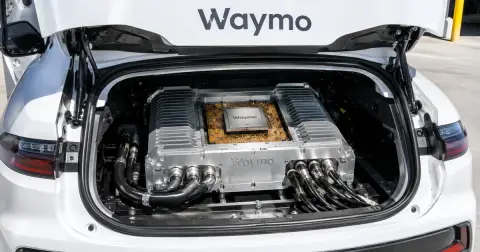 Waymo Custom Chip: 5nm ASIC for Lidar and CamerasThe Waymo custom chip is a 5nm ASIC that fuses lidar, radar and camera data ahead of the driving stack. What its 1,000 TOPS covers, and what it does not.