What NHTSA granted the Zoox robotaxi in July 2026
On July 31, 2026, NHTSA, the National Highway Traffic Safety Administration, granted Zoox, Inc. an exemption for its robotaxi. The notice describes a passenger car with no manually operated driving controls, driven by an Automated Driving System (ADS), the hardware and software that run the car.
The exemption lets Zoox "manufacture and deploy commercially" that car even though it does not meet certain Federal Motor Vehicle Safety Standards (FMVSS), the safety rules a passenger car has to satisfy in the US. Engadget, Carscoops and New Atlas covered the grant as an approval for paid rides, and both the Engadget and Carscoops headlines say "Amazon's Zoox". The notice itself says nothing about fares or launch dates.
Exemption from parts of eight safety standards
The exemption removes certain requirements from eight standards and applies to the Zoox sedan. The list runs from windshield defogging and wipers to lamps, rear visibility, brakes, glazing and two occupant-protection standards.
The eight FMVSS covered by the exemption (per the Federal Register notice)
NHTSA is granting an exemption to Zoox, Inc. (Zoox) to allow it to manufacture and deploy commercially a passenger car, which is equipped with an Automated Driving System (ADS), that does not comply with certain requirements in the Federal Motor Vehicle Safety Standards (FMVSS). Specifically, NHTSA grants Zoox an exemption for its Zoox sedan from certain requirements in eight FMVSS: FMVSS No. 103, Windshield defrosting and defogging systems; FMVSS No. 104, Windshield wiping and washing systems; FMVSS No. 108, Lamps, reflective devices, and associated equipment; FMVSS No. 111, Rear visibility; FMVSS No. 135, Light vehicle brake systems; FMVSS No. 201, Occupant protection in interior impact; FMVSS No. 205, Glazing materials; and FMVSS No. 208, Occupant crash protection. — From the passage describing the eight standards covered by the exemptionView official source →
Two years of production, capped at 2,500 vehicles
The exemption is effective from July 31, 2026 through July 31, 2028, which makes it a two-year grant. During those two years Zoox may manufacture vehicles under it.
The grant carries a volume limit. No more than 2,500 exempted vehicles may be introduced into interstate commerce for commercial deployment in any 12-month period.
Zoox is permitted to manufacture vehicles pursuant to this exemption for two years, provided that not more than 2,500 exempted vehicles are introduced into interstate commerce for commercial deployment in any 12-month period. / DATES: NHTSA grants Zoox's exemption effective from July 31, 2026 through July 31, 2028. — From the passages on the exemption's effective period and the 12-month volume capView official source →
First passenger-carrying ADS vehicle under general authority
The notice states that the Zoox robotaxi is the first passenger-carrying ADS-equipped vehicle to receive an exemption under NHTSA's general exemption authority. It is also the first one issued since NHTSA introduced process improvements under the Department's Automated Vehicle (AV) Framework. Another robotaxi story is covered in Waymo Uber Exclusivity to End in Austin, Atlanta.
Those improvements follow the framework's three core principles. The first two are to prioritize the safety of ongoing AV operations on public roads and to remove unnecessary regulatory barriers. The third is to enable commercial deployment of AVs to improve safety and mobility for the American public.
The Zoox robotaxi is the first passenger-carrying ADS-equipped vehicle to be granted an exemption under NHTSA's general exemption authority. / It is also the first exemption to be issued since NHTSA introduced process improvements under the Department's Automated Vehicle (AV) Framework. / These process improvements have been made in accordance with the AV Framework's three core principles: (1) prioritize the safety of ongoing AV operations on public roads; (2) unleash innovation by removing unnecessary regulatory barriers; and (3) enable the commercial deployment of AVs to enhance safety and mobility for the American public. — From the passages on the first-of-its-kind status and the AV Framework's three principlesView official source →
What kind of vehicle the Zoox robotaxi is
The notice gives Zoox's own description of the car. Every figure below is Zoox's, as reported in the notice.
Symmetrical body with seats facing the cabin center
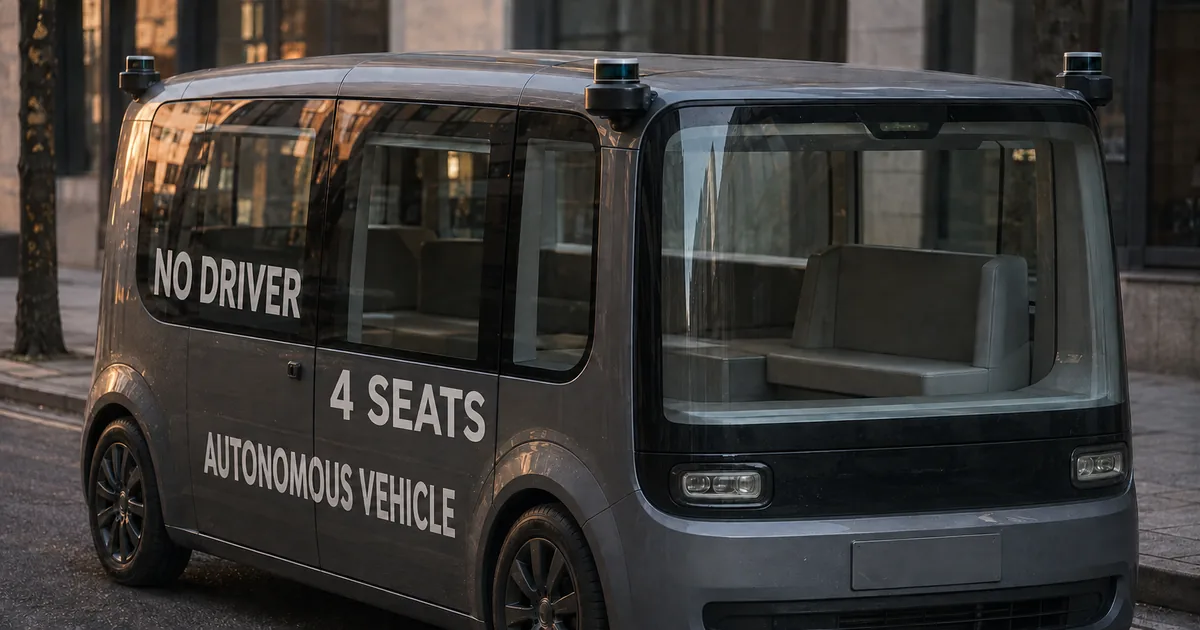
Zoox calls the robotaxi a purpose-built, fully autonomous, all-electric vehicle made for ride hailing in cities. It is classified as a passenger car with a top speed of 75 mph, seats for up to four passengers, and a gross vehicle weight rating (the maximum loaded weight) of 3,000 kilograms (6,614 pounds).
The body is symmetrical, so the front and rear are identical. Instead of forward-facing rows, the seats are set in a carriage-style arrangement in which seated occupants face the center of the cabin.
Zoox describes the robotaxi as a purpose-built, fully autonomous, all-electric vehicle optimized for ride hailing in cities. It is classified as a passenger car and has a top speed of 75 mph. The vehicle seats a maximum of four passengers and has a gross vehicle weight rating (GVWR) of 3,000 kilograms (6,614 pounds). / Unlike conventional human-driven cars, the Zoox robotaxi is symmetrical, meaning its front and rear are identical. Rather than forward-facing rows, the Zoox robotaxi's seats are configured in a carriage-style arrangement where seated occupants face the center of the cabin. — From the passages on the vehicle's specifications and its symmetrical shapeView official source →
No human can drive it: the car has no manual controls
The notice says the robotaxi lacks manually operated driving controls. Zoox states that this is the primary difference between its robotaxi and a nonexempt vehicle: a human cannot drive it.
The phrase "no steering wheel" comes from press coverage, such as Engadget's headline calling the car steering-wheel-free. The notice itself uses the wording above.
The Zoox robotaxi is a passenger car that is equipped with an ADS and lacks manually operated driving controls. / Zoox states that the primary difference between the Zoox robotaxi and a nonexempt vehicle is that the Zoox robotaxi is not capable of being driven by a human. — From the passages on the missing manual driving controls and on the difference from a nonexempt vehicleView official source →
Sensors and in-house software, Level 4 per Zoox
The car perceives its surroundings with lidar, radar, cameras, long-wave infrared cameras, microphones and other sensors, read by custom perception software. That information goes to planner and control systems, which plan the driving maneuvers and carry them out without a person.
Zoox says it developed the ADS entirely in-house. In its words, the hardware and software together can perform the entire dynamic driving task (steering, braking and watching the road) plus the fallback (reaching a safe state when something fails) on a sustained basis. This holds within a specified operational design domain (ODD, the set of conditions the system is built to operate in).
Zoox expects that no passenger will need to step in. On that basis, it states that its system fits the description of a Level 4 ADS under SAE J3016 (April 2021), the industry's standard scale of driving automation.
Instead, the Zoox robotaxi is equipped with lidar, radar, cameras, long-wave infrared cameras, microphones, and other sensors that perceive the environment with custom perception software. This information is then fed into planner and control systems which plan and execute the driving maneuvers autonomously. / Zoox states that its ADS is developed entirely in-house and consists of the hardware and software collectively capable of performing the entire dynamic driving task and fallback on a sustained basis within a specified operational design domain (ODD), without any expectation that a passenger will need to intervene. / Zoox states that, therefore, their system meets the description of a Level 4 ADS under SAE J3016: Taxonomy and Definitions for Terms Related to Driving Automation Systems for On-Road Motor Vehicles (April 2021). — From the passages on the sensor suite and the claim that the system corresponds to SAE J3016 Level 4View official source →
Why NHTSA granted the Zoox robotaxi exemption
The summary of the notice states NHTSA's basis for the grant. The basis ties the exemption to what the FMVSS would otherwise do to this vehicle.
Compliance would keep an equally safe vehicle off the road
NHTSA granted the application because compliance would stop Zoox from selling or commercially deploying a car whose overall safety level is at least equal to that of a car meeting every applicable FMVSS. The comparison is between overall safety levels: the Zoox robotaxi on one side, a fully compliant vehicle on the other.
NHTSA is granting Zoox's application on the basis that compliance with these requirements would prevent Zoox from selling, or otherwise commercially deploying, a motor vehicle with an overall safety level at least equal to the overall safety level of a vehicle that complies with all applicable FMVSS. — From the passage on the "overall safety level" basis for granting the exemptionView official source →
Fixed grant conditions and updatable authorizations
The notice sets two kinds of terms. The grant conditions are fixed, and an Operational Authorization, a permission NHTSA will issue under an enhanced oversight condition, may change. The table sets the two side by side.
Fixed grant conditions versus Operational Authorizations (per the Federal Register notice)
| Grant conditions | Operational Authorization | |
|---|---|---|
| What it is | Conditions that contributed to NHTSA's overall safety finding | Authorization NHTSA will issue under the enhanced oversight condition |
| Can it change? | Not without a modification to the exemption | May be updated and expanded as Zoox's ADS technology matures |
| Over time | Binds Zoox for the life of the exempted vehicles | NHTSA anticipates that Zoox's operations, ODD and use case will change |
Grant conditions cannot change without a modification
NHTSA treats the grant conditions as fixed because they contributed to its overall safety finding. They cannot be changed unless the exemption itself is modified. Zoox must comply with them for the life of the exempted vehicles.
The grant conditions are considered fixed conditions because they contributed to NHTSA's overall safety finding and therefore cannot be changed without a modification to this exemption. Zoox must comply with the grant conditions for the life of the exempted vehicles. — From the passage on the fixed grant conditionsView official source →
Operational Authorizations may expand as the ADS matures
NHTSA anticipates that Zoox's operations, ODD and use case will change over time. The exemption also comes with terms and conditions that include an enhanced oversight condition.
Under that condition, NHTSA will issue Operational Authorizations. They may be updated and expanded as Zoox's ADS technology matures.
In addition, NHTSA anticipates that Zoox's operations, ODD, and use case will change over time. / NHTSA grants Zoox an exemption subject to certain specified terms and conditions, including the application of an enhanced oversight condition. Under this condition, NHTSA will issue Operational Authorizations that may update and expand as Zoox's ADS technology matures. — From the passages on the expected change in operations and the enhanced oversight conditionView official source →
FAQ
- What exactly was approved?
- NHTSA, the US road safety regulator, granted Zoox's robotaxi an exemption from certain requirements within eight Federal Motor Vehicle Safety Standards (FMVSS). They cover windshield defrosting and defogging, wipers, lamps, rear visibility, brakes, occupant protection in interior impact, glazing materials, and occupant crash protection.
- Are there limits on duration and volume?
- Yes. The exemption runs for two years, from July 31, 2026 through July 31, 2028. On volume, no more than 2,500 exempted vehicles may be introduced into interstate commerce for commercial deployment in any 12-month period.
- Why was an exemption necessary in the first place?
- Because meeting the existing requirements would have blocked a vehicle that is at least as safe overall from reaching the market. NHTSA granted the application on the basis that compliance would prevent Zoox from selling or commercially deploying such a vehicle.
- What kind of oversight follows the grant?
- An enhanced oversight condition is attached. NHTSA will issue Operational Authorizations that may be updated and expanded as Zoox's ADS technology matures. The grant conditions that underpinned the safety finding, by contrast, are fixed and cannot change without modifying the exemption itself.
Related articles
 Tesla Robotaxi Las Vegas: What the Permit AllowsTesla robotaxi Las Vegas plans won approval for up to 5,000 vehicles, but nobody can ride yet: the conditions, the 120-day window and the airport catch.
 Waymo Custom Chip: 5nm ASIC for Lidar and CamerasThe Waymo custom chip is a 5nm ASIC that fuses lidar, radar and camera data ahead of the driving stack. What its 1,000 TOPS covers, and what it does not.
 Ratepayer Protection Act Fails Senate Vote 57-43The House passed H.R. 9340 417-3, but the Senate fell three votes short of 60 on September 30. What the Ratepayer Protection Act asks of data centers.
 AI Distillation Attacks in PLA-Linked ResearchWhat AI distillation is, and why a China Brief analysis of PLA-linked research on distillation attacks, watermark removal and detection evasion matters.