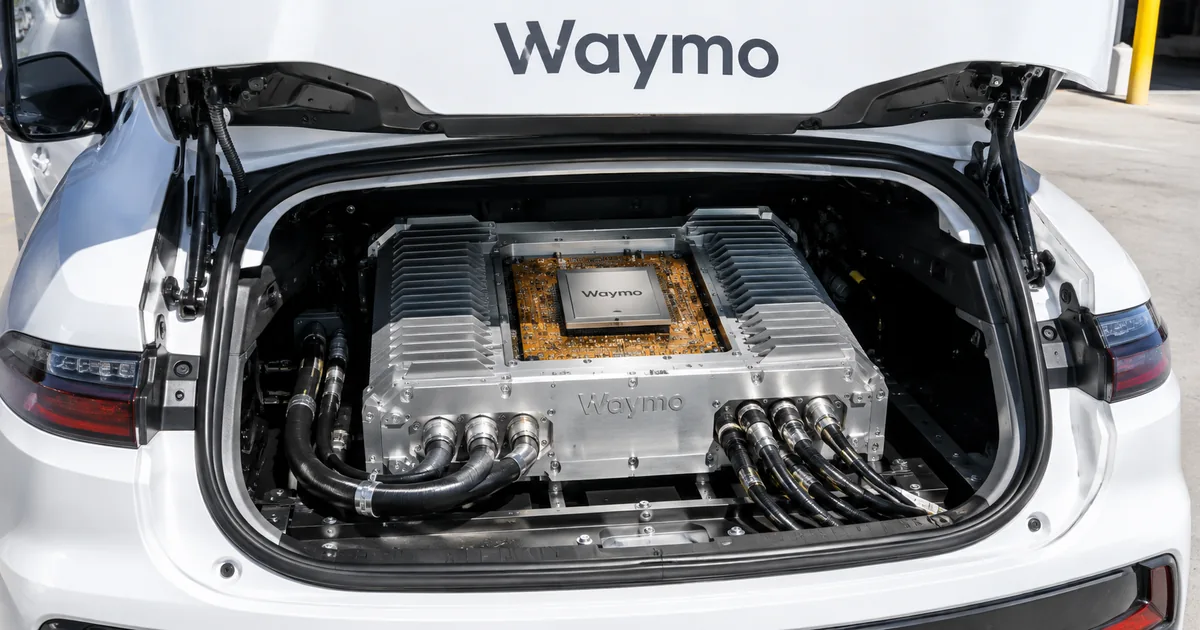
What Waymo's 5nm ASIC does with raw sensor data
The chip takes in raw data from the car's lidar, radar and cameras and prepares it before it reaches what the post calls the core ML brain. An ASIC (application-specific integrated circuit) is a chip designed for one task instead of general use. Waymo introduced this one in a post dated August 20, 2026, written by Satish Jeyachandran, Vice President of Engineering, and Daniel Rosenband, Compute Lead.
The ASIC does not drive the car. Waymo places it ahead of that core ML brain. It handles the large flow of raw data arriving from the sensors, fuses it, and runs neural networks on it in real time.
The announced ASIC at a glance
| Property | Detail |
|---|---|
| Type | Purpose-built ASIC |
| Process node | 5nm (foundry undisclosed) |
| Role | Prepare raw sensor data and run ML models on it ahead of the core ML brain |
| Sensors | Lidar, radar and cameras |
| Cameras | 13 high-resolution cameras at once in the latest system |
| Status | One of several custom components in development; the post does not describe the others |
Does 1,000 TOPS cover the whole compute system?
No. TOPS stands for trillions of operations per second, a count of how much machine-learning arithmetic a chip can perform. Waymo says the ASICs alone deliver over 1,000 TOPS, dedicated to front-end processing and its ML models. The post gives no figure for the compute system as a whole.
Waymo adds that it optimizes across the full stack to raise the performance actually achieved, particularly in the low-batch regimes it often runs in. That is a separate claim from the 1,000 TOPS, which the post ties to the front-end chips alone.
"To handle the massive influx of raw data before it reaches our core ML brain, we are excited to introduce our purpose-built 5nm ASIC. While this chip is just one of several exciting custom components we’re developing, it is a specialized ML powerhouse engineered exclusively to process, fuse, and run advanced neural networks on raw sensor data in real time."/"While these ASICs alone deliver over 1,000 TOPS of ML performance dedicated to front-end processing and ML models, we optimize across the full stack to maximize achieved performance, especially in the low-batch regimes we often operate."(Waymo official blog・Waymo's purpose-built 5nm ASIC section)View official source →
How the front end handles lidar, radar and cameras
Waymo describes the front end as extraction followed by sensor fusion. Specialized accelerators pull out the information that matters, including noise removal across time, and a purpose-built inference engine then runs sensor fusion models.
Work the front end takes on
| Step | What the post says |
|---|---|
| Extraction | Specialized accelerators pull critical information out of the raw lidar, radar and camera streams |
| Temporal denoising | Noise removal over time, part of the extraction work, aimed at low-light perception |
| Sensor fusion | A purpose-built inference engine runs the fusion models, which merge the different sensor types into one view of the scene |
Waymo says this design gives greater efficiency without sacrificing fidelity. It also says that developing silicon, sensors and algorithms side by side lets it push sensor fidelity, bandwidth efficiency and quantization (storing numbers in fewer bits). The aim is to run models from sparse convolutions to dense transformers.
How does temporal denoising help in low light?
The post says the accelerators include temporal denoising for better low-light perception, and gives no mechanism beyond that. What it does state is what the latest system delivers overall: it processes 13 high-resolution cameras simultaneously and in real time, and shows environmental details that traditional cameras miss. Waymo illustrates this with a left and right image comparison.
"The ASIC’s specialized accelerators instantly extract critical information from raw lidar, radar, and camera streams, including temporal denoising for superior low-light perception. This data feeds into our purpose-built inference engine to run sensor fusion ML models, enabling greater efficiency without sacrificing fidelity."/"Our latest system (right) processes high-fidelity data from 13 high-resolution cameras simultaneously and in real time, delivering exceptional low-light perception and revealing critical environmental details that traditional cameras (left) miss."(Waymo official blog・Waymo's purpose-built 5nm ASIC section)View official source →
Redundancy, latency and ruggedization in compute hardware
Waymo says it built its compute around three requirements it calls non-negotiable: responsive, ruggedized and redundant. They draw on more than 200 million miles of fully autonomous experience. The bar is high because the system does the whole job of driving with no human backup, unlike driver-assist computing.
The three stated requirements
| Requirement | What the post says |
|---|---|
| Responsive | Everything runs onboard and decides within milliseconds. Raw compute power scaled 20x in eight years |
| Ruggedized | Built for constant vibration, shock and extreme temperatures, and tied into the vehicle's liquid cooling for freezing Midwest winters and the heat of Phoenix |
| Redundant | Two independent engines that normally run as one unit. If one has a fault, the other takes over |
Because no human can take over, the post says, safety and redundancy are built in from the start. On latency, Waymo says it lowered the delay from what the sensors see to what the car does by tuning dynamic workloads at every percentile. It does not give the new delay in milliseconds.
The post uses the words "ASICs" and "two independent engines" in different paragraphs and does not link them. Reading the two engines as two ASICs goes beyond the text.
Waymo says the move from off-the-shelf parts to a custom system required rethinking its physical and architectural design, and the benefits it names concern the vehicle. A highly integrated system delivers a lot of processing power without hurting the rider experience. It saves battery, leaves ample trunk space and runs silently.
The architecture is ML-primary, meaning it is built first to run neural networks at minimal latency. Tasks that are not ML, such as orchestration, data movement and logging, are handled by pairing Waymo's ML hardware with CPUs, GPUs and accelerators, which leaves more time for ML computation. Waymo calls the result a balanced, heterogeneous system, one made of different kinds of processors.
"Unlike traditional driver-assist computing, our system handles the entire task of driving without a human backup, demanding significantly higher performance. Drawing from more than 200 million miles of fully autonomous experience, we engineer our compute around three non-negotiable requirements:"/"We have engineered our stack for ultra-low latency, minimizing the delay from first pixel to action."/"Unlocking this requires impressive raw compute power—which we’ve scaled 20x in just eight years—paired with a deeply optimized software stack to harness it efficiently."/"By integrating directly with the vehicle's liquid cooling system, we sustain peak performance whether navigating freezing Midwest winters or the blistering heat of Phoenix."/"Our compute is designed like two independent engines. While they normally operate as one unit running full parallel workloads, if one experiences a fault, the other seamlessly takes over."/"Evolving from off-the-shelf components to custom systems required rethinking our physical and architectural design. Our highly integrated system delivers immense processing power without compromising the rider experience, maximizing battery efficiency while preserving ample trunk space and running silently. We built an ML-primary architecture to run advanced neural networks at minimal latency. To manage critical non-ML tasks like orchestration, data movement, and logging while maximizing time for ML computation, we pair our ML technologies with the best CPUs, GPUs, and accelerators. The result is a balanced, heterogeneous system."(Waymo official blog・three non-negotiable requirements and custom systems sections)View official source →
Custom ASIC alongside Nvidia and six other named partners
The post does not announce a move away from suppliers. Next to its custom silicon, Waymo says it works closely with industry leaders whose computing solutions give it a foundation to scale efficiently. It names seven: AMD, Micron, Nvidia, Samsung, Sandisk, Socionext and TSMC.
Partners named in the post
| Company | Component the post assigns to it |
|---|---|
| AMD | None named |
| Micron | None named |
| Nvidia | None named |
| Samsung | None named |
| Sandisk | None named |
| Socionext | None named |
| TSMC | None named |
The post calls the ASIC one of several custom components and does not say any partner is being replaced. It also never says the chip reduces Waymo's reliance on a supplier.
Does the post say which partner supplies which part?
No. The post introduces the seven only as "a number of partners like" these companies, without matching any of them to a component. Reports that tie TSMC to the 5nm ASIC therefore go beyond what the post says. TSMC is one name on the list, and the post does not state who manufactures the chip.
In short, the Waymo custom chip handles the sensor front end. It does not drive the car, and the post does not describe it displacing any supplier. The post closes by calling itself a glimpse of what is to come, and it points readers to Waymo's talks at Hot Chips without giving a date or session.
"Along with our custom silicon efforts, we partner closely with industry leaders whose world-class computing solutions provide the powerful foundation needed to scale our technology efficiently. We are proud to work alongside a number of partners like AMD, Micron, NVIDIA, Samsung, Sandisk, Socionext, and TSMC to deliver the most capable autonomous computing system."(Waymo official blog・partners section)View official source →
FAQ
- What process node is Waymo's ASIC built on?
- 5nm. The post calls it a purpose-built 5nm ASIC. It does not say which foundry makes the chip. TSMC appears only on the list of seven partners, with no component assigned to it.
- Does the ASIC make driving decisions?
- No. The post places the ASIC ahead of what it calls the core ML brain. Its job is to process the raw sensor data before that stage receives it. The post does not describe the ASIC as making driving decisions.
- How many cameras does the current system handle at once?
- Thirteen high-resolution cameras, processed simultaneously and in real time. Waymo says this gives exceptional low-light perception and reveals environmental details that traditional cameras miss.
- Is Waymo dropping Nvidia and other suppliers?
- The post does not say so. It names seven partners it works alongside (AMD, Micron, Nvidia, Samsung, Sandisk, Socionext and TSMC) and calls the ASIC one of several custom components. It does not describe any partner being replaced.
Related articles
 Malaysia seizes 30 AI chip servers at KLIA airportMalaysian customs seized 30 AI chip servers worth RM49.5 million at KLIA, declared as electronic components, in the year's fifth case tied to one syndicate.
 Waymo Uber Exclusivity to End in Austin, AtlantaWaymo Uber exclusivity in Austin and Atlanta ends in early 2028, with a Waymo app planned. It stays on Uber at least through May; split talk is an FT report.
 Flash prices up 5x on AI, eroding Apple's leverageAI demand made flash 5x pricier in a year, the WSJ reports. Cloud giants now buy twice as much as Apple, and doubling iPhone 17 Pro storage costs Apple $66.
 Waymo will test Toyota bZ4X robotaxis in JapanToyota will build bZ4X robotaxis for Waymo at its Takaoka plant, with testing in Japan from 2027 and the UK to follow. No city, fleet size or fare is set yet.