YouTube Shorts update: originals first, reuploads lose reach
The update at a glance
YouTube is tilting Shorts recommendations toward original videos and away from reuploads. The announcement came from TeamYouTube on the YouTube Help Community, not from a blog post or a policy page.
Shorts recommendations now favor originals over reuploads
The recommendation system will push original Shorts harder and give less reach to videos reuploaded from other creators without anything added. YouTube says the system already weighs billions of signals, such as watch history, topic interests and engagement, to decide what each viewer sees. This update changes how that system treats borrowed clips.
YouTube frames it as a better feed for viewers and a fairer shot for creators who post their own work. It also says the change lines up with its existing YouTube policies.
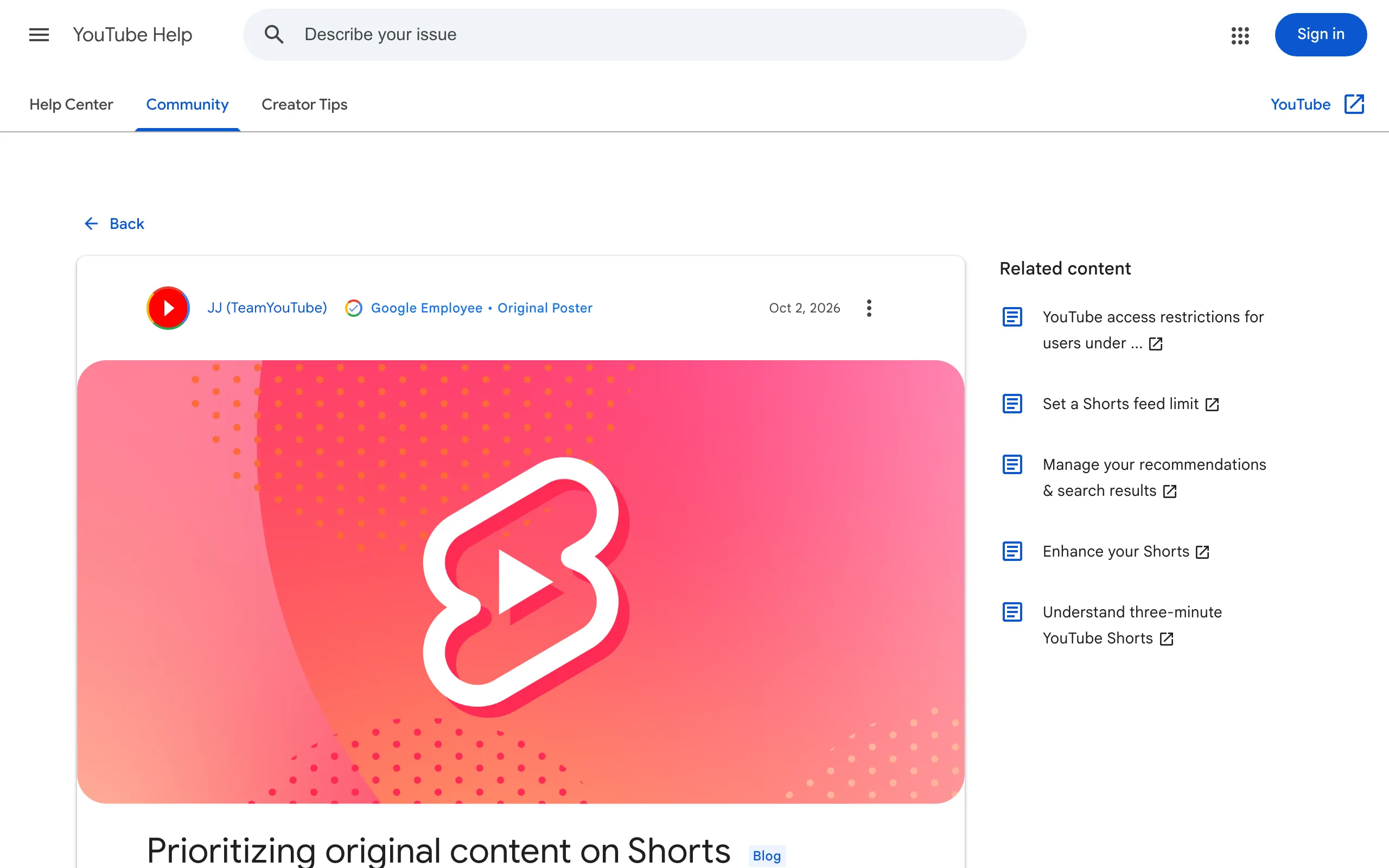
"We evaluate billions of signals—including watch history, topic interests, and engagement—to ensure the best possible experience for viewers."/"To improve the Shorts experience for everyone, we’re updating our recommendation systems to further prioritize original content and reduce the reach of content re-uploaded from other creators without adding anything of your own."/"This change is also aligned with our existing YouTube policies."(from the TeamYouTube post・opening paragraphs)View official source →
YouTube gave no start date and said nothing about AI content
The post has no date on it. There is no word on whether the change is already live, and no Studio screen that tells you if your channel has been classified as an aggregator.
It also never mentions AI. Coverage that lumps this in with crackdowns on AI slop goes beyond the text. What the post targets is reuploading other creators' videos, whatever tool made them.
Channels built on reuploads lose reach in Shorts
What doesn't count and what does
Using other people's clips is still allowed; the question is what you add to them. YouTube and its creator liaison spelled out both sides of that line.
Channels that mostly reupload others' clips get less reach
Channels identified as mainly aggregating or reuploading other creators' videos without significant changes will likely see less distribution in the Shorts feed. The wording points at the channel, not a single video.
A creator who borrows a clip now and then is in a different spot from an account built on reuploads. If you do use someone else's clip, YouTube asks you to add real value with your own commentary, unique edits or storytelling.
"Channels identified as primarily aggregating or re-uploading other creators’ videos without significant changes will likely see less distribution within the Shorts feed. If you use clips from another creator, make sure you're adding real value through your own original commentary, unique edits, or storytelling."(from the TeamYouTube post・What this means for you section)View official source →
Voiceovers and template edits don't make a reupload original
A voiceover that just describes what's happening on screen won't turn someone else's clip into your video. Rene Ritchie, YouTube's creator liaison, said so on X, and put minor technical edits and template-based bulk changes in the same bucket.
Light edits and templates change how a video looks, not what it says. What YouTube wants is analysis, a point of view, or a story that the original didn't have. For a sports clip, that could mean explaining why a player made a move rather than just showing it.
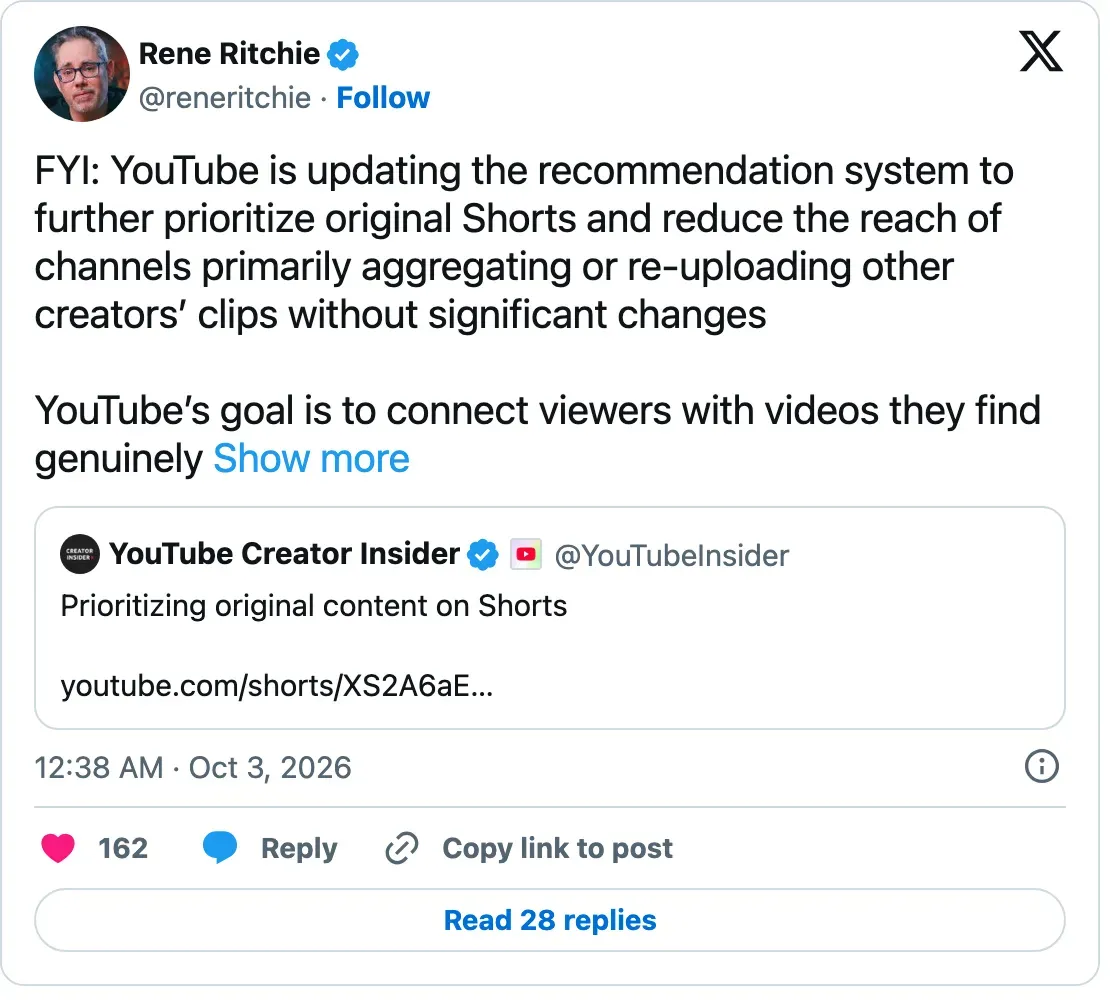
"If you’re inspired by another creators’ clip and want to remix it or use it as the launching point for your own work, make sure you're adding real, distinct value all your own"/"Not just VO descriptions of what’s happening on screen, minor technical edits, or template-based bulk changes."(from Rene Ritchie's post on X)View official source →
Share another creator's video from your posts tab instead
If you simply like a video and want your audience to see it, Ritchie's advice is to share it from your channel's posts tab rather than reupload it. Viewers then watch the original, the original creator gets the view, and your channel doesn't build a reupload history.
"If you just love another creators’ video and want to get it in front of your audience, share it on your channel’s post tab, so everyone can watch the original"(from Rene Ritchie's post on X)View official source →
YouTube monetization policy on reused content is unchanged
Two separate systems
Nothing in this update changes who can earn money from Shorts. For clip channels in the YouTube Partner Program, that distinction matters most.
The recommendation update leaves monetization rules alone
The update is about which Shorts get recommended, not about who gets paid. Recommendations decide how far a video travels. The YouTube Partner Program decides whether a channel can earn ad revenue, and for borrowed material it relies on the reused content section of the monetization policies.
That section defines reused content as repurposing material already on YouTube or elsewhere without significant original commentary, substantive changes, or educational or entertainment value. It is applied to the whole channel, so problem videos can cost a channel its monetization outright.
Permission from the original creator doesn't exempt you, because the policy runs separately from copyright. For the full workflow, from asking permission to posting, see YouTube clipping: permission, editing and earnings.
The last big change to these rules came on July 15, 2025, when YouTube renamed its "repetitious content" policy to "inauthentic content" and made clear that it covers mass-produced and repetitive videos. In the same note, YouTube said the reused content policy was not changing.
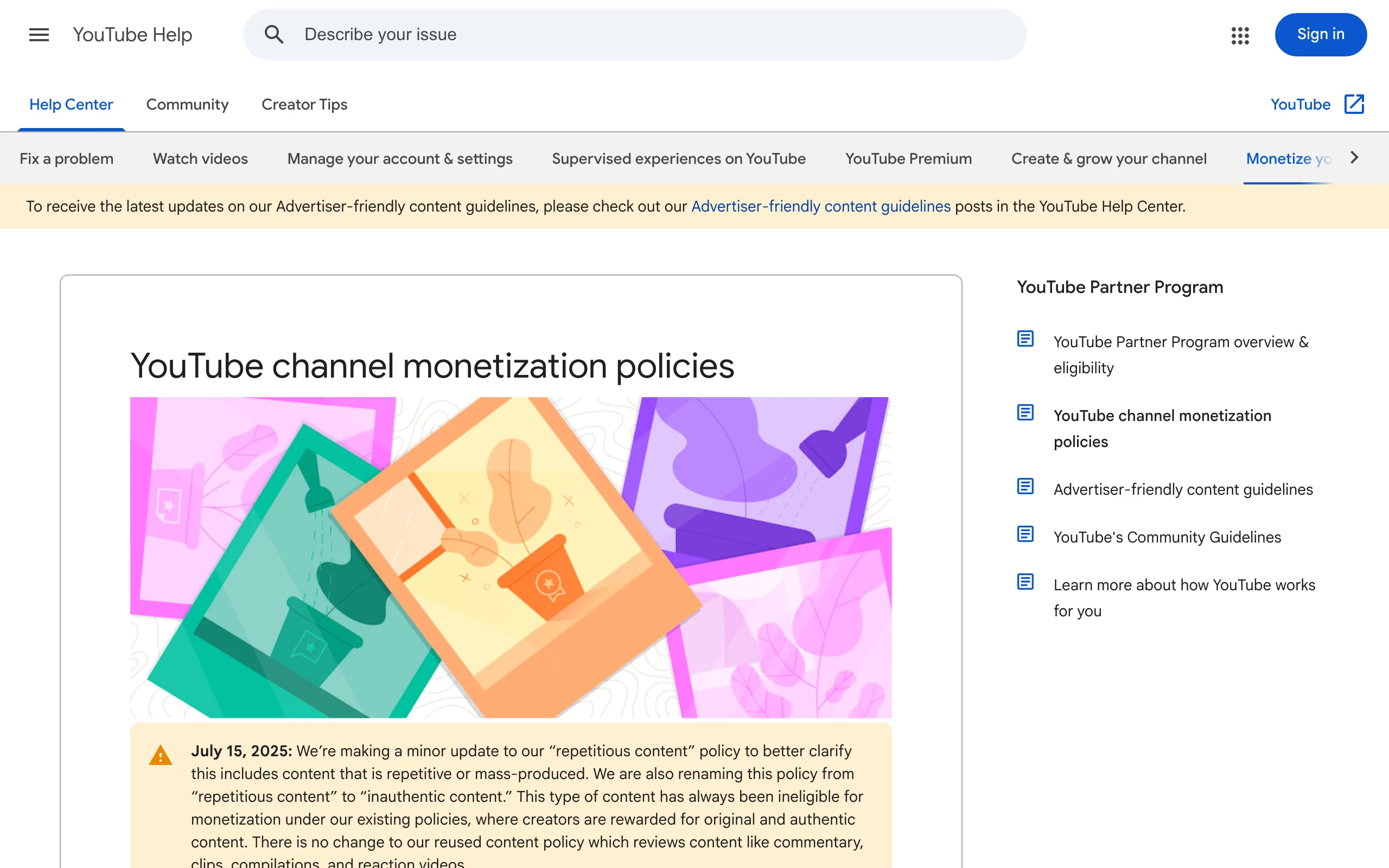
"Reused content refers to channels that repurpose content that’s already on YouTube or another online source without adding significant original commentary, substantive modifications, or educational or entertainment value."/"This policy applies even if you have permission from the original creator."/"There is no change to our reused content policy which reviews content like commentary, clips, compilations, and reaction videos."(from YouTube channel monetization policies・Reused content section and July 15, 2025 update note)View official source →
Reused content policy: commentary passes, compilations fail
The policy's test is whether viewers can see a meaningful difference between the original and your video. These are the examples from the policy that come closest to clip channels.
| Status | Example |
|---|---|
| Allowed | Clips used for a critical review |
| Allowed | Reaction videos where you comment on the original |
| Allowed | Footage from other creators edited with a storyline and commentary |
| Allowed | Sports replays where you explain why a player's moves worked |
| Not allowed | Moments from a show edited together with little or no narrative |
| Not allowed | Short videos compiled from other social media sites |
| Not allowed | Content downloaded or copied without substantive changes |
| Not allowed | Mostly non-verbal reactions with no voice commentary |
YouTube notes that both lists are examples, not complete rules. The allowed side always layers your words or structure on top of the source, while the rejected side just selects and strings clips together. The new recommendation change sorts Shorts the same way.
"Using clips for a critical review"/"Reaction videos where you comment on the original video"/"Edited footage from other creators where you add a storyline and commentary"/"Clips of moments from your favorite show edited together with little or no narrative"/"Short videos you compiled from other social media websites"/"Content downloaded or copied from another online source without any substantive modifications"(from YouTube channel monetization policies・allowed and not allowed examples)View official source →
Shorts not getting views: cut reuploads and add commentary
A quick audit
If your Shorts views dropped in October, start by checking how much of your recent output is reuploaded material. Working through the three steps above shows how exposed your channel is to this change.
Shifting to original Shorts gets your reach re-evaluated
A channel that used to aggregate or reupload can recover: if it shifts toward original content, the recommendation system will re-evaluate its reach. Ritchie said this directly, which means you don't need to start a new channel.
YouTube hasn't said how long that takes or what share of original uploads is enough. After you change course, track your views over several weeks rather than days.
"If your channel was previously aggregating or re-uploading and you shift towards original content, the recommendation system will re-evaluate reach,"(from Rene Ritchie's post on X)View official source →
Add your own commentary and storytelling to clips you use
If you keep making clips, each one needs something the source didn't have. YouTube names four things:
- Your own commentary
- Unique edits
- Storytelling
- Your voice or point of view
In practice that might be a few seconds up front on why the moment matters, on-screen context the original lacked, or two clips side by side with your take on the difference. Shorts are short, so more commentary means a tighter clip. For current limits, see Social media video length: TikTok, Instagram, X.
"Rather than making minor technical edits or template-based changes simply to alter a video, focus on bringing your own voice, storytelling, or distinct point of view to the conversation."(from the TeamYouTube post・What this means for you section)View official source →
Summary: originals now rank above unchanged reuploads
The YouTube Shorts algorithm update changes which videos get recommended: originals move up, unchanged reuploads move down. Monetization rules are the same as before and still turn on the reused content policy.
If you run a clip channel, the fix is the same for both: add commentary, edits or a story that make the video yours. Make that visible in the thumbnail too, so your Short reads as your own when it shows up in the feed.
FAQ
- When does the Shorts originality update take effect?
- YouTube hasn't said. The TeamYouTube post went up on October 1, 2026 with no start date, and there is no screen that tells you whether your channel has been flagged. If you compare views from before and after the post, compare Shorts of the same kind.
- Can I monetize clips if the original creator gave me permission?
- Permission alone doesn't settle it. YouTube's reused content policy applies even when the original creator has said yes, and it is judged separately from copyright. Your video still needs commentary or editing that makes it clearly different from the source.
- Is this update aimed at AI-generated Shorts?
- The post doesn't mention AI at all. What it targets is channels that mainly aggregate or reupload other creators' videos without significant changes. The test is whether you added something of your own, not which tool made the video.
Related articles
 YouTube clipping: permission, editing and earningsYouTube clipping starts with the creator's permission. Learn the six steps to make clips, the tools, and why clips without commentary can't be monetized.
 AI fact check: only 40% of cited stats hold upAI fact check: Trakkr traced 1,285 stats cited by ChatGPT, Perplexity, Gemini, Claude and AI Overviews. Only 40% led to a matching study. How to check one.
 Reddit to require logins as search referrals fallReddit will test a logged-in-only site outside the US in Q4. Search referrals fell over 1M a week in October; its CEO says Google's AI Mode drives no traffic.
 AI crawler training opt-out in one robots.txt ruleAI crawler training opt-out now takes one robots.txt rule. OpenAI, Google and Microsoft will honor it, Microsoft from Feb. 1, 2027. Until then, name each bot.