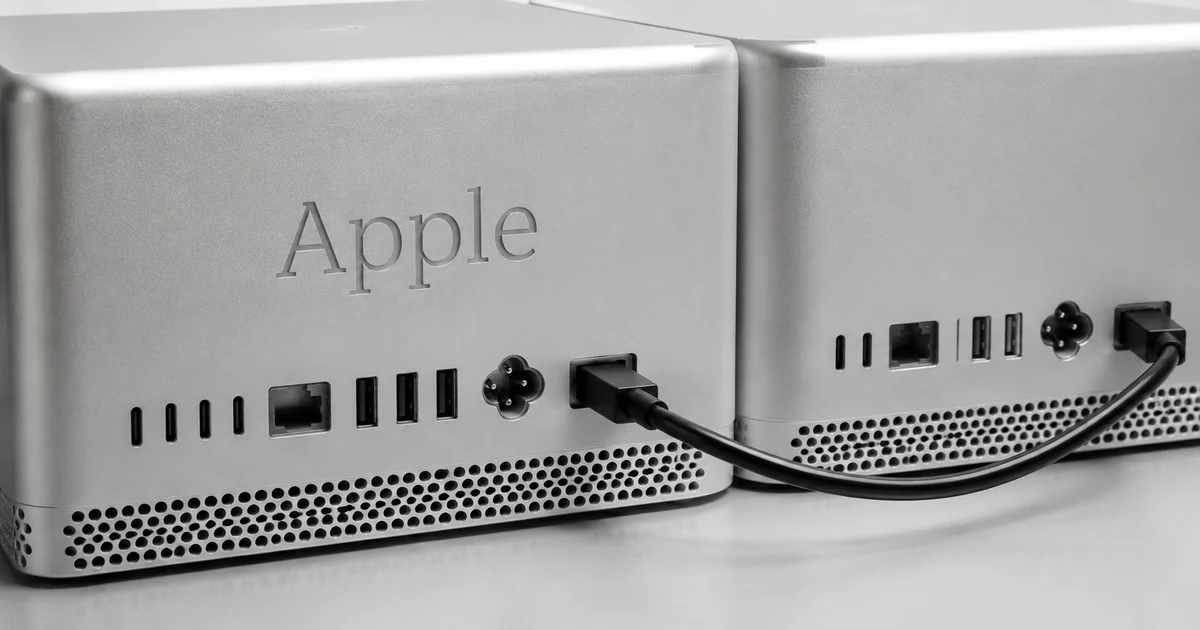
Mac Studio M5 Ultra release date, pre-order and price
Pre-orders for the Mac Studio M5 Ultra opened on August 25, the day Apple announced it, and arrivals begin September 22. Only the 512GB configuration comes later, in late October, according to Apple.
You can pre-order at apple.com/store or in the Apple Store app in 30 countries and regions, including the United States. Treat September 22 as the date Apple plans for arrivals to start, not as a confirmed delivery.
Mac Studio M5 Max and M5 Ultra price, with education pricing
In the U.S., the Mac Studio M5 Max starts at $2,499 and the M5 Ultra at $5,499. With education pricing, they start at $2,299 and $5,099.
That puts $3,000 between them at standard prices and $2,800 at education prices. Apple sends buyers to apple.com/mac-studio for configure-to-order options and gives no price for the 512GB build, so $5,499 is the M5 Ultra's entry price, not the cost of the biggest configuration.
The 512GB M5 Ultra release date: late October
The 512GB M5 Ultra comes in late October, about a month after the rest of the lineup starts arriving on September 22, and Apple gives no reason. If your work needs that much memory, plan around the wait; if not, every other configuration begins arriving on September 22.
"Customers can pre-order the new Mac Studio with M5 Max and M5 Ultra starting today, August 25, on apple.com/store and in the Apple Store app in 30 countries and regions, including the U.S."/"It will begin arriving to customers, and in Apple Store locations and Apple Authorized Resellers, starting September 22. Mac Studio with 512GB of unified memory is coming in late October."/"Mac Studio with M5 Max starts at $2,499 (U.S.) and $2,299 (U.S.) for education."/"Mac Studio with M5 Ultra starts at $5,499 (U.S.) and $5,099 (U.S.) for education."/"Additional configure-to-order options are available at apple.com/mac-studio."(Pricing and Availability section)View official source →
Mac Studio M5 Ultra specs compared with the M5 Max
The M5 Ultra goes up to 36 CPU cores, 80 GPU cores and 512GB of unified memory, while the M5 Max tops out at 18, 40 and 128GB. In both chips, every GPU core has a Neural Accelerator, which Apple says makes matrix multiplication dramatically faster. The M5 Ultra is the first Ultra chip to get them.
M5 Max vs M5 Ultra
| Spec | M5 Max | M5 Ultra |
|---|---|---|
| CPU | 18 cores (6 super, 12 performance) | Up to 36 cores (12 super, 24 performance) |
| GPU | Up to 40 cores | Up to 80 cores |
| Unified memory | Up to 128GB | Up to 512GB |
| Memory bandwidth | Up to 614GB/s | 1.2TB/s |
| Starting price (U.S.) | $2,499 | $5,499 |
Apple lists up to six Thunderbolt 5 ports at up to 120Gb/s each, and Apple's N1 chip brings Wi-Fi 7 and Bluetooth 6 to the Mac Studio for the first time. It supports up to eight displays. Apple also measured storage at up to twice as fast as an earlier M3 Ultra system.
"Mac Studio with M5 Max features an 18-core CPU, an up-to-40-core GPU with Neural Accelerators built into each core, and up to 128GB of unified memory, accelerating complex pro and AI workloads."/"The new Mac Studio with M5 Ultra features an up-to-36-core CPU with 12 super cores and 24 performance cores"/"Mac Studio with M5 Max delivers a huge boost in performance, featuring an 18-core CPU with 6 super cores and 12 performance cores"/"Neural Accelerators in each GPU core deliver dramatically faster matrix multiplication."/"Its up-to-80-core GPU, the most powerful Apple silicon GPU ever, brings Neural Accelerators to the Ultra chip for the first time"/"Storage performance is up to twice as fast, with a next-generation SSD architecture"/"Thunderbolt 5 ports deliver transfer speeds up to 120Gb/s of bandwidth"/"The Apple-designed N1 chip brings Wi-Fi 7 and Bluetooth 6 to Mac Studio for the first time"/"Mac Studio delivers extensive pro connectivity, including up to six ports of Thunderbolt 5, support for up to eight displays, and now Wi-Fi 7 and Bluetooth 6."(Introduction and Blazing-Fast Storage sections)View official source →
M5 Ultra 512GB RAM and 1.2TB/s memory bandwidth
The M5 Ultra takes up to 512GB of unified memory running at 1.2TB/s, and unified means the CPU and GPU share one pool of memory instead of separate banks. People search for it as RAM, but Apple calls it unified memory. Apple says 1.2TB/s is 50 percent more than before, without giving the earlier number.
The M5 Max stops at 128GB and 614GB/s, so the Ultra holds four times the memory. Apple's pitch is that massive models run entirely on the machine, with complete privacy, no token counting and no worry about rising cloud costs. An Ultra chip with 512GB is not new, though: the M3 Ultra system in Apple's own comparison footnote already had 512GB of unified memory.
Local LLM on a Mac Studio: model size against RAM
Running an LLM locally on a Mac Studio comes down to whether the model's weights fit in memory, up to 128GB on the M5 Max and up to 512GB on the M5 Ultra. Local inference means running a trained model on your own machine, and a model too big for the memory will not run. For weights larger than 128GB, Apple's release points to two options: the M5 Ultra with 512GB, or a cluster of machines.
Apple's release does not name any model or say which sizes fit. Instead it points to two Apple frameworks: Core AI, a new framework for deploying full-scale LLMs locally, and MLX, Apple's open-source machine learning framework. LM Studio appears as the app Apple used to measure LLM prompt processing.
"With the powerful M5 Ultra, Mac Studio scales up to a 36-core CPU, up to an 80-core GPU, and a staggering 512GB of unified memory, enabling users to run enormous LLMs entirely on device."/"Combined with up to 512GB of unified memory and 1.2TB/s of memory bandwidth, 50 percent higher than before, Mac Studio lets users run massive models entirely on device with complete privacy — without counting tokens or worrying about rising cloud costs."/"Core AI is a brand-new framework for building, running, and deploying AI models on Apple silicon."/"allowing developers to deploy full-scale LLMs locally"/"MLX, Apple’s open-source machine learning framework optimized for Apple silicon, enables developers to run, train, and fine-tune models with exceptional efficiency on Mac."/"Results are compared to previous-generation Mac Studio systems with Apple M3 Ultra, 32-core CPU, 80-core GPU, 512GB of unified memory, and 8TB SSD."(A Monumental Step for AI section and footnote 2)View official source →
M5 Ultra vs M3 Ultra benchmark: every multiple is Apple's own test
Apple ran these tests itself in July 2026, against older Apple chips, and its release cites no outside source for any figure. For storage, Apple's footnote describes the M3 Ultra system it compared against, with a 32-core CPU, an 80-core GPU, 512GB of unified memory and an 8TB SSD. The headline claims are up to 4.3x faster AI performance, up to 2x faster storage, up to 1.8x faster graphics and up to 1.3x faster CPU speed.
On peak AI compute, Apple rates the M5 Ultra at up to 4.3x the M3 Ultra and 9.8x the M1 Ultra. For the M5 Max it claims up to 3.9x faster AI performance than the previous generation, and names prompt processing as the task that speeds up.
Performance figures Apple published for M5 Ultra
| Workload | Up to, vs M1 Ultra | Up to, vs M3 Ultra |
|---|---|---|
| LLM prompt processing in LM Studio | 9.8x | 4x |
| CopyCat ML training in Foundry Nuke | 15.4x | 3.3x |
| Text-to-image | 8.2x | 4.3x |
| Scene rendering in Maxon Redshift | 4.7x | 1.7x |
Performance figures Apple published for M5 Max
| Workload | Up to, vs M1 Max | Up to, vs M4 Max |
|---|---|---|
| LLM prompt processing in LM Studio | 10.7x | 3.9x |
| Text-to-image | 7.4x | 3.5x |
| Magic Mask in DaVinci Resolve Studio | 5.3x | 3x |
| Basecalling in Oxford Nanopore MinKNOW | 3.5x | 1.9x |
| Scene rendering in Maxon Redshift | Not given | 1.4x |
"Testing was conducted by Apple in July 2026. See apple.com/mac-studio for more information."/"Now featuring up to 4.3x faster AI performance,1 up to 2x faster storage,2 up to 1.8x faster graphics,1 and up to 1.3x faster CPU speed,1 along with higher memory bandwidth"/"Results are compared to previous-generation Mac Studio systems with Apple M3 Ultra, 32-core CPU, 80-core GPU, 512GB of unified memory, and 8TB SSD."/"With M5 Ultra, Mac Studio achieves up to 4.3x the peak AI compute performance of M3 Ultra and a staggering 9.8x more than M1 Ultra."/"M5 Max features phenomenal on-device AI compute with up to 3.9x faster AI performance than the prior generation, speeding up prompt processing."/"Up to 9.8x faster LLM prompt processing in LM Studio when compared to Mac Studio with M1 Ultra, and up to 4x faster than M3 Ultra."/"Up to 15.4x faster CopyCat ML training performance in Foundry Nuke when compared to Mac Studio with M1 Ultra, and up to 3.3x faster than M3 Ultra."/"Up to 8.2x faster text-to-image performance when compared to Mac Studio with M1 Ultra, and up to 4.3x faster than M3 Ultra."/"Up to 4.7x faster scene rendering performance in Maxon Redshift when compared to Mac Studio with M1 Ultra, and up to 1.7x faster than M3 Ultra."/"Up to 10.7x faster LLM prompt processing in LM Studio when compared to Mac Studio with M1 Max, and 3.9x faster than M4 Max."/"Up to 7.4x faster text-to-image performance when compared to Mac Studio with M1 Max, and up to 3.5x faster than M4 Max."/"Up to 5.3x faster Magic Mask performance in Blackmagic Design DaVinci Resolve Studio when compared to Mac Studio with M1 Max, and up to 3x faster than M4 Max."/"Up to 3.5x faster basecalling for DNA sequencing in Oxford Nanopore MinKNOW when compared to Mac Studio with M1 Max, and up to 1.9x faster than M4 Max."(Introduction, A Monumental Step for AI and footnote 1)View official source →
Mac Studio M5 Ultra cluster benchmark: four systems for a local LLM
Linking Mac Studio systems over Thunderbolt 5 and RDMA turns their memory into one shared pool, and Apple says four systems run AI inference up to 3x faster than one. RDMA, short for remote direct memory access, lets one machine read and write another's memory directly. Apple's release says two separate things about clusters, and only one of them is backed by a measurement.
One concerns size: the shared pool can hold the largest open-weight models available today, meaning models anyone can download and run. The other concerns speed: the 3x for four systems comes from Apple's own July 2026 testing, and Apple does not name the model it ran on the cluster.
"Users and teams looking to share AI compute can cluster multiple Mac Studio systems together using the built-in support for Thunderbolt 5 and RDMA (remote direct memory access). This creates a vast shared memory pool across systems, allowing users to load the largest and most demanding frontier-class open-weight models available today."/"A cluster of four Mac Studio systems delivers up to a remarkable 3x faster AI inference than a single system."(A Monumental Step for AI section)View official source →
Mac Studio M5 Max vs M5 Ultra: which one to pre-order
Pick the M5 Max if your model fits in 128GB, an M5 Ultra if it needs more, and a cluster if one machine is not enough. Every branch comes down to one question: do the weights fit in the machine's memory?
- Fits in 128GB: get the M5 Max, from $2,499, arriving from September 22.
- Needs more than 128GB but less than 512GB: an M5 Ultra under 512GB also arrives from September 22. The release does not list memory sizes below 512GB, so check the configure-to-order options at apple.com/mac-studio.
- Needs up to 512GB: get the M5 Ultra with 512GB, due in late October. Apple gives no price for that build.
- Needs more than one machine can hold: connect several Mac Studio systems over Thunderbolt 5 and RDMA, which Apple presents as the way to load the largest open-weight models.
If you are thinking of moving up from an M3 Ultra, Apple's release gives three figures: up to 4.3x the M3 Ultra's peak AI compute, up to 4x faster LLM prompt processing in LM Studio, and memory bandwidth 50 percent higher than before. Apple does not say which chip that last comparison is against.
"With up to 614GB/s of unified memory bandwidth, M5 Max delivers superfast on-device AI compute, enabling users to run LLMs, generate images and video, as well as accelerate complex workflows."/"Mac Studio with 512GB of unified memory is coming in late October."/"Additional configure-to-order options are available at apple.com/mac-studio."(Mac Studio with M5 Max and Pricing and Availability sections)View official source →
FAQ
- How much memory can the M5 Ultra hold?
- Up to 512GB of unified memory at 1.2TB/s of bandwidth, which Apple says is 50 percent higher than before. The M5 Max stops at 128GB.
- How much does the M5 Ultra Mac Studio cost, and when does it ship?
- In the U.S. the M5 Ultra starts at $5,499 ($5,099 for education) and the M5 Max at $2,499 ($2,299 for education). Apple's release sets September 22 as the start of arrivals and puts the 512GB configuration in late October. It gives no price for the 512GB build.
- Can several Mac Studio systems be clustered?
- Yes. Thunderbolt 5 and RDMA support is built in, and the cluster forms a shared memory pool for large open-weight models. Apple says a cluster of four systems delivers up to 3x faster AI inference than a single system.
- Is the M5 Max enough for local AI?
- Apple says the M5 Max, with up to 128GB of unified memory and up to 614GB/s of bandwidth, can run LLMs and generate images and video on device. A model whose weights do not fit in 128GB needs the M5 Ultra or a cluster.
- Who measured the performance multiples?
- Apple did, in July 2026. The comparisons are against older Apple chips, and the release contains no third-party test.
Related articles
 Apple Intelligence launches in China with QwenApple Intelligence comes to iPhones in China with iOS 27.3 in December. Alibaba's Qwen handles some Siri and Writing Tools requests, but Siri AI is left out.
 Flash prices up 5x on AI, eroding Apple's leverageAI demand made flash 5x pricier in a year, the WSJ reports. Cloud giants now buy twice as much as Apple, and doubling iPhone 17 Pro storage costs Apple $66.
 Survival LLM: offline AI assistant for emergenciesSurvival LLM is a free offline AI assistant that keeps a local model and 1.5 million reference articles on your computer and cites sources with no internet.
 Siri AI supported devices and the waitlist stepsSiri AI supported devices start at iPhone 15 Pro. Here is the storage each needs, the six languages in iOS 27.2, and how to join the waitlist in Settings.