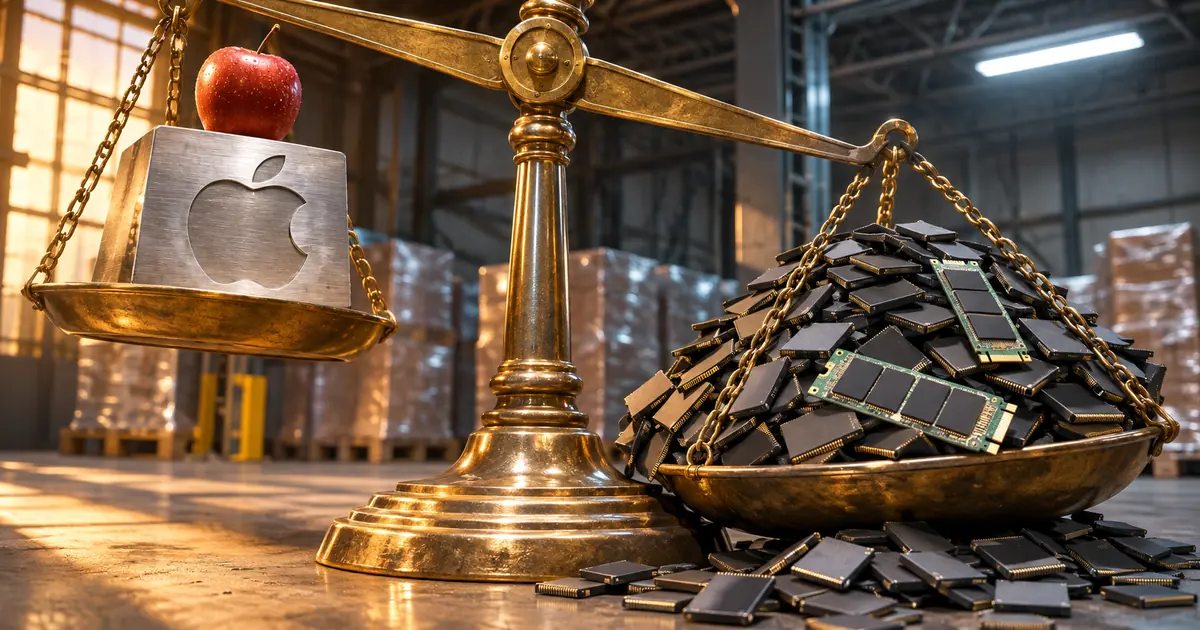
Flash prices rose fivefold as hyperscalers outbought Apple
Flash memory, the chips that hold an iPhone's photos and apps, got five times more expensive in a year as AI data centers bought more of it, and Apple is no longer the biggest buyer. The Wall Street Journal reported the shift on October 28, 2026, citing estimates from the research firm TechInsights.
For years Apple bought more flash than anyone and used that volume to set the terms. Hyperscalers, the cloud giants that run huge data centers, now hold that position.
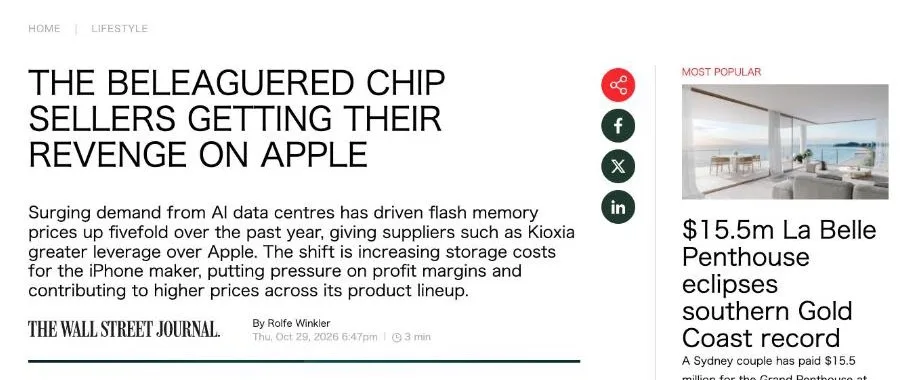
"Surging demand from AI data centres has driven flash memory prices up fivefold over the past year, giving suppliers such as Kioxia greater leverage over Apple."View official source →
Per-gigabyte prices jumped 550% from the 2023 low
A price that had been falling for nearly two decades turned around and climbed 550% from its 2023 bottom. According to the WSJ, flash cost $68 a gigabyte in 2005 and had dropped to a nickel by 2023. AI demand has since pushed it above 30 cents a gigabyte.
| Year | Price per gigabyte |
|---|---|
| 2005 | $68 |
| 2023 | 5 cents |
| October 2026 (WSJ report) | More than 30 cents, up 550% from 2023 |
"Flash that cost $68 a gigabyte in 2005 had fallen to a nickel by 2023. Now, demand by the AI industry has lifted the price to more than 30 cents a gigabyte, a 550% jump"View official source →
Hyperscalers now buy twice as much flash as Apple
In two years the buying order flipped, from Apple at nearly twice the four largest cloud buyers combined to the cloud giants at twice Apple. TechInsights estimates that two years ago Apple bought nearly twice as much flash as Microsoft, Amazon, Meta and Google put together. Today those hyperscalers buy double Apple's share.
| When | Bigger buyer | By how much |
|---|---|---|
| Two years ago | Apple | Nearly twice the four cloud giants combined |
| October 2026 (WSJ report) | Cloud giants | Twice Apple's share |
"In the past year, demand by AI hyperscalers has quintupled prices for flash, according to research firm TechInsights, opening a new era for Kioxia and other suppliers. Two years ago, Apple bought nearly twice the flash storage of Microsoft, Amazon, Meta and Google combined, according to TechInsights estimates. Hyperscalers are now buying double Apple’s share."View official source →
Apple once used its size to squeeze suppliers
Apple made flash makers open their books so it could watch their sales and make sure no rival paid less. As the world's largest flash buyer, Apple pressed suppliers for every cent, the WSJ reported. Japan's Kioxia had little room to push back.
Walt Coon, an analyst at TechInsights, told the WSJ that Apple has historically been a very tough negotiator with memory suppliers. He added that many suppliers are pleased now that the balance of power is moving their way. Apple said in a statement that its partnerships with suppliers go back decades and that it values them.
"His Japan-based manufacturer, Kioxia, had little leverage. Apple was the world’s biggest buyer of flash—the chips in iPhones that store photos, music and apps—and used its position to squeeze every cent from suppliers. Apple bullied flash makers into opening their books so it could monitor sales, making sure no one else got a better deal."/"“Apple has historically driven a very hard bargain with memory suppliers,” said Walt Coon, an analyst at TechInsights. “And there’s no shortage of satisfaction among suppliers now that the balance of power is shifting.”"/"“We’ve worked with many of our suppliers for decades, and we deeply value their partnership over the years,” Apple said in statement."View official source →
Hyperscalers lock in supply with higher-priced long-term deals
Meta, Microsoft and Amazon secured long-term flash supply from Kioxia in 2026 by agreeing to pay higher prices. A long-term agreement commits a supplier to deliver to a buyer over several years. According to the WSJ, these contracts shield Kioxia's profits even if the market turns, and Kioxia declined to comment. The paper also notes that the cloud giants' costs differ from Apple's in two ways.
| Difference | What it means |
|---|---|
| Cost share | Flash is a smaller part of the cost of building a data center than of making an iPhone |
| Accounting | Accounting rules let companies spread the cost over several years |
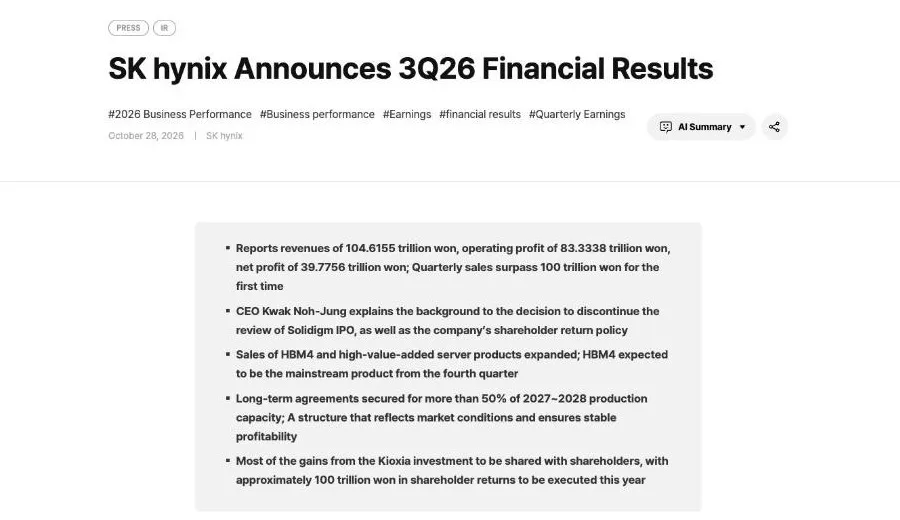
Other memory makers are signing similar deals. SK hynix said in its October 28 earnings release that its long-term agreements, signed with customers that include leading cloud providers, now cover more than half of its production capacity for 2027 and 2028.
"Meta, Microsoft and Amazon signed contracts with Kioxia this year to secure long-term supply by committing to higher prices. The contracts protect Kioxia’s profits if the market turns. The company declined to comment."/"Flash storage is a smaller part of building a data center than making an iPhone, and accounting rules allow companies to spread the cost over years."View official source →
"The company has currently signed LTAs with 14 major customers, including leading global cloud service providers (CSPs), and is also proactively discussing with a number of customers the possibility of extending the contract terms, which are typically five years."/"The LTA volume secured to date corresponds to more than 50% of total production capacity for 2027 and 2028."View official source →
Apple's flash bill is set to quadruple for about the same volume
Apple's bill is rising because each gigabyte costs more, not because it is buying more, and that squeezes the margin it has long made on storage upgrades. TechInsights estimates that Apple will spend $25 billion on flash in 2026. That buys roughly the same amount of storage Apple got for $6 billion in 2025, so the bill is more than four times larger.
"Apple is expected to spend $25 billion on flash storage this year for about the same amount it bought for $6 billion in 2025, according to estimates by TechInsights."View official source →
Doubling iPhone 17 Pro storage now costs Apple $66, up from $15
The margin Apple earns on its $200 storage upgrade is under pressure as the cost of the extra flash has more than quadrupled. A WSJ analysis found that iPhone 17 Pro buyers paid Apple $200 to go from the 256GB base model to double the storage. At launch, that extra storage cost Apple $15, and it now costs $66.
| At launch (2025) | October 2026 (WSJ report) | |
|---|---|---|
| Upgrade price paid by buyers | $200 | — |
| Apple's cost for the extra storage | $15 | $66 |
Storage upgrades have been among Apple's most profitable sales. From the launch of the iPhone and iPad through 2025, Apple kept an average of more than 80 cents in gross profit for every dollar buyers paid for extra storage, the WSJ found. For Macs sold since 2010, the figure was nearly 80 cents.
"Buyers of the iPhone 17 Pro paid Apple $200 last year for double the storage of its 256-gigabyte base model. The extra storage at the time cost Apple $15 and has since shot up to $66, according to an analysis by The Wall Street Journal."/"Apple recorded an average gross profit of more than 80 cents for every dollar it charged iPhone and iPad buyers for extra storage since it first released those devices through 2025, the Journal found. For Mac computers sold since 2010, it averaged nearly 80 cents."View official source →
Tim Cook likened the price surge to a "100-year flood"
People familiar with Apple's purchasing say the company ignored analysts' warnings and was caught off guard. Tim Cook, Apple's executive chairman, has compared the climb in memory chip prices to a "100-year flood." According to the same people, Apple's executives believed they understood the market better than anyone.
"Tim Cook, Apple’s executive chairman, compared escalating memory chip prices to a “100-year flood.”"/"Yet Apple had ignored analysts’ warnings and was caught off guard, said people familiar with the company’s procurement practices."/"Company executives believed they knew the market better than anyone else, the people said."View official source →
iPhone prices rose 13% on average, older models included
Apple has raised prices on nearly everything it sells, including older iPhones that normally get cheaper. iPhone prices rose 13% on average over recent months, according to the WSJ. Older models usually get a price cut when a new generation arrives, but this time they went up too. Mark Newman, an analyst at Bernstein Research, described the relationship between Apple and the flash industry as "love-hate."
"In recent months, Apple raised prices for nearly all of its products. Prices rose an average of 13% for iPhones, an increase that included older models which typically get a price cut."/"“It’s been a love-hate relationship between Apple and the flash industry,” said Mark Newman, an analyst with Bernstein Research."View official source →
Memory makers expect tight supply to last
Neither a market research firm nor a major seller sees the squeeze easing soon. TrendForce published its outlook for the fourth quarter of 2026, and SK hynix gave its view of supply and demand through 2030. TrendForce ties the price rise to cloud providers' data center demand, while SK hynix points to hard-to-make chips and slow fab construction.
TrendForce sees NAND contract prices up 15–20% in Q4
The steepest increases are in enterprise SSDs bought by cloud providers, while phone makers are getting by on inventory. On September 30, TrendForce said it expects contract prices for NAND flash, the industry term for flash memory, to rise 15–20% in the fourth quarter from the third. Contract prices are what large buyers pay under supply deals, as opposed to spot prices.
| Product | TrendForce outlook for Q4 2026 |
|---|---|
| NAND flash overall | Contract prices up 15–20% from Q3 |
| Enterprise SSDs | The only memory category where price growth is accelerating; 2026 demand by capacity up more than 80% year on year |
| Phone storage (eMMC, UFS) | Smartphone brands rely largely on existing inventory, with very limited new purchases |
Enterprise SSDs are the high-capacity drives used in servers. TrendForce attributes the demand jump to cloud providers expanding the infrastructure that runs AI inference, the stage where a trained model answers prompts.
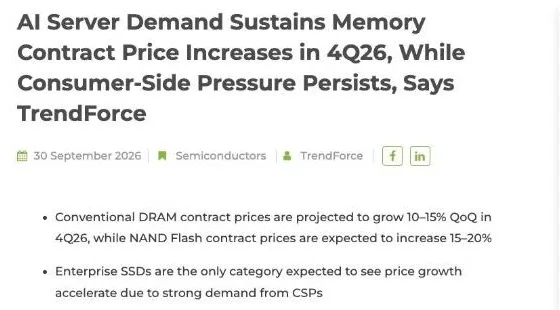
"Overall NAND Flash contract prices are projected to increase 15–20% QoQ."/"Bit demand for enterprise SSDs is projected to grow by more than 80% YoY in 2026 as CSPs continue to expand AI inference infrastructure."/"Enterprise SSD price growth is therefore expected to accelerate in 4Q26, making it the only memory product category to see a larger increase than in the previous quarter."/"For eMMC/UFS, smartphone brands—the primary source of demand—are largely relying on existing inventories to support fourth-quarter production, resulting in very limited incremental procurement from suppliers."View official source →
SK hynix expects demand to outrun supply through 2030
The seller's view is that hard-to-make chips and slow fab construction will keep supply behind demand. In its October 28 earnings release, SK hynix said it expects demand for memory to exceed supply through 2030. That forecast comes from a company that profits from higher prices, so it is one seller's outlook rather than a neutral estimate.
Apple has already looked for other sources. In July 2026, reports said Apple had asked the US government for permission to use memory from Chinese makers, a plan Micron opposed (related: Apple CXMT plan: Lutnick says no to Chinese memory).
"Given technical difficulty of leading-edge processes and the long lead time required to build new production facilities, it expects the structure in which demand exceeds supply to persist through 2030."View official source →
Summary: volume and contracts now favor the cloud giants
Apple's discounts rested on being the biggest buyer, and now that cloud giants buy more and have locked in supply with long-term deals, memory makers hold the stronger hand. The price surge is being led by enterprise SSDs for data centers, not by phone storage. That leaves Apple paying prices set largely by someone else's demand.
Cheap flash once made storage upgrades one of Apple's richest sources of profit. With the cost of that extra storage up more than fourfold, the margin is under pressure, and iPhone buyers are seeing higher prices across new and older models.
FAQ
- Why can't Apple get cheap flash memory anymore?
- Apple is no longer the biggest buyer. TechInsights estimates that two years ago Apple bought nearly twice as much flash as Microsoft, Amazon, Meta and Google combined, and those cloud giants now buy twice Apple's share. Meta, Microsoft and Amazon also locked in supply from Kioxia in 2026 with long-term contracts at higher prices.
- How much does it cost Apple to double iPhone 17 Pro storage now?
- A WSJ analysis puts it at $66, up from $15 when the iPhone 17 Pro launched. iPhone 17 Pro buyers paid Apple $200 to double storage from the 256GB base model.
- How long will the memory shortage last?
- SK hynix said on October 28, 2026 that it expects demand to exceed supply through 2030, because leading-edge processes are difficult and new fabs take a long time to build. That is the view of a seller that benefits from higher prices.
Related articles
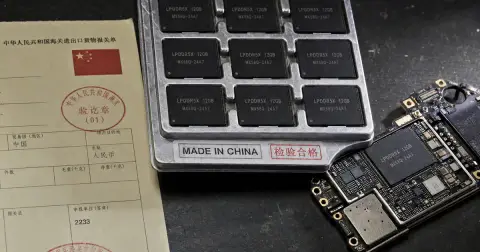 Apple CXMT plan: Lutnick says no to Chinese memoryThe Apple CXMT plan would put CXMT and YMTC memory in products sold outside the US. Micron and senators oppose it, as does the administration, per Lutnick.
 Apple Intelligence launches in China with QwenApple Intelligence comes to iPhones in China with iOS 27.3 in December. Alibaba's Qwen handles some Siri and Writing Tools requests, but Siri AI is left out.
 Siri AI supported devices and the waitlist stepsSiri AI supported devices start at iPhone 15 Pro. Here is the storage each needs, the six languages in iOS 27.2, and how to join the waitlist in Settings.
 Apple MCP in Keynote, Pages and Numbers explainedApple MCP support comes to Keynote, Pages and Numbers in November, letting outside AI agents read and edit documents on macOS 27, plus a beta assistant.