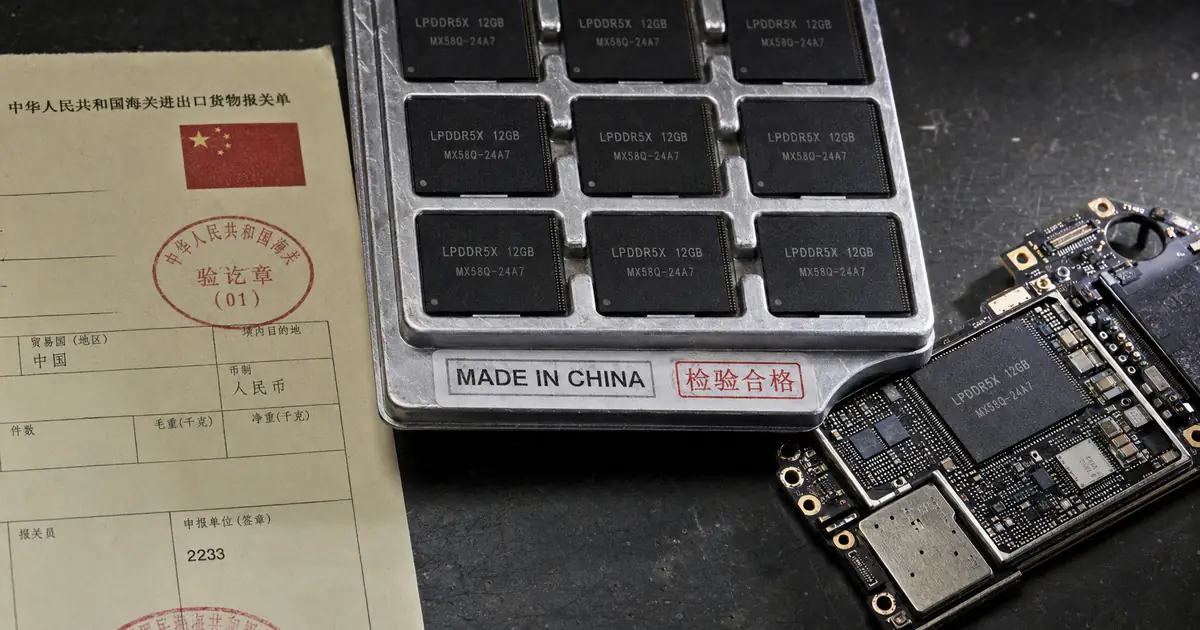
Apple wants CXMT and YMTC memory for products sold abroad
How the Apple CXMT request came to light
| Date | Event |
|---|---|
| June 2026 | Apple raises prices on several products and asks the Trump administration whether buying from Chinese memory makers would be acceptable |
| June 28 | TechPowerUp relays a Financial Times report that Apple is in talks with the US government to clear CXMT |
| July 8 | MacRumors, citing the FT, reports that Apple is testing CXMT DRAM with no commercial commitment |
| July 24 | The Wall Street Journal reports that the request covers products sold anywhere outside the US |
Apple is asking the Trump administration to let it use memory from CXMT and YMTC, two Chinese chipmakers, in products sold outside the US. It is making the request during a memory shortage that had already pushed Apple to raise prices. Reports since late June have filled in the details, and no supply deal with either company has been announced.
Apple's request covers products sold anywhere outside the US
Apple wants approval to put the chips in products for every market outside the US, not only in devices for China, the Wall Street Journal reported on July 24, 2026. The Journal said Tim Cook and other senior executives pitched the idea to President Trump, Commerce Secretary Howard Lutnick and Treasury Secretary Scott Bessent.
The request looked narrower in earlier coverage. A July 8 MacRumors report, citing Bloomberg, said Cook's pitch was to use Chinese memory in devices for the Chinese market. The Journal's report about two weeks later described a broader request covering every market except the US.
Strictly speaking, Apple does not need Washington's permission. 9to5Mac noted on July 29 that no law requires government approval for Apple to buy from either company, though doing so without the administration's support could carry a political cost. MacRumors, citing the Financial Times, also reported that Apple was testing CXMT's DRAM and leading a lobbying push among US tech companies for Washington's approval.
"In recent weeks, Apple Chief Executive Tim Cook and top executives have pitched Trump and officials including Commerce Secretary Howard Lutnick and Treasury Secretary Scott Bessent on a plan to use memory chips from China’s ChangXin Memory Technologies and Yangtze Memory Technologies in Apple products sold outside the U.S., people familiar with the discussions said." — 9to5Mac's excerpt from the Journal, July 24, 2026View official source →
"Legally, Apple is not required to obtain US government approval to purchase chips from the companies, but doing so without the administration’s support could expose it to significant political ramifications." — from the "A bit of context" section, July 29, 2026View official source →
"Apple has apparently still not committed to using CXMT's chips commercially, and is continuing to lead a lobbying effort among U.S. tech companies to get Washington's blessing for broader use of the supplier's products." — MacRumors, July 8, 2026View official source →
Pentagon lists CXMT and YMTC, and YMTC is on the Entity List
Both chipmakers appear on the Pentagon's Section 1260H list of Chinese military companies, and YMTC is on the Commerce Department's Entity List as well. They make different kinds of memory: CXMT mostly produces DRAM, the fast working memory apps use while running, and YMTC concentrates on NAND flash, the storage that keeps the operating system and files when the power is off.
Both are still on the list after the Defense Department's June 2026 update. MacRumors notes that the label mainly restricts defense contracting and does not usually block ordinary commercial purchases, and eWeek makes the same point.
The Entity List governs what can be shipped to YMTC. The Commerce Department's Bureau of Industry and Security added YMTC on Dec. 15, 2022, and from the next day any item covered by US export rules needed a license to go to YMTC, with applications denied by default.
CXMT is already a major supplier. MacRumors ranks it fourth among DRAM makers after Samsung, SK Hynix and Micron, with about 11% of global DRAM wafer capacity in 2025 and a projected 15% by 2028.
"ChangXin Memory Technologies, Inc. (CXMT)"/"Yangtze Memory Technologies Co., Ltd. (YMTC)" — two of the entries in the Pentagon's list of Chinese military companiesView official source →
"Two PRC entities that were on the UVL—Yangtze Memory Technologies Co, and Shanghai Micro Electronics Equipment (Group) Co., Ltd – are being added to the Entity List for reasons not related to the prevention of an end-use check."/"The effective date for both rules is December 16, 2022." — from the release announcing the additions to the Entity ListView official source →
"These entities are added with a license requirement for all items subject to the EAR and a license review policy of presumption of denial for all items subject to the EAR." — from the paragraph adding Yangtze Memory Technologies Co., Ltd. and two related entitiesView official source →
"CXMT has grown from a heavily subsidized and unremarkable domestic chip maker into the world's fourth-largest DRAM producer, behind Samsung Electronics, SK Hynix, and Micron Technology, accounting for roughly 11% of global DRAM wafer capacity last year. That share is expected to climb to 15% by 2028 as new production lines come online in Hefei, Shanghai, and Beijing." — MacRumors, July 8, 2026View official source →
AI data centers are absorbing memory supply
Micron quarterly revenue, a year apart
Fiscal Q3 2026 ended on May 28, 2026. Revenue was more than four times the same quarter a year earlier.
AI data centers are soaking up memory supply, eWeek reports, and Micron's fiscal third quarter shows how much: revenue of $41.46 billion, up from $9.30 billion a year earlier. Micron reported the quarter on June 24, 2026, with CEO Sanjay Mehrotra crediting the record to memory's strategic value in the AI era. The same AI build-out has tightened memory supply and raised component costs, according to eWeek, and PrimeXBT says it has sent DRAM and NAND prices sharply higher.
Micron's business-unit table puts about 63% of that jump in data centers. Its Cloud Memory and Core Data Center units together brought in about $25.3 billion in the quarter, compared with about $4.9 billion a year before.
According to eWeek, Apple has also looked at Intel and Samsung manufacturing to give itself more flexibility in chip supply. The same rush for AI hardware runs through other recent deals, such as AMD Anthropic Deal: Up to 2GW MI450 and $5B Stake and OpenAI Jalapeno Chip: Inference Benchmarks 2026.
"Revenue of $41.46 billion versus $23.86 billion for the prior quarter and $9.30 billion for the same period last year"/"“Micron’s record fiscal Q3 financial results and even stronger outlook for Q4 reflect the strategic value of memory in the AI era,” said Sanjay Mehrotra, Chairman, President and CEO of Micron Technology." — from the "Fiscal Q3 2026 highlights" of Micron's release, June 24, 2026View official source →
Apple raised prices before the plan surfaced
The memory shortage led Apple to raise prices on several products in June 2026, before its talks about Chinese suppliers were public. Shortly before the increases, Tim Cook told the Wall Street Journal that the US should rethink its restrictions on certain Chinese suppliers, saying "everything needs to be on the table" and "we should look at all supply."
Every iPhone, Mac and iPad contains memory chips, so a tighter memory market shows up in what Apple devices cost. One more supplier could give Apple extra capacity and more bargaining power with Samsung, SK Hynix and Micron, according to eWeek.
"Which is why, in an interview with The Wall Street Journal ahead of Apple’s recent price hikes, Tim Cook said that “everything needs to be on the table,” adding that “we should look at all supply.”" — 9to5Mac, July 29, 2026View official source →
Micron is lobbying against Apple's Chinese memory plan
Micron, the only large US memory chipmaker, is pressing the administration to turn Apple's plan down, the Wall Street Journal reported on July 24. CXMT makes DRAM just as Micron does, so approval would put one of Micron's direct competitors into Apple's supply chain.
Micron warns of a repeat of what happened to US steel
Letting Chinese memory makers sell to US tech companies could gut the US memory industry, Micron executives including CEO Sanjay Mehrotra told Lutnick and other officials, according to the Journal. They likened the risk to China's role in the decline of US steel and manufacturing plants. Since Micron's argument applies to devices sold anywhere, keeping the chips out of US-market products would not address it.
Seven senators made much the same argument later in their letter to Apple. Beijing, they wrote, had used this approach in many supply chains before, including steel, batteries and shipbuilding.
"Those arguments have been countered by Micron, the only sizable U.S. maker of memory chips. Micron executives including CEO Sanjay Mehrotra have warned Lutnick and other administration officials that allowing CXMT and other Chinese companies to sell to U.S. tech companies, regardless of the region of sale, could destroy the domestic industry the same way China played a role in decimating U.S. steel and manufacturing plants, the people said." — the Journal's account of Micron's lobbying, as excerpted by 9to5MacView official source →
"Beijing has run this same playbook in countless critical supply chains before including steel, batteries, and shipbuilding" — from the senators' letterView official source →
Micron offers domestic plants as its alternative
Micron's fix for the shortage is to make more memory in the US. It says it can help by speeding up construction of domestic plants and raising its US investment, according to the Journal. PrimeXBT counts Micron among the three makers of leading-edge DRAM, with Samsung and SK Hynix, and notes the substantial CHIPS Act funding it has received to grow US capacity.
Micron is not a neutral party here. CXMT is its DRAM competitor, and the data-center demand that squeezed memory supply also delivered Micron's record fiscal Q3 2026 revenue shown in the chart above.
"Additionally, the Journal reports that Micro says that it can help ease the shortage by accelerating construction of domestic plants and increasing US investment." — 9to5Mac, July 24, 2026 ("Micro" in the original is a typo for Micron)View official source →
"Micron is one of only three companies globally that manufactures cutting-edge DRAM, alongside Samsung and SK Hynix. It has received substantial CHIPS Act funding to expand US manufacturing capacity." — from the "The Micron factor" sectionView official source →
Senators and Lutnick have pushed back since July
How Washington responded to the Apple CXMT plan
| Date | Event |
|---|---|
| July 24 | The White House tells the Journal only that it will seek investment and economic relief while safeguarding national security |
| July 29 | Bloomberg reports a bipartisan Senate letter urging Apple to drop the plan |
| July 30 | The Senate Foreign Relations Committee publishes the letter |
| Aug. 14 | The Journal reports Lutnick saying the administration is "not in favor" |
| Aug. 21 | The senators' deadline for Apple's answers |
The opposition has grown since late July, from Micron to the Senate and then to the Commerce Secretary himself. On July 24 the White House gave the Journal a statement that took no position, and three weeks later Lutnick's remarks put the administration on record against the plan.
A bipartisan Senate letter set an Aug. 21 deadline
Seven senators from both parties asked Tim Cook to commit to keeping CXMT and YMTC memory out of every Apple product sold anywhere, and to reply by Aug. 21, 2026. Bloomberg reported the letter on July 29, as relayed by 9to5Mac, and said it was led by Republican Jim Banks of Indiana and Democrat Chuck Schumer of New York. The Senate Foreign Relations Committee published it on July 30, with Jeanne Shaheen, Mike Crapo, Andy Kim, Jim Risch and Pete Ricketts also signing.
The senators called the plan short-sighted and said a limit to devices sold in China could not be expected to hold, because once a part is approved for Apple production, one more purchasing decision could take it worldwide. They also asked what product details Apple had shared, or would share, with the suppliers while testing their chips. The letter recalls that Apple evaluated YMTC NAND for the iPhone in 2022 and dropped it after congressional scrutiny.
Bloomberg's account, as passed on by 9to5Mac, says the senators also warned that other companies might follow Apple's lead. That, in their view, could weaken domestic memory production and planned investments in Indiana, Idaho, New York and Virginia.
"This short-sighted move would be a mistake, and it would ensure the world’s most valuable consumer-electronics company grows dependent on critical supplies from a firm the United States government has formally designated as a Chinese military company."/"The limitation that CXMT memory would, for the moment, be confined to devices sold in China cannot be expected to hold, because once a part clears qualification for Apple production, extending it worldwide is a single procurement decision away."/"Accordingly, we request your responses to the following by August 21, 2026: Will Apple commit that it will not incorporate CXMT or YMTC memory into any Apple product, whether sold in the United States or abroad?" — from the senators' letterView official source →
Lutnick said on Aug. 14 the administration is not in favor
Commerce Secretary Howard Lutnick told the Wall Street Journal, in an interview reported on Aug. 14, 2026, that the administration is "not in favor" of Apple using Chinese memory. He spoke after touring an Apple manufacturing site in Houston and said he had told Apple so "plainly."
The memory problem needs fixes other than US companies buying Chinese chips, Lutnick added. In the same report, Apple COO Sabih Khan said memory involves little customization, which 9to5Mac read as leaving room for off-the-shelf Chinese chips. Custom parts would be another matter, 9to5Mac says, since sharing product information with CXMT or YMTC falls under US export controls and needs a Commerce Department license.
"“The Trump administration is not in favor of that,” Lutnick said in an interview after touring an Apple manufacturing facility in Houston. There have to be “other solutions to the memory issue, but it’s not great American companies using Chinese memory.”"/"When asked by the WSJ whether he had relayed the Trump administration’s opposition to the idea directly to Apple, Lutnick said he had done so “plainly.”" — 9to5Mac's excerpt from the Journal, August 14, 2026View official source →
"In a statement to the Journal, a White House spokesperson offered little direct indication of how the administration plans to square Apple’s and Micron’s competing priorities, saying only that it would pursue “investments and economic relief for the American people while safeguarding our national security.”" — the White House's response in July, via 9to5MacView official source →
Apple CXMT plan: still unapproved, suppliers look inward
Nothing has been approved or bought as of Sept. 29, 2026, and Apple has not publicly answered the senators, whose deadline was Aug. 21. Apple asked to use CXMT and YMTC memory, and Micron, the senators and Lutnick have each opposed it. The next move belongs to Apple and Washington, and to the two Chinese suppliers as well.
No approval or purchase has been reported as of Sept. 29
eWeek wrote on Aug. 2 that the available reporting did not show CXMT or YMTC chips in any Apple product on sale, and no supply deal has been announced since. Until Apple confirms a production decision, eWeek added, the two are possible suppliers rather than confirmed ones. Apple has not said publicly whether it made the commitment the senators requested.
For federal buyers, one date is already set. Section 5949 of the fiscal 2023 defense authorization law will bar federal agencies from buying products that use CXMT or YMTC chips starting in December 2027, as the senators' letter points out. A proposed federal purchasing rule describes how that ban would apply, eWeek says, with the details depending on the final rule, statutory exceptions and waivers.
"No agreement has been announced, and available reporting does not establish that chips from either company are used in commercially available Apple products."/"Until the company confirms a production decision, CXMT and YMTC remain potential — not confirmed — sources for Apple hardware." — eWeek, August 2, 2026View official source →
"Section 5949 of the FY 2023 NDAA barred federal agencies from acquiring products that use CXMT and YMTC semiconductors beginning in December 2027." — from the senators' letterView official source →
The Chinese suppliers have their own priorities
Industry insiders cited by BigGo Finance say CXMT and YMTC are putting demand inside China ahead of Apple. In their view the two treat Apple's supply chain as a test of product quality, and a Taiwan-based industry report from Aug. 26, also cited by BigGo, says neither plans to supply Apple at scale. BigGo reports that both are focused on domestic demand from AI servers and cloud computing, and that they aim to lift China's memory self-sufficiency above 50% between late 2027 and 2028.
Both are raising money of their own, too. CXMT raised 29.5 billion yuan (about $4.4 billion) in its listing on Shanghai's STAR Market, and YMTC was preparing an even bigger IPO, according to BigGo. China AI Chips: Ding Xuexiang's Reported Warning covers Beijing's broader push for Chinese companies to buy homegrown chips.
"Industry insiders say CXMT and YMTC view Apple's supply chain as a litmus test for product quality, but are far more focused on expanding capacity and prioritizing surging domestic demand from AI servers and cloud computing."/"Both companies plan to lift China's domestic self-sufficiency rate above 50% by late 2027 to 2028." — from BigGo's summary of the reportView official source →
FAQ
- What is Apple asking for with CXMT and YMTC?
- Apple wants the Trump administration to accept its use of memory chips from China's CXMT and YMTC in products it sells outside the US, not only in devices for China. The Wall Street Journal reported on July 24, 2026, that Tim Cook and other executives made the case to President Trump, Commerce Secretary Howard Lutnick and Treasury Secretary Scott Bessent.
- Has the Trump administration approved Apple buying CXMT memory?
- No approval had been announced as of Sept. 29, 2026. Commerce Secretary Howard Lutnick told The Wall Street Journal, in an interview reported on Aug. 14, that the administration is not in favor of the plan and that he had told Apple so plainly.
- Is it illegal for Apple to buy chips from CXMT or YMTC?
- No law requires Apple to get government approval first. The Pentagon lists both companies as Chinese military companies, a label that mainly affects defense contracting, and YMTC is also on the Commerce Department's Entity List, so anyone sending it items subject to US export rules needs a license. Buying without the administration's support could still carry a political cost for Apple.
- What did the senators ask Apple to do?
- Seven senators from both parties asked Tim Cook to commit that no CXMT or YMTC memory will go into any Apple product, whether sold in the US or abroad. They asked for answers by Aug. 21, 2026, including what product information Apple has shared, or would share, with the two suppliers.
Related articles
 Flash prices up 5x on AI, eroding Apple's leverageAI demand made flash 5x pricier in a year, the WSJ reports. Cloud giants now buy twice as much as Apple, and doubling iPhone 17 Pro storage costs Apple $66.
 PC shipments fell 20.1% in Q3 as prices stay highIDC says worldwide PC shipments fell 20.1% to 62.7 million in Q3 2026 after a first-half stock-up. AI data center demand keeps prices high, and HP fell 30.9%.
 Nvidia Price Increase: AI Servers Up More Than 15%Bloomberg reports the Nvidia price increase: AI servers up more than 15% in many cases from early 2027 on memory costs. Q3 gross margin guide: 74.0%.
 Apple Intelligence launches in China with QwenApple Intelligence comes to iPhones in China with iOS 27.3 in December. Alibaba's Qwen handles some Siri and Writing Tools requests, but Siri AI is left out.