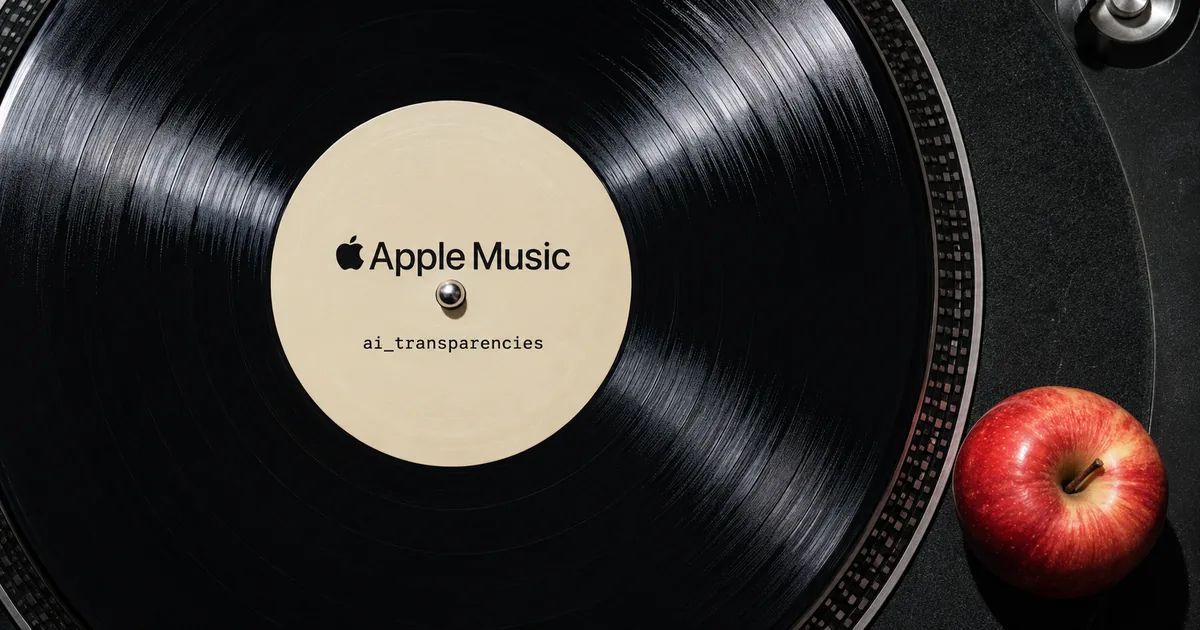
Who tags AI-generated music on Apple Music
An Apple Music AI tag is a piece of delivery metadata, the same kind of data as a genre or a songwriter credit. The label or distributor adds it when it sends a release to Apple, and Apple only decides how to show it to listeners. The table below shows which side does each job.
Who does what with the Apple Music AI tag
| Job | Labels and distributors | Apple |
|---|---|---|
| Decide whether AI use counts | Yes | Leaves it to the provider |
| Add the tag at delivery | Yes, now required | — |
| Show the label to listeners | — | Yes, later this year |
In short, the label or distributor both decides and tags. Apple's job is the display.
Apple Music distributors and labels carry the AI tag duty
Apple has left the judgment to content providers since the tags launched on March 4, 2026. It treats AI use like genres, credits and other metadata.
In its newsletter, Apple said that tagging content properly is the first step toward giving the industry the data it needs to set AI policy. It also said labels and distributors must take an active part in reporting AI use.
Music Business Worldwide read this as putting disclosure on the supply chain rather than on the platform. It pointed out that Deezer took a different route, building its own detection system instead of relying on self-reporting.
For an independent artist, the practical point is that the distributor sends the tag, but the artist is the one who knows how the music was made. A distributor can only tag what it has been told. So the information has to travel from the artist to the distributor before the release goes out.
"similar to genres, credits, and other metadata,"/"it defers to content providers to determine what qualifies as AI-generated content."/"“Proper tagging of content is the first step in giving the music industry the data and tools needed to develop thoughtful policies around AI,”"/"“and we believe labels and distributors must take an active role in reporting when the content they deliver is created using AI.”"/"The announcement places the responsibility for disclosure squarely on the content supply chain rather than at the platform level…"/"Deezer, for example, has spent the past year building its own AI detection infrastructure, identifying AI-generated content through technical analysis rather than relying on self-reporting."(Music Business Worldwide・the newsletter quotes and the surrounding analysis; the second fragment continues the sentence the first one opens)View official source →
What Apple Music does with the Made With AI label
The Made With AI label is the part listeners will see. Content tagged as materially generated using AI will carry it, and it will be visible to every Apple Music user. 9to5Mac reports that Apple wants to give listeners as much transparency as possible.
The timing is still open. The email said the label arrives later this year and gave no date.
For anyone who delivers music, though, the label launch is not the deadline. The tagging rule applies to deliveries now.
9to5Mac also reports that Apple points creators to its Music Style Guide. The tag definitions themselves sit in the Apple Music Specification, which Apple revises from time to time.
"Apple sent emails to its music industry partners about the upcoming launch of a Made With AI label that Apple will apply to AI-generated content"/"Content tagged as being"/"materially generated using AI"/"will have a label visible to all…"/"Apple's email did not give a specific timeline for the launch of the AI labels in"/"but said they will show up"/"later this year."(MacRumors・fragments two to four are one sentence split at Apple's quotation marks; the last three are one sentence split the same way)View official source →
"provide listeners with as much transparency as possible,"/"refers creators to its"(9to5Mac・the second fragment is followed by a link to the Music Style Guide)View official source →
What makes AI-generated songs need an Apple Music tag
A song needs an Apple Music AI tag when AI created a material portion of it. Apple describes the rule in words rather than numbers, so the label or distributor has to decide where the line falls.
Material portion and AI platform generated songs
The email requires a tag in any case where AI created a material portion of the content. It also names tracks generated on AI platforms as included. Apple defines that category as anything primarily derived from a generative AI service.
Neither phrase comes with a percentage. A song that a generative music service produced from a text prompt clearly falls inside the rule.
A song an artist wrote, sang and played, with one AI tool used to clean up a vocal take, is the hard case. Apple has not said where that kind of song falls, so the provider has to decide and stay consistent.
Leaving that call to the provider is not new. Back in March, when the tags were still optional, Apple already said the provider decides what counts as AI-generated. The August email changed whether a tag is required, not who judges.
"AI Transparency Tags are required in"/"any instance where AI was used to create a material portion of the content, including tracks that are AI platform generated."/"Apple said AI-platform-generated content is defined as"/"anything that is primarily derived from a generative AI service."/"Apple said at the time that the tags were optional, and it would defer to content providers to determine what qualifies as AI-generated."(MacRumors・the second and fourth fragments are Apple's own wording from the August email; the last is the March position)View official source →
Four Apple Music transparency tags at different levels
Apple Music transparency tags are four separate tags, one for each creative element of a release. Apple launched them on March 4, 2026. The table below shows where each one applies.
The four Apple Music transparency tags
| Tag | Applied at | Covers |
|---|---|---|
| Artwork | Album level | Static or motion graphic artwork |
| Track | Track level only | The sound recording |
| Composition | — | Lyrics and other compositional elements |
| Music Video | Bundled or standalone | Visual content |
A provider can apply more than one tag to the same release. Take an album with human vocals and AI-made cover art. It would carry the Artwork tag without the Track tag, so the release is described element by element instead of with one yes-or-no answer.
One gap needs attention. The public Apple Music Specification 5.3.26, as of August 23, 2026, still marks the tag optional at album, track and video level.
If a tag is left out, the spec says none is assumed. The "required" wording comes from the partner email, so delivery teams should follow the email and confirm the details with their Apple contact or distributor.
"When artificial intelligence is used to generate a material portion of the content, you disclose this information using the"(the tag name follows)/"Album Artificial Intelligence (AI) Transparencies"/"Track Artificial Intelligence (AI) Transparency"/"Video Artificial Intelligence (AI) Transparency"/"optional; may be updated"(the qualifier printed beside each of those three headings)/"If omitted, none is assumed."(Apple Music Specification)View official source →
"The platform has launched what it is calling Transparency Tags — a system of disclosure labels that record labels and music distributors can begin applying to content delivered to Apple Music immediately, and will be required to use when delivering new content in future."/"The new framework covers four key creative elements: Artwork, Track, Composition, and Music Video."/"The Artwork tag, applied at the album level, flags when AI has been used to generate a material portion of static or motion graphic artwork. The Track tag — available at the track level only — is used when AI generates a material portion of a sound recording. The Composition tag covers AI-generated lyrics or other compositional elements, while the Music Video tag applies to any visual content, whether bundled with albums or delivered as standalone."/"Labels and distributors can apply multiple tags simultaneously"(Music Business Worldwide・the launch paragraph, the four-element summary, the per-tag detail and the subheading on multiple tags)View official source →
How much AI-generated music reaches Apple Music
AI-generated music makes up a large share of what is uploaded to Apple Music but a tiny share of what people play. Two figures from Apple Music's head are the only public numbers on that split.
A third of uploads, half a percent of Apple Music plays
Oliver Schusser, who runs Apple Music, gave both figures on Billboard's podcast. More than a third of the music uploaded each month is fully AI-generated, yet it makes up less than 0.5% of all listening on Apple Music.
Fully AI-generated music on Apple Music
Both figures are as reported from Schusser's remarks; Apple has not published exact values.
| Measure | Share |
|---|---|
| Monthly uploads that are fully AI-generated | More than a third |
| Listening on the service | Less than 0.5% |
Read together, the figures show a catalog problem more than a listening problem. A label helps listeners sort a crowded catalog without taking songs down. Schusser also said Apple has an in-house system for detecting AI, but that Apple still relies on the people who make the content to disclose AI use.
"he said that although more than a third of the music uploaded to Apple Music each month is fully AI-generated, it accounts for less than 0.5% of listening on the service."(9to5Mac・reporting Schusser's remarks on Billboard's podcast)View official source →
"Schusser said Apple has an in-house system for detecting AI, but is still relying on content makers to disclose AI use."(MacRumors)View official source →
Apple Music AI policy steps for a delivery workflow
The Apple Music AI policy comes down to four steps for anyone who delivers releases. None of them has to wait for the label launch.
- Ask each artist, before delivery, whether AI created a material portion of the release and in which element.
- Decide the tag per element: artwork, track, composition and music video are judged separately.
- Write down the in-house rule for "material portion", with examples, so a second person makes the same call.
- Keep a dated copy of the Apple Music Specification and compare it when Apple revises the page.
Because the provider owns the judgment, keeping calls consistent across releases falls to the provider, not Apple. A written rule is the simplest protection. Labeling is one answer to AI content; detection is another, and "Claude Text Watermark: What a Hit Actually Proves" and "AI Video Detector: NVIDIA Says Up to 92% Accurate" cover that side.
FAQ
- Does Apple Music label AI-generated songs?
- Yes, starting later this year. Songs that a content provider tags as materially generated using AI will carry a Made With AI label that every Apple Music listener can see. The tags already exist in Apple's delivery system; what changes is that they become required and visible.
- Who has to declare that AI was used?
- The content provider, which means the label or distributor that delivers the release. Apple does not make the call itself. It treats AI use like genres and credits and leaves the decision to whoever sends the content.
- What triggers the requirement?
- A tag is required when AI created a material portion of the content, and any track made on an AI platform is named as included. Apple defines AI-platform-generated content as anything primarily derived from a generative AI service. No percentage is given, so the provider decides where the line falls.
Related articles
 Apple Intelligence launches in China with QwenApple Intelligence comes to iPhones in China with iOS 27.3 in December. Alibaba's Qwen handles some Siri and Writing Tools requests, but Siri AI is left out.
 Flash prices up 5x on AI, eroding Apple's leverageAI demand made flash 5x pricier in a year, the WSJ reports. Cloud giants now buy twice as much as Apple, and doubling iPhone 17 Pro storage costs Apple $66.
 Siri AI supported devices and the waitlist stepsSiri AI supported devices start at iPhone 15 Pro. Here is the storage each needs, the six languages in iOS 27.2, and how to join the waitlist in Settings.
 Apple MCP in Keynote, Pages and Numbers explainedApple MCP support comes to Keynote, Pages and Numbers in November, letting outside AI agents read and edit documents on macOS 27, plus a beta assistant.