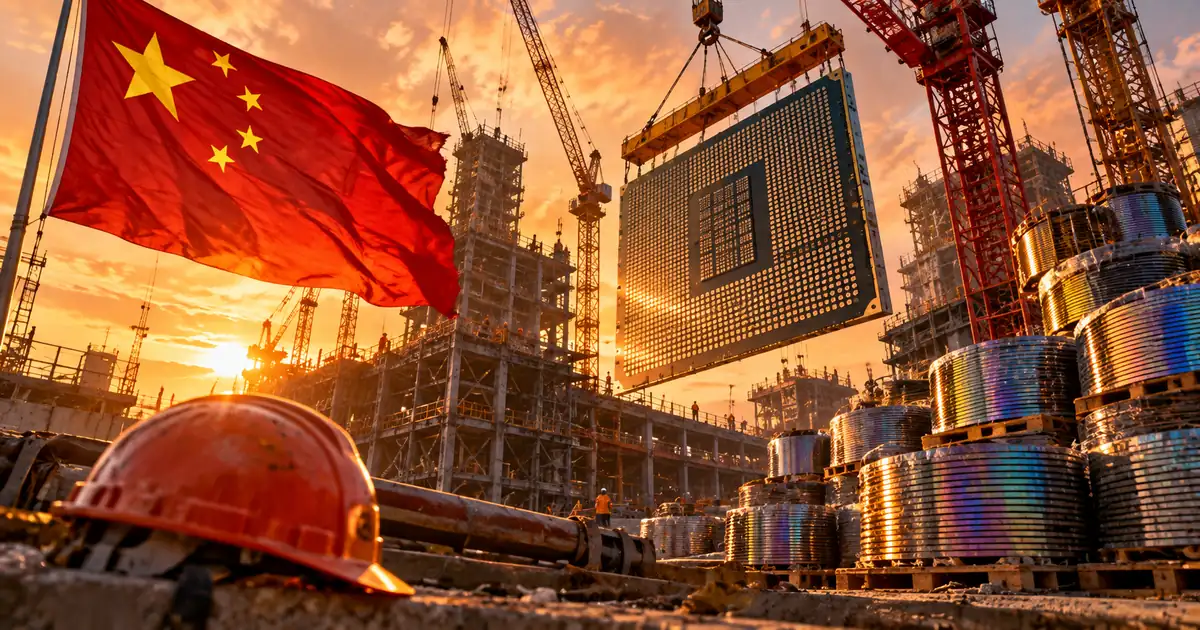
China's AI data center plan: $295 billion over five years
What the reported plan covers
Bloomberg broke the news, citing people familiar with the matter who asked not to be named. According to them, the plan is still in early discussions, and the figure had not been made public before.
Shares of Chinese data center companies jumped on the report. GDS Holdings rose as much as 12% in US pre-market trading, and Vnet Group gained 17%.
Shares of major Chinese data center service provider GDS Holdings Ltd. rose as much as 12% in pre-market U.S. trading, while Vnet Group Inc. climbed 17% after Bloomberg’s report./The data center blueprint remains in early discussions and details could change, the people said, asking not to be named talking about a private matter. — from the passages on the market reaction and the plan's statusView official source →
The NDRC plans one network linking China's data centers
China's state planning agency, the National Development and Reform Commission, is one of the bodies drafting the blueprint. The aim is one network of linked computing hubs instead of scattered regional sites that each serve only their own area.
Pooling those regional resources would open high-performance computing to more companies, Charlie Dai, a principal analyst at Forrester Research, told Bloomberg. He expects firms in finance, manufacturing, health care and logistics to get cheaper and more flexible AI capacity.
He also thinks inland provinces could attract more digital investment and talent. Beijing wants the network to carry AI into public services such as health care, transport and city management as well.
Key government agencies including the National Development and Reform Commission are drafting a blueprint to erect a network of inter-connected computing hubs across the country, people familiar with the matter said. — from the opening of the Bloomberg reportView official source →
China Mobile and China Telecom would run most of the hubs
The two state-owned carriers would run most of the new data centers and keep them linked to one another. Neither replied to Bloomberg's requests for comment.
The telecoms trade publication Capacity sees this as a new role for both carriers. Beyond selling connectivity, they would supply computing power for the whole country.
State firms including China Mobile and China Telecom will operate the bulk of the data centres and ensure they are connected/The plan represents a significant expansion of the carriers’ role beyond connectivity and into the provision of sovereign compute at national scale. — from Capacity's reportView official source →
A 2028 target builds on China's five-year plan through 2030
A national computing network is not a new idea. China's latest five-year plan, running through 2030, already put data infrastructure first. What the new blueprint adds is a deadline: the scattered sites are to form one network by 2028.
The data center push also belongs to the "Six Networks" program Beijing announced earlier in 2026, which covers basic infrastructure from water and electricity to computing. Bloomberg's report says it is unclear how private hubs run by companies such as Alibaba and Tencent would fit into the state network.
The idea of building a nationwide computing network was laid out in China’s latest five-year plan covering the period through 2030, in which Beijing pledged to prioritize the construction of data infrastructure./But the broad goal is to connect those scattered data facilities to a cohesive network by 2028. — from the passages on the five-year plan and the timelineView official source →
An 80% local-chip target would squeeze out Nvidia and AMD
Chip suppliers under the 80% rule
Under the blueprint, at least 80% of the technology in the new data centers, AI chips included, would have to come from Chinese suppliers. Huawei is the only company the reports name, and Nvidia and AMD would be left to compete for no more than the remaining 20%.
The 80% sets a minimum, not a fixed share. Neither report says how the rest would be divided. Capacity notes that the rule pushes China away from Western chips from the buying side, just as US export controls have from the selling side.
The plan is designed to rely on local suppliers including Huawei for at least 80% of technology such as AI chips, effectively squeezing out Nvidia and AMD./That threshold would mark a decisive shift away from Western silicon in Chinese state infrastructure, accelerating a decoupling that US export controls have been pushing in the same direction from the other side. — from Capacity's reportView official source →
Huawei and other homegrown AI chipmakers stand to gain
Huawei is not China's only option. In May 2026, nine kinds of domestic AI chips passed a security review by a Chinese technology-security agency. Their makers include Huawei, Alibaba, Shanghai Biren Technology and Moore Threads.
Clearing that review opens the chips to wider use in sectors with strict security rules. A state network required to buy at least 80% local technology would draw on this group of suppliers.
In May, nine types of homegrown AI chips including from Huawei, Alibaba, Shanghai Biren Technology Co. and Moore Threads Technology Co. passed a security review by a Chinese technology-security agency, opening the door to their wider adoption in sectors with higher security requirements. — from the passage on domestic chipsView official source →
Nvidia H200 sales to China: approved, not shipped by June
Washington has approved Nvidia's sale of the H200 to Chinese customers, a real easing of controls meant to slow China's AI progress. The H200 is about one generation older than Nvidia's Blackwell chips.
Shipments had not begun by the time of the June report, and Bloomberg read the delay as a sign of Beijing's growing confidence in replacing some computing capacity with Chinese hardware. Even if the H200 ships, the 80% floor would limit foreign chips in the state network to whatever share is left.
Washington has agreed to allow Nvidia to sell its previous-generation H200 AI chips to Chinese customers, a significant easing of measures aimed at restraining China’s AI development./But shipments of the component have yet to begin, in a sign that Beijing is growing increasingly confident in replacing some AI computing capacity with locally made hardware. — from the passage on Nvidia's H200View official source →
Government debt would fund most of China's AI investment
Projected investment with and without the power grid
Wiring the power grid into the project would more than double the bill. The $735 billion is a minimum, so the gap may be wider.
The state, not companies, would put up most of the $295 billion, with bank loans and private capital only filling gaps. That stands out because other public spending in China is being cut as government debt rises.
Bloomberg sees the plan as a sign of how determined Beijing is to keep paying for advanced technology regardless. The order of funding sources below is as Bloomberg's sources described it.
Ultra-long bonds and state funds first, then bank loans
The biggest source would be sovereign debt (bonds issued by China's central government), including ultra-long-term special government bonds that usually run more than 10 years. The second would be state funds that invest in strategic industries.
- Main source: sovereign debt, including ultra-long-term special government bonds
- Main source: state funds for investment in strategic industries
- Supplement: bank loans
- Supplement: private capital
Neither the Ministry of Finance, which issues the bonds, nor the NDRC answered Bloomberg's faxed requests for comment. The plan's financing details therefore rest on the unnamed sources alone.
The sum will be funded mainly through sovereign debt including ultra-long-term special government bonds – typically of more than 10 years’ tenure – and state funds for investment in strategic industries, the people said. Bank loans and private capital would supplement the financing, they said. — from the passage on financingView official source →
Grid spending could bring the total to $735 billion or more
The $295 billion pays for the AI facilities themselves: data centers and faster communications links. China also plans to tie the power grid into the project, and the sources told Bloomberg that including that work could take total projected investment to at least $735 billion.
In addition to AI facilities, which includes data centers and faster communications infrastructure, China also plans to integrate the power grid with the project, the people said. That could take the total projected investment to at least $735 billion, the people said. — from the passage on the power gridView official source →
China vs. US AI investment: five years against one year
AI spending per year: China's state plan vs. US companies
Spread evenly, China's plan is about a twelfth of what US firms are budgeting for 2026. The China bar is sakutto's calculation, not a reported yearly figure.
US companies such as Meta and Microsoft have budgeted $725 billion for AI in 2026 alone, while China's $295 billion is spread over five years. Set side by side, the two totals look closer than they are, since one covers a single year and the other five.
US firms' 2026 budget is about 12 times China's yearly pace
Neither report gives a year-by-year schedule. Spread evenly, China's plan would come to about $59 billion a year.
That yearly figure is simply $295 billion divided by five, not a number from the reports. Measured that way, the $725 billion US companies plan for 2026 is roughly 12 times China's annual pace.
The $295 billion five-year total compares to the $725 billion that US companies including Meta and Microsoft are setting aside for AI investment in 2026 alone. — from Capacity's reportView official source →
Private spending is excluded, and China builds for less
Two factors suggest the real gap is smaller than 12 times. The $295 billion counts only the state plan, so spending by private firms such as Alibaba and Tencent is not in it.
Data centers also tend to cost less to build in China than in the US. Labor, parts and construction are cheaper, and local governments offer incentives.
Neither report quantifies either factor, so the 12-times figure compares state money in China with company money in the US without any cost adjustment. The blueprint is also still in early discussions, and the $295 billion could change before anything is announced.
Chinese data centers in general cost less than in the U.S. because of cheaper labor, component and construction costs, and local government incentives./The $295 billion also doesn’t include spending by private firms such as Alibaba Group Holding Ltd. and Tencent Holdings Ltd., the people said. — from the passage comparing China with the USView official source →
FAQ
- How much is China spending on AI data centers?
- About 2 trillion yuan, or roughly $295 billion, spread over five years, according to people familiar with the plan who spoke to Bloomberg News in June 2026. The blueprint is still being drafted, and the sum covers only the state plan, not spending by private companies such as Alibaba and Tencent.
- Why would the plan hurt Nvidia and AMD?
- The blueprint calls for at least 80% of the technology in the new data centers, AI chips included, to come from Chinese suppliers such as Huawei. That leaves foreign chipmakers such as Nvidia and AMD competing for whatever share remains.
- Is China's AI investment bigger than US spending?
- No. US companies such as Meta and Microsoft are setting aside $725 billion for AI in 2026 alone, more than China's five-year total. Spread evenly, China's plan works out to about $59 billion a year by sakutto's calculation. Chinese data centers are cheaper to build, and the figure leaves out private spending.
Related articles
 LongCat 2.0: Meituan's 1.6T Open MoE Coding ModelLongCat 2.0 is Meituan's open 1.6T MoE coding model with a 1M-token context. Covers the domestic-chip training claim, SWE-bench Pro 59.5 and how to run it.
 Claude Fable 5.2: 20% price cut, up to 30% fasterAnthropic released Claude Fable 5.2 on November 9, 2026. API prices fall 20% to $8/$40 per million tokens, and output is up to 30% faster than Fable 5.1.
 PayPay security and passkeys in 10 Japan pay appsPayPay security compared with 9 other Japanese payment apps: passkeys, extra checks to send or pay, and fraud compensation deadlines.
 AI fact check: only 40% of cited stats hold upAI fact check: Trakkr traced 1,285 stats cited by ChatGPT, Perplexity, Gemini, Claude and AI Overviews. Only 40% led to a matching study. How to check one.