
LongCat 2.0 Explained: Meituan's 1.6T Open MoE Model
LongCat 2.0: key specs
LongCat 2.0 is Meituan's trillion-parameter open AI model for agentic coding, announced on June 30, 2026. The model pages write the name LongCat-2.0, and the model is built for understanding, generating and running code inside real agent workflows. The open weights followed later on Hugging Face.
The design rests on three choices: a sparse MoE, a selective attention scheme that reaches 1M tokens, and post-training that distills three groups of specialists into one model. Each one targets a different cost: compute per token, memory over a long context, and the number of models to serve.
1.6T total parameters, about 48B active per token
LongCat 2.0 has 1.6T total parameters but activates only about 48B of them per token on average. In a Mixture-of-Experts (MoE) model, only some experts run for each token, so the model can be huge while each token touches a small share of it: 48B of 1.6T is about 3%. The official page gives the per-token range as 33B to 56B, and the Hugging Face card gives the same average as "~48 billion activated per token".
The range comes from Zero-Computation Experts, which the page describes as token-level dynamic activation. The page's example is that naming a variable and deriving a recursive algorithm need very different compute. Simple tokens consume no compute, and complex ones get more of the budget.
The Hugging Face card adds that 135B N-gram Embedding parameters are included in the model. N-gram Embedding is inherited from LongCat-Flash-Lite.
"a large-scale MoE language model with 1.6 trillion total parameters and ~48 billion activated per token" — from the Hugging Face model cardView official source →
LongCat Sparse Attention and the 1M-token context
LongCat Sparse Attention (LSA) lets LongCat 2.0 handle a native 1M-token context by attending to key information instead of every token. Plain attention compares each token with every other, so cost climbs quickly as the context grows. The official page says LSA cuts computation from quadratic to linear complexity and describes the aim as retrieval across 1 million tokens.
The Hugging Face card is more specific. It lists three improvements to LSA: Streaming-aware Indexing (SI), Cross-Layer Indexing (CLI) and Hierarchical Indexing (HI). Training also used hundreds of billions of tokens of 1M-context data.
"LongCat-2.0 natively supports 1 million token context." — from the LongCat official site (LongCat-2 model page)View official source →
Three expert groups distilled into one model
MOPD distills three expert groups (Agent, Reasoning and Interaction) into the single LongCat 2.0 model. MOPD, short for Multi-Teacher On-Policy Distill, starts from a LongCat SFT checkpoint, branches into specialist groups, and distills their abilities into one model on domestic accelerator clusters. The groups are:
- Agent Experts: tool use, API parsing and self-correction
- Reasoning Experts: multi-hop reasoning, STEM reasoning and adaptive computation
- Interaction Experts: instruction following, human alignment and hallucination suppression
At inference, a gating network routes each task to the most capable experts. Distillation here means training one model to absorb the abilities of several specialists. For related reading on agent models, see AI Agent Model at 35B Rivals Trillion-Parameter AI.
"LongCat-2.0 fuses three expert groups through MOPD (Multi-Teacher On-Policy Distill)." — from the LongCat official site (LongCat-2 model page)View official source →
Meituan LongCat AI on Domestic Chips: The 50,000-Card Claim
Meituan claims LongCat 2.0 was trained and served entirely on domestic chips. Both sources that make the claim, the official page and the Hugging Face card, are the company's own. Neither source names the chips or their maker, and the two give different training-token figures.
Meituan's claim of a 50,000-card cluster
The official page says LongCat 2.0 is the first trillion-parameter model to complete full training and inference on a 50,000-card domestic compute cluster. It adds that work on domestic compute began in 2023, that the team scaled from thousands of cards to 50,000 over three years, and that the problems were operator adaptation, communication optimization and distributed stability. The page reports results in four areas:
- Stability: a reduction of more than 70% in the monthly fault rate
- Correctness: deterministic operators and bitwise consistency verification
- Efficiency: a 1.5× improvement in MFU (model FLOPs utilization)
- Throughput: steady-state daily throughput above 1T tokens per day
The page does not name the chips or their maker, and it does not mention NVIDIA. The quote below gives the 70% reduction and the 1.5× gain without saying what they are measured against.
"it is the industry's first trillion-parameter model to complete full training and inference on a 50,000-card domestic compute cluster."/"70%+ reduction in monthly daily fault rate"/"1.5× MFU improvement" — from the LongCat official site (LongCat-2 model page)View official source →
What the Hugging Face card says: AI ASIC superpods
The Hugging Face card says both the full training run and the large-scale deployment ran on AI ASIC superpods. ASIC stands for application-specific integrated circuit, a chip designed for one class of workload. The card adds that pretraining spanned millions of accelerator-days and more than 35 trillion tokens, with no rollbacks or irrecoverable loss spikes.
Neither the card nor longcatai.org names NVIDIA or any specific chip. Meituan uses two different terms for the hardware: a domestic compute cluster on longcatai.org and AI ASIC superpods on the card. Neither source says the two terms describe the same machines.
"Both the full training run and the large-scale deployment are built entirely on AI ASIC superpods." — from the Hugging Face model cardView official source →
Training tokens: 30T+ on the site, 35T+ on Hugging Face
Meituan gives two different training-token figures: 30T+ on longcatai.org and more than 35 trillion on Hugging Face. Both are lower bounds, so they do not strictly contradict each other. The 30T+ pretraining figure covers tokens spanning Chinese, English, multilingual and code data.
"Pretrained from scratch on 30T+ tokens spanning Chinese, English, multilingual, and code data" — from the LongCat official site (LongCat-2 model page)View official source →
"Pretraining spans millions of accelerator-days across more than 35 trillion tokens, with no rollbacks or irrecoverable loss spikes" — from the Hugging Face model cardView official source →
LongCat 2.0 Benchmark: SWE-bench Pro 59.5 and Other Scores
SWE-bench Pro scores as listed on the LongCat page (higher is better)
The four scores span 5.3 points, and the lead over second place is 0.9 points. All four come from the vendor's own page.


The official page prints six LongCat 2.0 benchmark scores in one table. Only the first two rows compare LongCat 2.0 with rival models, and none of the six scores comes from an outside evaluation.
SWE-bench Pro: 59.5 against GPT-5.5 and Opus 4.6
LongCat 2.0 scores 59.5 on SWE-bench Pro, the top score of the four models on the page. The row labels the focus as deep software engineering. It lists Gemini 3.1 Pro at 54.2, GPT-5.5 at 58.6 and Claude Opus 4.6 at 57.3.
That leaves LongCat 2.0 ahead of GPT-5.5 by 0.9 points and of Gemini 3.1 Pro by 5.3 points. Meituan published the table itself, and no outside run of the same test appears in either source.
"leads Gemini 3.1 Pro 54.2, GPT-5.5 58.6, Claude Opus 4.6 57.3" — from the LongCat official site (benchmark table)View official source →
Other published scores: Terminal-Bench 2.1 and BrowseComp
Beyond SWE-bench Pro, the page lists five more scores, from 70.8 on Terminal-Bench 2.1 to 79.9 on BrowseComp. Of those five, only SWE-bench Multilingual carries a rival score. The other four show only what LongCat 2.0 reports for itself.
| Benchmark | LongCat 2.0 | What the page says it covers |
|---|---|---|
| SWE-bench Pro | 59.5 | Deep software engineering |
| SWE-bench Multilingual | 77.3 | Multilingual coding, on par with Claude Opus 4.6 (77.8) |
| Terminal-Bench 2.1 | 70.8 | Real terminal command interaction |
| RWSearch | 78.8 | Search agent tasks |
| FORTE | 73.2 | Productivity scenarios |
| BrowseComp | 79.9 | Complex browsing and retrieval |
Where the benchmark numbers come from
Every benchmark number above comes from Meituan's own pages. The Hugging Face card has an evaluation entry for Terminal-Bench 2.1 with the same 70.8, marked as not verified. Its note says the score was measured in-house under LongCat's own unified harness, and gives no further scaffold, temperature or context details.
An evaluation harness is the scaffolding that feeds tasks to the model and scores its output, and results can shift with it. Neither source cites an independent evaluation, so read the scores as the developer's claims.
"Measured in-house under LongCat's own unified harness; no further scaffold/temperature/context details given." — from the Hugging Face model card (evaluation entry for Terminal-Bench 2.1)View official source →
How to Run LongCat 2.0: Hugging Face, OpenRouter, and API
LongCat 2.0 can be self-hosted from open weights or called through a hosted service. The official page and the model card describe both routes, but neither gives pricing.
Open weights on Hugging Face under the MIT license
The LongCat 2.0 weights are in the meituan-longcat/LongCat-2.0 repository on Hugging Face, tagged with an MIT license. The repository page also has a License Agreement section, so read it before commercial use. The repository was created on July 5, 2026, after the June 30 page.
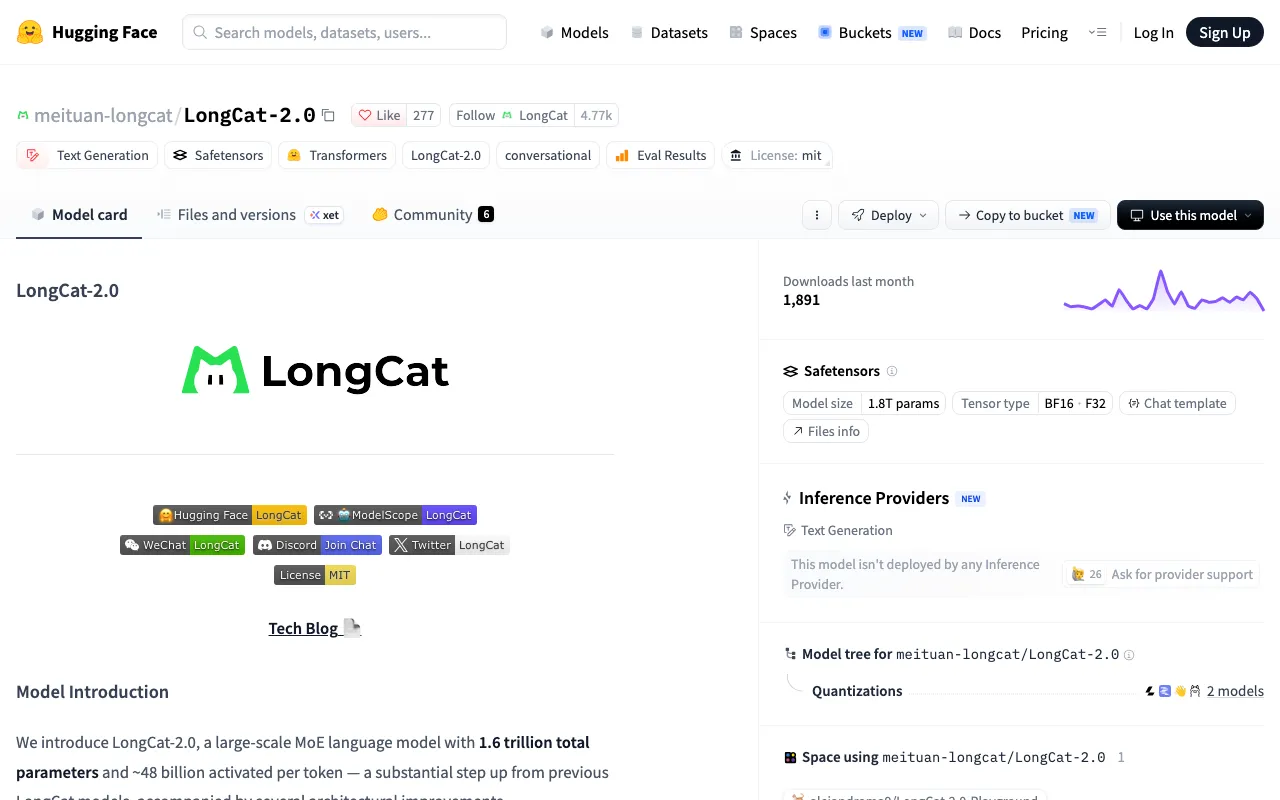
The five days between the June 30 page and the repository's creation matter for dating the release. The June 30 page said weights and self-hosting guides would be linked once officially published, so June 30 marks the announcement, not the weights.
"Model weights and self-hosted deployment guides will be linked here when officially published on Hugging Face / GitHub." — from the LongCat official site (LongCat-2 model page)View official source →
Serving LongCat 2.0 with vLLM or SGLang
The model card shows how to run LongCat 2.0 with Transformers, vLLM, SGLang and Docker Model Runner. Both vLLM and SGLang get install, serve and curl steps that expose an OpenAI-compatible API on localhost. Docker Model Runner gets a single command, shown below.
docker model run hf.co/meituan-longcat/LongCat-2.0
The card also has separate deployment sections for GPU and for NPU, and it says the model is deeply integrated with harnesses such as Claude Code, OpenClaw and Hermes. A model this size is not a laptop workload, so the hosted options below are the easier route.
"deeply integrated with mainstream harnesses such as Claude Code, OpenClaw, and Hermes" — from the Hugging Face model cardView official source →
Hosted access: longcat.ai, OpenRouter, and the API platform
The official page lists three hosted routes for LongCat 2.0: longcat.ai, OpenRouter and the LongCat API platform. The page describes each in a few words:
- longcat.ai: an online experience
- OpenRouter: global API access
- LongCat API platform: Meituan's own API, at longcat.chat/platform/usage
The page adds that a preview version has been available on OpenRouter and longcat.ai. It says the preview ranked among the top three models globally by call volume on OpenRouter, without giving a date or period in the sentence quoted below. Neither the official page nor the model card gives pricing, so check the provider pages for current terms. The LongCat 2.0 model card and deployment guides are long documents.
"A preview version has been available on OpenRouter and longcat.ai, ranking among the top three models globally by call volume on OpenRouter." — from the LongCat official site (LongCat-2 model page)View official source →
FAQ
- What is LongCat 2.0?
- LongCat 2.0 is Meituan's open MoE model for agentic coding. It has 1.6T total parameters, activates 33B to 56B of them per token (about 48B on average), and supports a 1M-token context. The official page is dated June 30, 2026.
- Was LongCat 2.0 trained on domestic chips?
- That is what Meituan claims. The official page says training and inference were completed on a 50,000-card domestic compute cluster, and the Hugging Face card says both ran on AI ASIC superpods. Neither source names NVIDIA or cites a check of the claim by anyone outside the company.
- How does LongCat 2.0 score on coding benchmarks?
- The official page lists SWE-bench Pro at 59.5, ahead of the GPT-5.5 (58.6), Claude Opus 4.6 (57.3) and Gemini 3.1 Pro (54.2) figures it prints beside it. It also lists SWE-bench Multilingual at 77.3. These are Meituan's own published numbers.
Related articles
 AI Agent Model at 35B Rivals Trillion-Parameter AIAn AI agent model at 35B, Agents-A1 from Shanghai AI Lab, claims trillion-parameter performance. Its MoE weights are public under Apache 2.0.
 China AI data centers: $295B plan, 80% local chipsChina AI data centers would get about $295 billion over five years, with at least 80% of chips from local suppliers. US firms top that in 2026 alone.
 Claude Fable 5.2: 20% price cut, up to 30% fasterAnthropic released Claude Fable 5.2 on November 9, 2026. API prices fall 20% to $8/$40 per million tokens, and output is up to 30% faster than Fable 5.1.
 PayPay security and passkeys in 10 Japan pay appsPayPay security compared with 9 other Japanese payment apps: passkeys, extra checks to send or pay, and fraud compensation deadlines.