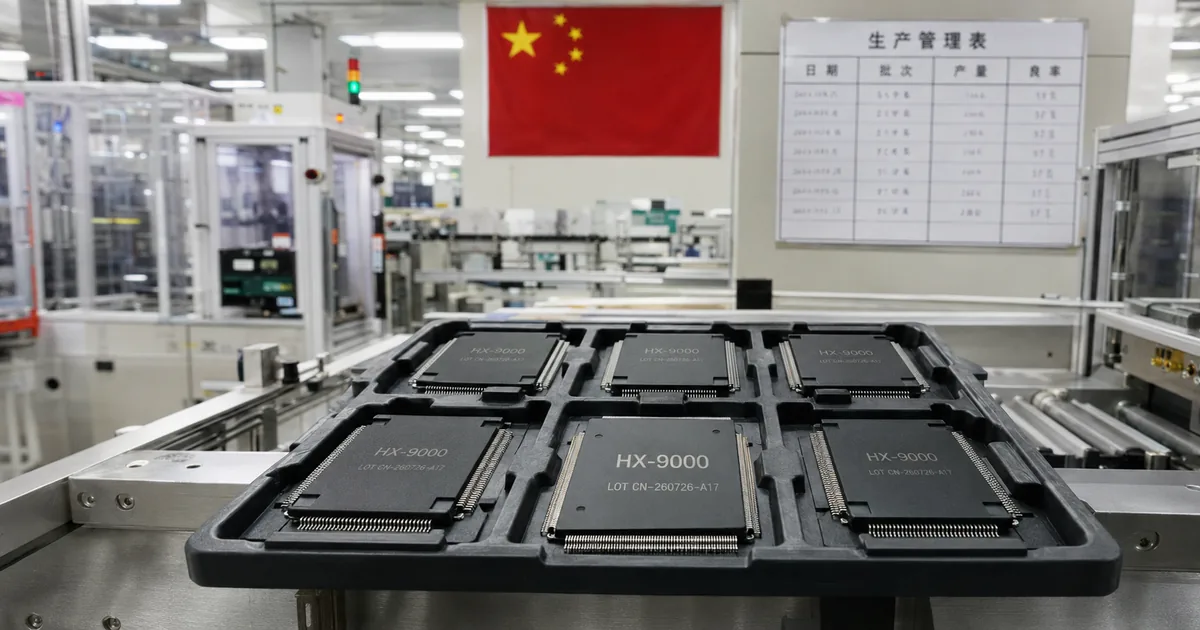
Ding Xuexiang's reported traitor warning on China AI chips
Sources told the Wall Street Journal that Ding Xuexiang, China's Vice Premier, warned AI companies that anyone who resisted using local chips was a traitor. The WSJ article is dated July 24, 2026, and we cite the opening that The Currency republished. The warning rests on what sources told the paper.
The WSJ describes Ding as a confidant of Chinese leader Xi Jinping. A senior official close to China's top leader is said to have warned AI companies not to resist using chips made in China.
This is not an announcement by the Chinese government. Treat the word "traitor" as the account of the WSJ's sources, and attribute it that way when you quote it.
"Chinese AI companies warned that anyone who resisted using local chips was a traitor" / "Ding Xuexiang, a confidant of Chinese leader Xi Jinping" — Wall Street Journal articleView official source →
How US export controls on AI chips push China domestic chips
The WSJ sets this against Washington squeezing China's access to advanced AI chips and the tools needed to make them. This page calls such measures US export controls: government rules that limit which products a country may sell abroad. Here they cover both the chips and the equipment used to make them.
The quoted passage gives no account of how strongly companies resisted, or why. It states the squeeze on chips and tools, and nothing beyond that.
"Washington had squeezed China's access to cutting-edge AI chips and the tools required to manufacture them" — Wall Street Journal articleView official source →
China AI self-reliance at the Digital China Summit in 2026
Ding stated the self-reliance line in public on April 29, 2026, at the 9th Digital China Summit. According to the Chinese government's English site, he stressed self-reliance and independent innovation. He said China's AI sector must forge its own path to withstand any external pressure or attempts at suppression.
At the same event, he called for open and mutually beneficial cooperation. That included deeper international collaboration on computing power, data and talent, and sound implementation of the Global AI Governance Initiative.
So the self-reliance line is on the record, on the government's own site. The traitor wording is not.
"He stressed the need for self-reliance and independent innovation, noting that China's AI sector must forge its own path to withstand any external pressure or attempts at suppression." / "On the global front, he advocated open and mutually beneficial cooperation, calling for sound implementation of the Global AI Governance Initiative and deeper international collaboration on computing power, data and talent." — Chinese government official English site (April 29, 2026)View official source →
Huawei's three-year plan for China domestic AI chips
The "three years" figure is Huawei's statement, not a government target. According to the WSJ, Huawei briefed Ding on a plan for rivaling Nvidia. The company said China could become self-sufficient in some critical areas of AI within three years.
The briefing was private and took place the summer before the article. The claim is also narrower than it sounds: it says "some critical areas" of AI, not all of them.
"The company laid out a plan for rivaling American behemoth Nvidia and said China could become self-sufficient in some critical areas of AI within three years." — Wall Street Journal articleView official source →
China local AI chips vs Nvidia: what it means for users
If you are following this story, two habits are enough: keep the source of each statement attached to it, and check what hardware a China-made AI product assumes. The first habit is about wording. The traitor warning comes from sources cited by the WSJ, the self-reliance line from the government's English site, and the three-year figure from Huawei.
The second habit is about products. When a China-made AI model or service comes out, the chips behind it may differ from the Nvidia hardware you know. Check the product's own announcement, since the WSJ passages quoted above do not mention specific products.
For related context, Chinese Open Source AI Faces Possible US Curbs covers US restrictions on Chinese open-source AI. China AI data centers: $295B plan, 80% local chips covers China's five-year AI plan. Alibaba Bans Claude Code Over Hidden Tracking Code covers one company's response to a foreign AI tool.
Separate the report, the policy and Huawei's claim
The warning is reported, the self-reliance line is public, and the three-year figure is Huawei's claim. The traitor warning is the WSJ's sourced account, published on July 24, 2026. The self-reliance line is Ding's own, from April 29, 2026, and the three-year figure belongs to Huawei. Anyone writing about China AI chips can keep those three apart and avoid repeating a sourced claim as an announcement.
FAQ
- Who is reported to have given the "traitor" warning?
- Chinese Vice Premier Ding Xuexiang, according to sources cited by the Wall Street Journal, which describes him as a confidant of leader Xi Jinping. It is a reported warning, not an announcement by the Chinese government.
- Where does the "self-sufficient within three years" figure come from?
- It comes from Huawei, not from a government target. According to the Wall Street Journal, Huawei laid out a plan for rivaling Nvidia and said China could become self-sufficient in some critical areas of AI within three years.
- What has the Chinese government said publicly?
- At the 9th Digital China Summit on April 29, 2026, Ding said China's AI sector must forge its own path to withstand any external pressure or attempts at suppression. That self-reliance line is on the record.
Related articles
 Malaysia seizes 30 AI chip servers at KLIA airportMalaysian customs seized 30 AI chip servers worth RM49.5 million at KLIA, declared as electronic components, in the year's fifth case tied to one syndicate.
 Nvidia's Jensen Huang close to alleged Chinese spyThe NYT says US officials judged Megaspeed's Alice Huang, close to Nvidia CEO Jensen Huang, a Chinese intelligence asset. Nvidia calls it normal business.
 Tiangong Ultra 8.86s at World Humanoid Robot GamesTiangong Ultra ran the 100m in 8.86 seconds at the World Humanoid Robot Games, down from 9.39 on August 22. The rules the robots ran under are below.
 Waymo Custom Chip: 5nm ASIC for Lidar and CamerasThe Waymo custom chip is a 5nm ASIC that fuses lidar, radar and camera data ahead of the driving stack. What its 1,000 TOPS covers, and what it does not.