
What is Cloudflare Clef, the Jev-compatible decision model?
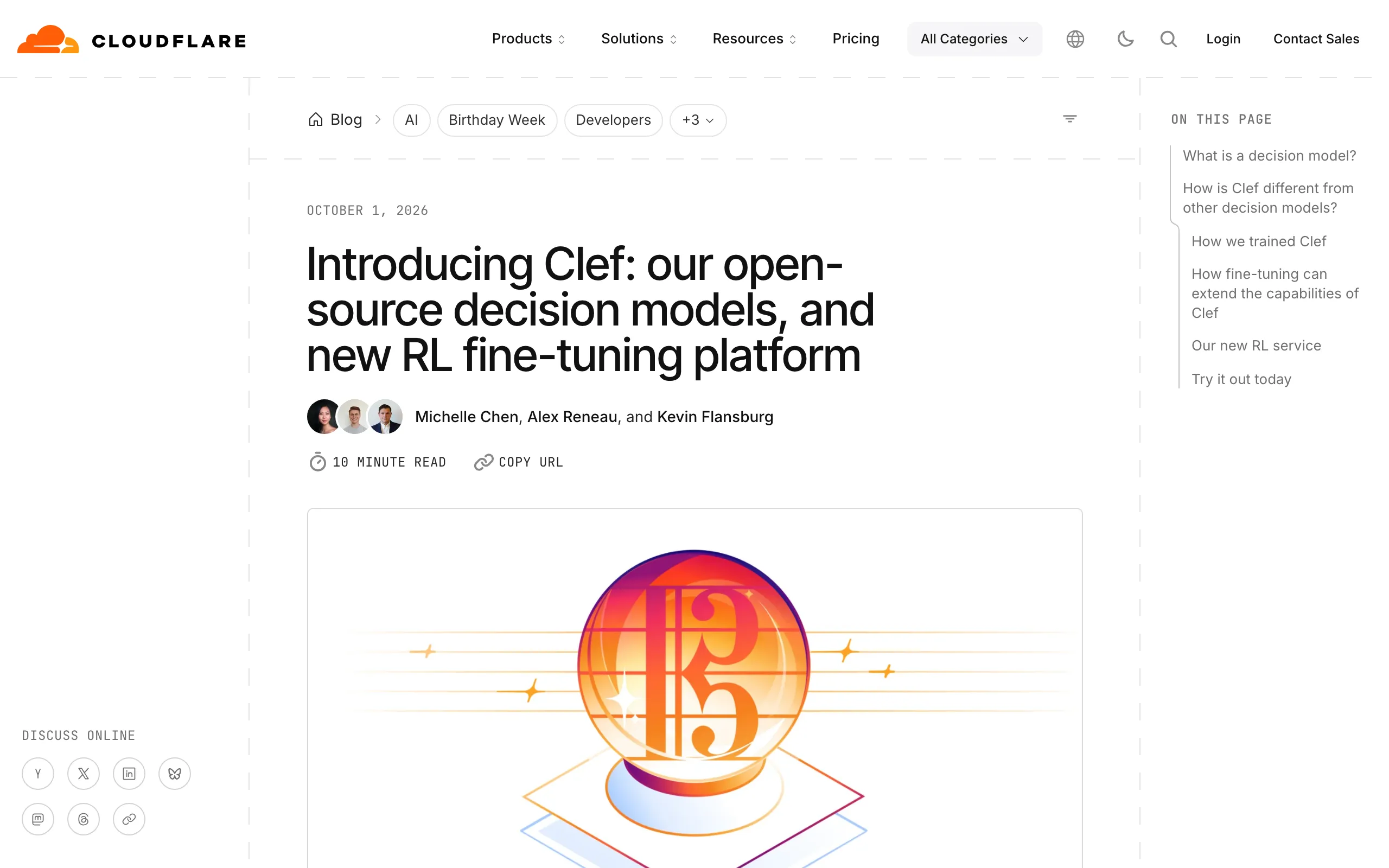
Cloudflare Clef is a family of decision models that answer typed questions with probabilities instead of text, and it accepts the same requests as TypeSafe's Jev. It is the first model the Workers AI team trained in-house, and it arrived on October 1, 2026, about two weeks after Jev launched on September 15. You can call it on Workers AI or download the weights from Hugging Face.
How a decision model returns probabilities instead of text
A decision model reads an input, which Cloudflare calls the state, plus a set of typed questions, and gives back a probability for every allowed answer. Hand it a support message such as "Checkout has been failing for every customer for the last hour" and ask whether it is urgent and which team should take it. You get numbers back, and your code decides whether to route the ticket, escalate it or pass it to a person.
The speed comes from skipping text generation. Clef runs its Qwen backbone over the input once, in a single prefill pass, then scores the valid options in parallel.
Training also added a Brier loss term to keep the probabilities calibrated, meaning a high score should match a high rate of correct answers. That matters if you plan to act automatically above a threshold such as 0.9.
Cloudflare's threat intelligence team has been using it to classify domains. Clef fetched, rendered and labeled a site in 2.2 seconds. The fastest general-purpose LLM the team tried, gpt-oss-120b, took 4.7 seconds for the same job and came back with only two labels.
A decision model will return typed answers with probabilities (outputs), which your code can use to route the ticket, trigger an escalation, or defer to a human. / During inference, Clef uses Qwen for a prefill-only pass, then scores the valid schema choices in parallel. / Our post-training utilizes label-smoothed cross-entropy for valid schema outputs paired with a Brier loss to refine probability calibration. / This classification took our Clef model 2.2s to fetch, render, and classify the website. In contrast, our fastest general LLM gpt-oss-120b took 4.7s in the same workflow, and only returned two classifications. — From the sections on what a decision model returns, how Clef scores options, how it was trained, and the domain classification testView official source →
Clef and Clef-flash on Workers AI and Hugging Face
Clef is the larger model built for the highest-precision decisions, and Clef-flash is the smaller one tuned for latency. Both have a 64K-token context window and run on Workers AI under their own model IDs.
Clef and Clef-flash at a glance (Cloudflare documentation)
| Clef | Clef-flash | |
|---|---|---|
| Parameters | 27B | 9B |
| Base model | Qwen3.8-27B | Qwen3.5-9B |
| Built for | Highest-precision decisions | Latency-critical decisions |
| Workers AI model ID | @cf/cloudflare/clef | @cf/cloudflare/clef-flash |
| Context window | 64K tokens | 64K tokens |
In Cloudflare's tests, Clef-flash answered in a median 38.8 milliseconds, against 524.1 milliseconds for Jev. The weights for both sit on Hugging Face.
@cf/cloudflare/clef 27B Highest-precision decisions 64K tokens @cf/cloudflare/clef-flash 9B Latency-critical, hot-path decisions 64K tokens — From the table listing size, intended use and context window for each modelView official source →
Clef vs Jev: images, context window and Workers AI price
Clef and Jev take the same API calls, but they differ on what you can send, how much fits in one request, how the weights are distributed and what you pay. The table sums up the four gaps.
Clef compared with Jev (Cloudflare blog, The Register and TypeSafe docs)
| Clef | Jev | |
|---|---|---|
| Input | Text, JSON, images, video | Text, JSON; images experimental, no video |
| Context window | 64K | 32K per Cloudflare's comparison |
| Weights | On Hugging Face, Apache 2.0 | Not published |
| Price per 1M input tokens | $0.24 on Workers AI | $0.042 per The Register |
Image and video input, where Jev lags behind
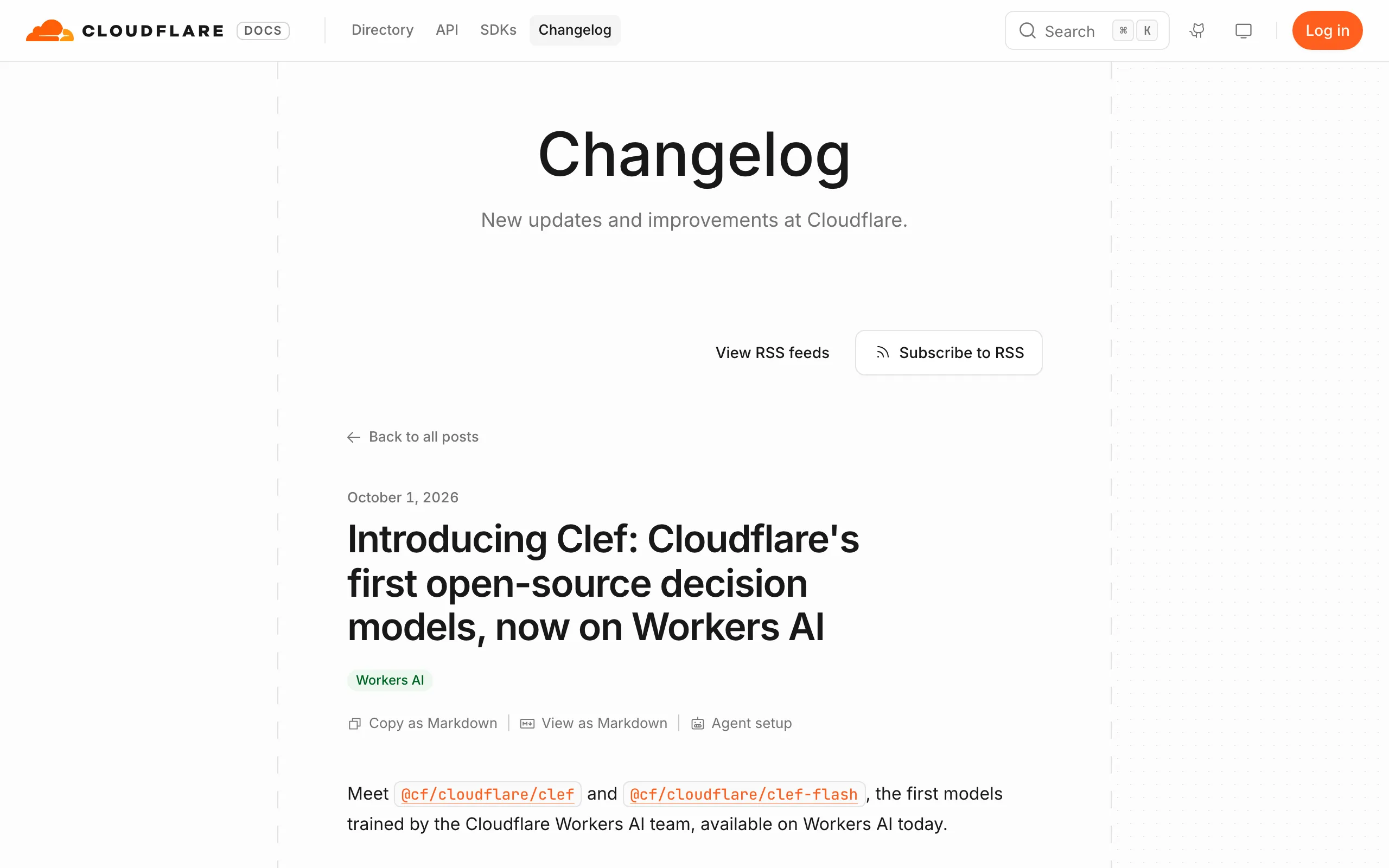
Clef has a vision encoder, so it can judge images and video; Jev handled only text when Cloudflare announced Clef on October 1. On Workers AI you can attach up to four PNG, JPEG or WebP images per request. Images must be embedded in the request body, since remote URLs are refused.
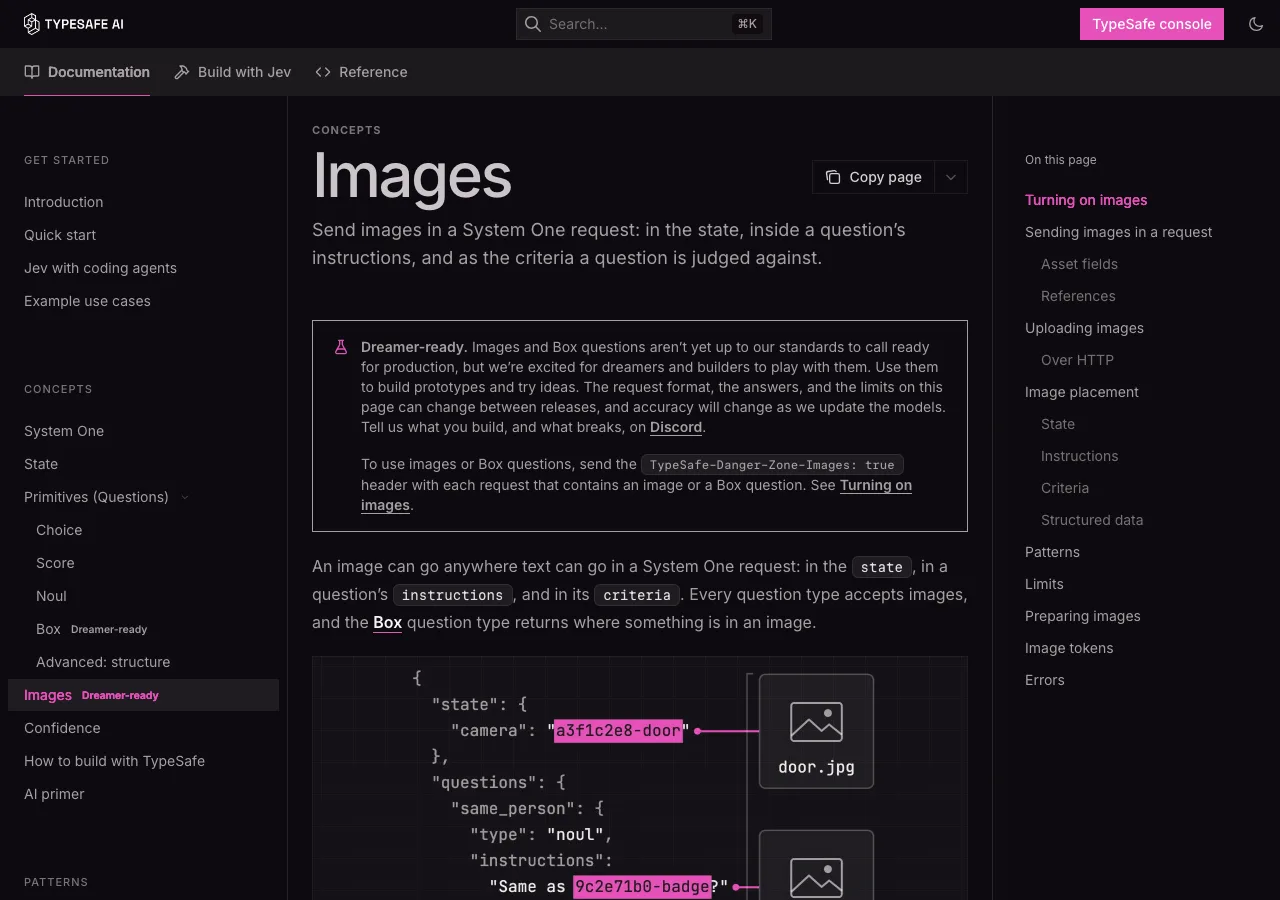
TypeSafe narrowed that gap on October 14. It revealed that jev-1.13.0 could read images all along and opened image input behind an opt-in TypeSafe-Danger-Zone-Images: true header, sent with each request. The new jev-1.14.0 also adds a box question type, which returns a single bounding box around the target.
TypeSafe does not yet recommend either feature for production. Jev accepts only still images in PNG or JPEG, so a video has to be exported one frame at a time. For production work with images or video, Clef is still the only ready option of the two.
The context window gap is smaller than the headline suggests. Cloudflare compares its 64K window with Jev's 32K, yet The Register notes that Jev also accepts 64K tokens per request. Jev's 32K cap covers only the state plus the longest single question.
Open weights are the third difference. Because Cloudflare released Clef as an open source AI model, at least as far as the weights go, a team that cannot send data outside its network can still run it on hardware it controls.
First, it has a vision encoder so it’s able to take in images and classify visual content. This is different from Jev, which only does text classification today. Secondly, our model has a 64k context window (compared to Jev’s 32k), which allows users to squeeze more input state for the model to classify against. — From the passage comparing Clef's vision input and context window with JevView official source →
Images and Box questions are off by default. To use them, send the TypeSafe-Danger-Zone-Images: true header with each request that contains an image or a Box question. — From the section on turning on image input for JevView official source →
Workers AI pricing at about six times Jev
On Workers AI, Clef costs $0.24 per million input tokens, roughly six times the $0.042 that Jev charges. The Jev figure and the six-times comparison come from The Register.
Price per million input tokens
Bar height is relative to the highest value (Clef at $0.24 = 100). Sources: Workers AI model page and The Register.

If the per-token bill is the problem, the weights are the way out, though they need a large GPU. The hardware numbers are in the section on running Clef below.

For those that would prefer not to pay the token cost (Clef costs $0.24 per million tokens - nearly six times the price of Jev at $0.042/M), Clef can also be downloaded from Hugging Face , and is open weight under the same Apache-2.0 terms as Qwen. — From the passage comparing Clef and Jev pricesView official source →
Cloudflare's AI benchmark results for Clef
Cloudflare says Clef is both more accurate and faster than Jev, and the numbers below are the ones it published. They include the tests where Jev comes out ahead.
First place on 7 of 10 decision benchmarks
Cloudflare picked 10 benchmarks from the Jev Decision Index and reports that Clef or Clef-flash scored highest on 7 of them. Jev scored highest on When2Call, which tests whether a model should call a tool, and on the retrieval benchmark BRIGHT.
Selected benchmark scores (as published by Cloudflare)
Scores on a 0–100 scale, higher is better. Source: Cloudflare blog. All runs by Cloudflare.
The tenth benchmark, PhishNChips, went to a different model, DiffusionGemma Jev, at 85.35. The bigger model is not always the better one either. Clef-flash scored 97.73 on home appliance commands against 82.95 for Clef, but on CLINC150+OOS it fell to 66.77 while Clef reached 97.43.
Cloudflare also ran TypeSafe's own workflow evals and says Clef beat Jev on invoice processing, customer service and security incidents. Jev kept the fourth area, agent trace observability, at 71.6 to Clef's 68.5.
Across 10 decision benchmarks, a Clef model scores highest on 7, ahead of Jev and other open decision models. / On Typesafe's own workflow evals, Clef beats Jev in 3 of 4 areas: invoice processing, customer service, and security incidents. — From the benchmark summary and the TypeSafe workflow resultsView official source →
Clef-flash median latency 13 times lower than Jev's
Across 43 benchmark runs, Clef-flash's median latency was 13 times lower than Jev's and Clef's was 2.5 times lower, according to Cloudflare. Jev's median was 524.1 ms in the same runs.
Median latency (lower is faster)
Bar height is relative to the slowest value (Jev at 524.1 ms = 100). Source: Cloudflare blog.
The order holds at p95, the time within which 95% of responses arrive. Clef came in at 238.6 ms, Clef-flash at 122.4 ms and Jev at 536.0 ms.
Clef is 2.5x faster than Jev at the median, and Clef-flash 13x faster. Latency Clef Clef-flash Jev Median 209.3 ms 38.8 ms 524.1 ms p95 238.6 ms 122.4 ms 536.0 ms — From the latency table comparing median and p95 timesView official source →
Why the Clef benchmark numbers are disputed
Every score above was measured and published by Cloudflare, and none has been reproduced on the official index. The company behind Jev also says it does not yet see real competitors.
Self-reported scores missing from the Jev Decision Index
The Register points out that Cloudflare self-reported its Clef scores and that they have not yet been reproduced for ranking on the official Decision Index. Cloudflare also ran the rival models itself, so Jev's numbers in the charts above come from Cloudflare's runs rather than TypeSafe's.
The open source label has limits too. Cloudflare's Michelle Chen told The Register that the training datasets are not public. Anyone can download the weights, but nobody outside Cloudflare can inspect the data behind them.
To be fair to the competition, Cloudflare self-reported its own scores against the benchmark, and they have yet to be reproduced for ranking on the official Decision Index . / While described as “open source” in the announcement, Cloudflare AI Platform group product manager Michelle Chen confirmed to The Register that its training datasets aren’t public. — From the passages on unreproduced scores and private training dataView official source →
TypeSafe's CEO on Jev-style decision model rivals
TypeSafe founder and CEO Diogo Almeida told TechCrunch he does not see real competition emerging yet. In his view, newcomers may underestimate how hard it is to make these models actually smart. The current batch, he said, looks more like machine learning engineers trying out an appealing architecture than teams devoted to useful intelligence.
He said this in a story about Amazon's own Jev-style model, and he did not mention Clef by name. His comment was aimed at the wave of Jev-compatible models released after Jev, which includes Clef.
“I get that people think it’s a gold rush, but they might be underestimating the difficulty of making the models actually smart,” CEO and founder Diogo Almeida told TechCrunch, saying that for now, he didn’t see real competition for his company emerging yet. “The current batch seems more like ML people wanting to implement a cool architecture than a team deeply dedicated to making intelligence useful.” — From TypeSafe's response to the new decision modelsView official source →
Running Clef on Workers AI or as a local LLM
You can call Clef as a hosted API on Workers AI or download the Hugging Face weights and run them on your own GPU. Workers AI is the quicker start, and self-hosting is for data that cannot leave your network.
Writing noul, choice and score questions for Clef
Each request carries a state and between 1 and 64 questions, and every question uses one of three types. The type decides what shape the answer takes.
Question types Clef accepts (Workers AI documentation)
| Type | What you ask | What comes back |
|---|---|---|
| noul | A yes or no question | The probability of yes |
| choice | Pick one option from a set you define | The chosen option, each option's probability, a confidence value |
| score | Rate against an ordered rubric | A probability-weighted score and each level's probability |
A trimmed version of the documentation example asks all three at once. It checks urgency, picks a team and rates the impact in a single call.
const response = await env.AI.run("@cf/cloudflare/clef", {
  model: "clef",
  state: "Checkout has been failing for every customer for the last hour.",
  questions: {
    urgent: { type: "noul", instructions: "Is this support request urgent?" },
    team: {
      type: "choice",
      instructions: "Which team should handle this request?",
      criteria: { billing: "Payments, invoices, and refunds", technical: "Outages, errors, and configuration", sales: "Plans and upgrades" },
    },
    severity: {
      type: "score",
      instructions: "How severe is the customer impact?",
      criteria: ["No impact", "Minor", "Major", "Critical"],
    },
  },
});
The answers come back keyed by the same question IDs, so there is no free text to parse. Long text in the state is cut to fit the token limit, which means the key details belong near the top.
Ask up to 64 questions per request, in three types: noul : A yes/no question. Returns the probability that the answer is yes. choice : Pick one option from a set you define. Returns the chosen option, a probability per option, and a confidence value. score : Rate against an ordered rubric. Returns a probability-weighted score and a probability per level. — From the description of the three question typesView official source →
VRAM needed for the Hugging Face weights
Running the weights locally takes a GPU with at least 41 GB of VRAM for Clef-flash and 85 GB for Clef. Cloudflare's Michelle Chen gave The Register those figures and said they assume one request at a time and a 64K context window.
Unless your data has to stay in-house, Workers AI is the simpler way to try Clef because there is no hardware to provision. Cloudflare has also published the setup it uses for its own AI agents, covered in Cloudflare OS: An Open-Source AI Agent Platform.
Chen told us that Clef-flash will run on any GPU with at least 41 GB of VRAM, while Clef requires 85 GB of VRAM on a GPU for it to function. “This is assuming single concurrency and a 64k context window,” Chen added. — From the passage on hardware requirements for local useView official source →
Should you switch from Jev to Cloudflare Clef?
Switch to Cloudflare Clef if your production decisions involve images or video, or you need the weights in-house, and stay on Jev if you only route text and price matters most. Clef costs about six times more per token on Workers AI.
- Images, screenshots or video in production: Clef, since Jev's image input is still experimental and Jev takes no video
- Data that cannot leave your network: Clef, using the open weights
- Text-only routing at high volume: Jev, at $0.042 per million input tokens as of October 2026
The accuracy lead is Cloudflare's own measurement, so treat it as a claim until the Decision Index reproduces it. Because the two APIs match, the cheapest test is to send the same sample of your real requests to both and compare accuracy, latency and cost before you move anything.
FAQ
- Is Cloudflare Clef free to use?
- The weights are free under Apache 2.0 on Hugging Face, so you pay only for your own GPU. On Workers AI, Clef is billed at $0.24 per million input tokens.
- Can I move an existing Jev integration to Clef?
- Yes. Clef follows the same System One API as Jev, so the switch is a change of endpoint and model name. Clef's images field is its own extension, and Jev's experimental image input uses a different request format.
- Is Clef fully open source?
- Only the weights are open. Cloudflare told The Register that the training datasets are not public, so you cannot see what the model was trained on.
Related articles
 Microsoft-Decision-1: Jev-priced decision modelMicrosoft-Decision-1 scores fixed options instead of writing text, at Jev's price of $0.042 per million input tokens. JevBench measured 459 ms, not 85 ms.
 Cloudflare's GLM-5.3 leaked data in 155 responsesFrom August 27 to September 9, 155 GLM-5.3 replies on Cloudflare Workers AI held other users' data. Only prompts over 681,280 tokens were hit; it is fixed.
 Jev maker TypeSafe AI raises $870M at $7.5BTypeSafe AI raised $870M at a $7.5B valuation 24 days after launching Jev. Five days later Jev 1.14 added images, box and long context as experiments.
 Apple Intelligence launches in China with QwenApple Intelligence comes to iPhones in China with iOS 27.3 in December. Alibaba's Qwen handles some Siri and Writing Tools requests, but Siri AI is left out.