TypeSafe AI's $870M Series A, led by a16z
TypeSafe AI, the company behind Jev, announced a $870 million Series A on October 9, 2026, on its own blog. Andreessen Horowitz led the round. Sequoia Capital, existing investor DCVC and a group of angel investors also took part.
A $7.5B valuation 24 days after Jev launched
The round values TypeSafe AI at $7.5 billion and came 24 days after Jev went live. TypeSafe opened Jev in early access on September 15, 2026. TechCrunch called the raise unsurprising because Jev spread so quickly after launch.
Three people co-founded TypeSafe in 2024: Diogo Almeida, a former OpenAI researcher; Sasha Sheng, a former Meta research engineer; and Erik Gafni, an engineer and entrepreneur. Almeida says he helped build the instruction-following methods at OpenAI that became the research behind ChatGPT.
Martin Casado joins the TypeSafe AI board
Martin Casado joins the TypeSafe AI board as part of the round. The announcement is short. TypeSafe starts by saying it finds fundraising posts boring, then spells out in a few lines each what the money means for developers, businesses and job candidates.
TypeSafe AI Series A at a glance (from the company blog)
| Item | Detail |
|---|---|
| Announced | October 9, 2026 |
| Amount | $870 million |
| Valuation | $7.5 billion |
| Lead investor | Andreessen Horowitz (a16z) |
| Other investors | Sequoia Capital, DCVC, angel investors |
| Board | Martin Casado joins |
led by Andreessen Horowitz / , with participation from Sequoia Capital, existing investor DCVC, and the tech illuminati (aka a bunch of the best angel investors). / $870 million at a $7.5B valuation, with Martin Casado joining the board. — from the opening and closing lines of the announcementView official source →
What is Jev, and what does it return instead of text?
Jev is a model for decisions inside software. You send it some state and a set of questions with fixed answer options, and it returns a probability for each option plus a confidence score. It never writes free text, so your code can branch on the result directly without parsing anything.
Typed decisions with calibrated probabilities
Jev answers only in the shapes you define ahead of time. A chat model such as ChatGPT writes its reply one token at a time, and a token is a small chunk of text. Software that wants to use that reply has to find the right part and check its format.
Jev skips that step. In production it takes three kinds of questions: yes or no, pick one item from a list, or give a score.
The docs call them noul, choice and score. Jev 1.14 adds a fourth type, box, as an experiment.
Because Jev cannot answer outside the options you supply, the output always matches the type your code expects. Every answer also comes with a confidence score, so you can send only the low-confidence cases to a person.
The names come from two thinkers. "System One" refers to the fast, intuitive System 1 thinking that Daniel Kahneman described in Thinking, Fast and Slow. Jev is named after the economist William Stanley Jevons.
Jev's latency and price compared with frontier LLMs
TypeSafe's launch post puts Jev's end-to-end response time at 70 to 500 milliseconds, against 3 to 329 seconds for frontier LLMs. Input costs $0.042 per million tokens, and output tokens are free. For LLMs, the same post says output tokens cost about 5x as much as input tokens.
TypeSafe trains Jev with a method it calls Reinforcement Learning for Calibrated Decisions (RLCD). Calibrated means that higher confidence goes with higher accuracy, so a confidence threshold in your code means what it says.
Think of Jev as a frontier-intelligence function call: unstructured state in, typed probabilistic decisions out. / Type-safe structured values. Possible outputs and structure are defined in advance. The model never makes type errors. All answers are accompanied with calibrated probabilities and confidence scores. / End-to-end response time is 70ms-500ms for TypeSafe. / Input tokens: $0.042 / MTok ($42 per billion tokens). / Output tokens: FREE (too cheap to meter). — from the opening of the launch post and its comparison table against existing LLMsView official source →
Jev 1.14 adds images, box and long context behind flags
TypeSafe released Jev 1.14.0 on October 14, 2026, five days after the round was announced, together with three experimental features that are off by default. The features are image input, a new box question type and a longer context limit. TypeSafe says it cannot vouch for them in production, and Jev 1.14 costs the same as 1.13.
Jev 1.14 experimental features at a glance (TypeSafe docs)
| Feature | Header to send | Works on | What changes |
|---|---|---|---|
| Images | TypeSafe-Danger-Zone-Images: true |
Jev 1.13 and 1.14 | PNG or JPEG in the state, instructions or criteria |
| Box | TypeSafe-Danger-Zone-Images: true |
Jev 1.14 only | One bounding box per question |
| Long context | TypeSafe-Danger-Zone-Long-Context: true |
Jev 1.13 and 1.14 | 262k tokens instead of 64k per request |
Both versions cost $0.042 per million input tokens and share the same default context of 64k tokens per request and 32k per question. Each header switches a feature on only for the requests that carry it.
Image input works on Jev 1.13 and 1.14 with a header
Images already work on jev-1.13.0, and you switch them on by sending the images header with every request that contains one. Without the header, the API rejects the request. TypeSafe says the Jev people already use had been multimodal, meaning able to take more than text, all along.
An image can go anywhere text can go: in the state (the data Jev judges), in a question's instructions or in a question's criteria. Each image is listed once in the request and referred to by a string. The format is PNG or JPEG, still images only, up to 16 MiB per file.
The docs show a doorbell camera photo sent as the state with two questions: is a person there, and is that person carrying a package, a bag or nothing. Each image counts as input tokens at the same per-token price as text, with no separate charge. TypeSafe warns that every model, Jev included, does worse on images than on plain text, and says splitting a question into the simplest possible pieces helps.
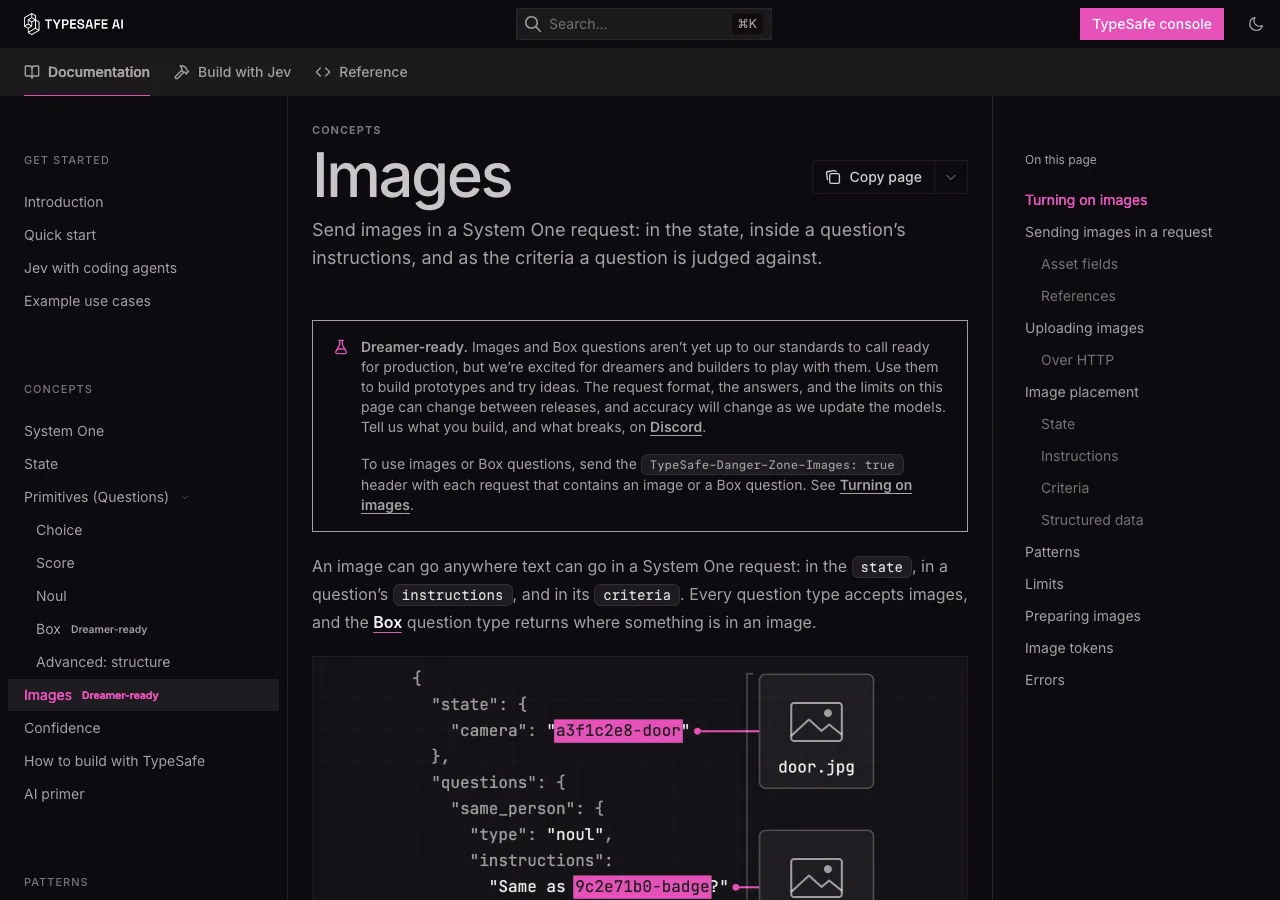
Jev 1.13 and Jev 1.14 both accept images. Box questions need Jev 1.14. / Each image counts as input tokens, billed at the same per-token input price as text. There is no separate charge for images. — from the sections on sending images and on image tokensView official source →
The box type returns one bounding box per question
The box type answers "where is it?" with one bounding box, the smallest rectangle that contains the target. The rectangle comes as four edges: top, bottom, left and right. Each edge is a fraction from 0 to 1 of the image's height or width, measured from the top-left corner, so the same answer works at any image size.
A box question needs an image in the request and the model jev-1.14.0 or jev-preview. It takes no criteria. Each answer also carries a confidence from 0 to 1, and TypeSafe gives no recommended threshold yet.
Say you want the signature on a scanned form. A box question always returns four edges, even when the target is absent.
The docs' fix is to add a yes or no question in the same request asking whether the target is visible, and to ignore the box when that answer is low. For several targets, ask one box question for each.
To check whether a box cuts off part of the target, the docs suggest one yes or no question per edge. On 36 test crops of paintings, each with part of the target cut off, four edge questions caught 30 of the cuts, one "is all of it inside" question caught 26, and an outline drawn on the full image caught 20. Those counts come from TypeSafe's own test.
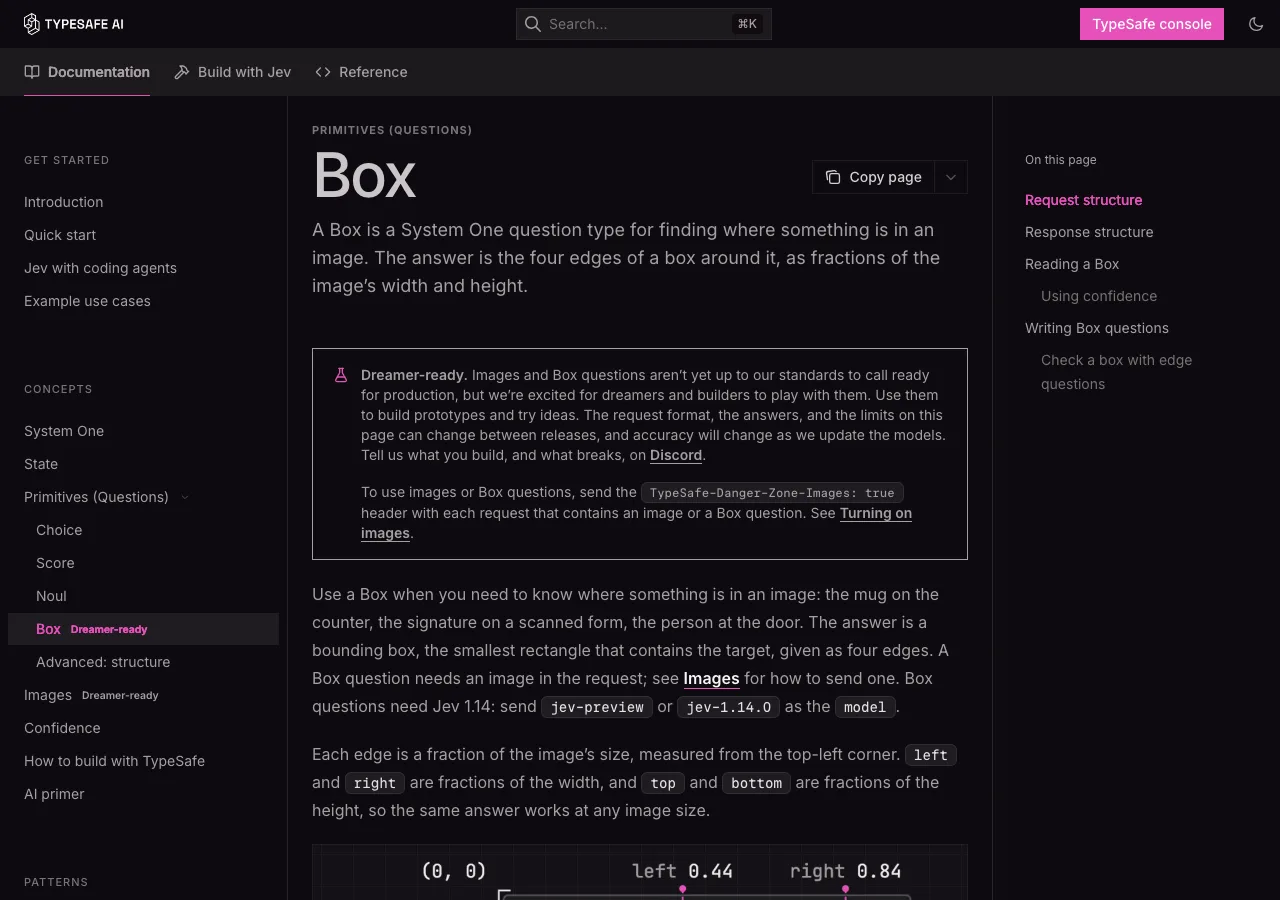
The answer is a bounding box, the smallest rectangle that contains the target, given as four edges. / A Box answer is always a box. There is no “not found” answer, so a Box question about something absent still returns four edges. / On 36 test crops of paintings, each with a known part of the target cut off, the four edge questions caught 30 of the cuts. — from the introduction, the section on writing Box questions and the section on checking a box with edge questionsView official source →
Long context raises the limit to 262k at the same price
Sending the long-context header raises both the per-request and the per-question limit to 262k tokens. By default, the per-request limit covers the state plus all questions, and the per-question limit covers the state plus any one question. Those defaults are 64k and 32k.
Long context works on Jev 1.14 and 1.13 and costs the same per token. It is slower and less accurate than staying within the defaults. The docs' example sends a long contract and asks whether it has a clause that lets either party end the agreement early.
TypeSafe says Jev can handle much longer input than it enabled, and it set the limit on purpose because Jev, like every model, is less reliable on long input. It strongly recommends keeping context short.
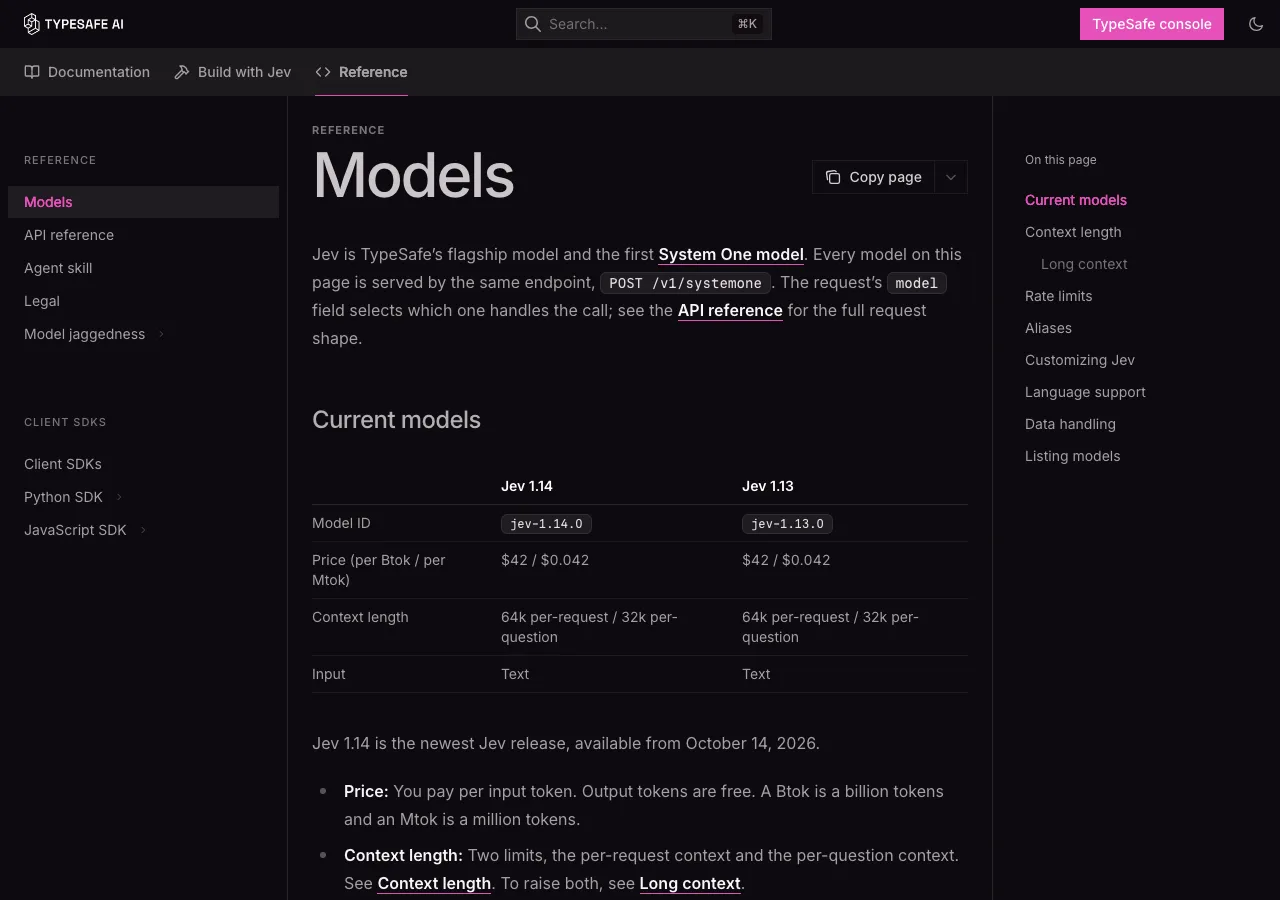
Long context is off by default and works on both Jev 1.14 and Jev 1.13. / With the header, the per-request context and the per-question context are both 262k tokens. / Long context costs the same per token as any other request. It is slower and less accurate than staying within the default limits, so turn it on only for requests that need it. — from the section on long contextView official source →
We chose to limit it intentionally because Jev, like all models, is less reliable on longer contexts, and this constraint encourages more effective usage patterns in prod. — from the section on context lengthView official source →
What danger zone means and when jev-latest moves
"Danger zone" is TypeSafe's name for features it ships behind API headers because it will not vouch for them in production. TypeSafe says they will stay for future models, but their quality is still too uneven. The docs add that the request format, the answers and the limits can change between releases.
The release also adds an opt-in that lets users share queries so TypeSafe can find weak spots. TypeSafe says it still will not train on queries.
jev-1.14.0 sits under the alias jev-preview. TypeSafe said jev-latest would move to jev-1.14.0 in a week, and in the docs on October 16, 2026, jev-latest still pointed to jev-1.13.0.
An alias moves when a new release ships, so answers can change without any change to your code. If you tuned confidence thresholds against one version, send a versioned ID such as jev-1.13.0.
TypeSafe intends to give 60 days of warning before it formally deprecates jev-1.13.0 and 30 days for jev-1.14.0. It expects the biggest gain in 1.14 to be multilingual support, but the docs still say English is where accuracy is best, so test other languages on your own content.

But as a warning, we think there is still way too much jaggedness for us to vouch for these for production use cases! — from the section on TypeSafe's philosophyView official source →
An alias moves when a new release ships, so its answers can change without any change to your code. — from the section on aliasesView official source →
Which Jev numbers come from TypeSafe itself?
The adoption figure, the speed and cost multipliers and the new 1.14 intelligence measure all come from TypeSafe. TechCrunch and SiliconANGLE both report them as claims by the company.
A third of the Fortune 500, with no customers named
TypeSafe says a third of the Fortune 500 use Jev, but it has not named a single one. The funding post also says Jev has already saved customers millions of dollars in production. TechCrunch reported the Fortune 500 figure as the startup's claim and called the uptake unusually fast.
How TypeSafe measured 193.6x faster and 444.6x cheaper
The "193.6x faster, 444.6x cheaper" line on TypeSafe's homepage comes from four workflow evaluations that TypeSafe published. A workflow here is a chain of decisions written in code.
Every model runs the same workflow, and its answers are compared with a reference built from the average of GPT-6 Astra and Fable 5.1. The LLMs run through TypeSafe's own wrapper, which forces them to return the same kind of structured decision as Jev.
TypeSafe lists the limits itself. Its own model capabilities team built the workflows, so some bias could exist, and it expects the two multipliers to sit at the higher end of real-world gains. The same post gives a broader range of 40x to 200x faster for queries at a similar level of intelligence.
This is where the claims of 193.6x faster, 444.6x cheaper on our home page comes from, and we expect that these are on the higher end of real world gains. / However, they were made by individuals on our model capabilities team, so some bias could exist. — from the notes under the workflow evals sectionView official source →
The 1.14 intelligence measure and its stated bias
With Jev 1.14, TypeSafe shared for the first time its own internal measure of the kind of intelligence it says matters most to developers. The post names no benchmark and gives no score. TypeSafe says it dislikes public benchmarks.
TypeSafe calls the measure its best guess and says it will keep changing, so internal numbers shown again may not be consistent. It includes only open-weight models, meaning models whose weights anyone can download, because TypeSafe guards its private validation set and distrusts its model providers' data policies.
TypeSafe also says the measure is likely biased toward its own models and suggests looking only at how the open-source models rank against each other. It tells readers not to believe the measure entirely and to favor their own evals. With no benchmark names or scores in the post, you have nothing in it to check.
This is likely biased towards our models. / Don’t believe it entirely. Always favor your own experimentation and evals with your use cases. — from the notes under the section on measuring intelligenceView official source →
Where the money goes and who ships Jev-compatible models
TypeSafe plans to spend the round on more System One models and on the enterprise features customers have asked for. At least one rival, Cloudflare, already ships a model that works with the same API.
More System One models and enterprise features
The funding post promises developers more models built for software rather than chat, and promises businesses the enterprise features they have requested. SiliconANGLE reported that Jev is the first entry in a planned System One series and that the money will add more models to that lineup. The 1.14 post sets a modest tone for what follows: expect most releases to be small improvements, better stability and features for real deployment.
Cloudflare Clef follows the same API as Jev
Cloudflare released its own decision model, Clef, on October 1, 2026, 16 days after Jev launched, and it follows the same API. Clef reads images and ships open weights.
When Cloudflare announced it, Jev publicly accepted text only, so image input counted as a gap. Jev now accepts images behind a header too, although TypeSafe labels that experimental, and open weights remain the difference. For a side-by-side look at price and test scores, see Cloudflare Clef vs Jev: decision model benchmarks.
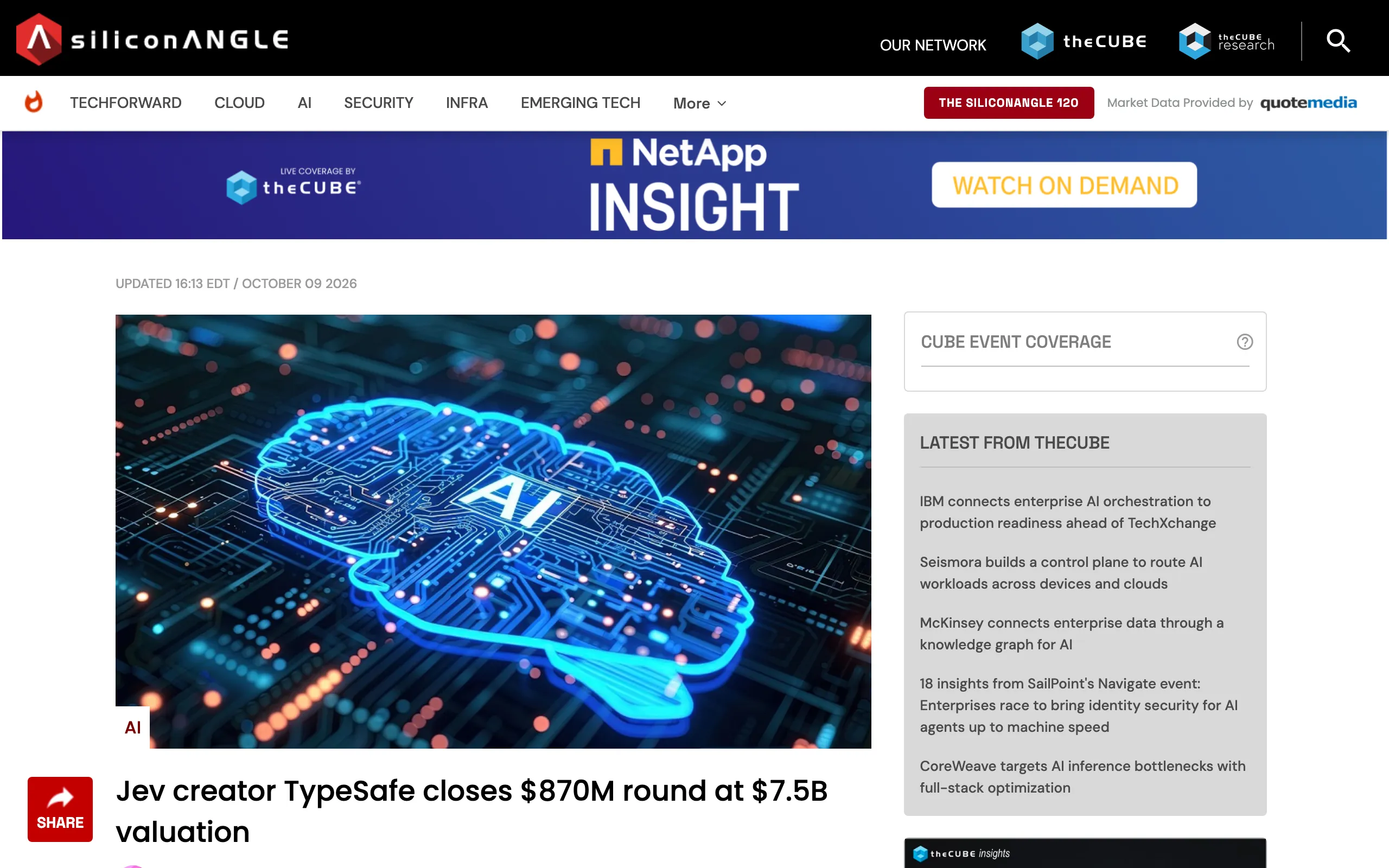
Jev is part of a planned model series dubbed System One. TypeSafe will use the proceeds from its funding round to make more additions to the lineup. — from the paragraph on use of fundsView official source →
What the round means for teams evaluating Jev
Investors put a $7.5 billion valuation on a company whose model had been public for 24 days, and the adoption, speed and cost figures behind it come from TypeSafe. None of them tells you how Jev will do on your decisions, and the new 1.14 flags arrived five days after the round as experiments.
TypeSafe's multipliers are a reason to run a test, not a substitute for one. Check the claims on your own data first and add the experimental features only after the plain version works. A sensible order is:
- Run Jev on a sample of your own routing or scoring tasks and compare accuracy and latency with what you use today. Use the confidence score to decide which cases go to a person.
- Send a versioned model ID, such as jev-1.13.0 or jev-1.14.0, once you have tuned thresholds, because aliases move.
- Keep images, box and long context out of production until TypeSafe says they are ready, and use them for prototypes.
FAQ
- How much did TypeSafe AI raise?
- TypeSafe AI raised $870 million in a Series A at a $7.5 billion valuation, announced on October 9, 2026. Andreessen Horowitz led the round, with Sequoia Capital and DCVC taking part.
- Is Jev a large language model?
- No. Jev uses a transformer architecture, but it does not generate text. It returns probabilities for answers you define in advance, which TypeSafe calls calibrated decisions.
- How much does Jev cost?
- Jev costs $0.042 per million input tokens, and output tokens are free. TypeSafe opened early access on September 15, 2026, and Jev 1.13 and 1.14 cost the same.
- Is Jev 1.14 ready for production?
- Not the new features. TypeSafe's docs say images and box questions are not yet up to its standards for production, and its release post says it cannot vouch for the danger zone features in production. Images, box and long context stay off unless you send a TypeSafe-Danger-Zone header with the request.
Related articles
 Microsoft-Decision-1: Jev-priced decision modelMicrosoft-Decision-1 scores fixed options instead of writing text, at Jev's price of $0.042 per million input tokens. JevBench measured 459 ms, not 85 ms.
 Cloudflare Clef vs Jev: decision model benchmarksCloudflare Clef is an open-weight decision model that speaks Jev's API and reads images, at about 6x Jev's price. Its benchmark lead is still self-reported.
 Stability AI Funding: $76M From the Music MajorsStability AI funding round: a $76M Series B from Sony, Universal, Warner and Electronic Arts. Total funding under CEO Akkaraju is $232M, this round included.
 Claude Fable 5.2: 20% price cut, up to 30% fasterAnthropic released Claude Fable 5.2 on November 9, 2026. API prices fall 20% to $8/$40 per million tokens, and output is up to 30% faster than Fable 5.1.