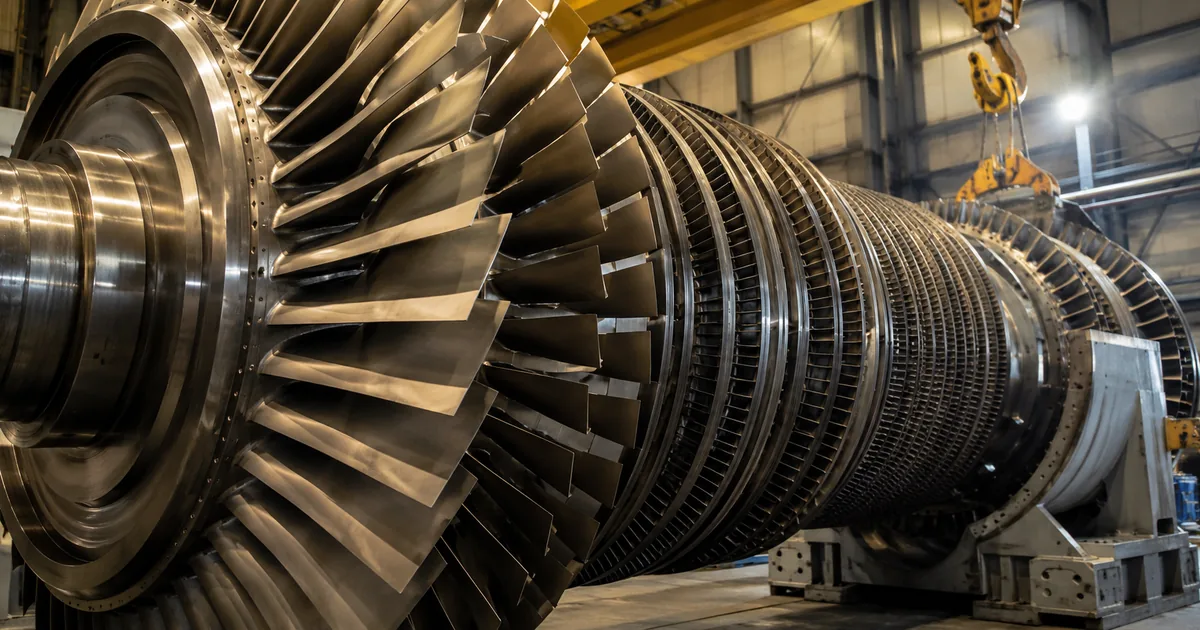
Data center power demand outpaces gas turbine manufacturers
US data center power demand is set to grow faster in 2027 than gas turbine manufacturers can build machines. Goldman Sachs, in a May estimate quoted by OilPrice, puts that demand at 31 GW in 2025, 41 GW in 2026 and 66 GW in 2027. A gigawatt (GW) measures how much power can be delivered at one moment, so these totals show how much generating capacity data centers would need.
The yearly additions grow faster than the totals. Data centers added 8.5 GW in 2025, and are scheduled to add 13.6 GW in 2026 and 36.3 GW in 2027. By then they would take 8.5% of total US peak summer demand, up from 4.1% at the time of the May estimate.
US data center power demand and additions (Goldman Sachs)
| Year | Demand | Additions that year |
|---|---|---|
| 2025 | 31 GW | 8.5 GW (realized) |
| 2026 | 41 GW | 13.6 GW (scheduled) |
| 2027 | 66 GW | 36.3 GW (scheduled) |
Supply falls short of the 2027 additions. GE Vernova builds about 20 GW a year worldwide, for every customer combined, and the 36.3 GW due in 2027 exceeds the yearly output of all three major turbine makers together.
Data centers are also not the main buyer, since only a fifth of the contracted gigawatts are earmarked for them. The rest serves utilities replacing coal, Middle East power and desalination projects, industrial customers, and grid reliability work that was queued before the inference clusters arrived.
"Goldman Sachs has U.S. data centers adding 36.3 GW of capacity in 2027 alone, more than the combined annual manufacturing output of all three major turbine makers."/"Year-over-year capacity additions accelerate from 8.5 GW actually realized last year to 13.6 GW scheduled for 2026 and 36.3 GW scheduled for 2027."/"Everything GE Vernova builds annually, worldwide, for every customer on the planet, is about 20 GW."/"Only a fifth of the gigawatts under contract are earmarked for data centers in the first place."(article body)— OilPrice.com, citing a May Goldman Sachs estimateView official source →
GE Vernova gas turbine backlog differs from Siemens Energy’s
The three headline backlogs of 116 GW, 69 GW and 35 GW count different things, so adding them up to 220 GW overstates the case. At the end of the second quarter of 2026, GE Vernova counted 116 GW across firm orders and slot reservations, up from 83 GW at the end of 2025 and 100 GW three months earlier. A slot reservation is a paid option on future production: the customer turns it into a firm order if the data center gets built, and otherwise the manufacturer keeps the deposit and resells the slot.
Only 53 GW of the GE Vernova figure is firm equipment backlog, and the other 63 GW is reservations. Siemens Energy reported 69 GW of firm backlog with no reservations mixed in, after booking 15 GW and shipping 6 GW in the fiscal quarter that ended on June 30. Mitsubishi Heavy Industries reported 35 GW on August 6, up from 23 GW a year earlier, and that number counts large-frame turbines only, over the March to June period.
Industry-wide orders hit a record 38 GW in the second quarter, 71% more than a year earlier, and half of them came from the US. Wood Mackenzie estimates that factories worldwide can make 60 to 70 GW a year, while orders stand near 110 GW.
"Of GE Vernova’s 116 GW, only 53 GW is firm equipment backlog; the other 63 GW is slot reservations, paid options that haven’t converted to orders yet. Siemens’ 69 GW is firm backlog with no reservations mixed in. Mitsubishi’s 35 GW covers large-frame turbines only, leaving out its aeroderivative and mid-size lines."/"Global orders in the second quarter hit a record 38 GW , up 71% year on year, with the U.S. accounting for half. Wood Mackenzie puts worldwide manufacturing capacity at 60 to 70 GW a year against roughly 110 GW of orders."/"A slot reservation agreement is a paid option on future production."(article body)— OilPrice.com, citing company disclosures and Wood MackenzieView official source →
Gas turbine prices rise as the supply chain stays thin
OilPrice traces the rise in gas turbine prices to scarce castings, skilled labor and factory slots. The hottest parts of a turbine, the blades and vanes exposed to a 1,000-degree gas path, are cast by a small group of specialized foundries.
The welders and machinists who put the machines together were let go about a decade ago and were not rehired. Even a buyer with a slot may struggle to find qualified contractors to install the unit.
Lead times show the strain: a new combined-cycle plant took three and a half years on average in 2023 and takes roughly five years as of August 2026, and some heavy-duty frames take seven years. Cost per kilowatt moved the same way: BloombergNEF put the average combined-cycle project at $2,157 per kW in 2025, up from under $1,500 in 2023.
GridLab reviewed project filings. Plants due in 2026 and 2027 list $1,116 to $1,427 per kW, and projects aimed at 2030 and 2031 usually list $2,000 per kW or more.
For turbines alone, Wood Mackenzie projects $600 per kW by the end of 2027, which is 195% above 2019. GE Vernova's first-half 2026 equipment orders were priced more than 20% above its fourth-quarter 2025 orders.
OilPrice does not blame fuel. In mid-August, Henry Hub spot gas sat near $2.79 per MMBtu (million British thermal units), and the 2026 average from government trackers is close to $3.31.
"Hot-section castings, the blades and vanes that sit in a 1,000-degree gas path, come from a thin bench of specialized foundries, and the welders and machinists who assemble these machines were laid off a decade ago and never replaced."/"Average lead times for a new combined-cycle plant have gone from three and a half years in 2023 to roughly five now , and seven for some heavy-duty frames."/"BloombergNEF put the average combined-cycle project at $2,157 per kilowatt last year , up from under $1,500 in 2023."/"Wood Mackenzie expects turbine prices alone to reach $600 per kW by the end of 2027, a 195% jump from 2019."(article body)— OilPrice.com, citing BloombergNEF, GridLab and Wood MackenzieView official source →
PJM capacity auction results show a 6,831 MW shortfall
The PJM capacity auction of July 14 paid the highest price its rules allow and still ended 6,831 MW below the reliability requirement. A capacity auction is where a power market buys, years ahead, the generation it expects to need. PJM, the grid operator serving 67 million people, held this one for the 2028/2029 delivery year.
The auction bought 138,318 MW of unforced capacity (output PJM can count on after allowing for outages), and that left the system 6,831 MW under what PJM itself says it needs for reliability. Only 525 MW of that was new generation or uprates (extra output from existing plants), so the capped price drew about half a gigawatt of new supply.
For the third year running, the price settled at the $325 per megawatt-day cap approved by FERC, the federal energy regulator. PJM's own modeling showed the region would have cleared at $554.72 per megawatt-day without the cap, and the ComEd zone at $776.69.
PJM has proposed a one-time Reliability Backstop Procurement that targets roughly 14.9 GW of new capacity. Part would be bilateral contracts starting in September 2026, and the rest a pay-as-bid auction in March 2027.
"The auction for the 2028/2029 delivery year cleared at $325 per megawatt-day, the FERC-approved cap, for the third consecutive year. It procured 138,318 MW of unforced capacity, which left the system 6,831 MW below PJM’s own reliability requirement. New generation and uprates that cleared: 525 MW."/"PJM’s own modeling showed that without the cap , the RTO would have cleared at $554.72 per megawatt-day and the ComEd zone at $776.69."/"PJM has proposed a one-time Reliability Backstop Procurement targeting roughly 14.9 GW of new capacity, split between bilateral contracts starting this September and a pay-as-bid auction next March."(article body)— OilPrice.com, citing PJM auction resultsView official source →
Exelon and Texas revise data center power demand forecasts
Exelon cut its data center load estimate and Texas ordered an audit of its grid-connection queue, so some announced load may never be built. Exelon lowered its "high probability" data center load estimate on July 30, from about 18 GW to about 11 GW, nearly 40% less. Its wider interconnection pipeline shrank from about 43 GW to 25 GW within one quarter, and roughly 4 GW of it has signed transmission service contracts, backed by $1 billion of collateral already posted.
On August 3, Texas Governor Greg Abbott ordered an audit of each data center waiting in the connection queue of ERCOT, the Texas grid operator. Requests there had grown to roughly 474 GW, about 90% from data centers, which is over five times the highest demand Texas has recorded. ERCOT then halted its Batch Zero process for large loads.
BloombergNEF estimates that nearly 50 GW is at risk of delay because of ERCOT's pause, about a fifth of the national pipeline. Goldman Sachs itself assumes that only 50% to 60% of data center capacity scheduled for the next two years arrives on time.
GE Vernova's second-quarter free cash flow reached $5.1 billion, and customer down payments on slot reservations improved its working capital by $6.4 billion. Of the 116 GW, the 63 GW of reservations become orders only if the data centers behind them get built.
"Exelon cut its “high probability” data center load from roughly 18 GW to about 11 GW on July 30, a drop of nearly 40%."/"Gov. Greg Abbott ordered an audit of every data center in the ERCOT interconnection queue on Aug. 3 after requests swelled to roughly 474 GW , about 90% of it data centers and more than five times the state’s record peak demand."/"BloombergNEF estimates the pause puts nearly 50 GW at risk of delay , about a fifth of the national pipeline."/"Goldman itself assumes only 50% to 60% of the data center capacity scheduled over the next two years shows up on time."/"Second-quarter free cash flow hit $5.1 billion, helped by a $6.4 billion working capital benefit from customer down payments tied to slot reservations."(article body)— OilPrice.com, citing Exelon, Texas officials, BloombergNEF, Goldman Sachs and GE VernovaView official source →
Engines cover AI data center power that gas turbines cannot
If the data center demand is real, equipment that ships within 24 to 36 months, mostly reciprocating (piston) engines, covers what gas turbines cannot. OilPrice names Caterpillar and Wärtsilä, which now sell prime power into AI campuses and whose own order books are full into 2028. Fuel cells fill in around the edges, existing plants run harder, and coal units due to retire stay open.
If the demand is not real, the correction appears later as canceled slot reservations in 2028 and 2029. In either case, power that arrives before 2030 comes from something other than a new gas turbine.
"If the demand is real, the turbines can’t arrive fast enough and the shortfall gets covered by whatever can be delivered inside 24 to 36 months, mostly reciprocating engines"/"That’s why Caterpillar and Wärtsilä are now selling prime power into AI campuses, and why their own order books are full into 2028 too."/"If the demand isn’t real, the correction shows up as canceled slot reservations in 2028 and 2029"(article body)— OilPrice.comView official source →
Data center gas turbine slots at GE Vernova sell into 2031
Under the gas turbine shortage, delivery slots rather than announced gigawatts set when AI data centers get gas power. Turbines that run data centers in 2027 were ordered in 2023 and 2024, and turbines ordered in August 2026 land around 2030 or 2031. Any power needed between 2027 and 2030 is already spoken for, comes from something other than a new gas plant, or does not happen.
GE Vernova is taking reservations for 2031 delivery and, according to CEO Scott Strazik, should have more than half of that year contracted by the end of 2026. It expects at least 125 GW under contract by December, while production runs at about 20 GW a year, with 24 GW planned by 2028 and a push toward 30 GW by 2030. Siemens Energy quotes lead times of three years or more, and Mitsubishi Heavy Industries says orders booked in its fiscal first quarter are scheduled for delivery between 2028 and 2030.
For a data center planner, the question to ask of any new campus is which delivery slot it holds and who sold it. A power plan that names gigawatts without naming a slot cannot be placed on this calendar.
"Order a heavy-duty gas turbine from GE Vernova today and it won’t arrive until 2031."/"The turbines running data centers in 2027 were ordered in 2023 and 2024. Turbines ordered this month land somewhere around 2030 or 2031."/"It expects at least 125 GW under contract by December."/"Lead times run three years or more."/"CFO Hiroshi Nishio said orders booked during the quarter are scheduled for delivery between 2028 and 2030"(article body)— OilPrice.com, citing GE Vernova, Siemens Energy and Mitsubishi Heavy IndustriesView official source →
FAQ
- How long is the wait for a gas turbine right now?
- OilPrice reports that a heavy-duty machine ordered from GE Vernova in August 2026 arrives in 2031, a schedule the company confirmed on its July 22 earnings call. Siemens Energy quotes lead times of three years or more.
- Can the three big backlogs be added together?
- No, because they count different things. Of GE Vernova's 116 GW, only 53 GW is firm order backlog and 63 GW is paid slot reservations. Siemens Energy's 69 GW carries no reservations, and Mitsubishi's 35 GW covers large-frame machines only.
- What does the shortage look like in a power market?
- PJM's July 14 auction for the 2028/2029 delivery year cleared at the regulated cap for the third year in a row. It still finished 6,831 MW under PJM's own reliability requirement, and only 525 MW of new generation and uprates cleared.
Related articles
 Ratepayer Protection Act Fails Senate Vote 57-43The House passed H.R. 9340 417-3, but the Senate fell three votes short of 60 on September 30. What the Ratepayer Protection Act asks of data centers.
 Data Center Economy: What Quincy Actually GotData center economy in Quincy, Washington: poverty fell from 29.4% to 6.2% and taxes funded public buildings, but an advocate says farmworkers missed out.
 Thermodynamic Computing: Noise as the Power SourceThermodynamic computing uses thermal noise as its power source. What Berkeley Lab shows, what Extropic’s TSU chips claim, and the energy efficiency case.
 Claude Fable 5.2: 20% price cut, up to 30% fasterAnthropic released Claude Fable 5.2 on November 9, 2026. API prices fall 20% to $8/$40 per million tokens, and output is up to 30% faster than Fable 5.1.