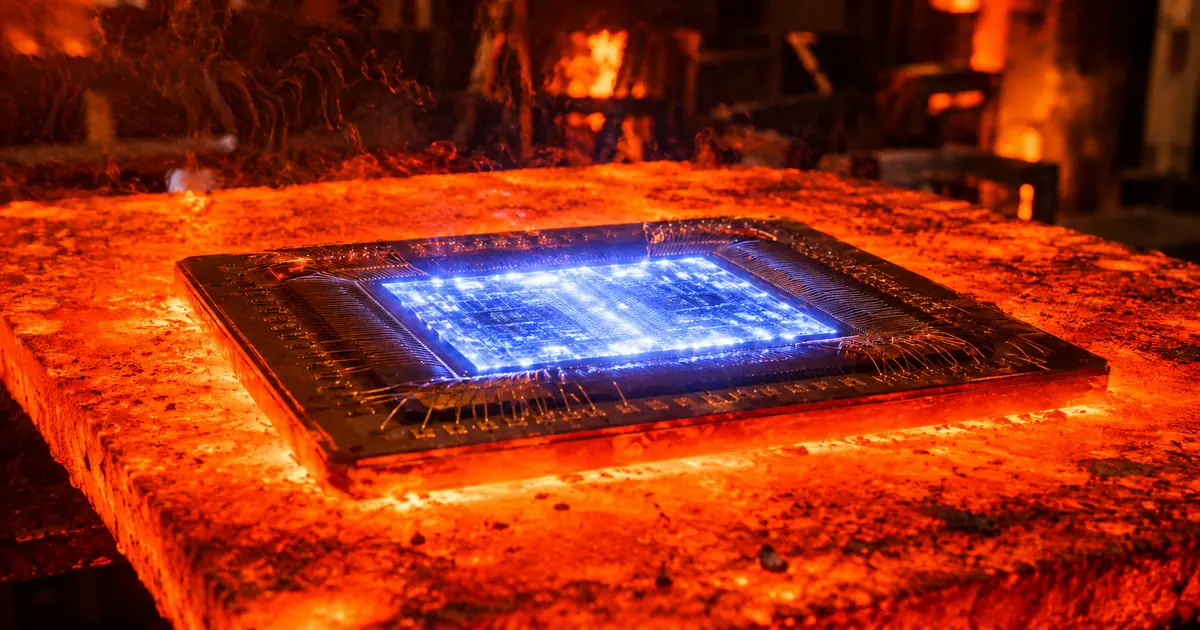
Unconventional computing: how a thermodynamic computer uses noise
Berkeley Lab describes thermodynamic computing as a branch of unconventional computing. Unconventional computing, in general, means designs that depart from the standard digital processor. Berkeley Lab says the approach inverts the paradigms of both classical and quantum computing and uses thermal fluctuations as its power source.
Thermal noise, which Berkeley Lab calls thermal fluctuations, is the small random motion that heat causes in matter. In a thermodynamic computer, that motion is the source of power.
The same Berkeley Lab page frames the energy question with an everyday figure. A single Google search consumes enough energy to power a six-watt LED for three minutes.
"But thermodynamic computing, a branch of unconventional computing, inverts the paradigms of both and uses those same fluctuations as its power source."/"Modern computing requires energy: a single Google search, for example, consumes enough energy to power a six-watt LED for three minutes."View official source →
How a stochastic thermodynamic neural network is trained
Berkeley Lab says a thermodynamic computer is a stochastic system. Stochastic means chance is part of how the system behaves, so no two runs look the same. Berkeley Lab adds that the methods used for training digital neural networks do not apply.
The Nature Communications paper "Nonlinear thermodynamic computing out of equilibrium," by Berkeley Lab's Stephen Whitelam and Corneel Casert, takes up the training question. Its authors simulate a digital model of a thermodynamic neural network.
The authors show that a genetic algorithm, a search method that tries many parameter settings and keeps the better ones, can adjust that network's parameters. The adjusted network then performs nonlinear calculations, where the output does not simply scale with the input, at specified observation times. The network in that paper is a simulated model, not a built device.
"A thermodynamic computer is a stochastic system, meaning that no two runs on a thermodynamic computer look the same, and the methods used for training digital neural networks don’t apply."View official source →
"We simulate a digital model of a thermodynamic neural network, and show that its parameters can be adjusted by genetic algorithm to perform nonlinear calculations at specified observation times, regardless of whether the system has attained thermal equilibrium."View official source →
Thermodynamic AI and energy efficiency: costly to train, cheap to run
Berkeley Lab states the energy efficiency trade-off in one sentence. Its training framework is considerably more costly than the methods used to train digital networks.
The result, once built and trained, is a computer that can operate using very little energy. The sentence gives no figures for either side.
Casert draws the line between training and inference. Inference means running a trained model to get answers. Training by digital simulation is expensive, he says, but once the network is trained and built as physical hardware, inference on it would cost very little energy.
Berkeley Lab sums up the aim as a design that could drastically reduce the energy requirements of machine learning. Neither the news page nor the paper's abstract puts a number on that reduction, such as watts saved or a ratio against a GPU.
"This training framework is considerably more costly than the methods used to train digital networks, but it yields a computer that can operate using very little energy after it’s built and trained."/"Training a thermodynamic neural network by simulating it digitally is expensive, but once trained and built as physical hardware, we can perform inference on that hardware for a very low energy cost,"/"the researchers have proposed a design and training framework for a type of thermodynamic computer that mimics a neural network, which could drastically reduce the energy requirements of machine learning."View official source →
Extropic TSU: a thermodynamic sampling unit built on standard CMOS
Extropic describes its TSUs as chips that use the natural thermodynamic fluctuations of standard CMOS transistors. CMOS is the ordinary process used to make most of today's chips. Extropic gives this description on a page titled "Thermodynamic Computing Chips in America".
The chips use those fluctuations to sample directly from programmable probability distributions in a power-efficient manner, according to Extropic. Sampling means producing random outcomes, each as often as its probability says, and programmable means those probabilities can be set. Extropic calls the capability useful for generative AI and for simulations of biology and markets, among other uses.
"TSUs use the natural thermodynamic fluctuations of standard CMOS transistors to sample directly from programmable probability distributions in a power-efficient manner, a capability useful for generative AI, simulations of biology, markets, and beyond."View official source →
Thermodynamic computing hardware: what Extropic has and what is open
Berkeley Lab's design has not been built as hardware yet; Extropic is a separate company that describes chips of its own. The Berkeley Lab results come from digital simulation, and the team is looking for experimental partners to make both hardware and software a reality.
According to Whitelam, it is important to work out how to realize these designs in hardware. Existing algorithms assume systems at equilibrium, so Berkeley Lab says new ones will need to be developed as well. Extropic's TSUs are a different approach.
"Currently, the team is looking for experimental partners to make both hardware and software a reality — another step exploring what’s possible with thermodynamic computing."/"According to Whitelam, it’s important to work out how to realize these designs in hardware."/"Existing algorithms are meant for systems working at equilibrium; with that requirement no longer a roadblock, new ones will need to be developed."View official source →
FAQ
- What makes thermodynamic computing different from classical computing?
- Berkeley Lab says thermodynamic computing is a branch of unconventional computing that inverts the paradigms of both classical and quantum computing. Thermodynamic computing uses thermal fluctuations as its power source.
- Why did the Berkeley Lab work use a genetic algorithm?
- Berkeley Lab says a thermodynamic computer is stochastic, so no two runs look the same, and the methods used to train digital neural networks do not apply. The Nature Communications paper adjusts the parameters of a simulated model by genetic algorithm instead.
- How much energy does a trained thermodynamic computer use?
- Berkeley Lab says a thermodynamic computer can operate using very little energy once it is built and trained, and the sentence gives no figure. It adds that the training framework is considerably more costly than the methods used to train digital networks.
- What does Extropic say its TSUs do?
- Extropic says its TSUs use the natural thermodynamic fluctuations of standard CMOS transistors to sample directly from programmable probability distributions in a power-efficient manner. It names generative AI and simulations of biology and markets as uses.
- What does Berkeley Lab say about building thermodynamic computing hardware?
- Berkeley Lab quotes Whitelam as saying it is important to work out how to realize these designs in hardware.
Related articles
 Flash prices up 5x on AI, eroding Apple's leverageAI demand made flash 5x pricier in a year, the WSJ reports. Cloud giants now buy twice as much as Apple, and doubling iPhone 17 Pro storage costs Apple $66.
 Malaysia seizes 30 AI chip servers at KLIA airportMalaysian customs seized 30 AI chip servers worth RM49.5 million at KLIA, declared as electronic components, in the year's fifth case tied to one syndicate.
 PC shipments fell 20.1% in Q3 as prices stay highIDC says worldwide PC shipments fell 20.1% to 62.7 million in Q3 2026 after a first-half stock-up. AI data center demand keeps prices high, and HP fell 30.9%.
 AI Chip Smuggling: Taiwan Indicts Nine Over B300sTaiwan indicted nine over alleged B300 server smuggling. Prosecutors say 74 of 130 servers reached China via Indonesia, Japan and Hong Kong; customs held 56.