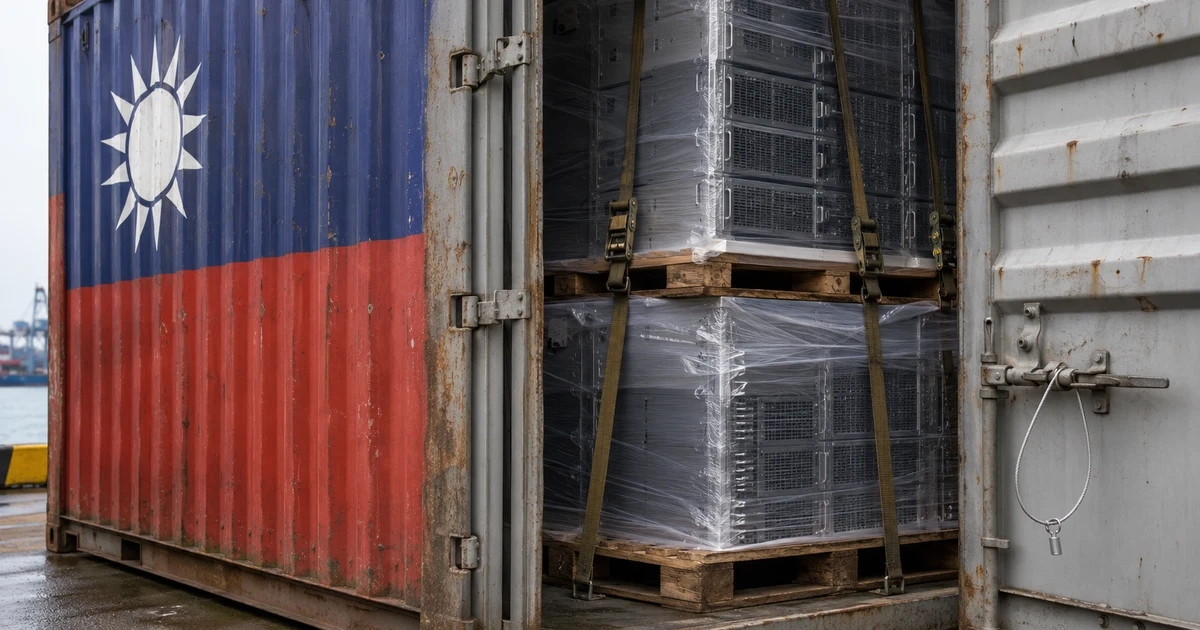
Prosecutors say 74 of 130 B300 servers reached China
Prosecutors say 74 of the 130 B300 servers approved for sale reached China, and customs stopped the other 56. The release calls all of them B300 servers and gives no hardware specification. The sale was split into three delivery stages of 2, 64 and 64 units.
The release is dated 24 August 2026. It matters to vendors, distributors and data center customers because it sets out which of a seller's own checks the defendants allegedly beat.
Shipments as described by prosecutors
| Shipment | Units | Route |
|---|---|---|
| 20 January 2026 | 16 | Direct to China |
| 30 January 2026 | 26 | Indonesia, then China |
| 2 and 12 February 2026 | 24 | Indonesia, then China |
| Stage 3, Hong Kong leg on 11 April 2026 | 8 | Japan, then Hong Kong, then China |
| Stage 3, never shipped | 56 | Held back at customs |
The four shipped legs add up to 74 units, and the blocked 56 bring the total back to the 130 approved. The release does not say when the 8 units left Taiwan for Japan; 11 April 2026 is the date it gives for the Hong Kong leg.
"使美○微臺灣子公司、美○微公司因而同意出售 B300 伺服器共 130 臺予飛○公司,並將訂單分成 3 階段交付,第 1 階段 2 臺、第 2、3 階段各 64 臺"/"於 115 年 1 月 30 日,將第 2 階段之伺服器 26 臺,以長○公司名義"/"出口至印尼,再轉運至中國,交付予中國客戶丁。"(alleged facts section)View official source →
How insiders allegedly beat the whitelist and site audit
Prosecutors allege that insiders defeated each control on the sale in turn, from the whitelist review to the on-site check. The controls were set by a US company that designs GPUs (the vendor) and by its US partner that builds those GPUs into AI servers (the integrator).
A buyer had to be on the vendor's whitelist, an approved-buyer list, and file end-use and end-user declarations. Resale was banned, and orders of 8 or more units also needed an on-site inspection by sales and technical staff. The release says the buyer was put on the whitelist by means it does not specify.
From July 2025, prosecutors say, the buyer's operators and three other defendants agreed on three tasks. A sales director at the integrator's Taiwan subsidiary would explain the sales review so the buyer could prepare its papers in advance. The general manager of a distributor would front the money to dodge a review of where the buyer's funds came from, and a data center project manager would make the leased server room look operational.
On 8 September 2025 the buyer's general manager completed the integrator's declaration. It named the buyer as the end user and Taiwan as the installation country and promised no export to US-sanctioned parties; prosecutors say all three statements were false. The site inspection followed two days later, on 10 September 2025.
According to the release, the defendants at the inspection knew that the leased rack space, power and network bandwidth could not support 130 servers, and hid this from the visiting staff. The staff misjudged the site, and a vendor employee then emailed managers that the check was done. The false declarations were filed again in December 2025 and after 26 February 2026, which released stages 2 and 3.
"欲向美○微臺灣子公司購買高階 AI 伺服器者,除須經輝○公司審核列入白名單外,尚應出具終端用途/終端使用者聲明等文件"/"渠等均知悉飛○公司係使用是○公司之報價單充作租約,且飛○公司向是○公司所承租之機房區域,其機櫃空間、配置電力及網路頻寬均顯然無法滿足 130 臺高階 AI 伺服器之使用需求,竟仍刻意隱瞞,致使不知情之輝○臺灣分公司人員誤判。"(alleged facts section)View official source →
Why customs stopped the last 56 servers
Customs was the check that stopped the stage 3 shipment: its staff noticed something was wrong and required an export license before it could leave. The Customs Administration under Taiwan's Ministry of Finance asked for a strategic high-tech commodities export license from the International Trade Administration. The 56 units were being exported to a Japanese company in the buyer's name at that point.
Prosecutors say the customs broker, the buyer's general manager and the owner of a trading company then agreed that the broker would fabricate a web page for the application. On 15 April 2026 the buyer filed a license application with false content, attaching a web page pieced together from the integrator's own site. The case was uncovered before the license was issued, so the 56 units never left.
A Keelung prosecutor, Hsiao Yung-li, found the exports while directing a Coast Guard Administration team on another case. Investigators then ran 3 searches and detained 7 defendants, including Zhang. Defendant He later turned himself in, and the release says this revealed the whole picture.
Investigators seized more than US$457,000 and proceeds of crime of more than NT$39.32 million. The release gives both as rounded amounts without exact figures.
"惟為財政部關務署人員察覺有異,要求須取得經濟部國際貿易署(下稱國貿署)核發戰略性高科技貨品輸出許可證,始得出口。"/"然因國貿署尚未核發上開許可證之際,本案即遭查獲,上開 AI 伺服器 56 臺乃未完成出口。"/"3 次搜索,羈押被告張男等共 7 人,嗣又接獲被告何男向本署自首,乃查悉上情全貌"(alleged facts and investigation sections)View official source →
Charges and sentences sought against the nine defendants
Nine defendants are indicted, eight on the export offenses and three on a separate asset-stripping count, and no court has convicted any of them. Eight face breach of trust and forgery of documents under Taiwan's criminal code over the exports, and the ninth, He, is not on that count. Three face aggravated breach of trust under the Securities and Exchange Act, over the alleged asset-stripping of a listed distributor, and two of those three are among the eight.
Prosecutors' requests differ by role. For the export count they ask for the statutory maximum against Zhang, Lin, Wang and W, and for 1 year 6 months against the customs broker. For Lin they ask for 6 years on the separate asset-stripping count, the heaviest request in the release.
They ask for 3 years each for Cai and for a defendant the sentencing line names as Chen. Elsewhere the release describes Chen as wanted in a separate case, so the line leaves unclear who is meant.
Defendants He and Lü confessed in full and cooperated, and prosecutors recommend leniency for them. All of these figures are requests to the court, and no court has ruled on any charge.
"認被告張男等 8 人(被告何男除外)就不法出口高階 AI 伺服器部分,均涉犯刑法背信、偽造文書等罪嫌"/"被告張男、林男、王男及 W 男均請從重量處法定最高刑度有期徒刑"/"被告蔡男、陳男請量處有刑徒刑 3 年,被告游男請量處有刑徒刑 1 年 6 月。另被告林男就掏空青○公司財產部分,請從重量處有期徒刑 6 年。"/"被告何男、呂男 2 人於偵查中坦承全部犯行,並配合相關偵查作為"(investigation and sentencing sections)View official source →
Where the money went: US$21.2 million in alleged gains
Prosecutors put the alleged gain from reselling the 74 servers at US$21,205,531, and they ask the court to forfeit it. The figure is what remained after paying the distributor for the goods, and none of it has been seized. The release attributes it to the two people who ran the buyer company.
Two sales directors at the integrator's Taiwan subsidiary, Lin and Wang, received bonuses of US$62,804 and US$83,872 for completing the order. The distributor's general manager, Lü, expected a bonus of NT$6,000,668 and received NT$164,600, and forfeiture is sought for the bonuses they received.
The separate asset-stripping count rests on four invoices issued between January and April 2026 for installation, wiring and configuration work that defendant He's electronics company never did. The distributor remitted NT$39,158,514 in total between January and May 2026. Lin, Lü and He collected and split NT$21,998,514 of it, and NT$17,160,000 had not yet been withdrawn.
The release also lists the harm to the integrator: reputational damage, a fall in its share price, exports placed on a mandatory inspection list, delayed deliveries and penalties owed to customers. The release puts no figure on that damage.
"而被告陳男、C 男則因已完成轉售出口總計 74 臺之 B300 伺服器,於扣除給付予青○公司之貨款後,共取得高達美元 2,120 萬 5,531 元之不法獲利"/"致美○微公司聲譽受損、股價下跌、出口產品遭列為必檢必驗對象,而遲延交貨,需賠付客戶違約金,致生財產損害。"(alleged facts section)View official source →
Why the release masks the company names
The release masks both company names, so they are referred to here only by role. It describes a US company that designs and sells GPUs and a US partner that builds those GPUs into AI servers, with a circle mark in place of a character in each name, and it does not say why.
Some news coverage names both companies, but that is a different source with a different standard of proof. The release contains no statement from any defendant, lawyer or company, so the only account in it is the prosecutors'. Nothing in that account has been proven in court.
"美國輝○公司(下稱輝○公司)主要從事圖形處理器"/"等晶片之設計、研發及銷售"/"為輝○公司之合作夥伴,將輝○公司提供之 GPU 整合"/"製造成 AI 伺服器。"(background section)View official source →
FAQ
- How many people were charged, and with what?
- Nine. Eight face breach of trust and document forgery under the criminal code over the exports, and three face aggravated breach of trust under the Securities and Exchange Act over stripping assets from a listed distributor. These are charges, not convictions.
- How many servers actually reached China?
- Seventy-four, according to prosecutors. Of the 130 units approved, the last 56 never shipped: customs required an export license, and the case was uncovered before one was issued.
- What checks were supposed to prevent this?
- Buyers had to be on the GPU designer's whitelist, file end-use and end-user declarations, and pass review at the two US companies and their Taiwan units, with resale prohibited. Orders of eight units or more also triggered a physical site inspection.
Related articles
 Malaysia seizes 30 AI chip servers at KLIA airportMalaysian customs seized 30 AI chip servers worth RM49.5 million at KLIA, declared as electronic components, in the year's fifth case tied to one syndicate.
 Nvidia Price Increase: AI Servers Up More Than 15%Bloomberg reports the Nvidia price increase: AI servers up more than 15% in many cases from early 2027 on memory costs. Q3 gross margin guide: 74.0%.
 Flash prices up 5x on AI, eroding Apple's leverageAI demand made flash 5x pricier in a year, the WSJ reports. Cloud giants now buy twice as much as Apple, and doubling iPhone 17 Pro storage costs Apple $66.
 Nvidia's Jensen Huang close to alleged Chinese spyThe NYT says US officials judged Megaspeed's Alice Huang, close to Nvidia CEO Jensen Huang, a Chinese intelligence asset. Nvidia calls it normal business.