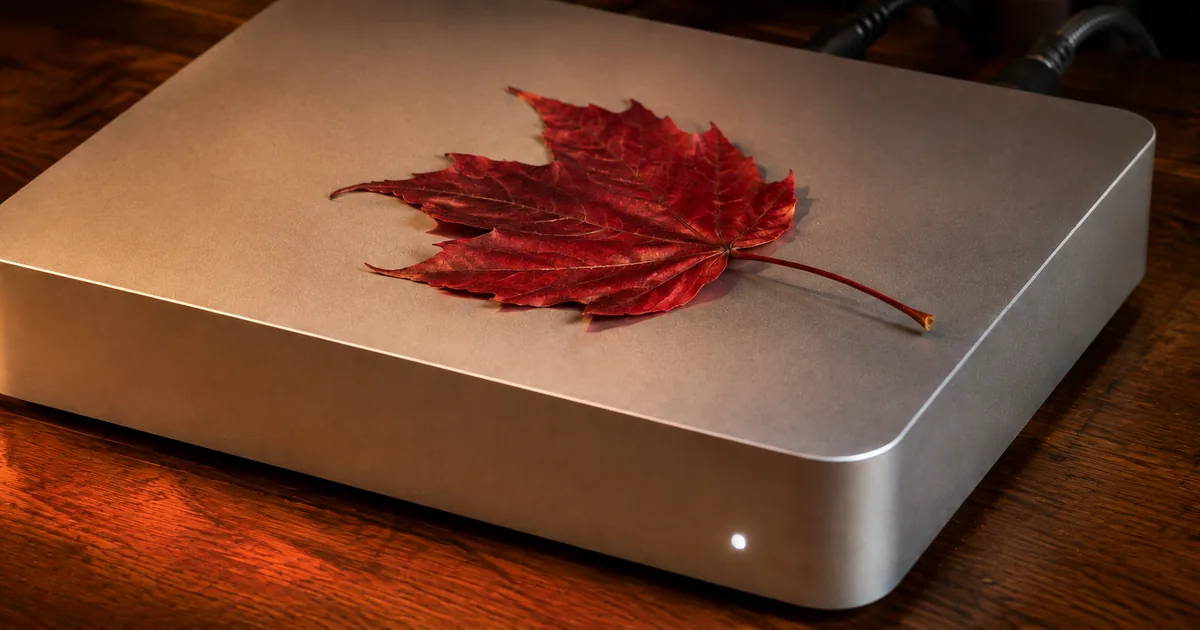
Maple-Preview is a 20B-A1B ternary-weight reasoning LLM
Maple-Preview is an open-source reasoning LLM from DeepGrove, billed as 20B-A1B and built on ternary weights. DeepGrove's model card says it has the best reasoning in its weight class and is competitive with larger models. Both are the developer's claims, and every figure about the model comes from DeepGrove's own model card on Hugging Face.
What 20B-A1B and ternary weights mean
The card never defines 20B-A1B; it gives the layout instead: 24 layers and 256 experts, 8 of them active. The attention is listed as 3:1 SWA-512:GA. Experts are the parallel sub-networks a mixture-of-experts layer chooses among; the Hugging Face page tags the model as mixture-of-experts.
The card does not say whether "8 active" counts experts per token or per layer. "Ternary-weight" is likewise the card's own term, with no definition and no list of the values a weight can take. The repository page carries a ternary tag, which confirms the label but adds nothing more.
The 5.31 GB checkpoint and 131,072-token context
The card's stat block lists a 5.31 GB checkpoint and a 131,072-token context. A checkpoint is the saved file of trained weights, and context is how many tokens the model can take in at once.
The card does not say which file the 5.31 GB describes. The Hugging Face page lists the stored tensor type as BF16, so check the repository's file listing for actual sizes before you plan disk space around that figure.
Today we introduce Maple-Preview, an open-source 20B-A1B ternary-weight reasoning LLM. / Maple-Preview has SOTA reasoning for its weight class and is even competitive with larger models. / 218 tok/s M4 Mac mini / 5.31 GB Checkpoint / 131,072 Token context / Maple-Preview is a 20B-A1B reasoning model designed from the start for efficient on-device inference. / It utilizes a 24-layer, 256-expert (8 active) configuration with 3:1 SWA-512:GA attention. — From the passages on the model's position and release form, the stat block, and the layer and expert configurationView official source →
218 tokens per second on a Mac mini M4, with a caveat
DeepGrove cites 200+ tokens per second on a Mac mini M4, but the card ties that result to a separate on-device runtime. Don't expect that speed from the code that ships with the model. The opening paragraph also says the model solves IMO-level problems, and it sets the speed at 5–16x that of Gemma 4, Qwen3.5 and gpt-oss.
The stat block gives 218 tok/s for the same machine. Both figures are DeepGrove's own.
The included code targets CUDA, not Apple Silicon
The shipped Transformers code is meant for CUDA, and the Apple Silicon number comes from a different runtime. CUDA is NVIDIA's GPU runtime, and Apple Silicon Macs do not have NVIDIA GPUs. The card names Triton and FlashAttention as dependencies of the included implementation.
The speed figure and the shipped code therefore describe two different setups. The card does not say whether that runtime is available to the public, and it gives no memory or hardware requirement for a Mac either.
It solves IMO-level problems and runs at 200+ tokens/sec on a Mac mini M4, 5–16× faster than efficient models like Gemma 4, Qwen3.5, and gpt-oss. / The included Transformers implementation depends on Triton and FlashAttention and is intended for a compatible CUDA environment. / The reported Apple Silicon result uses a separate on-device runtime. — From the claimed speed and the models compared against, the dependencies and intended environment of the included implementation, and the note on what the Apple Silicon result usedView official source →
For local LLM coding, DeepGrove flags weaker agentic results
The card makes no coding claim; it warns that a preview built for raw reasoning may fall short on agent benchmarks. In this context, an agent is a model that calls tools and acts on the results over several steps. Beyond that warning, the card's prose says nothing about coding quality.
Reasoning results: the Pareto frontier claim
DeepGrove claims a new point on the Pareto frontier, for memory against performance and for speed against performance. A Pareto frontier marks the best trade-offs on offer: a point on it is one no other model beats on both axes at once. That is DeepGrove's reading of its own benchmarks, and the card cites no independent rerun.
Minimal agentic post-training ahead of the full release
The Limitations section gives the cause of the agentic gap: little post-training for agent tasks and only a small round of general reinforcement learning. Post-training is the extra training after the main run, and reinforcement learning shapes a model by rewarding good outputs.
DeepGrove says more training will come before Maple's full release. The card frames the weaker agentic results as a limit of the preview stage. If you want a small local model for agent work, Liquid AI LFM2.5-2.6B: Fast Agents, Not for Coding covers one whose maker pitches it at agents and advises against using it for coding.
On benchmarks, Maple-Preview sets a new point on the Pareto frontier for both memory-to-performance and speed-to-performance, demonstrating its strong reasoning capabilities. / However, we note that this preview is focused primarily on raw reasoning and, as such, may underperform on agentic benchmarks. / We intend to continue improving general performance through extended training before Maple's full release. / This preview received minimal post-training for agentic tasks and only small-scale general reinforcement learning. — From the passages on where the evaluation results place the model, the limitation on agentic benchmarks, the plan ahead of full release, and its causeView official source →
MIT license and download: what to check before using it
The card says Maple-Preview is released under the MIT License, and the model is published on Hugging Face as deepgrove/maple-preview. The card names the license but does not spell out what it permits. Read the repository's LICENSE file for the terms before any commercial use.
Two things the card leaves open are worth checking before you download: how the repository's file sizes compare with the 5.31 GB figure, and whether you can obtain the runtime behind the Apple Silicon result. The model is also labeled a preview, and DeepGrove plans more training before the full release.
Maple-Preview is released under the MIT License — From the License sectionView official source →
FAQ
- How fast is Maple-Preview?
- DeepGrove cites 200+ tokens per second on a Mac mini M4, and its stat block gives 218 tok/s, 5–16x faster than Gemma 4, Qwen3.5 and gpt-oss. The card adds that the Apple Silicon result comes from a separate on-device runtime, not from the Transformers implementation it ships.
- What license does Maple-Preview use?
- The model card says it is released under the MIT License. The card does not spell out what that permits, so read the LICENSE file in the repository before any commercial use.
- Is Maple-Preview good for coding or agentic work?
- DeepGrove does not make a coding claim. It says the preview is focused on raw reasoning and may underperform on agentic benchmarks, and it gives minimal agentic post-training and only small-scale general reinforcement learning as the reason.
Related articles
 Embedding Gemma Transcribe: speed and accuracyEmbedding Gemma Transcribe turns Google's EmbeddingGemma 2 into a free Mac speech to text app: an hour of English in 12.6 s, at about 5% word error rate.
 Mac Full Disk Access gets stricter over AI agentsMac Full Disk Access will need very explicit user action, Apple says, citing AI agents. No date or macOS version yet; check which apps have it now.
 Keyboard symbols: names and how to type all 33Keyboard symbols: names and the keys that type them in a searchable list, plus Alt codes and Mac Option shortcuts for special characters not on the keyboard.
 How to scan documents to PDF: phone, PC, or storeHow to scan documents to PDF on iPhone, Android, Windows, or Mac, or at a FedEx Office copier, and where each method saves the file.