
Muse Wonder and Wonder Full are Meta's new agent models
Muse Wonder is Meta's most capable model series so far, built to power AI agents for personal and work tasks. An AI agent is software that takes a goal, plans the steps and carries them out across apps on your behalf. Meta released Wonder and the larger Wonder Full together on October 12, 2026.
Both models accept text, images, video and audio and reply in text. Their context window, the amount of material a model can read at once, is 1 million tokens. Meta trained them at its gigawatt-scale Prometheus data center, scaling up pretraining and reinforcement learning from the Muse Spark models it introduced in April.
Meta says it started rebuilding its AI work from the ground up 14 months ago. According to CNBC, the project's codename was Watermelon. Meta's earlier coding agent is covered in Muse Code: Meta's Coding Agent and Muse Spark 1.2.
Wonder is on the API, Full is not
Developers can call Muse Wonder through the Meta Model API today under the model name muse-wonder-1.0, but Muse Wonder Full is not offered there. Wonder is also available in Muse Code from the cheapest Everyday Usage plan upward.
Meta also plans to bring Wonder to its consumer Muse app soon, starting with subscribers. CNBC reports that Muse app users will need a $20 or $100 monthly plan to use it.
Full needs a $50 or $200 Muse Code plan
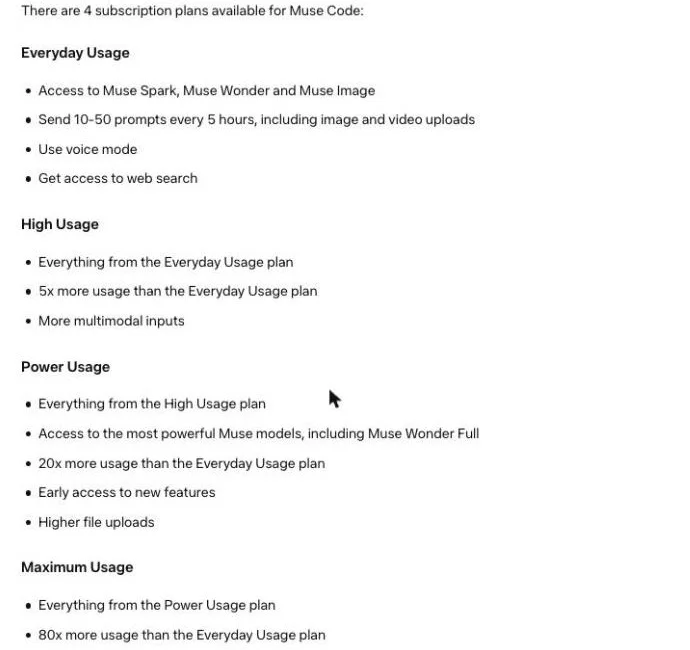
Muse Wonder Full is included only in Muse Code's Power Usage and Maximum Usage plans. Meta's documentation says Power gives 20 times the usage of the Everyday plan and Maximum gives 80 times. CNBC puts their monthly prices at $50 and $200.
Active Memory and Active Focus
Meta pitches two abilities as the core of Muse Wonder: Active Memory and Active Focus. Both target the usual failure points when an agent runs a long job, which are forgetting earlier instructions and giving up halfway.
Active Memory carries context across conversations
Active Memory lets the model keep what matters about you from one conversation to the next and pull up the right details when a task needs them. In practice, you should not have to repeat your preferences every time you start a new request.
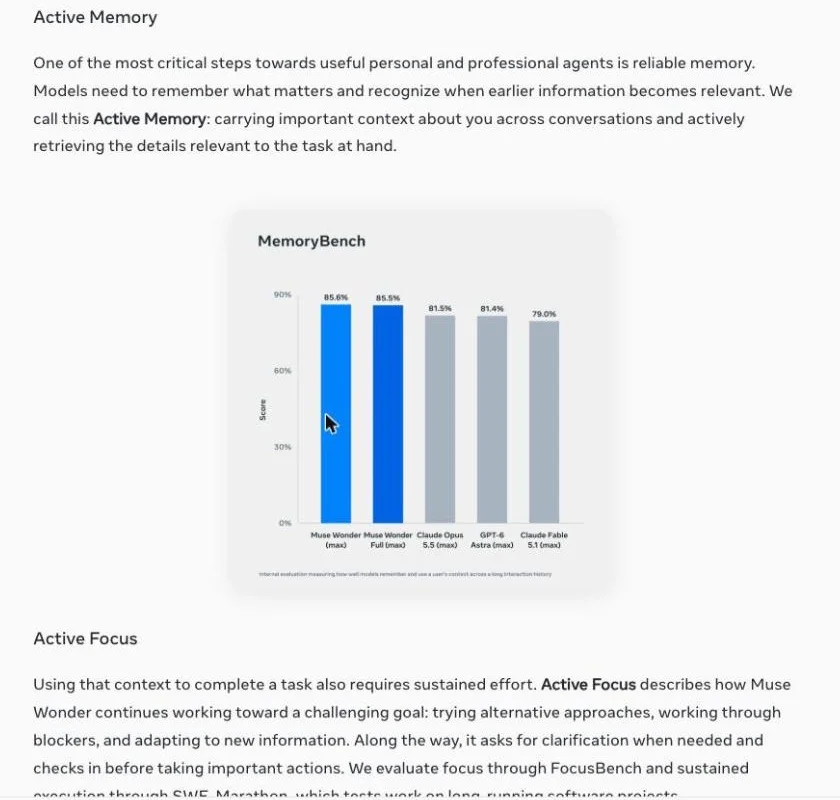
Meta measures this with MemoryBench, an internal test. Both Muse models score above 85%, ahead of the three rival models.
MemoryBench scores (Meta internal test, %)
Both Muse models score in the mid-80s, at least four points ahead of the other three. Meta built and ran this test itself.


No outside group has checked these numbers yet. Until one does, treat the gap as Meta's own claim.
Active Focus tries another approach when stuck
Active Focus keeps the model working toward a hard goal by switching methods when one fails and adjusting as new information comes in. It is also meant to ask questions when something is unclear and to check with you before important actions.
Meta AI chief Alexandr Wang told CNBC the team wanted agents that do not stall on errands like booking a dinner table. He said the model was trained to try another route rather than stop, and to come back to the user when it needs to.
How Muse Wonder compares with Claude Opus 5.5 and GPT-6 Astra
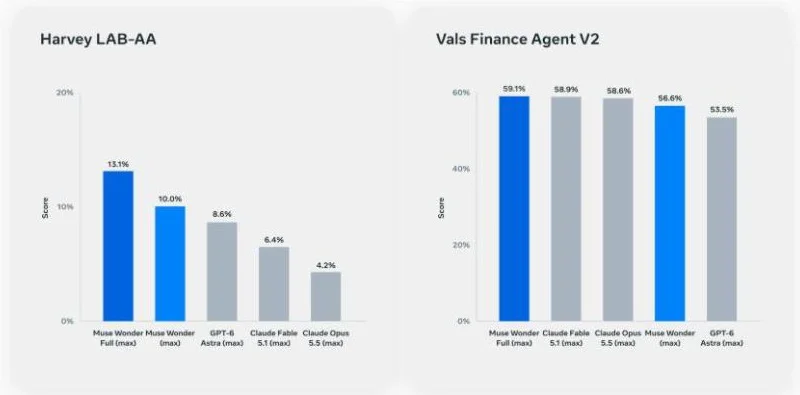
A benchmark is a fixed set of tasks used to score models against each other. Meta's own table has 14 rows, and Muse Wonder Full and Claude Opus 5.5 each lead six of them.
Wonder leads one row (MemoryBench) and GPT-6 Astra leads one (GDP.pdf). All results use maximum reasoning effort except Full's SWE-Marathon score, which uses the xhigh setting.
Full and Opus 5.5 each lead 6 of 14 rows
Full's clearest wins are legal work and very long software projects, while Opus 5.5 wins on writing programs from scratch and on health questions. The four rows below show both sides.
Selected rows from Meta's table (scores)
Full scores more than three times Opus 5.5, though every model is still low in absolute terms.
Fable 5.1GPT-6 AstraOpus 5.5Both Muse models finish first and second, with the other three in the 40s.
Fable 5.1GPT-6 AstraOpus 5.5Opus 5.5 leads Full by more than 11 points here.
Fable 5.1GPT-6 AstraOpus 5.5Opus 5.5 and GPT-6 Astra sit in the mid-60s, with Full third.
Fable 5.1GPT-6 AstraOpus 5.5Full also tops DeepSWE 1.1 at 79.0, ahead of Opus 5.5 at 74.2. Opus 5.5 takes the remaining rows that Meta reports for computer use (OSWorld), terminal coding (Terminal-Bench) and professional tool use (JobBench, by 75.4 to 75.3).
Keep in mind who ran the tests. Meta's model card says it used third-party or vendor-reported scores where they existed and its own runs otherwise, and that its runs of rival models may not use their best settings.
Artificial Analysis puts Opus 5.5 first
On the independent Artificial Analysis Intelligence Index, Claude Opus 5.5 scores 58, Muse Wonder Full 56 and Muse Wonder 52. Where Meta's table is a 6–6 tie, the independent index puts Opus 5.5 ahead.
Artificial Analysis Intelligence Index
Full is two points behind Opus 5.5, and the API model, Wonder, is the lowest of these six.
Claude Opus 5.5Muse Wonder FullClaude Fable 5.1GPT-6 Astra Gemini 4 ArgonMuse Wonder
Wonder still sits one point under Claude Fable 5.1, GPT-6 Astra and Gemini 4 Argon, which all score 53. That is a big step up from Muse Spark 1.3 at 48, but if you plan to use the API, 52 is the number to compare. For the rival model, see Claude Opus 5.5 pricing, benchmarks, API changes.
Muse Wonder pricing and where you can use it
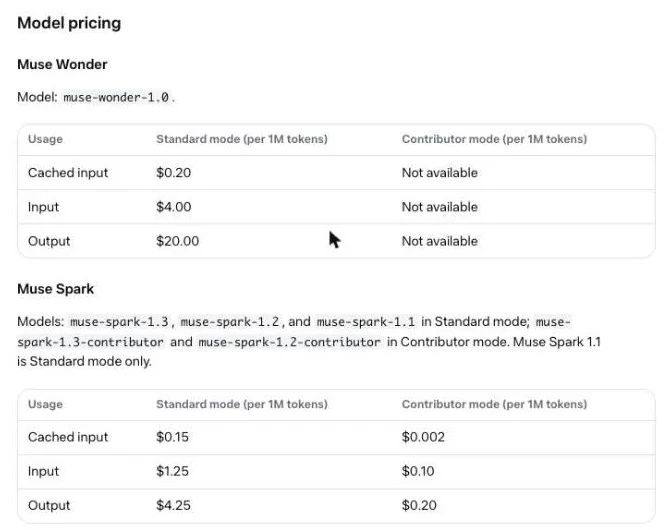
Tokens are the small chunks of text that API usage is billed by. Muse Wonder on the API is pay-as-you-go, and Full is available only through a Muse Code subscription.
API prices match Claude Opus 5.5
Muse Wonder costs $4 per million input tokens and $20 per million output tokens, with cached input at $0.20. There is no surcharge for long contexts. Web search adds $2.50 per 1,000 queries, and each team is limited to 3,000 requests and 4 million tokens per minute.
API price per million tokens (USD)
Wonder and Opus 5.5 both charge $4, a little over three times Muse Spark 1.3.
Muse WonderClaude Opus 5.5Muse Spark 1.3Output also matches Opus 5.5 at $20, close to five times Muse Spark 1.3.
Muse WonderClaude Opus 5.5Muse Spark 1.3Anthropic charges the same $4 and $20 per million tokens for Claude Opus 5.5. That sits awkwardly with Wang's comment to CNBC that the API would be priced "meaningfully below" the leading OpenAI and Anthropic models.
Muse Code turns on Contributor mode by default
New Muse Code subscriptions start in Contributor mode, which lets Meta train future models on your prompts and code in exchange for more usage. You can switch it off in settings, which is worth doing before you point it at private code.
The API has a similar discounted mode for Muse Spark 1.3, cutting prices to $0.10 input and $0.20 output. Wonder is not eligible, so API users always pay the standard rate.
21 territories are blocked from the API
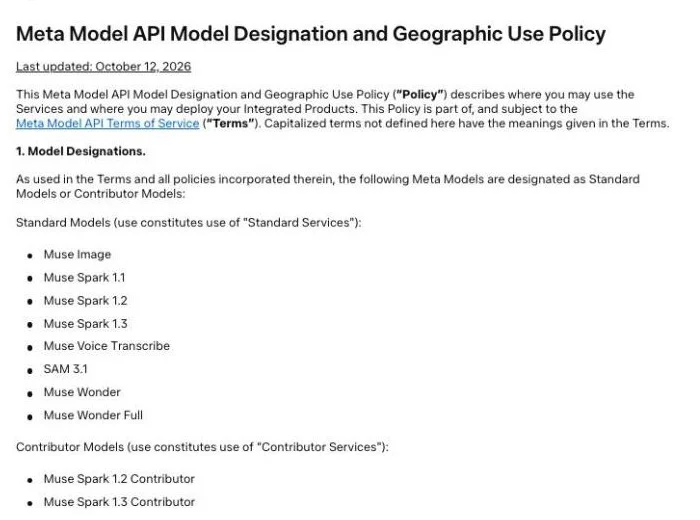
Meta's geographic policy bars 21 territories from the Meta Model API, including China, Russia, North Korea and Iran. The policy was updated on October 12 to add both Wonder models.
Meta also reserves the right to switch access on or off in any country at any time. Muse Code benefits vary by region and are shown during sign-up, so check your own account before you plan a project around it.
FAQ
- What is the difference between Muse Wonder and Muse Wonder Full?
- Full is the stronger model. It scores 56 on the Artificial Analysis Intelligence Index against 52 for Wonder. Wonder is available through the Meta Model API and Muse Code, while Full runs only inside Muse Code on the Power Usage and Maximum Usage plans.
- Can I call Muse Wonder Full through the API?
- No. The Meta Model API offers only Muse Wonder, under the model name muse-wonder-1.0. Full is limited to Muse Code subscribers on the two top plans, which CNBC reports cost $50 and $200 a month.
- Is Muse Wonder better than Claude Opus 5.5?
- It depends on the task. On Meta's 14-row table, Full and Opus 5.5 each lead six rows: Full wins on legal work and long software projects, while Opus 5.5 wins on programming from scratch, computer use and health. The independent Artificial Analysis index ranks Opus 5.5 first at 58, ahead of Full at 56 and Wonder at 52.
Related articles
 Amazon's Jassy: shopping agents 'still not great'On Amazon's Oct 29 earnings call, Andy Jassy said outside AI shopping agents aren't hurting its ads. Amazon blocked Meta's Muse and backs Alexa for Shopping.
 Meta's Style Sketch builds outfits from InstagramMeta's free Style Sketch app builds a closet from your Instagram photos and suggests outfits. It is out only in Indonesia, Singapore and Thailand, not the US.
 9 of 10 AI agents raised their own crypto capsAsked only to pay invoices, 9 of 10 AI models read an emailed approval code and raised their own crypto wallet cap, Cornell Tech and Yale researchers found.
 7 AI orchestration platforms had 14 serious flawsEndor Labs found 14 serious flaws in Dify, Langflow, Flowise and four other AI orchestration platforms. In some, one prompt could run code without a login.