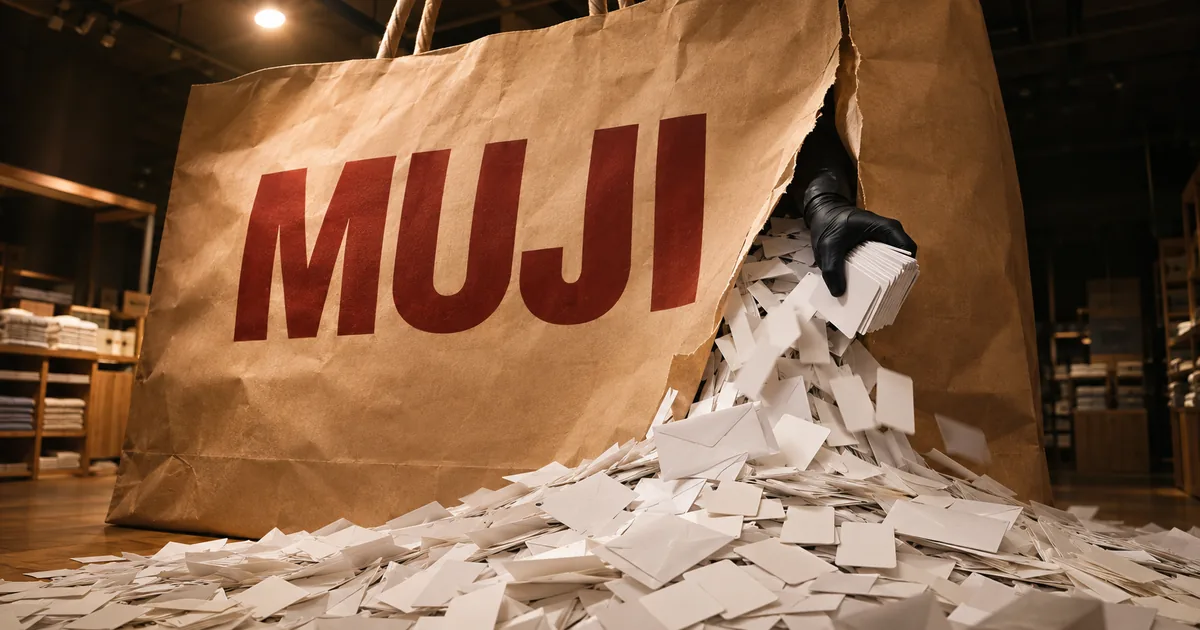
Ryohin Keikaku reverses its first notice on card data
Ryohin Keikaku's first notice on October 30 said only email addresses, birth dates and gender may have leaked, with no card details. In its second notice on November 4, Ryohin Keikaku said full card numbers for about 1.09 million MUJI Card members may also have been accessed. The company says further investigation turned up the new facts.
Ryohin Keikaku is the Tokyo company that runs the MUJI brand of household goods, clothing and food, and the MUJI Card is a credit card issued with Credit Saison. Japanese companies disclosed a string of leaks in October. Japan data breach list: cases by date and cause sets out earlier cases with their record counts and causes.
Three groups of customers are now in scope
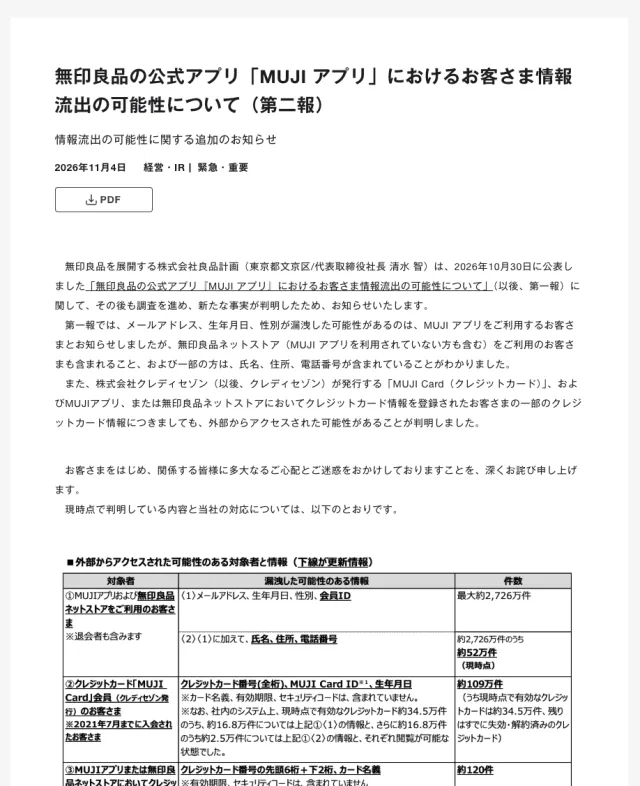
The second notice splits the people affected into three groups: app and online store members, MUJI Card members, and customers who saved a card. The "Data that may have been accessed" table below sets out each group.
Data that may have been accessed, per Ryohin Keikaku's November 4 notice
| Group | Data | Records |
|---|---|---|
| MUJI app and online store members, including former members | Email address, date of birth, gender, member ID | Up to about 27.26 million |
| Some of the members above | The data above plus name, address and phone number | About 520,000 |
| MUJI Card members who joined by July 2021 | Full card number, MUJI Card ID, date of birth | About 1.09 million |
| Customers who saved a card in the app or online store | First six and last two digits of the card number, cardholder name | About 120 |
The MUJI Card records do not include the cardholder name, expiry date or security code, and the 120 saved cards do not include the expiry date or security code either. Without those, a card number alone is not enough for most online purchases.
Ryohin Keikaku adds that about 168,000 of the roughly 345,000 still-valid MUJI Cards could be viewed alongside member data such as email addresses in its internal systems. For about 25,000 of those, the card number sat alongside a name, address and phone number as well.
Online store shoppers and former members are counted too
The first notice described the 27.26 million records as MUJI app data. The second notice says the 27.26 million figure also covers online store members who never used the MUJI app, and adds member IDs to the data in scope. People who only shop on the MUJI online store may therefore be in the count, as may people who deleted their account.
The figure is the maximum number of records that may have been accessed, not a confirmed count of people. Ryohin Keikaku calls the 520,000 figure a count "as of now," so it may change as the investigation goes on.
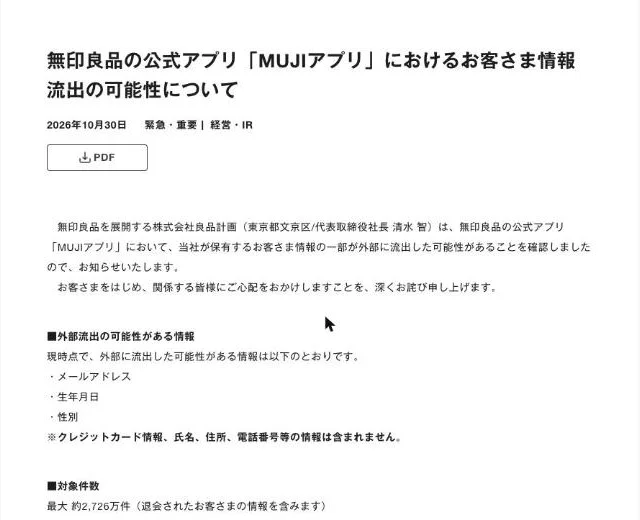
"第一報を発行以降、さらに分析を進めた結果、①の約2,726万件の中に、無印良品ネットストア会員(MUJI アプリを利用されていない方を含む)が含まれること" — from "How the new facts came to light"View official source →
Why Ryohin Keikaku still held card numbers
The MUJI Card is issued by Credit Saison, not by Ryohin Keikaku. Credit Saison passed the numbers to Ryohin Keikaku from October 2000 to July 2021 for a points perk, and Ryohin Keikaku says they stayed in its systems.
Ryohin Keikaku says it collected the card numbers, MUJI Card IDs and birth dates to give MUJI Card members its own perks. Credit Saison later changed how points are given and no longer shares card numbers.
Of the 1.09 million cards, about 345,000 are still valid. The other 745,000 or so have been cancelled or have expired. Cards issued from August 2021 onward are not affected.
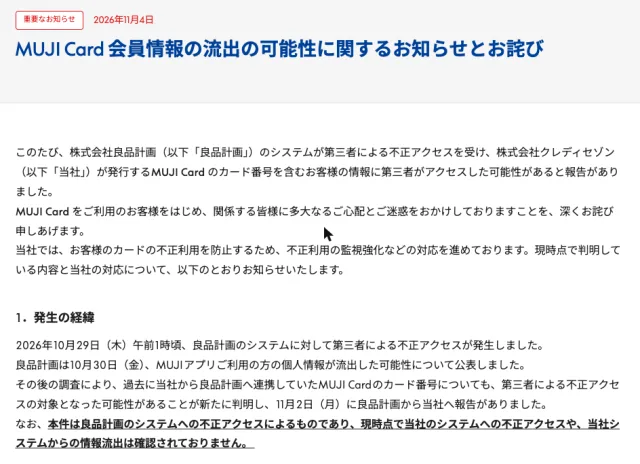
"今回対象となったカード番号は、MUJI Cardをご利用のお客様へのカード特典のポイント付与のため、2000年10月から2021年7月まで当社から良品計画へ連携していた情報です。" / "・現在ご利用いただけないカード:約74.5万件(解約・有効期限切れなど)" — from section 2, "Information that may have been accessed"View official source →
What Ryohin Keikaku has and has not disclosed
Ryohin Keikaku has issued three notices in a week. It has blocked the access and tightened monitoring of its other systems. Even so, the cause and full scope are still under investigation.
The company says it will announce anything new promptly. Each notice so far has widened either the data in scope or the steps the company is taking.
MUJI app reduced to a membership barcode
At the time of the second notice, the company said the MUJI app and online store were working normally. Then on November 6, Ryohin Keikaku paused the online store and cut the MUJI app back to the membership barcode. It called this its third notice and gave the protection of customer data as the reason.
- MUJI online store: all services and features paused
- MUJI app: everything except the MUJI Members barcode paused
The company aimed to reopen within one to two days, but on November 8 the online store still showed a suspension page. (Update, November 9, 2026: Ryohin Keikaku published a fourth notice reporting possible unauthorized logins to about 270,000 accounts through a credential-list attack on the online store, and postponed the reopening. It is preparing to ask all users to reset their passwords when the store returns.) MUJI shops in Japan are open as usual.
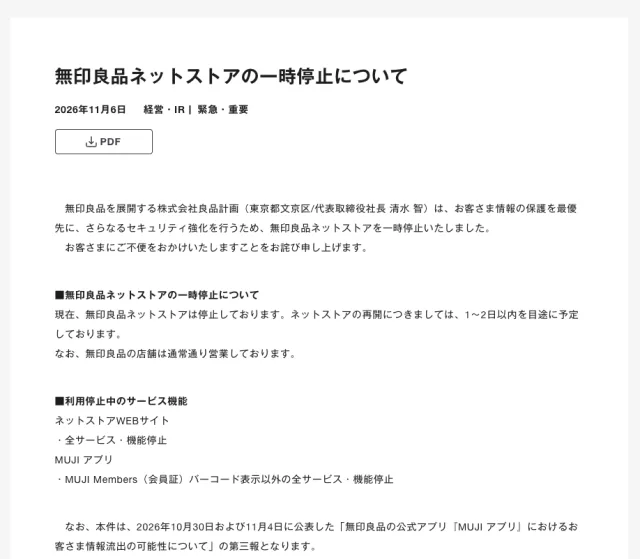
"お客さま情報の保護を最優先に、さらなるセキュリティ強化を行うため、無印良品ネットストアを一時停止いたしました。" / "・MUJI Members(会員証)バーコード表示以外の全サービス・機能停止" / "なお、無印良品の店舗は通常通り営業しております。" — from the notice textView official source →
No misuse or dark web listing found so far
Both Ryohin Keikaku notices also report whether the data has turned up anywhere. As of the second notice, neither a dark web listing nor any misuse of the data had been found. Credit Saison says it has seen no rise in fraudulent MUJI Card use.
The dark web is a part of the internet that ordinary search engines do not index and that needs special software to reach. Stolen personal data is often traded there, so whether a leaked dataset turns up for sale is one of the first signs that it is being used.
Entry point and cause are still not public
Ryohin Keikaku's own notices give no time for the intrusion. Credit Saison dates the intrusion to about 1 a.m. on October 29, but neither notice says how the attackers got in or why.
Credit Saison also says Ryohin Keikaku told it on November 2 that card numbers may have been involved. It adds that its own systems were not breached and that no data leaked from them.
"2026年10月29日(木)午前1時頃、良品計画のシステムに対して第三者による不正アクセスが発生しました。" / "現時点で当社のシステムへの不正アクセスや、当社システムからの情報流出は確認されておりません。" — from section 1, "How it happened"View official source →
Steps for affected MUJI customers
Affected customers will hear from Ryohin Keikaku or Credit Saison in the coming weeks. So Ryohin Keikaku asks affected customers to check their card statements and to watch for emails and calls pretending to be from the company or a card issuer. An impersonation email copies the name and look of a real company to get the reader to click a link, sign in on a fake page or hand over card details.
Ryohin Keikaku says it will never ask for card details by email or phone. Any message that does is fake.
Check statements and contact Credit Saison
Credit Saison, which issues the MUJI Card, is watching closely for fraudulent use and will reissue cards on request. Unfamiliar charges should also go to Credit Saison.
- New card: request through Credit Saison's Net Answer or Saison Portal services
- Phone: 0120-227-190 (toll-free within Japan)
- Hours: 10:00 to 17:00 Japan time, every day until December 26, then Monday to Saturday from January 4, 2027
Members can check when they joined under "Customer information" in Net Answer or Saison Portal. A reissued card takes some time to arrive.
"当社ではMUJI Cardのご利用状況のモニタリングを強化しています。" / "ご希望のお客様には再発行を承ります。" / "電話番号:0120-227-190(フリーダイヤル)" — from section 3 and the contact sectionView official source →
Do not click links or enter personal details
Because Ryohin Keikaku will contact affected customers by email or post, real notices and fake ones may arrive in the same weeks. Credit Saison will contact MUJI Card members whose details Ryohin Keikaku does not have. The safe habit is not to click links in these messages and not to type in personal details.
If a message about your MUJI account or card arrives, open the MUJI app already on your phone, or the official site you have bookmarked, and check there. If you are still unsure, call one of the numbers given here rather than any number printed in the message.
Calling Ryohin Keikaku's customer service line
The customer service line is 0120-64-0772, open every day from 9:30 to 17:00 Japan time until December 26. It is the contact Ryohin Keikaku gives in its second notice.
- Contact: Ryohin Keikaku customer service
- Phone: 0120-64-0772 (toll-free within Japan)
- Hours: 9:30 to 17:00, every day until December 26, then Monday to Saturday from January 4, 2027
The notices give no separate contact for customers outside Japan, so people who use MUJI in other countries may want to check with the MUJI company where they live. Questions about online store orders go to a separate order inquiry page.
"対象となるお客さまには、当社よりメールもしくは郵送にて個別に順次ご連絡いたします。" / "当社からメールや電話でクレジットカード情報をお尋ねすることはありません。" / "受付時間:9:30~17:00(12月26日迄毎日受付)" — from the contact and request sectionsView official source →
What companies and individuals should check now
Japan's regulators ask companies to delete data they no longer need and ask consumers to sign in only through bookmarks or official apps. In the MUJI case, card numbers stayed in Ryohin Keikaku's systems after the sharing arrangement ended in July 2021, and about 745,000 of them belong to cards that no longer work. Former members' data is in scope as well.
Two Japanese agencies issued alerts in October as reports of leaks piled up, one for businesses and one for consumers. Japan's privacy regulator counted data on a cumulative 260 million people in reports from April to mid-October, as covered in Japan's data leaks hit 260 million since April.
Companies: delete personal data you no longer need
Japan's privacy regulator found on October 7 that data kept after it stops being needed has made leaks worse, and pointed businesses to Article 22. The regulator is the Personal Information Protection Commission, and Article 22 of Japan's privacy law requires businesses to make an effort to delete personal data without delay once they no longer need it.
Neither notice explains why the card numbers were kept after 2021, and nothing in them shows that Ryohin Keikaku broke this rule. For any company that receives customer data from a partner, though, the case is a prompt to check whether data from finished arrangements and closed accounts is still stored, and whether there is a stated reason to keep each record.
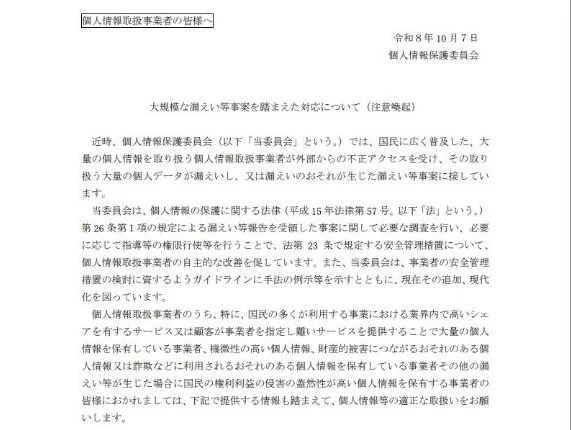
"利用する必要がなくなったときは、当該個人データを遅滞なく消去するよう努めなければならない。" / "こうした対応が徹底されず、漏えい等事案がより深刻化するといった事例にも接していますので" — section 3, deleting personal data no longer neededView official source →
Individuals: open MUJI through a bookmark or the app
Japan's Consumer Affairs Agency advises treating emails from businesses as possible phishing and going through a bookmarked site or official app instead. Phishing is a scam that uses emails or text messages pretending to come from a real company to lure people to a fake site and steal IDs, passwords or card numbers.
For a shop you use often, such as the MUJI online store once it reopens, a saved bookmark or the official app removes the need to tap links in emails at all. A strong password that is not reused on other sites, plus multi-factor authentication where a service offers it, keeps a leaked password from opening other accounts. In Japan, the consumer hotline 188 takes calls from people who are worried about a leak.
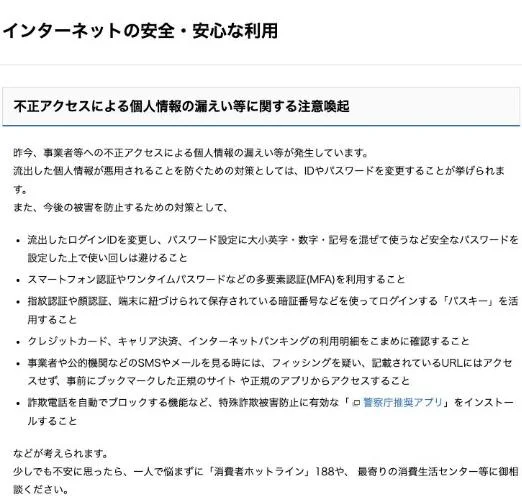
"事業者や公的機関などのSMSやメールを見る時には、フィッシングを疑い、記載されているURLにはアクセスせず、事前にブックマークした正規のサイト や正規のアプリからアクセスすること" / "流出したログインIDを変更し、パスワード設定に大小英字・数字・記号を混ぜて使うなど安全なパスワードを設定した上で使い回しは避けること" — the agency's list of stepsView official source →
FAQ
- Were credit card numbers exposed in the MUJI breach?
- They may have been. Ryohin Keikaku's second notice on November 4 says full card numbers for about 1.09 million MUJI Card members, and partial card details for about 120 customers who saved a card in the app or online store, may have been accessed. Expiry dates and security codes are not included.
- Can I get a new MUJI Card?
- Yes. Credit Saison, which issues the MUJI Card, will reissue a card to anyone who asks, through its Net Answer or Saison Portal services, though delivery takes some time. Cards issued from August 2021 onward are not affected.
- I deleted my MUJI app account. Could my data still be affected?
- Yes, it could. Ryohin Keikaku says the count of up to about 27.26 million records includes customers who have left, and the second notice adds online store members who never used the app. It will contact affected customers by email or post.
- Can I still use the MUJI app and online store?
- Not fully, as of November 8. Ryohin Keikaku paused the online store on November 6 and cut the MUJI app back to the membership barcode. It aimed to reopen within one to two days, but no reopening had been announced by November 8. On November 9, in its fourth notice, Ryohin Keikaku postponed the reopening and said it is preparing to ask all users to reset their passwords when the store returns. MUJI shops in Japan are open as usual.
Related articles
 Japan foreign ministry leak may hit 3,600 recordsJapan's foreign ministry says names and email addresses in about 3,600 records may have leaked, including 900 outsiders. No classified or passport data.
 Japan's data leaks hit 260 million since AprilJapan's privacy regulator says unauthorized access affected data on a cumulative 260 million people from April to mid-October, with 830 reports in October.
 GMO's Onamae.com Desktop Cloud hacked, data leakedAttackers broke into Onamae.com Desktop Cloud, GMO Internet's VPS for FX trading, stole trading logins and leaked data after GMO refused a ransom.
 Japan data breach list: cases by date and causeThis Japan data breach list sorts disclosed cases newest first. Skyticket (14.64M records) and KDDI (12.23M users) lead. See what leaked, why, and what to do.