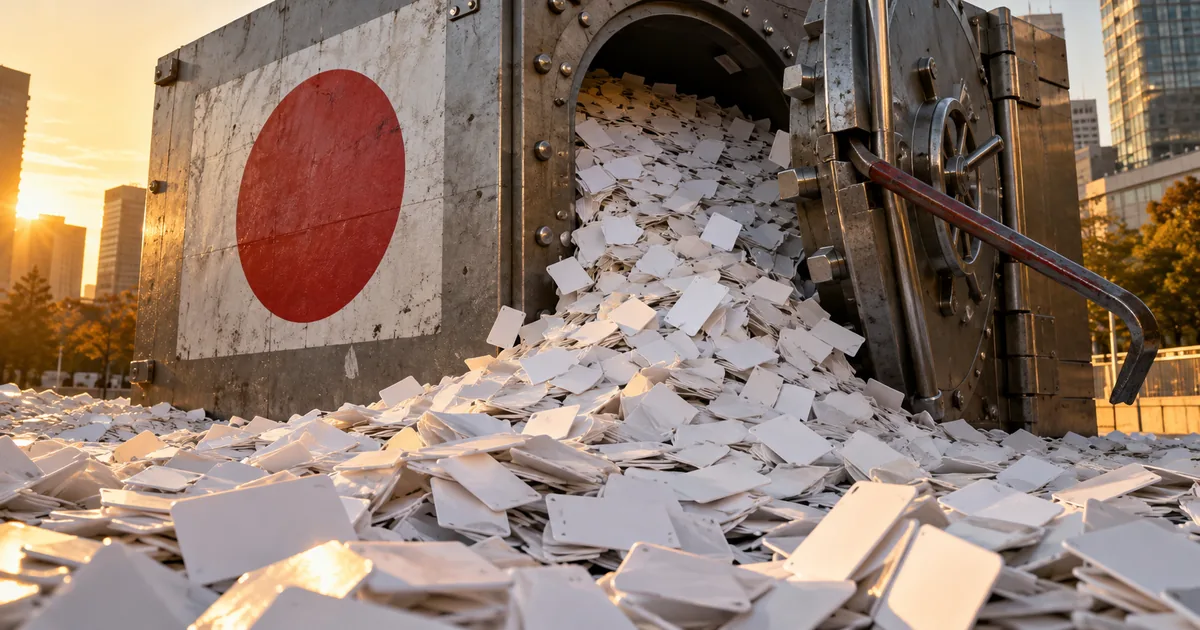
Unauthorized access hit data on 260 million people
Reports surged in October, and the 830 filed in its first 16 days make up about 40% of all reports in the period. Japan's Personal Information Protection Commission, the national regulator for privacy law, published the tally at its 374th meeting on October 28, 2026. Between April 1 and October 16, unauthorized access leaked or may have leaked personal data on about 260 million people, counted cumulatively, across 2,094 reports.
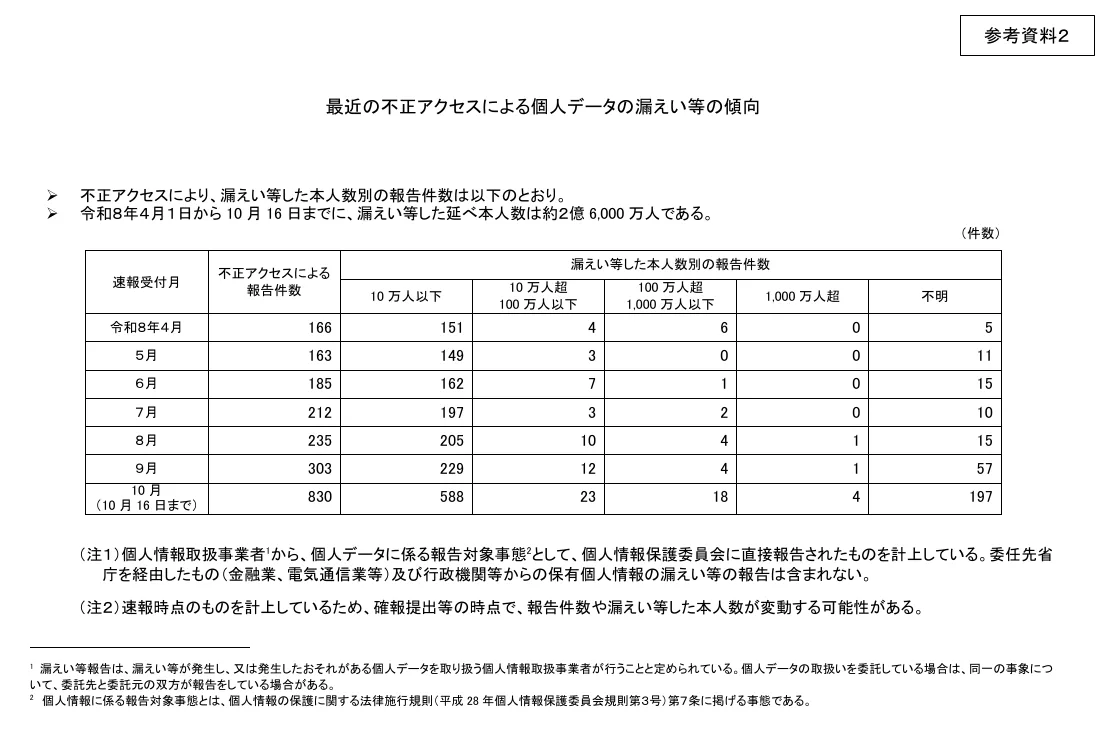
"令和8年4月1日から 10 月 16 日までに、漏えい等した延べ本人数は約2億 6,000 万人である。" — opening lines of page 1View official source →
October brought 830 reports in 16 days
Counted by the month the Commission received each preliminary report, April and May were flat and the numbers crept up from June. Then October broke the pattern. Monthly reports stayed between 163 and 303 from April to September, but October reached about 2.7 times September's total in half a month.
Reports of data leaks caused by unauthorized access, by month received
October counts reports through the 16th. Bar heights are relative to October's 830 (= 100). Source: Personal Information Protection Commission, Reference Material 2.
The second half of October is not in these numbers yet. From April 1 through October 16, the reports add up to 2,094.
Six reports involved more than 10 million people
Six reports in the period each covered more than 10 million people. Four of those six came in during the first half of October, when another 197 reports could not yet say how many people were affected. The other two arrived in August and September.
Reports by number of people affected (April 1 – October 16, 2026)
Source: Personal Information Protection Commission, Reference Material 2.
| People affected | Whole period | October (to 16th) |
|---|---|---|
| 100,000 or fewer | 1,681 | 588 |
| 100,001 to 1 million | 62 | 23 |
| 1,000,001 to 10 million | 35 | 18 |
| More than 10 million | 6 | 4 |
| Unknown | 310 | 197 |
Most reports were small: 1,681 of the 2,094 involved 100,000 people or fewer. The two largest size bands together account for 41 reports that each involved more than 1 million people. For a list of the individual Japanese incidents behind numbers like these, see Japan data breach list: cases by date and cause.
The 260 million figure counts some people twice
The total adds up every report, so one person can appear several times, and it counts suspected leaks as well as confirmed ones. It is not a headcount of unique victims, and it does not mean data on 260 million people has been confirmed as leaked. The Commission's notes and the way its monthly counts are built point to three things to keep in mind.
- A report is required when a leak happened or may have happened, so suspected cases are in the total
- When a company outsources data handling, the contractor and the client can both report the same incident
- The months in "Reports of data leaks caused by unauthorized access, by month received" show when the Commission received each preliminary report
Say a membership service hands its customer data to a contractor and the contractor is breached. If both companies file, the same customer is counted twice. The material does not give a figure with duplicates removed.
"漏えい等報告は、漏えい等が発生し、又は発生したおそれがある個人データを取り扱う個人情報取扱事業者が行うことと定められている。個人データの取扱いを委託している場合は、同一の事象について、委託先と委託元の双方が報告をしている場合がある。" — footnote 1View official source →
Banks, telecoms and government bodies are left out
Only reports filed directly with the Commission are counted, so leaks reported through other ministries and by government bodies are missing, and the preliminary figures may still change. In finance and telecommunications, companies report to the ministry that oversees their sector under powers delegated by the Commission, so those cases sit outside the 2,094.
The numbers also reflect the first, preliminary filing. When companies submit their final reports, the number of reports and the number of people affected could change.
"委任先省庁を経由したもの(金融業、電気通信業等)及び行政機関等からの保有個人情報の漏えい等の報告は含まれない。" / "速報時点のものを計上しているため、確報提出等の時点で、報告件数や漏えい等した本人数が変動する可能性がある。" — notes 1 and 2View official source →
What individuals, companies and employees should check
The Consumer Affairs Agency told individuals what to change on October 29, and the Commission told companies what to fix on October 7. The agency, which handles consumer protection in Japan, wrote its alert for people who use online services, and the Commission addressed its alert to businesses that hold personal data. The agency's advice on suspicious messages also applies to staff who get the same kind of email at work.
Individuals: replace reused passwords with passkeys
The agency advises changing any leaked login ID, using a strong password you do not reuse, and switching to passkeys or multi-factor authentication where available. A leaked password does the most damage when the same one opens other accounts. These are its four main recommendations.
- Change your login ID and switch to a password that mixes upper- and lowercase letters, numbers and symbols, and do not use it anywhere else
- Turn on multi-factor authentication, such as a code sent to your phone or a one-time password
- Sign in with a passkey, which uses your fingerprint, face or a PIN stored on your device
- Check card, carrier billing and online banking statements often for charges you do not recognize
Anti-fraud apps endorsed by the National Police Agency add another layer, and some of them block scam calls automatically. Anyone in Japan who is worried can call the consumer hotline at 188 or visit a local consumer affairs center.
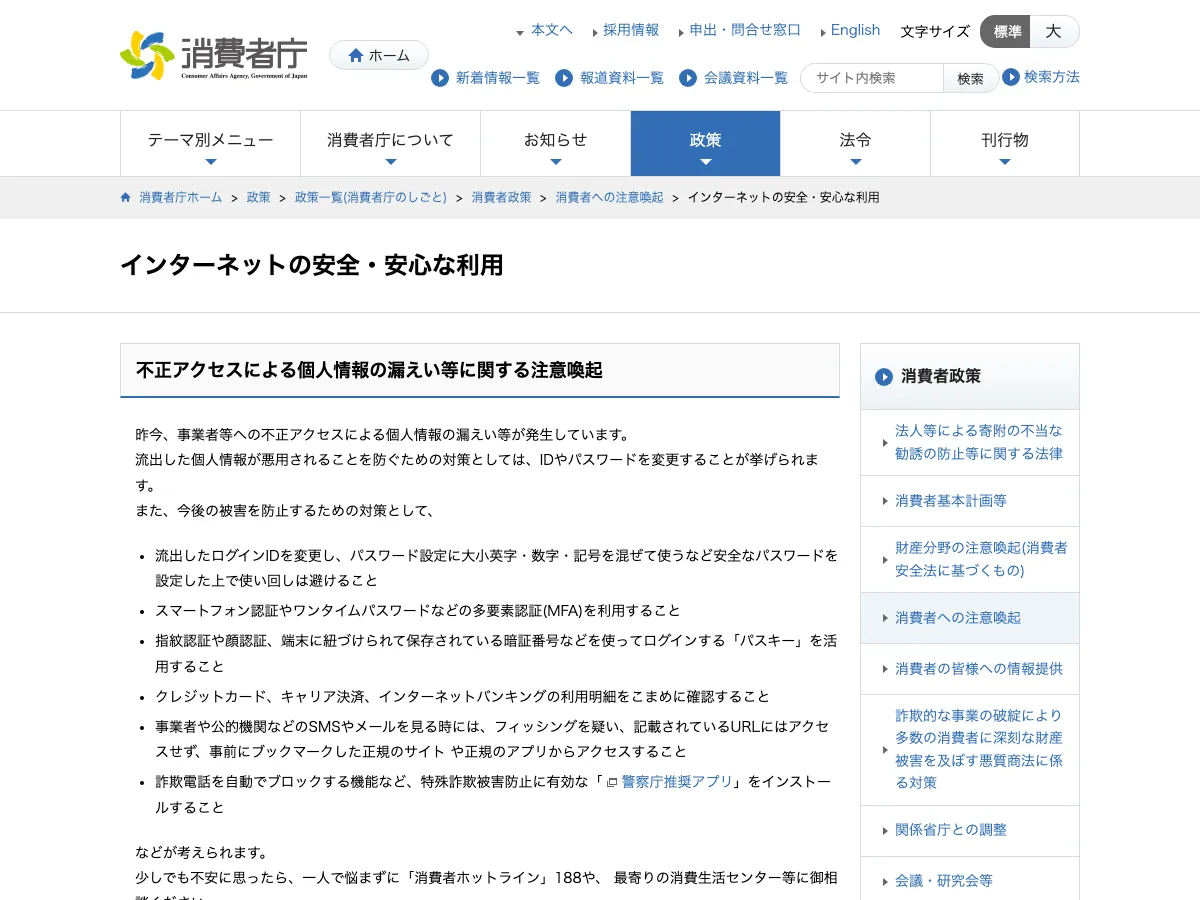
"流出したログインIDを変更し、パスワード設定に大小英字・数字・記号を混ぜて使うなど安全なパスワードを設定した上で使い回しは避けること" / "スマートフォン認証やワンタイムパスワードなどの多要素認証(MFA)を利用すること" / "指紋認証や顔認証、端末に紐づけられて保存されている暗証番号などを使ってログインする「パスキー」を活用すること" — measures to prevent further damageView official source →
Companies: delete unneeded data and review access controls
The Commission wants businesses to delete personal data they no longer need and to tighten access control and the early detection of unauthorized access. It said it had seen leaks become more serious because companies kept data they should have deleted, and asked them to check whether each set of stored data is still needed and on what legal basis.
The Commission is revising its guidelines on technical safeguards, with the final text due in April 2027. Its October 7 alert previewed the planned changes, which cover five safeguards:
- Access control, limiting which staff and systems can reach personal data
- Identifying and authenticating everyone who uses those systems
- Protecting systems from unauthorized access and malicious software
- Preventing leaks that come from using the systems
- Detecting unauthorized access early and stopping it from spreading inside the network
On October 9, Japan's trade ministry (METI) sent its own alert to companies in the industries it oversees, covered in Japan's METI warns firms after a spate of breaches. The first measure it named was having top executives lead the response.
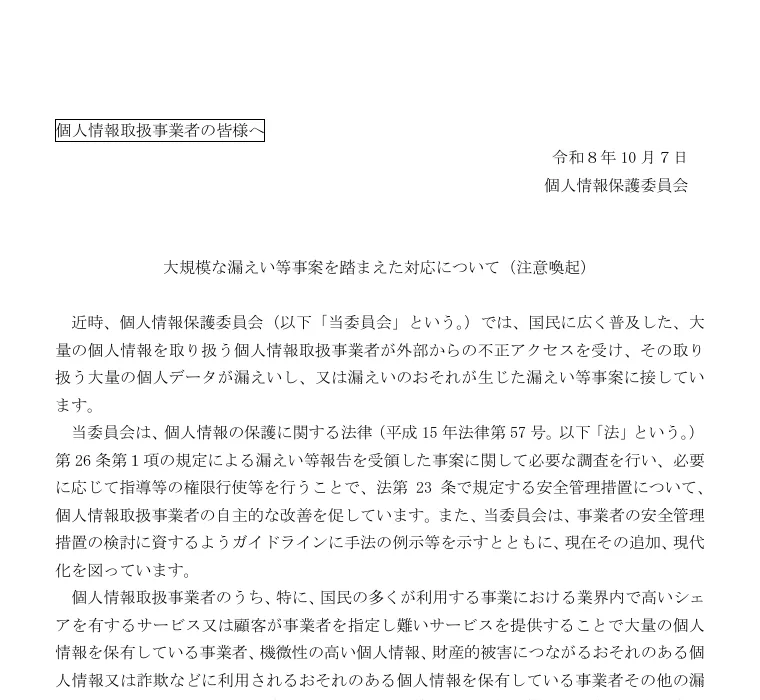
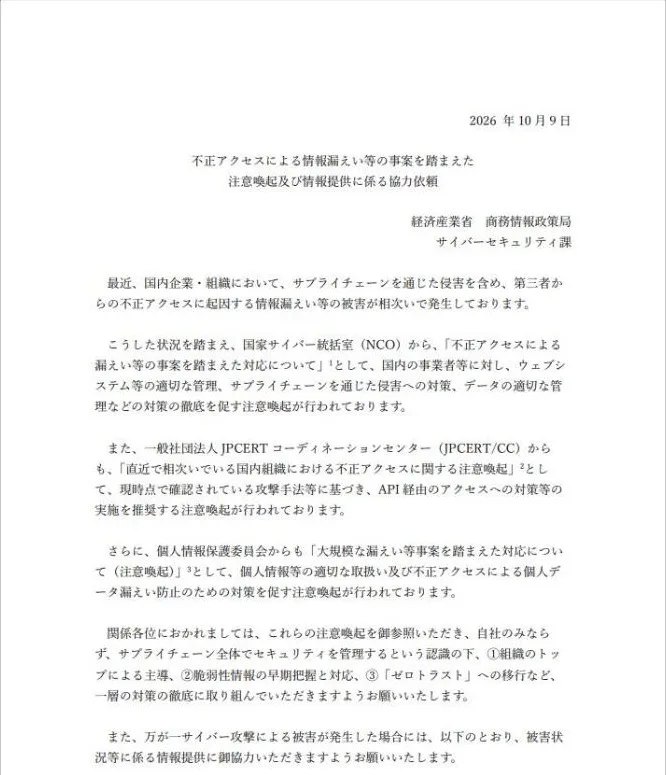
"こうした対応が徹底されず、漏えい等事案がより深刻化するといった事例にも接していますので" / "担当者及び個人データを取り扱う情報システムの範囲を限定するために、適切なアクセス制御を行わなければならない。" / "見直しの内容の確定は、来年4月を予定していますが、近時の動向を踏まえて、「手法の例示」として、より参考になると考えられるため、見直し予定の内容を先取りする形でお示しします。" — sections 2 and 3 and the attachmentView official source →
"自社のみならず、サプライチェーン全体でセキュリティを管理するという認識の下、①組織のトップによる主導、②脆弱性情報の早期把握と対応、③「ゼロトラスト」への移行など" — main textView official source →
Employees: skip links in emails and texts
Businesses and public bodies do not suddenly ask for card numbers by text or email, the agency says, so sign in only through a bookmark or the official app. The agency wrote this for consumers, but the same habit protects staff when a message claiming to be from a supplier or an internal system lands in a work inbox.
The agency tells people to treat any text or email from a company or public body as possible phishing, even one that looks familiar. Instead of tapping the link, open the site from a bookmark you saved earlier or go through the official app. Do not type an ID, password or card number on a page you reached from a message.
"記載されているURLにはアクセスせず、事前にブックマークした正規のサイト や正規のアプリからアクセスすること" / "事業者や公的機関などがSMSやメールを通じて、いきなりクレジットカード番号の入力を求めることはありません。" — measures to prevent further damage, and the section on credit card fraudView official source →
FAQ
- Does the 260 million figure mean 260 million different people in Japan?
- No. It is a cumulative count, so a person caught up in several incidents is counted each time, and a contractor and its client can both report the same incident. It also counts suspected leaks, not only confirmed ones.
- Are leaks at Japanese banks and telecom companies included?
- No. Companies in finance and telecommunications report through the ministry that oversees their sector, and those reports are not in this tally. Reports from government bodies are also excluded.
- What should I do first if a Japanese service I use may have leaked my data?
- Start by changing your ID and password, because a leaked password stops working once it is replaced. Multi-factor authentication or a passkey blocks sign-ins that rely on a stolen password alone, and checking card and banking statements often catches misuse early.
Related articles
 Japan foreign ministry leak may hit 3,600 recordsJapan's foreign ministry says names and email addresses in about 3,600 records may have leaked, including 900 outsiders. No classified or passport data.
 GMO's Onamae.com Desktop Cloud hacked, data leakedAttackers broke into Onamae.com Desktop Cloud, GMO Internet's VPS for FX trading, stole trading logins and leaked data after GMO refused a ransom.
 Japan data breach list: cases by date and causeThis Japan data breach list sorts disclosed cases newest first. Skyticket (14.64M records) and KDDI (12.23M users) lead. See what leaked, why, and what to do.
 Japan's METI warns firms after a spate of breachesAfter a spate of data breaches, Japan's trade ministry (METI) told companies on October 9 to put top executives in charge of security and move to zero trust.