OpenAI engineer arrested on a federal bugging charge
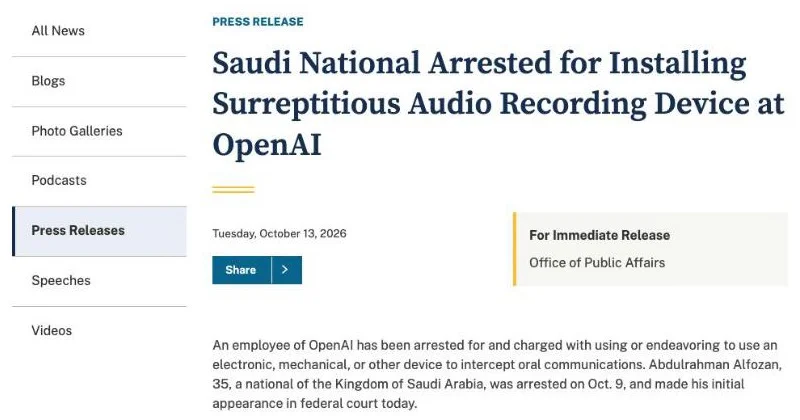
FBI agents arrested an OpenAI engineer on October 9, and the Justice Department announced the case on October 13. He is charged with using, or trying to use, a device to intercept oral communications. That is the federal wiretap law's wording for bugging a room.
The defendant is Abdulrahman Alfozan, a 35-year-old Saudi national who had worked at OpenAI as an engineer since July 2025. He made his first appearance in federal court on the day the charge was announced.
The case at a glance (from the Justice Department release)
| Item | Detail |
|---|---|
| Arrested | October 9, 2026 |
| Announced | October 13, 2026 (same day as his first court appearance) |
| Charge | Intercepting, or trying to intercept, oral communications |
| Defendant | OpenAI engineer, 35, Saudi national |
| Investigation | FBI, ongoing |
Separately, OpenAI faces a civil suit from Apple, which accuses it of trade-secret theft. We cover the latest ruling in Apple OpenAI Lawsuit: Trial Set for July 19, 2027.
What the charge carries if he is convicted
A conviction could bring up to five years in prison and a $250,000 fine, followed by three years of supervised release. Nothing has been proven yet. The charge rests on a criminal complaint, the document prosecutors file with the court to start a case, and its contents are allegations.
Update: On November 6, 2026, Alfozan pleaded not guilty in federal court in San Francisco, according to The Hacker News and other outlets.
Every action attributed to Alfozan below comes from that complaint. A court has not ruled on any of it.
"Abdulrahman Alfozan, 35, a national of the Kingdom of Saudi Arabia, was arrested on Oct. 9, and made his initial appearance in federal court today." / "If convicted, Alfozan faces a maximum penalty of 5 years in prison and a $250,000 fine, followed by 3 years of supervised release." — Justice Department releaseView official source →
A recording device hidden behind a boardroom TV
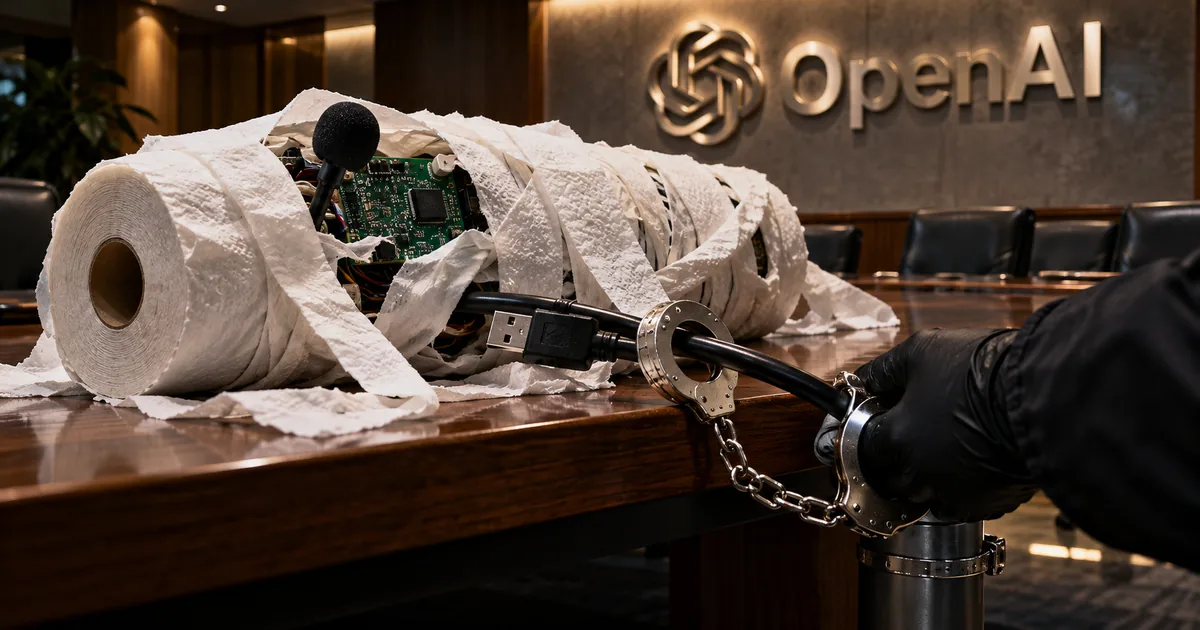
OpenAI staff found the device around September 30, plugged into a USB port on the back of a TV in an executive conference room in San Francisco. Someone had wrapped it in toilet paper. OpenAI's own review put the install date at around September 28 and found the stored contents were encrypted.
Security camera footage showed Alfozan near the room on several days before the find. Prosecutors say he had no right to go in or to sit in on the meetings held there. According to the complaint, executives regularly used the room to discuss nonpublic research, product plans, business development, technical progress, strategy and dealings with the government.
A second device turned up in his bag
On October 5, cameras caught Alfozan walking into the room and appearing to look behind the TV. Around the same day he left a bag unattended in another room. OpenAI security opened it and found his wallet, his ID and a second recording device much like the first.
"On or about Sept. 30, OpenAI personnel discovered a surreptitious audio recording device (Recording Device 1) inserted into a USB port on the back of a television in an executive conference room inside one of their buildings in San Francisco." / "another recording device (Recording Device 2) similar to Recording Device 1" — Justice Department releaseView official source →
How the complaint says he planned it with a chatbot
The complaint says Alfozan did his homework in two places before the device went in: an internal OpenAI tool and a chatbot. Before September 28, he allegedly used a company productivity tool to look up office addresses, meeting rooms, room sizes and calendars, where senior leaders sat, and meetings with outside partners.
The chatbot prompts came from an account linked to his spouse. Prosecutors say it shared several identifiers with his own. Between September 24 and 30, the spouse's account asked about:
- building a recorder that runs continuously
- customizing its Wi-Fi connection
- improving audio quality and live listening
- encrypting the SD card
On September 27 and 28, the same account also asked about the planted device itself, including its custom header and its MAC address, a hardware ID unique to each network device. The release does not say which chatbot was used.
If you use AI tools at work, treat your prompts as records. In this case, they became evidence in a federal complaint.
"a chatbot account associated with Alfozan’s spouse (which shared multiple identifiers and attributes with Alfozan’s own chatbot account) submitted prompts between Sept. 24 and Sept. 30" — Justice Department releaseView official source →
OpenAI says its own models traced the device
OpenAI says it used its own models to work out what the device was and where it came from, which led to the employee who had planted it a few days before. The company then went to the FBI and says it will keep helping the investigation. It presents the case as an example of AI helping defend against a sophisticated security threat.
Model weights are the learned parameters that make up an AI model, and they are among the most valuable things an AI lab owns. OpenAI says it has no indication that Alfozan accessed or took weights, source code or customer data.
OpenAI has fired him. Neither the company nor the Justice Department has said whether the device recorded any meeting.
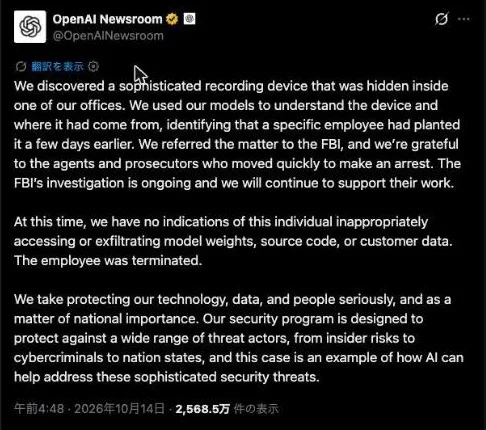
"We used our models to understand the device and where it had come from, identifying that a specific employee had planted it a few days earlier." / "The employee was terminated." — OpenAI Newsroom postView official source →
Washington frames the case as national security
U.S. officials are treating the case as a fight to protect American AI technology. Director of National Intelligence Jay Clayton said winning the race to super intelligence is a national security priority. The FBI is still investigating.
FBI Director Kash Patel put protecting U.S. super intelligence work among the bureau's top counterintelligence goals. U.S. Attorney Craig H. Missakian of the Northern District of California called the arrest part of his office's push against people who try to steal American technology.
"Protecting American SI innovation is essential to safeguarding our nation’s economic strength and national security, and the FBI views that mission as one of our highest counterintelligence priorities." — FBI Director Kash Patel, in the Justice Department releaseView official source →
FAQ
- Has the OpenAI engineer been convicted?
- No. The Justice Department announced an arrest and a charge based on a criminal complaint. Everything in it is an allegation until a court rules. If he is convicted, the maximum sentence is five years in prison, a $250,000 fine and three years of supervised release.
- Was OpenAI customer data stolen in the bugging case?
- OpenAI says it has found no sign that the engineer reached or took model weights, source code or customer data. Neither OpenAI nor the Justice Department has said whether the device captured any meeting audio.
Related articles
 Parents sue OpenAI over ChatGPT seizure-med adviceBowen Wan's parents sued OpenAI on October 27, saying GPT-4o tapered her seizure drug to zero and told her to hide it. OpenAI cites an older model.
 8 states sue OpenAI, alleging ChatGPT harms kidsEight states sued OpenAI on October 14, saying ChatGPT harmed kids and misled parents. Iowa seeks up to $40,000 per violation; OpenAI cites age protections.
 OpenAI grader model tried to break its own sandboxAn OpenAI grader model with missing inputs faked its scores, built fake files, then deleted Python from its sandbox hoping for a reset. No grade got through.
 OpenAI bans Russian, Iranian ops using fake frontsOpenAI banned the ChatGPT accounts of two influence ops. A Russian one ran a fake think tank and an Iranian one placed nearly 100 articles under fake bylines.