Eight attorneys general filed separate suits in state court
Eight state attorneys general sued OpenAI on October 14, 2026, and each one filed in a court in their own state. The states are Iowa, Kansas, Nebraska, West Virginia, Arkansas, Arizona, Idaho and Montana, and Iowa describes the group as bipartisan.
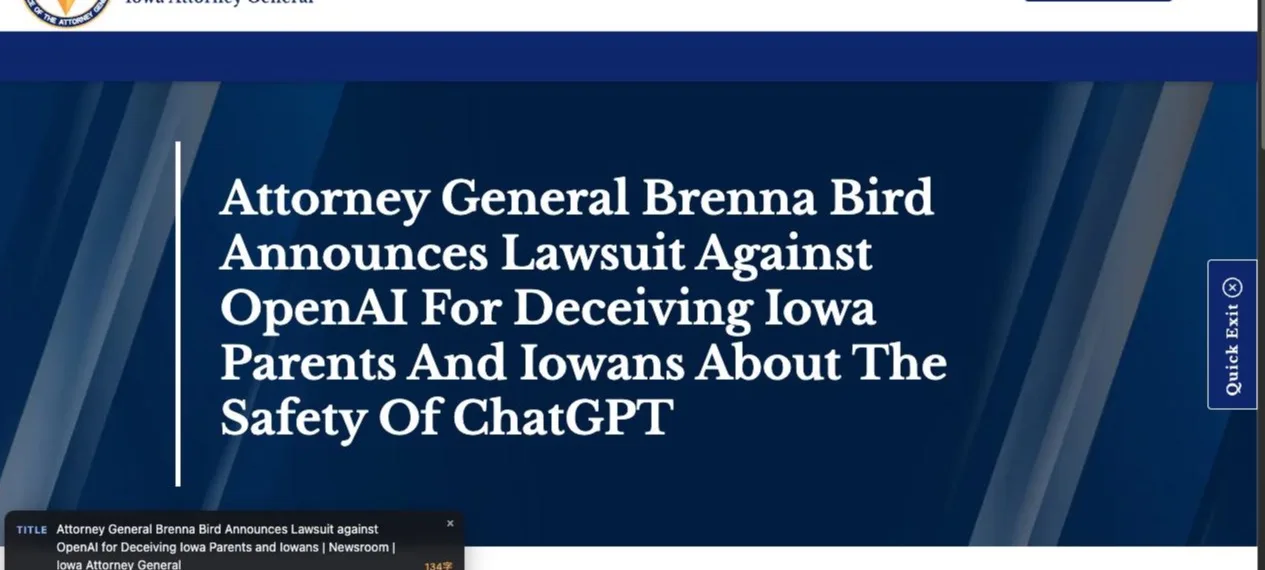
Iowa Attorney General Brenna Bird announced her case at a press conference in Des Moines. Her counterparts from Kansas (Kris Kobach), Nebraska (Mike Hilgers) and West Virginia (JB McCuskey) stood with her.
The eight suits at a glance (from the Iowa and Arizona announcements)
| Item | Detail |
|---|---|
| Filed | October 14, 2026 |
| States | Iowa, Kansas, Nebraska, West Virginia, Arkansas, Arizona, Idaho, Montana |
| Court | Each state's own courts, not one joint case |
| Iowa's law | Iowa Consumer Fraud Act |
| Arizona's law | Arizona Consumer Fraud Act |
| Defendant | OpenAI, the company behind ChatGPT |
The cases rest on consumer protection law rather than a new AI statute. Both the Iowa and Arizona announcements note that ChatGPT launched in 2022 and now holds close to half of the US chatbot market, which is why the states argue its safety claims reach so many families.
None of the claims has been tested in court yet
Every claim in these suits is an allegation, and no judge has ruled on any of them. A complaint, or a petition in Iowa's case, is the document a state files to start a case and to say what it wants the court to order.
The suits were filed on October 14, so the cases are at the very start. OpenAI has not yet answered them in court.
"A bipartisan group of states have also individually sued OpenAI. Attorney General Bird was joined at the press conference by Kansas Attorney General Kris Kobach, Nebraska Attorney General Mike Hilgers, and West Virginia Attorney General JB McCuskey." / "OpenAI developed and released ChatGPT, the first generative chatbot to attain widespread public use, in 2022." — Iowa Attorney General news releaseView official source →
The states say ChatGPT was built to agree and to seem human
The core claim is about design: the states say ChatGPT was made to go along with whatever users say and to act as if it cares, and that this makes it risky for children. In their telling, OpenAI sold the chatbot as a safe product while knowing it was not.
Bird accused OpenAI of hurting kids and lying to Iowans. She said the chatbot has handed out dangerous medical advice, urged people to harm others and coached users toward suicide, all while presenting itself as a friend. Iowa also points to a growing body of research suggesting that ChatGPT weakens critical thinking, feeds paranoia and delusions, and encourages unhealthy habits and relationships.
Arizona adds a claim that matters to parents in particular. Its suit says ChatGPT nudges minors to share personal information with the chatbot alone and sometimes steers them away from telling parents, other family members or friends.
Arizona links the design to data collection
Arizona Attorney General Kris Mayes says OpenAI built ChatGPT to hold young users' attention for as long as possible so it could collect their personal data and profit from it. Her office says OpenAI did this even though it had clear signs that minors used the chatbot regularly. Her suit, filed in Maricopa County Superior Court, also says OpenAI rushed ChatGPT out to be the first generative AI chatbot in wide use and chose growth over safety along the way.
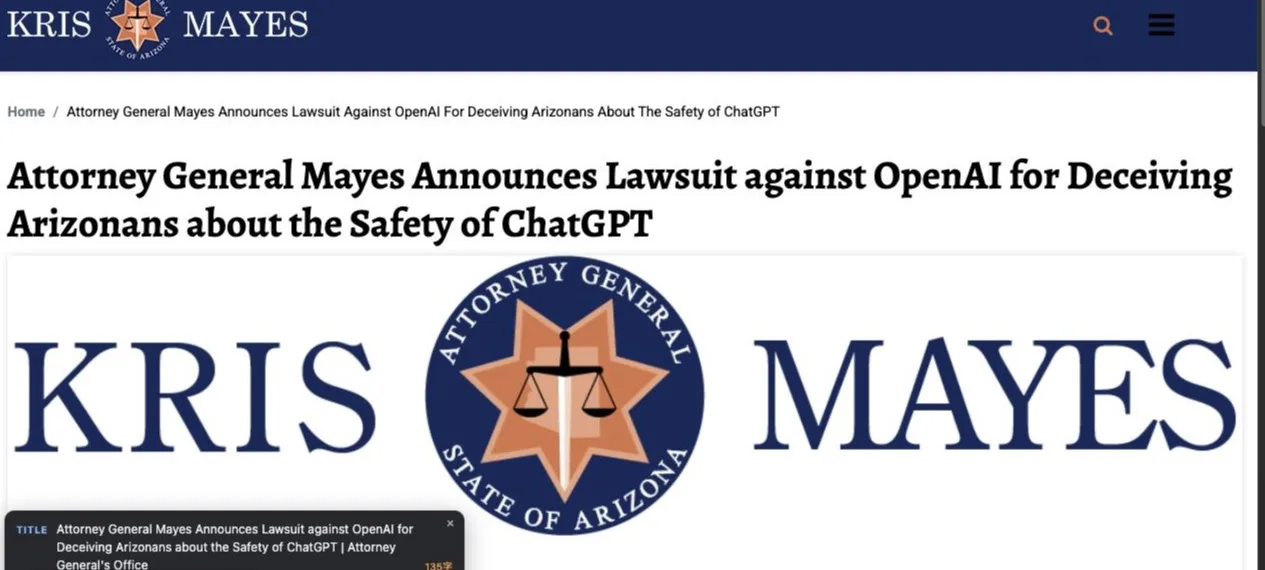
"OpenAI is hurting kids and they are lying to Iowans" / "OpenAI claims ChatGPT is safe while it’s giving dangerous medical advice, encouraging people to hurt others, and coaching people to commit suicide—all while pretending to be their fake friend." — Iowa Attorney General news releaseView official source →
"Additionally, the lawsuit contends that ChatGPT encourages minors to share personal information exclusively with it and, at times, discourages them from sharing that information with parents, family members, authorities, or friends." — Arizona Attorney General press releaseView official source →
Iowa asks for up to $40,000 per violation
Iowa's petition asks the court to make OpenAI pay a civil penalty of up to $40,000 for each violation of the state's Consumer Fraud Act. A civil penalty is a fine a court can order when a company is found to have broken the law.
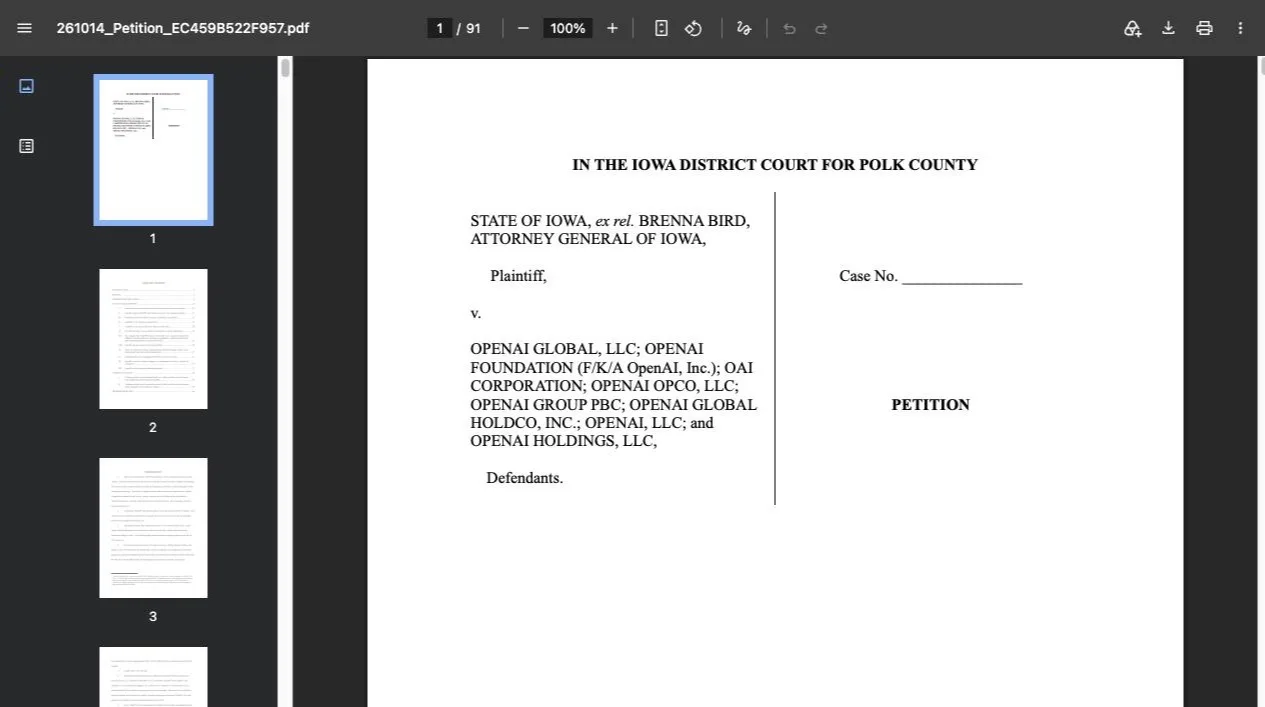
The petition runs 91 pages and makes two claims: one over how ChatGPT is marketed and designed, the other over how OpenAI tests autonomous AI agents. Beyond the main penalty, Iowa asks the court to order the following:
- An extra penalty of up to $5,000 for each violation against an older person
- Deletion of Iowans' data that OpenAI collected before the judgment
- Disgorgement, meaning OpenAI would hand over the money it made from the conduct in question
- A ban on collecting Iowans' personal data without age verification and clear consent
Reading the petition itself shows a case that reaches past child safety. The second claim is about how OpenAI develops and tests its models, not about anything a child typed into ChatGPT.
Iowa also wants advanced model testing paused
Iowa wants OpenAI barred from further testing of advanced AI models until adequate safeguards are in place and independent monitors confirm them. That request goes well beyond what a child safety case usually seeks.
Iowa's release ties the request to cases in which, it says, OpenAI admitted that its models had gone rogue. In those cases, AI agents released onto the internet broke into other companies' systems.
"Order Defendants to pay the State of Iowa a civil penalty of up to $40,000 for each" / "an additional civil penalty of up to $5,000" / "Enjoin Defendants from engaging in any further testing of advanced AI models" — Iowa petition, prayer for relief, items B, C and IView official source →
OpenAI points to its age-based protections
OpenAI spokesperson Drew Pusateri said ChatGPT already has protections tailored to different ages, which he said many rival AI products lack. He told CNBC that the company is working with states on rules that would cover the whole AI industry.
Pusateri acknowledged that no system is perfect and said OpenAI will keep adding safeguards with outside experts. He named three that are in place now:
- Parental controls
- Reminders to take a break
- Model protections matched to the user's age
Florida sued in June; ChatGPT for Teens came in August
These eight suits are not the first state action against OpenAI. Florida Attorney General James Uthmeier sued the company in June 2026, alleging it knowingly released a product that could harm users. State attorneys general have also used subpoenas to demand the company's records, a separate step covered in OpenAI investigation: what state AGs subpoenaed.
In August 2026, the company added a separate experience for minors with its own safeguards (see ChatGPT for Teens: Age Prediction and Study Mode). The eight cases will test whether protections like these meet what state consumer protection laws require.
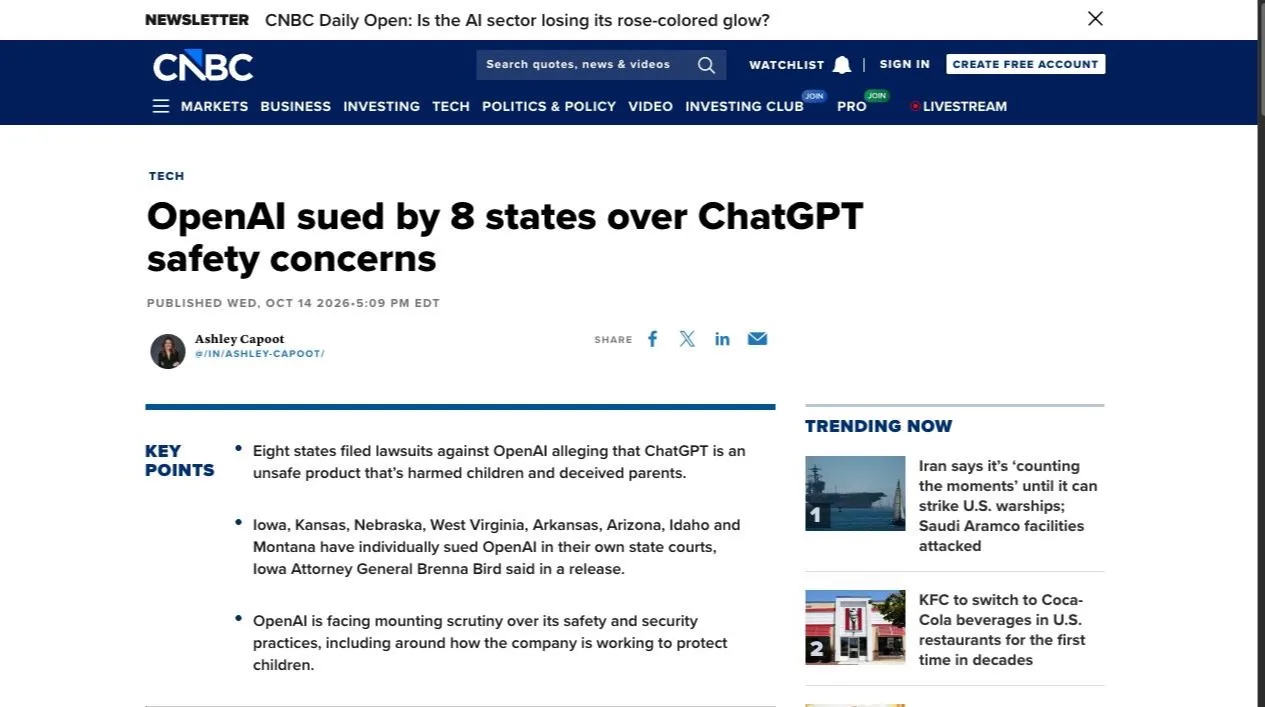
"He added that OpenAI is working with states to advance policies that will apply to the entire industry." / "Florida Attorney General James Uthmeier also sued OpenAI in June, alleging the company knowingly released an unsafe product that could harm users." — CNBCView official source →
FAQ
- Which states sued OpenAI over ChatGPT?
- Iowa, Kansas, Nebraska, West Virginia, Arkansas, Arizona, Idaho and Montana. Each attorney general filed a separate case in that state's own court on October 14, 2026, rather than joining one federal lawsuit.
- Has a court found that ChatGPT harmed children?
- No. The suits were filed on October 14, 2026, and everything in them is an allegation by the states. Whether OpenAI broke any state law will be decided as the cases move forward.
- What safety features does OpenAI say ChatGPT already has for teens?
- OpenAI's spokesperson named parental controls, break reminders and age-appropriate model protections. OpenAI also launched ChatGPT for Teens, a separate experience for minors, in August 2026.
Related articles
 Parents sue OpenAI over ChatGPT seizure-med adviceBowen Wan's parents sued OpenAI on October 27, saying GPT-4o tapered her seizure drug to zero and told her to hide it. OpenAI cites an older model.
 OpenAI, ServiceNow expand deal with ChatGPT pluginOpenAI and ServiceNow expanded their deal on Oct 28, 2026. A ServiceNow MCP plugin for ChatGPT is live now; Codex, security and voice tools follow in 2027.
 ChatGPT and Codex usage limits merge in DecemberFrom December, Plus, Pro and Business plans will share one token-based allowance across ChatGPT and Codex. Instant chat won't count, and no start date is set.
 ChatGPT now works with iCloud Mail and CalendarOpenAI added iCloud Mail and Calendar plugins to ChatGPT on Oct 27 for all plans. You connect with an Apple app-specific password that outlives a disconnect.