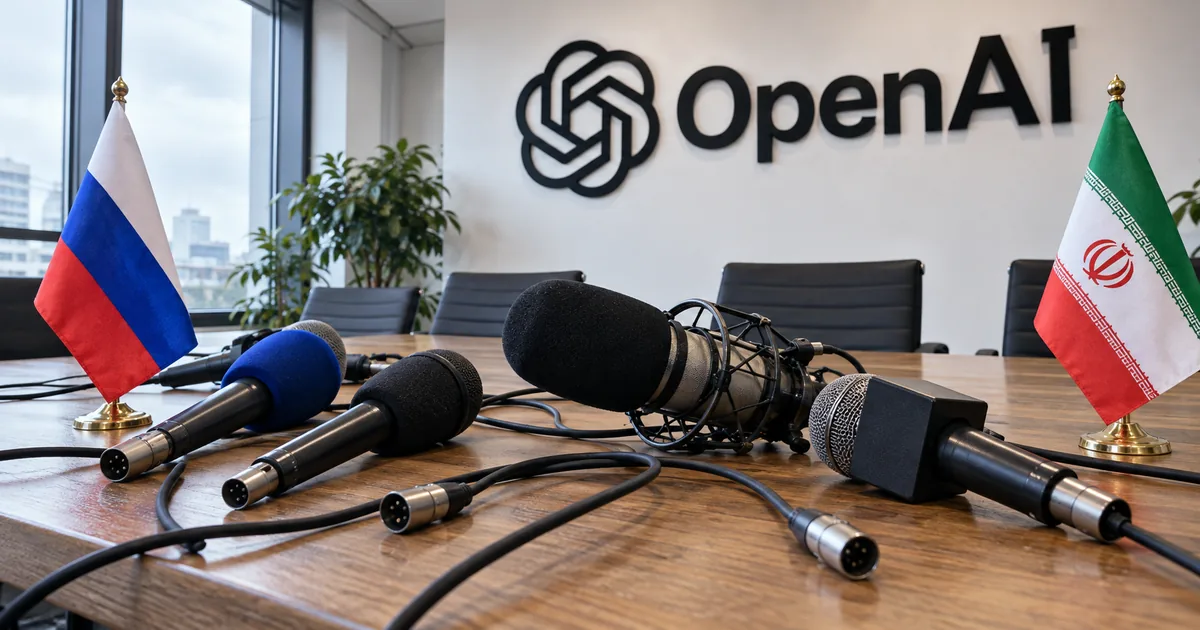
OpenAI banned the ChatGPT accounts of two influence ops
An influence operation is an effort to sway public opinion in another country while hiding who is behind it. In a report published on October 8, OpenAI said it had banned accounts used by two such operations, one originating in Russia and one in Iran. Both paired AI with long-standing tactics to prop up fake organizations or people and pass geopolitical, war-related messages to the audiences they targeted.
The two operations OpenAI disclosed on October 8
| Detail | Russia-origin | Iran-origin |
|---|---|---|
| OpenAI's name | Dark Clark | Bogus Bylines |
| Front | A think tank called the SRC | 7 fake journalist names |
| Main target | Latin America | Small and medium news sites |
| Breakout Scale | Category 5 | Category 4 |
What a false-front operation looks like
OpenAI calls both cases "false front" operations: a made-up think tank, outlet or journalist stands in for the real sender. The Russian group ran a research center staffed by local people who seem not to have known whom they were working for. The Iranian group invented reporters and pitched long articles under their names to news sites around the world.
Both operations reached mainstream media
What sets these two apart is that their material ended up in mainstream outlets instead of staying on social media. On a 1-to-6 scale of how far an operation spreads, OpenAI put the Russian case at Category 5 and the Iranian case at Category 4. OpenAI says it shared information on both cases with the relevant authorities.
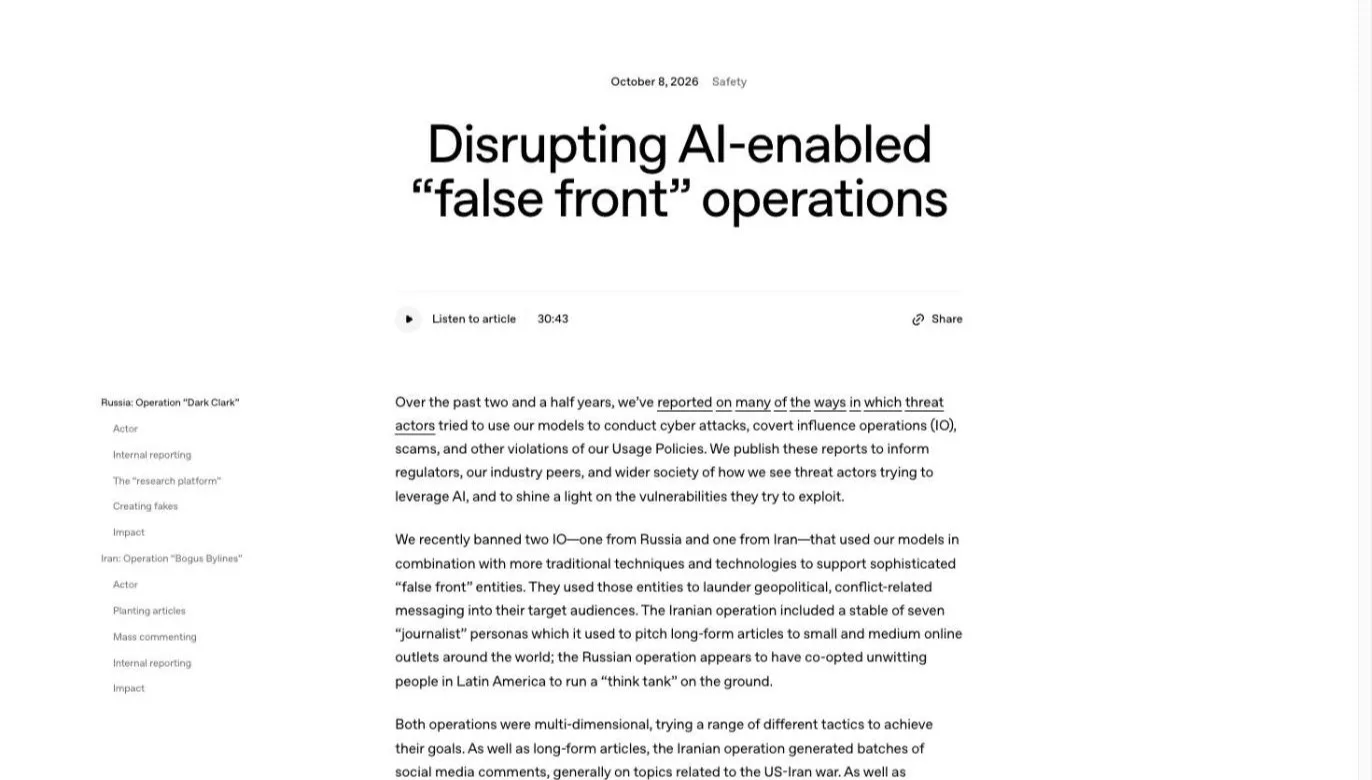
We recently banned two IO—one from Russia and one from Iran—that used our models in combination with more traditional techniques and technologies to support sophisticated “false front” entities. They used those entities to launder geopolitical, conflict-related messaging into their target audiences. / Both managed to land their content (not all of which was generated from our models) in mainstream media outlets, rather than simply posting it on social media. — From the passages on the two bans, the false-front entities and placement in mainstream mediaView official source →
Dark Clark ran a fake think tank across Latin America
OpenAI named the Russian operation Dark Clark. Its operators worked from Russia and aimed at countries across Latin America. Most of the effort went into damaging Ukraine's standing in the region, and part of it into local politics, especially in Argentina and Bolivia.
Fakes the Dark Clark operators claimed in their reports, and what OpenAI could match
| When and where | What the operators said they did | What OpenAI found |
|---|---|---|
| 2024, Argentina | Spread a story that President Milei bought Cartier collars for his dogs | Researchers had tied it to "Politology" |
| March 2026, Ecuador | Fake audio from Ukraine's consul | A matching TikTok post with little engagement |
| May 2026, Peru | Fake email telling schools to hold Ukraine events | Stories in Peru and Poland, a Polish MEP reacted |
| Late May 2026, Bolivia | Fake audio of a water company worker warning of cuts | The company issued a denial |
| June 2026, Ecuador | Got schools to pledge loyalty to the president | The education minister issued a rebuttal |
Local staff apparently did not know they worked for Russia
The center of the operation was a self-styled research platform called the Social Research Center, or SRC. The operators seem to have run it through an invented persona named Mia Clark, which is where OpenAI got the operation's name. OpenAI does not allow access from Russia, so the operators connected through VPNs.
According to OpenAI, the SRC's employees in Latin America appear not to have known that a Russian group was running them. The SRC website carried well over 60 articles, most of them written from scratch rather than copied. OpenAI calls it the most complex attempt to run a front identity that it has disrupted in two and a half years.
A fake email to Peruvian schools reached an EU lawmaker
In their internal reports, the operators said that in May 2026 they posed as the regional education office in Lima, Peru, and emailed schools. The email asked schools to mark the May 21 Day of Cultural and Linguistic Diversity with Ukraine-themed events and to mention Stepan Bandera, a Ukrainian nationalist with a disputed legacy. Stories about the events then ran in Peru and Poland, and a Polish member of the European Parliament responded.
The operators claimed credit for events they did not cause
OpenAI warns that the operators' own reports cannot be taken at face value. Among other things, they took credit for events they had nothing to do with.
Some fakes did spread widely, though. A forged contract that circulated in Ecuador drew a fact check, and fake audio about water cuts in Bolivia was publicly denied by the water company.
They appear to have controlled the SRC via a fake persona named “Mia Clark”; in honor of the name, we have nicknamed this operation “Dark Clark.” Since we do not allow access to our models from Russia, they used VPNs to connect to our services. / The available evidence indicates that the SRC’s employees in Latin America were not aware that they were working for a Russian group. / As such, their own claims of impact in their internal reporting cannot be taken at face value. — From the passages on control of the SRC, the local staff, and the reliability of the operators' reportsView official source →
Bogus Bylines placed nearly 100 articles under fake names
OpenAI named the Iranian operation Bogus Bylines, after the fake author names it used. A byline is the author name printed on an article. The operators invented seven Western-sounding journalists and pitched long pieces about the US-Iran conflict to news sites around the world.
How far Bogus Bylines got into news sites, per OpenAI's report
| Measure | Figure |
|---|---|
| Fake bylines | 7 |
| Articles published or syndicated | Almost 100 |
| Outlets | Roughly a dozen |
| First and latest article | July 2025 and October 2026 |
| Largest outlet named | Almost 2 million Facebook followers (August 2026) |
Seven personas posed as Western journalists
The operators worked from Iran, wrote their prompts in Persian, and hid their location with VPNs. Most of the seven personas presented themselves as American reporters, and one, Noah Lamington, claimed to live in New Zealand.
Another persona was Ervin B. Hoskins. Hoskins's bio called him an American freelance writer, but the transparency settings on his social accounts showed Iran.
Articles surged after the US-Iran conflict began
OpenAI traced almost 100 articles under these names across roughly a dozen outlets. The first appeared in July 2025 and the latest in October 2026. Output rose sharply once the US-Iran conflict started and clustered from March 2026 onward.
Most of the outlets were small or mid-sized sites covering world affairs and the Middle East. One of them, as of August 2026, had a sizable social following:
- Facebook: almost 2 million
- X: almost 355,000
- Instagram: over 544,000
OpenAI says the activity looked like the work of a commercial firm running influence campaigns for hire, but it could not identify the firm. It shared what it found with the relevant authorities.
The operators used seven different bylines to pitch their articles, so we have dubbed their campaign “Bogus Bylines.” The long-form articles focused on the US-Iran conflict. / The earliest article we identified was published in July 2025, and the latest in October 2026. The frequency of articles greatly increased after the outbreak of the US-Iran conflict. / The overall activity appeared consistent with a commercial actor running a for-hire influence campaign, but we are unable to identify the particular actor involved. — From the passages on the bylines, the timing of the articles and who was behind the operationView official source →
ChatGPT mostly wrote internal reports and polished drafts
In both cases, ChatGPT did more paperwork and editing than propaganda writing. OpenAI says the two operations looked a lot like elaborate influence campaigns from before AI existed, with AI simply easing parts of the work.
What each operation used ChatGPT for, per OpenAI's report
| Use | Dark Clark (Russia) | Bogus Bylines (Iran) |
|---|---|---|
| Main use | Writing and updating internal reports | Editing articles and writing pitches |
| Creating content | A forged letter, a contract | Batches of social media replies |
| Reporting results | Took credit for unrelated events | Counted views on other people's posts |
The Russian operators used AI mostly for paperwork
For the Russian operators, internal reports took up most of their ChatGPT use. Content creation was a small share.
One operator had ChatGPT draft a Russian-language letter linking Ukraine's honorary consul in Panama to corruption, then had it translated into Spanish along with a voiceover script. In March 2026, ChatGPT also proofread a contract between a company and a person in Ecuador, and the "contract" later spread on social media.
The Iranian operators polished pitches and batch replies
The Iranian operators had ChatGPT check English drafts against each outlet's submission rules and write the pitch emails to editors. They also generated replies to social media posts in batches.
In one example shown in OpenAI's report, a set of English replies went up within 10 minutes and a Persian set within 13 minutes. Iran International, a UK-based broadcaster critical of the Iranian government, drew more than two dozen batches of hostile replies in Persian.
Both groups inflated their own results
Each operation dressed up its numbers for whoever it reported to. The Iranian group measured impact by the views on the posts it replied to, not on its own replies. The Russian group, as noted above, counted unrelated events as wins.
Both operations also made heavy use of AI to draft internal reports (the Russian operation did this more than anything else); in both cases, the actors used questionable or outright deceitful methodologies to exaggerate the operators’ effectiveness. / What is most striking about these operations is that they closely resembled complex influence operations of the pre-AI age, but used AI to make some of the workflows easier. — From the passages on internal reports, inflated results and the comparison with pre-AI operationsView official source →
Breakout Scale: Category 5 for Russia, 4 for Iran
OpenAI measures reach with the Breakout Scale, a framework from the Brookings Institution. It rates an influence operation from 1 (lowest) to 6 (highest) by how far its material travels beyond the people who created it.
OpenAI's Breakout Scale ratings for the two operations
| Operation | Category | Why |
|---|---|---|
| Dark Clark | 5 | Fakes drew fact checks, official denials and a reaction from a Polish MEP |
| Bogus Bylines, articles | 4 | Steady placement in a number of outlets |
| Bogus Bylines, replies | 2 | Likes, views and comments in the single or double digits |
Dark Clark is OpenAI's first Category 5 operation
The Russian operation is the first Category 5 case OpenAI has disrupted since it began publishing these reports. What pushed it there was evidence that its fakes prompted fact checks and official denials and led a Polish member of the European Parliament to comment. OpenAI treats the operators' own claims with caution and leans on the ones it could match in public sources.
Bogus Bylines scored 4 for articles and 2 for replies
The Iranian operation earned two different ratings. Its articles kept landing in outlets, which put that part at Category 4, while its social media replies got almost no response and stayed at Category 2. The X accounts listed by three of the personas had been suspended as of August 2026.
Most notably, the operation’s claim to have tricked a Peruvian school into holding an event that portrayed Bandera was subsequently reported on in both Latin America and Europe, and appears to have led to comment from at least one Polish MEP. / The social media replies that we were able to identify generally enjoyed low numbers of likes, views, and comments (in the single or double digits). — From the passages on how far the Peru fake spread and how little the Iranian replies drewView official source →
Across 30 ops, those in real news outlets spread furthest
Looking across the 30 covert influence operations it has exposed in about two and a half years, OpenAI sees a pattern: the ones that get content into real news outlets reach the most people. Operations that lean only on fake social media accounts tend to stay small by comparison.
False-front operations OpenAI cites in its report
| Operation | Front | What happened next |
|---|---|---|
| Alice Donovan (2016-17) | Fake journalist for Russian military intelligence | Stopped after exposure |
| PeaceData (2020) | Fake news outlet | Stopped after exposure |
| Dark Clark | Fake think tank | Accounts banned by OpenAI |
| Bogus Bylines | Fake journalist names | Accounts banned by OpenAI |
AI can make fake fronts bigger and more fluent
OpenAI says AI can give operations like these more scale, efficiency, language fluency and editing skill. That lets operators use unsuspecting employees and editors to put material in front of readers who have no idea who is behind it. For a related case aimed at AI systems, see LLM Poisoning Case: A Reported Fake Think Tank.
Exposure shut down earlier fakes
OpenAI also points out that operations built on hidden identities are fragile once they are named in public. "Alice Donovan" placed articles in Western outlets in 2016-17 as a front for Russian military intelligence, and the fake news site "PeaceData" ran in 2020. Both went quiet once they were exposed, and that is why OpenAI says it publishes these reports: to make further research and takedowns easier and operations like these harder to keep going.
This is consistent with a pattern we’ve observed across the 30 covert influence operations we’ve exposed in the last two and a half years: the operations which try to land their content in real media outlets, rather than relying on fake social media distribution, tend to have the highest potential reach and impact. / AI can give such false-front operations greater scale, efficiency, linguistic fluency, and editorial ability. / Both “Alice Donovan” and “PeaceData” ceased their activity after they were exposed. That’s why our goal in reporting these false-front operations is to make further research and disruption easier—and make continuing the operations harder. — From the passages on the pattern across 30 operations, what AI adds, and why OpenAI publishesView official source →
Fake fronts gave two banned operations their reach
On October 8, OpenAI banned the ChatGPT accounts of two influence operations that hid behind a fake think tank and fake journalists. The Russian one spread forged emails and audio across Latin America and became the first Category 5 case OpenAI has disrupted. The Iranian one placed almost 100 articles under seven invented bylines in roughly a dozen outlets.
ChatGPT's main jobs were internal reports and editing, and both groups overstated their own success. For how one AI company now spells out its rules on influence operations, see Anthropic usage policy update: what changes Nov 12.
FAQ
- Which influence operations did OpenAI shut down?
- Two: one run from Russia, which OpenAI calls Dark Clark, and one run from Iran, which it calls Bogus Bylines. Both hid behind made-up organizations or people to push messages about geopolitics and war. OpenAI banned the ChatGPT accounts involved and passed what it found to the relevant authorities.
- Did ChatGPT write the fake stories?
- Mostly not. OpenAI says the Russian operators usually used ChatGPT to report on their campaigns rather than to create campaign material, with a few exceptions such as a forged letter and a contract. The Iranian operators mainly used it to fit articles to each outlet's submission rules and to write pitch emails.
- What does Category 5 on the Breakout Scale mean?
- The Breakout Scale, built by the Brookings Institution, rates how far an influence operation spreads from 1 (lowest) to 6 (highest). The Russian operation reached Category 5 because its fakes drew fact checks, government denials and a reaction from a member of the European Parliament. It is the first Category 5 operation OpenAI has disrupted.
Related articles
 OpenAI, ServiceNow expand deal with ChatGPT pluginOpenAI and ServiceNow expanded their deal on Oct 28, 2026. A ServiceNow MCP plugin for ChatGPT is live now; Codex, security and voice tools follow in 2027.
 ChatGPT and Codex usage limits merge in DecemberFrom December, Plus, Pro and Business plans will share one token-based allowance across ChatGPT and Codex. Instant chat won't count, and no start date is set.
 ChatGPT now works with iCloud Mail and CalendarOpenAI added iCloud Mail and Calendar plugins to ChatGPT on Oct 27 for all plans. You connect with an Apple app-specific password that outlives a disconnect.
 ChatGPT limits weapons information for teensOpenAI said on Oct 30, 2026 that ChatGPT will limit weapons information for teens, end chats fixated on violence, and report on safety every six months.