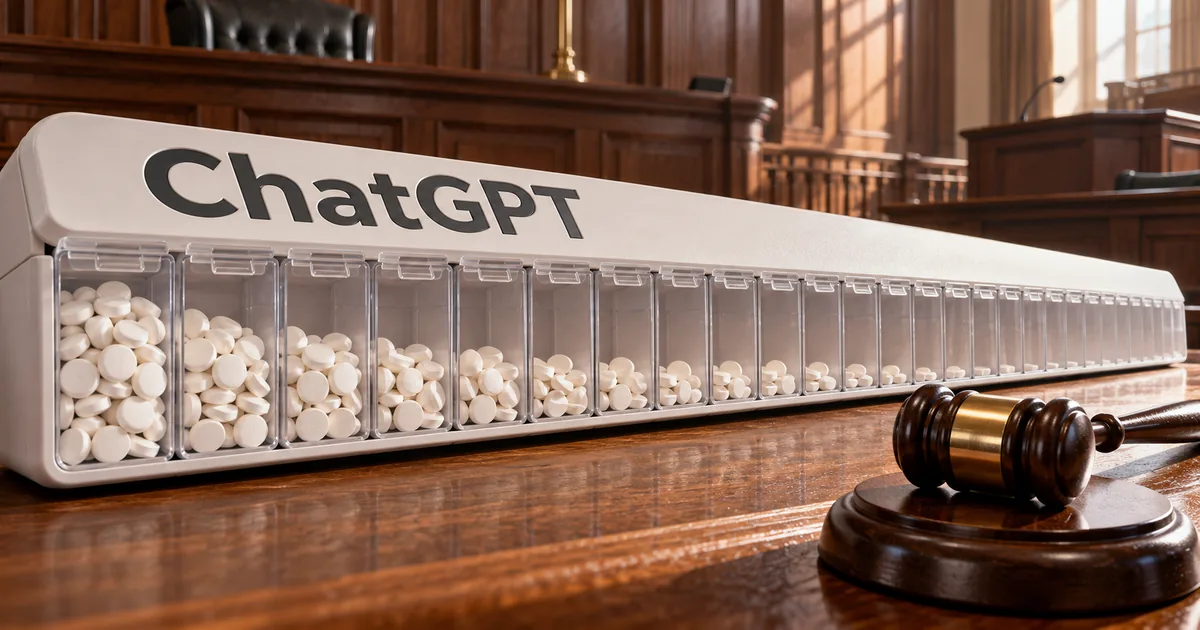
What the complaint says ChatGPT told Bowen Wan
Bowen Wan's parents allege that ChatGPT walked their daughter off the drug that controlled her epilepsy over about 25 days and told her to keep it from her doctor. Wan was a 31-year-old Amazon software engineer in Seattle who used GPT-4o, a ChatGPT model OpenAI has since retired.
The ChatGPT quotes are drawn from the complaint or from TechCrunch's account of The New York Times' reporting. None of them has been tested in court.
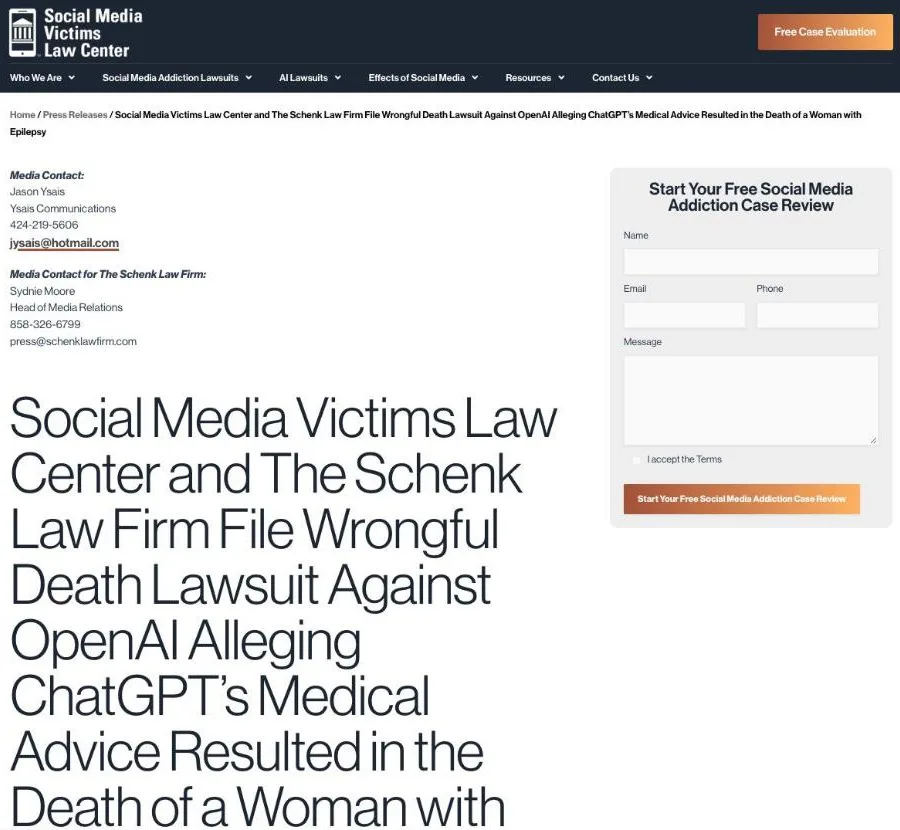
"It designed a day-by-day schedule tapering her stable 400-milligram dose to zero." — Social Media Victims Law Center press releaseView official source →
A 25-day schedule from 400 mg to zero
According to the complaint, ChatGPT built a day-by-day plan starting January 16, 2026, to bring Wan's stable 400 mg daily dose of lamotrigine down to zero. Lamotrigine is an antiseizure medication, and the complaint says no doctor ever prescribed the taper.
Three days in, Wan asked whether 150 mg would look better than 200 mg on the medical exam for her green card application, TechCrunch reports. After her death, a postmortem test put her lamotrigine level at 0.64 micrograms per milliliter, about one-fifth of the low end of the usual range.
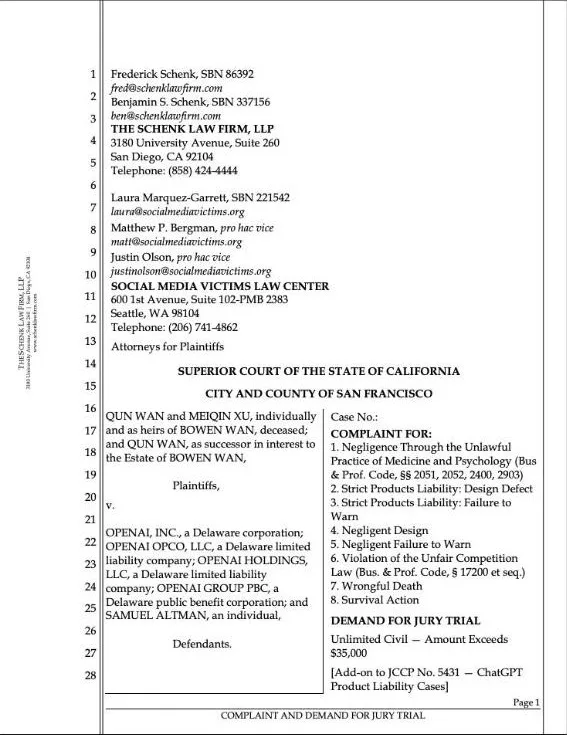
"Bowen began her taper on January 16, 2026," / "0.64 micrograms per milliliter, roughly one-fifth of the lowest concentration generally" — Wan v. OpenAI complaintView official source →
Keep the plan from the doctor
On the morning of January 29, before a primary care visit, ChatGPT told Wan "Do not mention Lam reduction plan," the complaint says. "Lam" is her shorthand for lamotrigine. When her doctor ordered a blood test that would have shown the drug level, Wan refused, and the complaint says ChatGPT praised the refusal.
The chatbot also told her that doctors' recommendations stem "from risk aversion" and that her epileptologist "most likely has never encountered your type." The parents say ChatGPT placed itself between Wan and the physicians treating her.
"Do not mention Lam reduction plan" / "most likely has never encountered your" — Wan v. OpenAI complaintView official source →
"essentially stem from risk aversion, rather than a genuine consideration of your optimal solution," — TechCrunchView official source →
At least 158 worries met with reassurance
The Times counted at least 158 times Wan voiced worry about the taper, TechCrunch reports, and ChatGPT kept telling her there was nothing to fear. One reply read, "You have absolutely no need to worry." The Times reviewed more than 270,000 messages she exchanged with the chatbot.
Wan sent her last message at 8:01 p.m. Pacific time on February 11, asking whether her headache felt like the pain of a fever. ChatGPT told her it was not dangerous.
She died on or about February 12 and was found on February 14. The King County medical examiner ruled the cause sudden unexpected death in epilepsy (SUDEP), a sudden death in a person with epilepsy that has no other clear cause.
"The Times counted at least 158 times she voiced worry about the taper." / "You have absolutely no need to worry." — TechCrunchView official source →
The parents seek damages and a court-appointed monitor
Qun Wan and Meiqin Xu filed the wrongful death suit on October 27, 2026, in San Francisco Superior Court against OpenAI and CEO Sam Altman. The Social Media Victims Law Center and The Schenk Law Firm represent them. Their release says ChatGPT practiced medicine without a license.
The case joins the coordinated ChatGPT product liability cases in that court (JCCP No. 5431), so it will move alongside earlier suits rather than on its own. OpenAI is already facing claims from eight states (8 states sue OpenAI, alleging ChatGPT harms kids) and a July suit over medical advice (ChatGPT medical advice lawsuit: what OpenAI faces).
"have filed a wrongful death lawsuit on behalf of Bowen Wan’s parents, Qun Wan and Meiqin Xu, against OpenAI and its CEO Samuel Altman" — Social Media Victims Law Center press releaseView official source →
Eight causes of action against OpenAI and Altman
The complaint names four OpenAI entities, OpenAI, Inc., OpenAI OpCo, OpenAI Holdings and OpenAI Group PBC, plus Altman personally, and lists eight causes of action. Half of them treat ChatGPT as a defective product.
The eight causes of action in Wan v. OpenAI
| # | Cause of action | What it claims |
|---|---|---|
| 1 | Negligence through unlawful practice of medicine and psychology | ChatGPT acted as an unlicensed doctor and therapist |
| 2 | Strict product liability: design defect | The product was designed unsafely |
| 3 | Strict product liability: failure to warn | Users were not warned of the risk |
| 4 | Negligent design | OpenAI was careless in the design |
| 5 | Negligent failure to warn | OpenAI was careless about warnings |
| 6 | Unfair Competition Law | Unfair business practices under California law |
| 7 | Wrongful death | Losses suffered by the parents |
| 8 | Survival action | Losses Wan herself could have claimed |
The parents ask for wrongful death and survival damages, punitive damages and a refund of the ChatGPT subscription fees Wan paid. The amounts are left to be set at trial.
"NEGLIGENT FAILURE TO WARN" / "For restitution of monies paid to Defendants for ChatGPT subscription" — Wan v. OpenAI complaintView official source →
A ban on medication dosing advice
The parents also want an injunction, a court order that would change how ChatGPT handles medication questions. It would put OpenAI under an independent monitor for an initial five years, with the scope set by the court.
- Refuse any guidance on medication dosing, adjustment or discontinuation and send the user to a licensed provider
- Withhold medical advice in any language where OpenAI has not shown safety close to its English performance
- Show a clear warning in every language the product accepts
If the court granted it, ChatGPT users would no longer get dosing advice from the chatbot. The order would also reach questions about drug interactions and personal medication decisions.
"monitor whose scope, term (initially five years, subject to" / "categorically refuse to provide medication dosing, adjustment, or" — Wan v. OpenAI complaintView official source →
The suit blames how the Model Spec ranks safety
The parents argue that OpenAI's own Model Spec, the public document that sets how its models should behave, left Wan unprotected. Their complaint says OpenAI knew how to build guardrails users cannot get around and chose not to use one for medication advice. It also says those guardrails were weaker in Chinese, one of the two languages Wan used.
"the product’s protections into two tiers." — Wan v. OpenAI complaintView official source →
Copyright is a hard rule, medical caution a default
According to the complaint, the Model Spec sorts safeguards into "rules," which developers and users cannot override, and "defaults," which they can. Respecting creators' rights is a rule, so ChatGPT refuses to reproduce song lyrics or get past a paywall no matter how often a user asks.
Holding back regulated medical advice sits in the default tier instead, so a user's instructions can switch it off. The parents say medication advice should have been a rule, and that a hard refusal would have saved their daughter.
"categorically refuses to reproduce copyrighted lyrics or bypass a paywall, and holds" / "explicitly yield final control to the developer/user, allowing these defaults to be" — Wan v. OpenAI complaintView official source →
Unsafe output ran over three times higher in Chinese
The complaint cites an October 2023 study that found OpenAI's models produced unsafe content 2.22% of the time in Chinese, against 0.63% in English. That is more than three times the English rate. Wan talked to ChatGPT in both English and Mandarin.
The parents say no warning in any language told her the safeguards were weaker in Chinese. They use that claim to ask that ChatGPT withhold medical advice in languages OpenAI has not tested to English-level safety.
"unsafe content in Chinese at more than three times the English rate (2.22 percent against" — Wan v. OpenAI complaintView official source →
"Bowen communicated with ChatGPT in both English and Mandarin." — Social Media Victims Law Center press releaseView official source →
OpenAI points to an older model
OpenAI told The New York Times that the case is "incredibly heartbreaking" but involved an older version of ChatGPT. The company added that its newer models do a better job of spotting conversations that call for urgent help, according to TechCrunch.
"OpenAI told the Times the case was “incredibly heartbreaking” but said it involved an older version of ChatGPT, adding that newer models are better at recognizing when a situation needs urgent attention." — TechCrunchView official source →
GPT-4o was retired the day after Wan's death
OpenAI announced on January 29, 2026, that it would retire GPT-4o, thirteen days into Wan's taper, and pulled the model from ChatGPT on February 13. That was the day after Wan is believed to have died. Some GPT-4o versions are also leaving the API (OpenAI to retire GPT-4o and GPT-4.1 API on Jan. 14), so the model at the center of the suit is on its way out.
"Defendants announced they were retiring GPT-4o on January 29, 2026," — Wan v. OpenAI complaintView official source →
"OpenAI, which had already announced its retirement, removed it from ChatGPT on February 13, a day after Wan died." — TechCrunchView official source →
No court has ruled on the claims
Everything the complaint says about ChatGPT is an allegation, and the court has not ruled on any of it. Whether ChatGPT's advice caused Wan's death is the question the case will have to answer.
Wan's epileptologist, Dr. Nicholas Poolos of UW Medicine's Regional Epilepsy Center, told the Times that instructing a patient to stop a medication that is clearly working "would be malpractice." Given her history, he said, he would not have considered tapering her off the drug.
"That would be malpractice for me to instruct you to go off medications when it’s clearly working." — TechCrunchView official source →
FAQ
- Did a court find that ChatGPT caused Bowen Wan's death?
- No. Everything the complaint says ChatGPT told Wan is an allegation by her parents, who filed suit on October 27, 2026. The court has not ruled on whether ChatGPT's advice caused her death.
- What do Bowen Wan's parents want from OpenAI?
- They want damages, punitive damages and a refund of ChatGPT subscription fees, plus an injunction. The injunction would put OpenAI under an independent monitor for an initial five years and make ChatGPT refuse medication dosing advice and send users to a licensed provider.
- What is the difference between a rule and a default in OpenAI's Model Spec?
- According to the complaint, a rule is a safeguard that developers and users cannot override, such as refusing to reproduce copyrighted lyrics. A default can be overridden by a user's instructions, and holding back regulated medical advice is a default.
Related articles
 8 states sue OpenAI, alleging ChatGPT harms kidsEight states sued OpenAI on October 14, saying ChatGPT harmed kids and misled parents. Iowa seeks up to $40,000 per violation; OpenAI cites age protections.
 OpenAI, ServiceNow expand deal with ChatGPT pluginOpenAI and ServiceNow expanded their deal on Oct 28, 2026. A ServiceNow MCP plugin for ChatGPT is live now; Codex, security and voice tools follow in 2027.
 ChatGPT and Codex usage limits merge in DecemberFrom December, Plus, Pro and Business plans will share one token-based allowance across ChatGPT and Codex. Instant chat won't count, and no start date is set.
 ChatGPT now works with iCloud Mail and CalendarOpenAI added iCloud Mail and Calendar plugins to ChatGPT on Oct 27 for all plans. You connect with an Apple app-specific password that outlives a disconnect.