
What OpenAI announced about Zero Data Retention
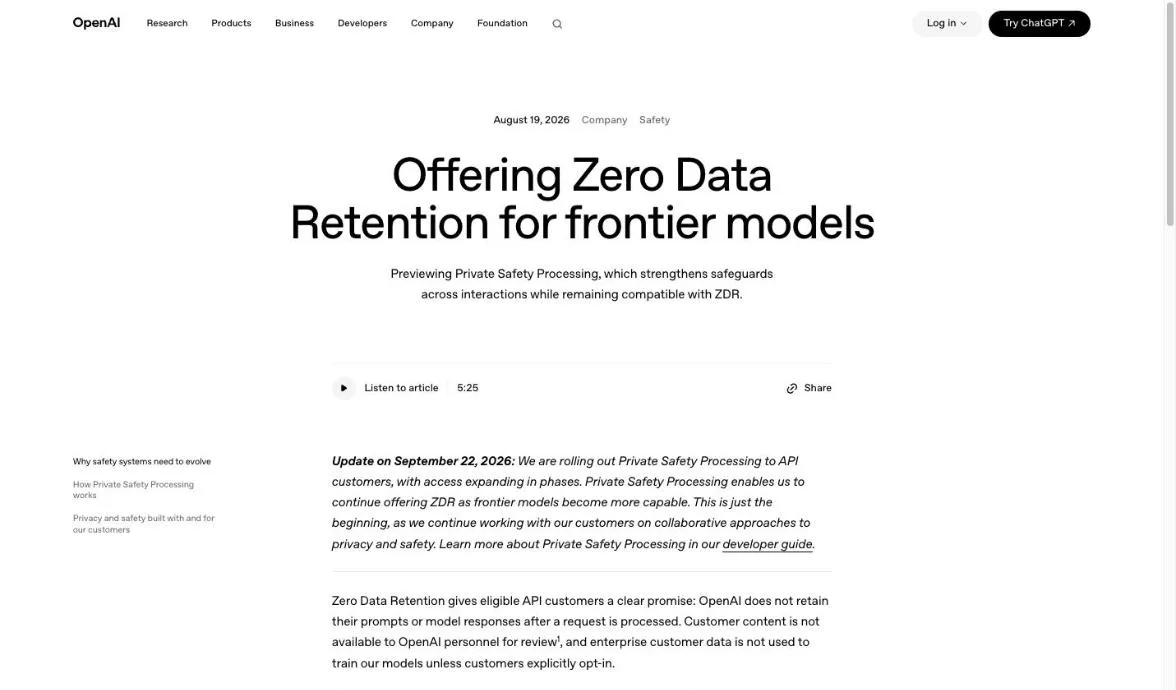
On August 19, 2026, OpenAI restated its Zero Data Retention promise and previewed Private Safety Processing as a way to keep that promise while improving safety checks. ZDR is the arrangement for eligible API customers: OpenAI does not retain their prompts or model responses after a request is processed. Customer content is not available to OpenAI personnel for review, and enterprise customer data is not used to train OpenAI's models unless the customer explicitly opts in.
The post is titled "Offering Zero Data Retention for frontier models". Its subtitle says the preview strengthens safeguards across interactions while remaining compatible with ZDR.
For a security or procurement owner who holds a ZDR agreement, the post is mainly a statement about an existing promise rather than a new product launch. One category of content falls outside the promise, and a later section covers it.
Single-interaction checks miss cross-interaction risk
ZDR-compatible safety systems judge each interaction on its own, and OpenAI says some serious risks only become visible when several interactions are read together. The company ties this to models taking on longer, more complex tasks. A single request can look harmless while the pattern around it is not.
OpenAI gives three examples of such patterns: bad actors repeatedly probing safeguards, coordinating across accounts, or disguising threats as routine research. A fourth example comes from AI agents, which can drift from what the user intended by continuing to act after being told to stop.
OpenAI says seeing the wider context helps separate legitimate activity from misuse and keep agents inside the authority they were given. Private Safety Processing is OpenAI's proposal for getting that wider view without OpenAI personnel reading customer content.
How Private Safety Processing works
OpenAI says automated systems look across related interactions and that it receives only a narrow signal about the type of activity, not the content. A signal here is a narrowly defined indication of the activity involved, not a copy of the prompt or response. The design builds on automated protections already used in ZDR and other deployments, and it extends them from single interactions to related ones.
Where the content sits depends on the setup. In ZDR deployments it remains on infrastructure the customer controls. OpenAI is also developing an option that stores content on OpenAI infrastructure, encrypted with keys the customer controls, and OpenAI personnel hold no copy of those keys.
When a risk is identified, the signal can be used to decide whether enforcement is necessary, and personnel get no access to the content even when it is flagged. Customers can investigate alerts and enforcement decisions with information in their own systems. They then choose whether to share relevant information to appeal, clarify legitimate activity, or support an investigation into verified abuse.
"Private Safety Processing utilizes customer content regardless of where it is stored—whether in infrastructure customers control (ZDR deployments) or in storage provided by OpenAI. With OpenAI-provided storage, customer content is encrypted using keys controlled by the customer. OpenAI personnel do not have a copy of those keys, so they cannot access the underlying content."/"When a risk is identified, OpenAI receives a narrowly defined signal indicating the type of activity involved, similar to our existing safety systems today. That signal can be used to determine whether enforcement is necessary. OpenAI personnel do not receive access to the customer content even when it is flagged."— from OpenAI's announcementView official source →
CSAM-flagged images are still retained under ZDR
Images flagged as possible child sexual abuse material (CSAM) are still retained under ZDR, exactly as they are today. OpenAI's footnote says that, like other frontier model providers, it is required by law to report apparent CSAM. Flagged images are kept for manual review and reporting.
The footnote is attached to the sentence saying customer content is not available to OpenAI personnel for review, so it qualifies that promise. It is the one exception the announcement states, and the preview does not change it.
For anyone answering a compliance questionnaire, the practical question is whether the workload sends images. The footnote speaks only of images, so that is where an answer of "nothing is retained" needs the qualification.
"Like other frontier model providers, OpenAI is required by law to report apparent child sexual abuse material (CSAM). Images flagged for potential CSAM will continue to be retained for manual review and reporting purposes, even in Zero Data Retention deployments, as they are today."— from OpenAI's announcementView official source →
Private Safety Processing vs. retention-based monitoring
OpenAI says Private Safety Processing is designed so ZDR can continue, while some recent frontier-model deployments have required customers to let the provider retain sensitive content for safety monitoring. For many organizations, the post adds, such a requirement conflicts with their security obligations or their commitments to the people they serve.
The post names no provider, and the contrast it draws is about method. Retention-based monitoring keeps sensitive content with the provider, while OpenAI says Private Safety Processing finds patterns without giving staff access to customer content.
Keeping ZDR available is the aim OpenAI states for the design. The post presents it as a goal, not a tested result, so the technical white paper OpenAI promised matters for judging it.
"Risks can also develop over the course of an agentic task—for example, if a system becomes misaligned with the user’s intent by continuing to act after being told to stop."/"Some recent frontier-model deployments have required customers to allow their AI provider to retain sensitive content for safety monitoring. For many organizations, such requirements conflict with their security obligations or commitments to the people they serve."/"Private Safety Processing is designed so we can continue to offer ZDR."— from OpenAI's announcementView official source →
When Private Safety Processing becomes available
OpenAI added an update to the post on September 22, 2026: it is rolling out Private Safety Processing to API customers, with access expanding in phases. The August 19 post had described a preview tested with early customers and a plan to start the rollout and share that white paper in September. OpenAI said it shared the preview because customers need predictability about how their content will be protected as AI systems become more capable.
The update points readers to a developer guide but does not mention the white paper, and it gives no schedule for each phase. A team waiting for access should read the developer guide rather than assume it already has the feature.
The August 19 post also promised that OpenAI would keep customers informed, explain what updates mean for existing commitments, and give customers time to plan. A team can use that promise as a checkpoint: record the commitments it relies on today, then compare them with what OpenAI explains.
"Update on September 22, 2026: We are rolling out Private Safety Processing to API customers, with access expanding in phases. Private Safety Processing enables us to continue offering ZDR as frontier models become more capable."— from OpenAI's announcementView official source →
What Zero Data Retention customers should check now
Check whether workloads send images, compare the agreement wording with the announcement, and keep a dated copy of the wording relied on. Images come first because the CSAM retention applies there, and it already applies today.
Next, read the agreement and the eligibility wording against the announcement. ZDR is offered to eligible API customers, so the question to settle is whether the organization qualifies.
Read the technical white paper, if it has been published, before relying on the design; until then the mechanism is OpenAI's description. OpenAI's page gained a September 22 update after its first publication, which shows why a dated copy is useful when a claim is questioned later.
FAQ
- Does Private Safety Processing break Zero Data Retention?
- Not under the design OpenAI has announced. Content stays on infrastructure the customer controls, and OpenAI is developing a second option with content on its own storage, encrypted with customer-held keys that OpenAI personnel do not hold. Automated systems return a narrow signal about the type of activity, and OpenAI says personnel get no access to the content even when it is flagged. The CSAM retention in the next answer is separate.
- Is anything still retained under OpenAI ZDR?
- Yes. Images flagged as potential child sexual abuse material are retained for manual review and reporting, in ZDR deployments as they are today, because OpenAI says the law requires it to report apparent CSAM. It is the one exception the announcement states, and a compliance answer has to account for it.
- When can customers use Private Safety Processing?
- An update added to the post on September 22, 2026 says OpenAI is rolling it out to API customers, with access expanding in phases. The update does not say when a given customer gets access, and it does not mention the technical white paper promised in August.
Related articles
 ChatGPT limits weapons information for teensOpenAI said on Oct 30, 2026 that ChatGPT will limit weapons information for teens, end chats fixated on violence, and report on safety every six months.
 OpenAI Preparedness Team: What the FT ReportedOpenAI denies an FT report that it disbanded its Preparedness team. Here is what each side says, who runs the work now, and what changed for Dylan Scandinaro.
 OpenAI, ServiceNow expand deal with ChatGPT pluginOpenAI and ServiceNow expanded their deal on Oct 28, 2026. A ServiceNow MCP plugin for ChatGPT is live now; Codex, security and voice tools follow in 2027.
 AI crawler training opt-out in one robots.txt ruleAI crawler training opt-out now takes one robots.txt rule. OpenAI, Google and Microsoft will honor it, Microsoft from Feb. 1, 2027. Until then, name each bot.