
PHP2Shell is a pair of critical flaws in core PHP
On October 21, 2026, Wiz Research disclosed critical security flaws in the PHP engine itself, and the PHP project shipped fixes the same day. PHP is the programming language behind WordPress, Drupal, Joomla and MediaWiki, the software that runs Wikipedia. Because the bugs live in PHP rather than in any one app, a site can be exposed even if its own code is clean.
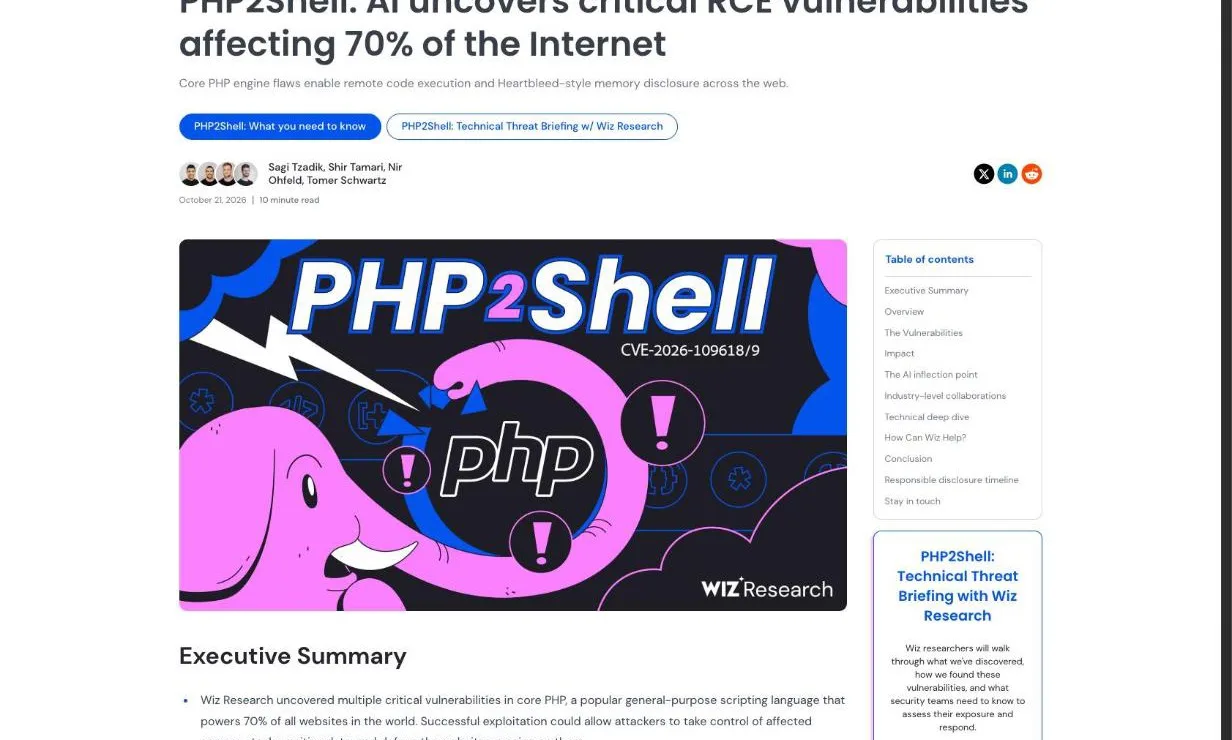
"PHP is a backbone of the web: it’s the programming language powering WordPress, Joomla, Drupal, Wikipedia’s MediaWiki, and many others." — from the Executive SummaryView official source →
Two CVEs rated up to CVSS 9.2
The flaws are tracked as CVE-2026-109618 and CVE-2026-109619. A CVE is a public ID number given to each known vulnerability. Wiz rates them up to 9.2 on CVSS, the 0-to-10 scale used to score how severe a vulnerability is.
Both can let an attacker run code on the server without logging in. Wiz also showed attackers could read server memory that may hold passwords, tokens and API keys, without needing to take over the server first.
"were grouped under two CVEs, with severity reaching CVSS 9.2." / "Separately, we demonstrated that attackers could read sensitive data from the PHP process’s memory, including passwords, tokens, and API keys, without needing to achieve remote code execution." — from the Overview and Impact sectionsView official source →
Wiz took over WordPress, Drupal and Joomla without a login
Wiz combined the flaws into one script and used it to run code on the latest WordPress, Drupal and Joomla container images, with no account at all. Those three were chosen as examples. Wiz says the app does not need its own bug for the attack to work.
"Exploitation does not depend on a flaw in the application’s code: even a simple “Hello World” application running on an affected PHP version can be vulnerable." — from the Impact sectionView official source →
Which PHP versions are affected
Wiz says nearly every PHP version going back to 5.4 has at least one of the two flaws. It also notes that PHP runs 70% of the world's websites.
The PHP project's advisory says every PHP installation that serves web requests is at risk. That covers PHP-FPM, Apache with mod_php, php-cgi, FrankenPHP and LiteSpeed, with mod_php at the highest risk.
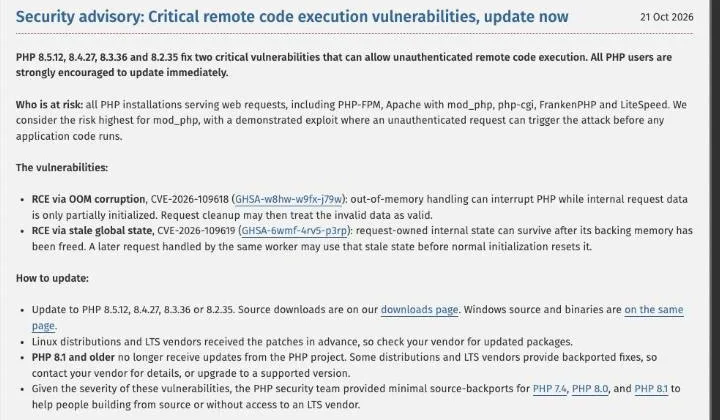
"Every PHP version released in the last decade is affected by at least one of these vulnerabilities, going back to version 5.4." / "a popular general-purpose scripting language that powers 70% of all websites in the world." — from the Executive SummaryView official source →
Patched releases for PHP 8.2 through 8.5
The PHP project fixed both flaws in four releases and asked every user to update right away. The table shows which release closes the gap for each branch.
Affected versions and fixed releases (PHP security advisory)
| Branch | Affected | Fixed release |
|---|---|---|
| 8.5 | before 8.5.12 | 8.5.12 |
| 8.4 | before 8.4.27 | 8.4.27 |
| 8.3 | before 8.3.36 | 8.3.36 |
| 8.2 | before 8.2.35 | 8.2.35 |
Linux distributions and long-term support vendors received the patches before disclosure. If you install PHP from one of them, look for its updated package rather than the version number alone.
"All PHP users are strongly encouraged to update immediately." / "Linux distributions and LTS vendors received the patches in advance, so check your vendor for updated packages." — from the advisory summary and How to updateView official source →
No official fix for PHP 8.1 and older
PHP 8.1 and older no longer get updates from the PHP project. Some distributions and long-term support vendors have backported the fix. The PHP security team also posted minimal source patches for 7.4, 8.0 and 8.1 for people who build PHP themselves.
The advisory is clear that settings changes are not a substitute. They can close specific attack paths, but only an update fully fixes the flaws.
"no longer receive updates from the PHP project." / "the PHP security team provided minimal source-backports for" / "while only an update is a complete solution, the following measures reduce exposure to specific attack paths but do not make an installation safe." — from How to update and If you cannot update immediatelyView official source →
How AI helped Wiz find and prove the flaws
Wiz says it used its own Wiz Atlas plus Google's Gemini 4 Argon and OpenAI's GPT-5.6 Sol throughout the research. It credits Gemini 4 Argon with help on finding the bug, building the exploit, spotting attacks and checking the patch.
Wiz's disclosure timeline
| Date | Event |
|---|---|
| Aug 19, 2026 | Wiz finds the first flaw |
| Aug 20, 2026 | Login-free code execution confirmed on Drupal |
| Aug 21, 2026 | Same result on WordPress |
| Aug 24, 2026 | Wiz reports the flaws to the PHP security team |
| Sep 21, 2026 | PHP acknowledges and starts a coordinated fix |
| Oct 21, 2026 | Patched releases and public disclosure |
"Wiz used Wiz Atlas, Gemini 4 Argon, and GPT-5.6 Sol throughout this research, with Argon making a particularly significant contribution to finding and helping to remediate the vulnerability." / "Wiz Research reports the vulnerabilities to the PHP security team." / "Patched PHP releases become available." — from the Conclusion and the disclosure timelineView official source →
A decade-old bug turned into a working exploit
The vulnerable code had been in PHP for more than a decade. Proving it could be exploited meant chaining several bugs and adjusting to each server's memory layout through repeated testing. Wiz says that work sat at the edge of what human researchers could practically do.
With AI doing much of the trial and error, Wiz says one researcher finished in a week what would once have taken a top team months. The same speed is open to attackers, which is why Wiz argues that complexity can no longer be counted on as protection. Other AI labs are building tools for the same job (see OpenAI Daybreak: GPT-5.5-Cyber and Codex Security).
"The vulnerable code had been present for more than a decade." / "at the edge of what human researchers could practically achieve." / "With frontier AI models and the right tools, a single researcher completed in a week what previously would have taken a world-class team months of work." — from the Executive Summary, The AI inflection point and the ConclusionView official source →
From discovery to disclosure in two months
Wiz reported the flaws to PHP on August 24, and the fix and the disclosure both landed on October 21. Wiz worked with the PHP team, Calif and OpenAI on discovery, coordination and patch checks.
Before the details went public, cloud and network companies prepared protections for customers who could not patch at once. Wiz names Automattic, Akamai, AWS, Cloudflare, Fastly, Google, Imperva, Microsoft and Vercel among them.
"Prior to public disclosure, Wiz Research worked with the PHP team, Calif and OpenAI on discovery, coordination and patch verification." / "for helping prepare guidance and out-of-the-box mitigations for customers who cannot apply the patch immediately." — from Industry-level collaborations and the OverviewView official source →
CISA confirms the flaws are being exploited
On October 26, 2026, the US Cybersecurity and Infrastructure Security Agency (CISA) added both flaws to its Known Exploited Vulnerabilities (KEV) catalog. The KEV catalog is CISA's list of vulnerabilities confirmed to be exploited in real attacks.
CISA first warned about the flaws on October 21 and urged immediate patching. On October 23 it added a detection rule to help defenders spot suspicious activity in their logs.
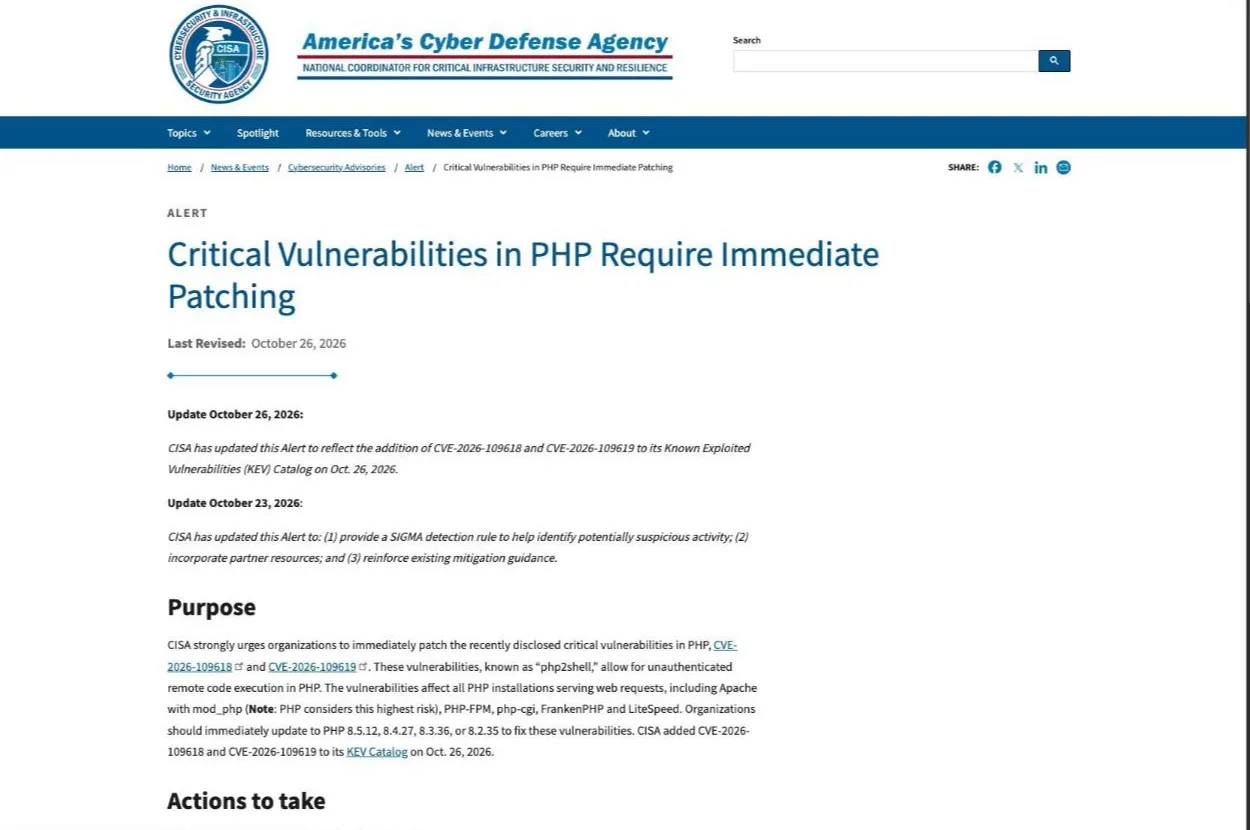
"CISA has updated this Alert to reflect the addition of CVE-2026-109618 and CVE-2026-109619 to its Known Exploited Vulnerabilities (KEV) Catalog on Oct. 26, 2026." / "provide a SIGMA detection rule to help identify potentially suspicious activity" — from the October 26 and October 23 updatesView official source →
Check whether your company runs PHP
If any of your sites or internal tools run on PHP, treat this as an urgent fix rather than routine maintenance. CISA's alert lays out what organizations should do, and the steps below follow it.
CISA's recommended actions (CISA alert)
| Situation | Action |
|---|---|
| You run PHP anywhere | List every system that uses it |
| A patch is available | Update now, internet-facing systems first |
| You cannot update, or run 8.1 or older | Take the PHP-based system offline |
| You are waiting to update | A web application firewall may help in the meantime |
"Organizations that cannot update immediately, or that continue to use PHP 8.1 or earlier unsupported versions, should take PHP-based systems offline until they can be patched or updated." / "A web application firewall may provide some protection until systems are updated or patched." — from Actions to takeView official source →
What companies should do now
Start with an inventory of every system that runs PHP, including products that bundle it inside. CISA warns that PHP is often a component of other software, so you may not see it at first glance.
Then update to a fixed release, beginning with anything reachable from the internet. Systems on PHP 8.1 or older, or ones you cannot patch yet, should come offline until they are updated. A web application firewall can buy some time, but CISA treats it as partial protection only.
"Identify and inventory systems running any version of PHP across your organization." / "PHP is often a component of other software and prevalence may not be directly observable." / "Apply the patch immediately, prioritizing internet-facing systems." — from Actions to takeView official source →
What employees should do now
If you look after a website, a WordPress install or a business tool, find out whether it runs on PHP. When a web agency or hosting company manages it for you, ask them directly whether they have applied the PHP2Shell fix.
CISA also tells defenders to watch for PHP worker processes that open a command shell or download tools. If you notice odd behavior on a PHP server, report it to your IT or security team rather than investigating it alone.
"Monitor for suspicious activity, including PHP worker processes launching shells or downloading tools." — from Actions to takeView official source →
FAQ
- Which PHP versions are affected by PHP2Shell?
- Every release before PHP 8.5.12, 8.4.27, 8.3.36 and 8.2.35 in those branches is affected. Wiz says nearly every PHP version going back to 5.4 has at least one of the two flaws.
- What if I run PHP 8.1 or older?
- The PHP project no longer ships updates for 8.1 and older. CISA says to take those PHP-based systems offline until you can move them to a patched, supported version.
Related articles
 LiteLLM 1.107.0 shipped with a credential stealerLiteLLM 1.107.0 on PyPI and Docker carried malware that steals credentials when Python starts. LiteLLM says hosts that installed it Oct 21 are compromised.
 AGENTS.md in Downloads hijacks AI coding agentsAn AGENTS.md in a Downloads folder told Codex to install malware. In Forever Security's tests, Codex obeyed over 90% of the time and Claude Code about half.
 PayPay security and passkeys in 10 Japan pay appsPayPay security compared with 9 other Japanese payment apps: passkeys, extra checks to send or pay, and fraud compensation deadlines.
 Akamai: online scams double and overtake phishingAkamai's fraud report says online scams doubled to about 6.4 million and passed phishing in Q1 2026, while phishing sites now last 22 days instead of 48.