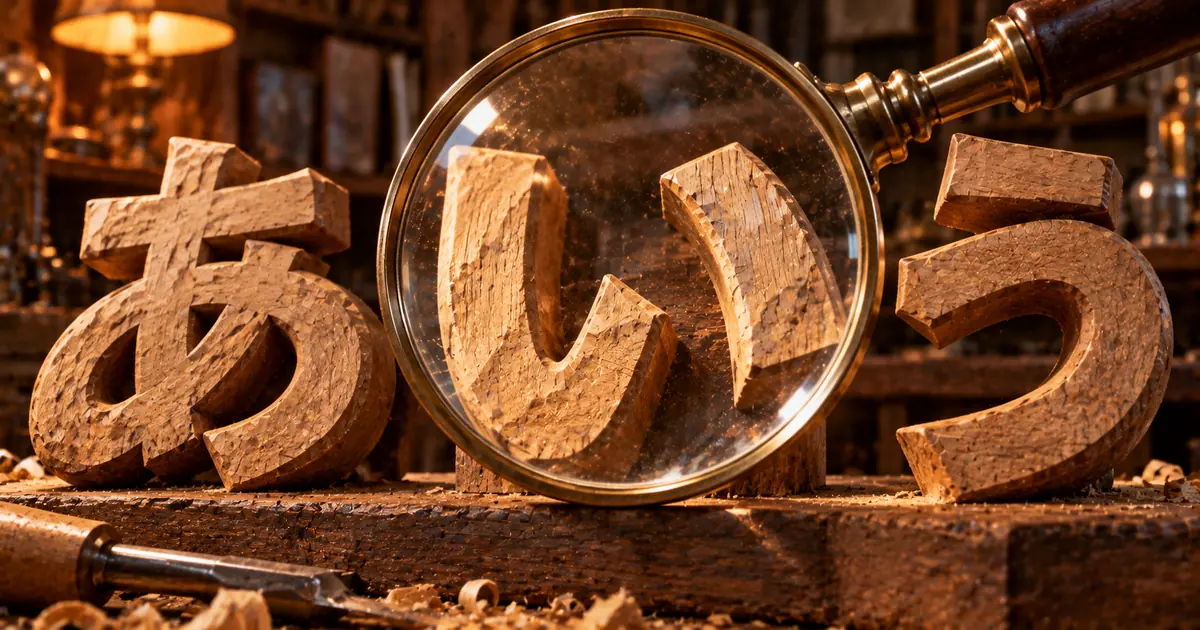
Most OCR stacks handle extra languages by loading extra models. PP-OCRv6, the current text-recognition generation of PaddleOCR, reads fifty languages with one model. The project pairs that with accuracy figures that look decisive, and every one of them comes from the project measuring itself.
For a developer or technical evaluator, the useful questions are what the release contains, who produced the numbers, and what a sample of real scans would still have to show. OCR (optical character recognition) here means software that turns an image of text into editable text.
What PP-OCRv6 changes in PaddleOCR
The release replaces a single model with a three-tier family, so one architecture can be sized to the hardware that runs it. PP-OCRv6 is a three-tier OCR model family spanning 1.5M to 34.5M parameters. The top tier is about 23 times the size of the bottom one, and the sizes are published before anything is installed.
PaddleOCR's own repository describes the project as an OCR toolkit that bridges images and PDFs with LLMs and supports 100+ languages. PP-OCRv6 sits inside that toolkit as the newest text-recognition generation after PP-OCRv5, which the repository page also lists.
"A three-tier OCR model family spanning 1.5M to 34.5M parameters."View official source →
One PaddleOCR model for 50 languages
A single set of weights replaces the per-language model swap that most OCR setups still need, which is what makes mixed-script pages practical. The medium and small tiers read 50 languages with one unified model. The tiny tier reads 49, and the language it leaves out is Japanese.
The set is Simplified Chinese, Traditional Chinese, English, Japanese and 46 Latin-script languages. Documents that mix scripts on one page, such as a bilingual invoice or a multilingual form, no longer need a step that picks the model first.
"the medium/small tiers support 50 languages with a single unified model, including Simplified Chinese, Traditional Chinese, English, Japanese, and 46 Latin-script languages (tiny supports 49, excluding Japanese)"View official source →
The accuracy numbers and whose benchmark they are
Each figure for PP-OCRv6 comes from the project's in-house multi-scenario benchmark, so it shows what the authors measured rather than what an outside party confirmed. The documentation says so in its own wording, and no independent evaluation is cited. The figure shows the two absolute values reported for the medium tier, and “Gains reported over PP-OCRv5_server” lists its gains over PP-OCRv5_server.
Absolute results reported for PP-OCRv6_medium (%)
Bars show percentages from the project's in-house benchmark, with no independent evaluation cited.
Gains reported over PP-OCRv5_server
| Measure | Reported gain |
|---|---|
| Recognition accuracy | +5.1% |
| Detection Hmean | +4.6% |
| GPU inference speed | 2.37x |
The absolute pair says more than the gains do. A gain shows the project improved on its previous version, while 83.2% recognition gives a rough idea of how many corrections a mixed set of documents might need. The documentation also states that, with 34.5M parameters, the model surpasses VLMs (vision-language models, general AI models that read images and text) such as Qwen3-VL-235B and GPT-5.5 in accuracy.
Qwen3-VL-235B has 235B parameters, about 6,800 times the size of PP-OCRv6 medium. OpenAI has not disclosed the size of GPT-5.5, so no ratio applies to it. A specialist model judged on a benchmark built for OCR is not doing the same job as a general model that also answers questions about images, so the claim covers this benchmark and not the wider abilities of a VLM.
"On our in-house multi-scenario benchmark, PP-OCRv6_medium achieves +5.1% recognition accuracy and +4.6% detection Hmean over PP-OCRv5_server, with 2.37× GPU inference speedup" / "with only 34.5M parameters, it surpasses VLMs such as Qwen3-VL-235B and GPT-5.5 in accuracy"View official source →
What PaddleOCR changed inside PP-OCRv6
Three documented changes explain the size and language claims, because each one trims cost in the detector or widens what the recognizer can spell. Detection finds where the text sits in the image, and recognition reads the characters inside each box. “Documented changes between PP-OCRv5 and PP-OCRv6” sets the published values side by side.
Documented changes between PP-OCRv5 and PP-OCRv6
| Part | PP-OCRv5 | PP-OCRv6 |
|---|---|---|
| Detection neck parameters | 172K | 118K (31% fewer) |
| Detection receptive field | 3x3 | 7x7 |
| Recognition dictionary | base set | about 200 diacritical characters added |
The detection neck shrinks while its receptive field, the patch of the image each output looks at, widens. Detection mode also uses standard stride-2 downsampling to build feature maps at strides 4, 8, 16 and 32, which gives the detector views at several scales.
The language coverage rests on the dictionary rather than on a bigger model. The added diacritical characters, such as accented Latin letters, are what let one model spell the 46 Latin-script languages.
"31% fewer parameters than PP-OCRv5's RSEFPN (118K vs 172K) with receptive field expanded from 3×3 to 7×7." / "detection mode uses standard stride-2 spatial downsampling producing multi-scale feature maps (stride 4/8/16/32)" / "Dictionary extended with ~200 diacritical characters, enabling single-model 50-language coverage."View official source →
Where PaddleOCR-VL and the Python API fit
PaddleOCR-VL is a separate pipeline with its own tutorial, so a page about PP-OCRv6 does not cover it. Its usage tutorial walks through local setup, quick start, VLM inference services, service deployment and fine-tuning. The repository page lists it next to PP-OCRv5 and PP-StructureV3 as a distinct section.
The Python API exposes two entry points, a general OCR pipeline under the name PaddleOCR and a vision-language pipeline under the name PaddleOCRVL. The documentation does not say which of the two loads PP-OCRv6, so a team planning an upgrade should confirm the loading path on its own installation.
What to test on your own documents
A reported average says little about one document type, so the figures need a check against the scans a team actually processes. If the corpus is receipts, handwriting or labels printed by a dot-matrix printer, the result can land far from the benchmark's overall figure. The project describes its benchmark as multi-scenario, which suits a general claim better than a specific one.
The 2.37x speedup is a GPU figure, so a deployment on CPU needs its own timing. The tiers differ in size, from 1.5M to 34.5M parameters, and hardware decides what that costs in latency. The upgrade from PP-OCRv5 follows the same logic: a gain of 5.1 points on the project's benchmark only matters if it holds on a sample from the pipeline already running.
A workable check is to pick a few dozen scans that include the worst cases, run the medium tier, and count the corrections needed against the current setup. Then repeat with the small tier if the language set or the hardware allows it.
Summary: a strong claim to verify on your own scans
The lasting news in PP-OCRv6 is that one model now covers 50 languages, while the accuracy figures stay a claim until a sample confirms them. The project reports the figures on its own benchmark, and the comparison with much larger VLMs rests on the same source. Qwen3-VL-235B is about 6,800 times the size of the medium tier, which makes the claim striking and also makes the benchmark's scope the key question.
For a team that reads several languages, run the medium tier on a sample of its own scans before planning around the reported 83.2% recognition accuracy. For a team that only needs English or Chinese, the upgrade from PP-OCRv5 should wait for the same check, because the gain of 5.1 points is measured on a mix that may look nothing like its documents.
FAQ
- How many languages does PP-OCRv6 read?
- Fifty, from a single model, on the medium and small tiers. The tiny tier reads 49 because it leaves out Japanese. The set covers Simplified Chinese, Traditional Chinese, English, Japanese and 46 Latin-script languages.
- How much better is it than PP-OCRv5?
- On the project's own multi-scenario benchmark, the medium tier gains 5.1 points of recognition accuracy and 4.6 points of detection Hmean over PP-OCRv5_server, and runs 2.37 times faster on GPU. Those are the project's measurements, not an independent evaluation.
- Does it really beat GPT-class vision models?
- That is the project's claim for accuracy on its own benchmark, at 34.5M parameters against Qwen3-VL-235B, a model about 6,800 times larger. A specialist OCR model and a general vision-language model are not being asked to do the same job, so the claim describes this benchmark rather than general capability.
- What are the absolute accuracy numbers?
- The medium tier reports 86.2% detection Hmean and 83.2% recognition accuracy. Both come from the project's own benchmark, so documents of a different kind can land well above or below them.
Related articles
 Roboflow Playground: compare vision AI models freeRoboflow Playground runs vision AI models on your own image, for free, with no API key. Learn how its 25 tasks, Arena ELO scores and Vision Evals work.
 Mistral OCR 4: Bounding Boxes, Pricing and APIMistral OCR 4 returns bounding boxes, block types and confidence scores in 170 languages. It costs $4 per 1,000 pages, $2 in Batch and $5 for Document AI.
 Claude Fable 5.2: 20% price cut, up to 30% fasterAnthropic released Claude Fable 5.2 on November 9, 2026. API prices fall 20% to $8/$40 per million tokens, and output is up to 30% faster than Fable 5.1.
 PayPay security and passkeys in 10 Japan pay appsPayPay security compared with 9 other Japanese payment apps: passkeys, extra checks to send or pay, and fraud compensation deadlines.