
Mistral OCR 4 is the document-reading model Mistral AI released on June 23, 2026, and it returns much more than text. Each page comes back as structured blocks, with a position, a type and a confidence score attached to each.
The headline figures, from the 85.20 OlmOCRBench score to the 72% win rate, are Mistral's own measurements. The API starts at $4 per 1,000 pages, and running it on your own infrastructure is limited to enterprise customers.
What Mistral OCR 4 is and what it returns
Mistral OCR 4 turns a document into text plus a structured map of the page: where each block sits, what type it is, and how confident the model is about it. OCR, short for optical character recognition, converts the characters in an image or PDF into text a program can use. Mistral says earlier generations concentrated on clean text and tables, while OCR 4 hands back a structured representation of the page.
What Mistral OCR 4 returns for one document
Bounding box OCR: where each block sits on the page
A bounding box is a rectangle that marks where a piece of text or a figure sits on the page. Mistral calls bounding boxes its most-requested capability. An application can use one to highlight the region a piece of text came from, and the OCR 4.0 model page describes the extraction as paragraph-level, so do not assume word-level precision.
Take a contract-review app answering a question about a termination clause. With a box, it can point at the clause on the original page instead of only quoting it. Check the API reference for the coordinate format before you plan any highlighting code.
"Bounding boxes, our most-requested capability, localize text for in-context highlighting and reliable data pipelines."— from the Mistral OCR 4 announcementView official source →
Block types and per-word confidence scores
Each block is classified by type, and confidence scores are generated per page and per word. Mistral names titles, tables, equations and signatures as block types, and a selector on the announcement page also lists Title, Subtitle, Text, Image, Table and Thinking. Read together, the fields give a downstream system four things for every region: its text, its position, its role and how sure the model is.
Mistral names three uses for that structure. Classified blocks make cleaner retrieval units for RAG (retrieval-augmented generation, where an AI answers from your own documents), agents get typed pieces to act on, and ingestion pipelines get consistent typed output. Separately, Mistral says confidence scores let a data pipeline use human verifiers efficiently.
"Each block is localized with a bounding box, classified by type, and inline confidence scores are generated per-page and per-word."— from the Mistral OCR 4 announcementView official source →
How Mistral OCR 4 differs from Mistral OCR 3
Mistral's announcement describes the change from earlier generations as a move from text-and-table conversion to a structured representation of the page. The new outputs, meaning boxes, block types and per-word confidence, are what the announcement presents as new.
Mistral compared OCR 4 against its own Mistral OCR 3 in its evaluations. If you are choosing between the two, run both on a sample of your own documents and compare the fields you actually need.
"Where previous generations focused on converting a page into clean text and tables, OCR 4 returns a structured representation of the document."— from the Mistral OCR 4 announcementView official source →
How Mistral OCR 4 scores on benchmarks
Mistral reports a top OlmOCRBench score, a 72% average win rate in a human evaluation and a lead on its own multilingual test, and it says the numbers are only directional. OlmOCRBench and OmniDocBench are public benchmarks that compare OCR output against reference annotations. Crawl Multilingual is Mistral's internal evaluation, so its result is a vendor figure by definition.
OlmOCRBench, OmniDocBench and the 72% win rate
OCR 4 scores 85.20 on OlmOCRBench, the top overall result among the models Mistral tested, and 93.07 on OmniDocBench. It also leads Mistral's internal Crawl Multilingual evaluation at 0.98. In the blind human evaluation, OCR 4 won more often than each competing OCR and document-AI product, averaging a 72% win rate.
Mistral OCR 4 results as reported by Mistral
The three bars use different scales: two are benchmark scores and one is a human-preference win rate, so bar length is not a ranking. Crawl Multilingual (0.98) is on another scale and stays in the text.
The human evaluation used 600+ documents in 12+ languages from third-party vendors meant to reflect real industry use, and annotators compared each competitor's output with OCR 4's, one document at a time. Mistral says a human ranking on realistic documents avoids much of the annotation and formatting noise that affects automated scores.
Mistral also publishes two customer statements. An AI engineer at Rogo reports equivalent accuracy at roughly 8x lower cost and 17x lower latency than leading agentic document parsers on a chart-heavy financial QA dataset.
Anaqua reports roughly 4x faster processing per page than its incumbent provider. Both are statements Mistral chose to publish, not independent tests.
"Independent annotators prefer OCR 4 over every leading OCR and document-AI system tested, with win rates averaging 72%, alongside the top overall score on OlmOCRBench (85.20)."— from the Mistral OCR 4 announcementView official source →
Why Mistral calls its own scores directional
Mistral says both OlmOCRBench and OmniDocBench have known limits in how they score some outputs, so one aggregate number can mislead in either direction. When it audited the mismatches behind its scores, most turned out to be artifacts of how the benchmarks compare output, not model errors. It lists five recurring causes:
- Errors in the reference annotations themselves.
- Different LaTeX that renders identically, counted as a mismatch.
- Equations split into fragments differently from the reference.
- Multi-column reading order, including words split across a column boundary.
- Header and footer handling: the benchmark does not expect them, so Mistral strips them before scoring, and the test then wrongly flags a string that also happens to be the page title.
These artifacts cluster in mathematical, scientific and multi-column documents, and Mistral says they more often penalize correct output than reward wrong output. It also notes that all competitor scores are its own internal reproductions. In practice, run a sample of your real files before you trust any leaderboard number.
"These benchmarks are directional. All competitor scores reflect internal reproductions. We recommend evaluating on your own documents."— from the Mistral OCR 4 announcementView official source →
Mistral OCR languages: 170 across 10 groups
OCR 4 supports 170 languages across 10 language groups. On the internal Crawl Multilingual test, Mistral says it leads in all eight language groups it reports, from English and the European and Middle Eastern groups through Chinese, East Asian and Southeast Asian languages to a specialized group. The specialized group includes Hindi, Japanese, Georgian and Tamil, among others.
Mistral says the margin is widest on specialized and low-resource languages, where many competing systems degrade sharply. Ten groups are supported, but the test reports results for only eight of them.
"Support for 170 languages across 10 language groups, with measurable gains on specialized and low-resource languages where several competing systems degrade."— from the Mistral OCR 4 announcementView official source →
Mistral OCR pricing per 1,000 pages
Mistral OCR 4 costs $4 per 1,000 pages through the API, $2 with the Batch API, and $5 per 1,000 pages for Document AI. These are list prices from Mistral's announcement and its OCR 4.0 model page, as of September 30, 2026. The tiers differ in what they return and how the request is submitted.
Standard OCR, Batch API and Document AI prices
Standard OCR is $4 per 1,000 pages, and the Batch API's 50% discount brings it to $2 per 1,000 pages. The Batch API is the bulk route, aimed at high-volume ingestion where you want control over throughput and cost. Document AI is $5 per 1,000 pages, which the model page words as $5 per 1,000 annotated pages.
Mistral OCR 4 list price per 1,000 pages (USD)
The Batch API halves the standard rate. Document AI is the highest bar, and it is the tier that adds structured layers on top of the OCR result.
The OCR 4.1 card at the foot of the announcement page shows the same $4 and $5 list prices. Prices can change, so confirm them on Mistral's pricing page before you budget.
"Mistral OCR 4 through the API is priced at $4 per 1,000 pages, with a 50% Batch-API discount, reducing the cost to $2 per 1,000 pages. Document AI is priced at $5 per 1,000 pages."— from the Mistral OCR 4 announcementView official source →
What the $5 Document AI tier adds
The $5 Document AI tier adds structured layers on top of the same OCR result, through the same endpoint with extra parameters. You can pass a JSON schema you define, and Mistral feeds the OCR output to mistral-small-2603 to generate content shaped to that schema. You can also annotate detected images with structured JSON, which triggers an additional vision-language model call per image, or add a custom prompt alongside a schema to steer how the whole document is interpreted or summarized.
Mistral Studio also offers Document AI as a no-code, application-level route to the same engine. It fits business users or pilot teams who want structured results without writing parsing logic.
"If you need the output reshaped into a structured format, annotated with domain-specific fields, or processed with a custom instruction, add the Document AI parameters to the same call. You always get the OCR result regardless; Document AI simply adds structured layers on top of it."— from the Mistral OCR 4 announcementView official source →
How to use the Mistral OCR API
You call OCR 4 through a single endpoint, and the main choice is whether to add Document AI parameters to the request. The integration decision stays small, because the extraction result comes back either way. Mistral points new users to its Getting Started with OCR 4 Cookbook, which starts with a first extraction before moving on to boxes and block types.
One endpoint, plain OCR or Document AI parameters
Use OCR 4 as it is when you need the raw extracted content, and add the Document AI parameters to the same call when you need the output reshaped, annotated or driven by a custom instruction. Every request returns extracted text, bounding boxes, block types, confidence scores and Markdown-structured text, whatever you add. Plain extraction suits four cases: embedding OCR in an application, agent or pipeline; driving your own logic from the raw response; high-volume Batch API ingestion; and self-hosting for strict privacy or compliance needs.
"Mistral's OCR 4 is available through a single API endpoint. Every request runs the same underlying OCR model and always returns extracted content, bounding boxes, block types, confidence scores, and markdown-structured text. What varies is how much you layer on top."— from the Mistral OCR 4 announcementView official source →
Model name, endpoints and supported features
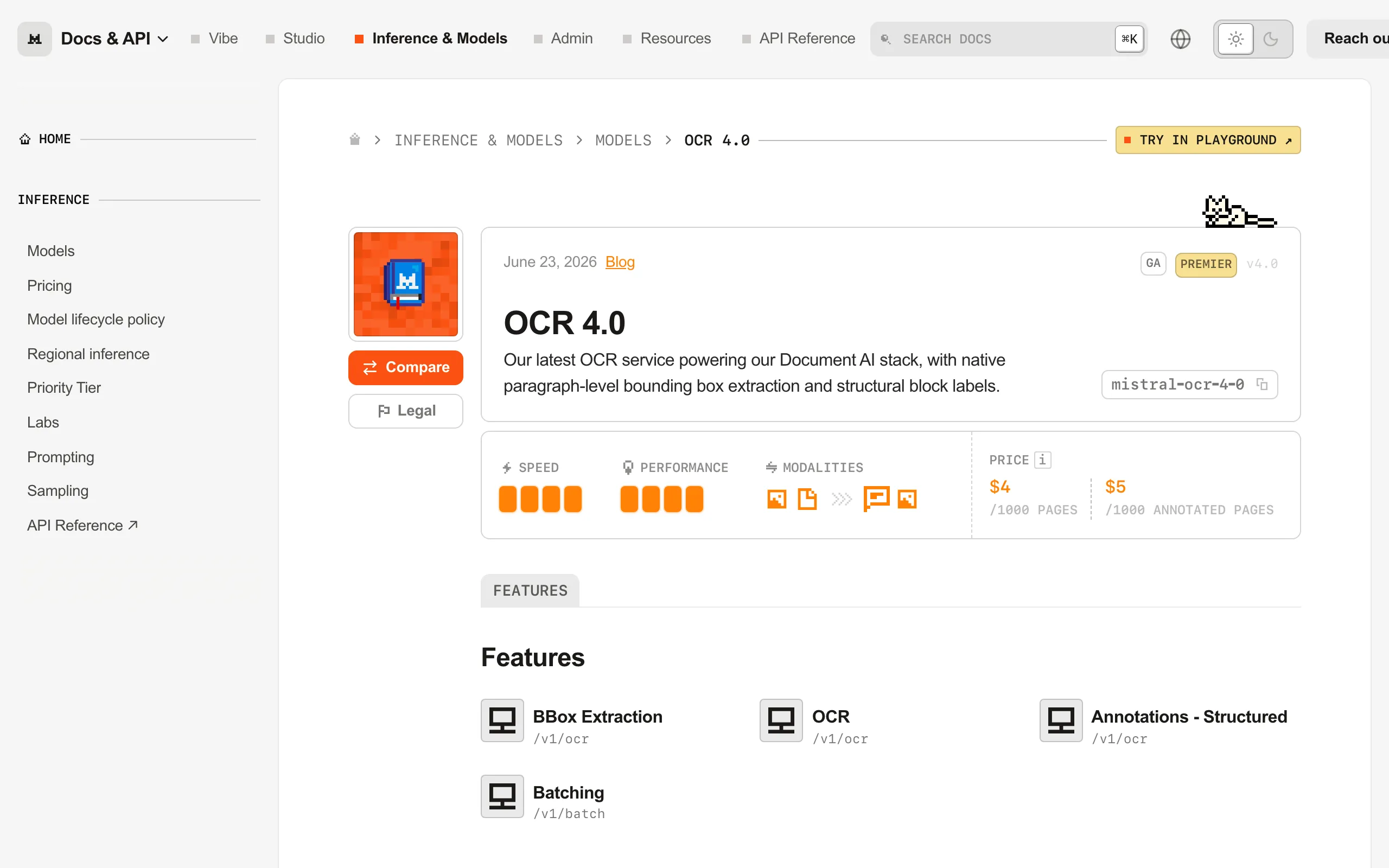
The model name on Mistral's OCR 4.0 model page is mistral-ocr-4-0, listed as version 4.0 and labelled GA and Premier. The page lists bounding box extraction, OCR and structured annotations on /v1/ocr, and batching on /v1/batch.
The announcement names PDF, DOC, PPT and OpenDocument as examples of the formats OCR 4 accepts. Every request returns the extracted content with its positions, block types and confidence scores.
"Our latest OCR service powering our Document AI stack, with native paragraph-level bounding box extraction and structural block labels."— from the OCR 4.0 model pageView official source →
Where the Mistral OCR API is available
Mistral OCR 4 and Document AI are available through the API in Mistral Studio, Amazon SageMaker and Microsoft Foundry, with Snowflake Parse Document listed as coming soon. As of September 30, 2026, the announcement page still lists Snowflake as coming soon, so do not plan around it until Mistral confirms. In the same announcement, Microsoft's Kimmi Grewal, VP of AI Ecosystem Partnerships, is quoted on Document AI with OCR 4 in Foundry.
"Both Mistral OCRv4 and Document AI (powered by OCRv4) are available via API through Mistral Studio, Amazon SageMaker, Microsoft Foundry, and coming soon Snowflake Parse Document."— from the Mistral OCR 4 announcementView official source →
Can you self-host Mistral OCR 4?
Yes for enterprise customers who arrange it with Mistral, through a self-managed deployment that runs in your own environment. Asking whether it is open source covers two questions: whether you can run it on your own infrastructure, and whether you can download it. Mistral's answer to the first is self-managed deployment for enterprise customers.
Single-container, self-managed deployment
OCR 4 is compact enough to run in a single container, which keeps document data inside your own environment. Mistral ties that to data residency, sovereignty and compliance, and says self-managed deployment is available to enterprise customers. Mistral asks anyone who wants to explore self-deployment to get in touch.
"OCR 4 is compact enough to deploy on a single container, keeping document data in your environment for residency, sovereignty, and compliance, while supporting cost-efficient, high-throughput batch processing. Self-managed deployment is available to enterprise customers."— from the Mistral OCR 4 announcementView official source →
Mistral OCR 4 in Mistral Search Toolkit
Mistral Search Toolkit is an open-source, composable search framework in public preview, and OCR 4 serves as one of its ingestion components. Mistral announced the toolkit at the AI Now Summit.
OCR 4's structured output gives the toolkit citation-ready inputs for its ingestion, retrieval and evaluation workflow, aimed at RAG and enterprise search. For a separate Mistral retrieval piece, see Mistral Agentic Search: 3x on FinanceBench vs RAG, which covers the search side rather than document reading.
"OCR 4 is an ingestion component of Search Toolkit, Mistral's open-source, composable search framework, announced at the AI Now Summit. Its structured output supplies citation-ready inputs to the toolkit's ingestion, retrieval, and evaluation workflow for RAG and enterprise search."— from the Mistral OCR 4 announcementView official source →
When to use Mistral OCR 4, and when not to
Use Mistral OCR 4 when you need documents turned into typed, located and scored content for RAG, agents or enterprise search, and skip it for anything that is a decision rather than a reading. Mistral itself makes this distinction in the announcement. As of September 30, 2026 its site also shows OCR 4.1, so check which version you are pricing.
Workloads Mistral names as a fit
Mistral recommends OCR 4 for complex multilingual document parsing, RAG, agent workflows, confidence-scored data pipelines and enterprise search. Here, agent workflows are tasks such as form filling, invoice processing and compliance checks, which Mistral says matter most in legal, financial services and healthcare. Early users report converting invoices into structured fields, digitizing company archives, pulling clean text out of technical and scientific reports, and running enterprise search on top.
Before you wire up an API, set a plain-text baseline: convert a sample PDF to Markdown and compare that output with what OCR 4 returns. A technical report with tables and equations makes a useful test file.
"Early users are applying OCR 4 to turn invoices into structured fields, digitize company archives, extract clean text from technical and scientific reports, and power enterprise search."— from the Mistral OCR 4 announcementView official source →
Out-of-scope uses Mistral lists
Mistral says OCR 4 is a document-understanding model, not a decision-maker. Out of scope, in Mistral's list, are medical diagnosis, legal advice or judgment, high-stakes financial decisions and safety-critical systems. Real-time or latency-sensitive processing is also excluded, as are inputs that are not documents, such as raw audio and video.
Because the model returns confidence values, a low-confidence region is a signal to send that region to a person rather than accept it as read. Mistral's own recommended use of confidence scores is to make human verification efficient.
"A note on out-of-scope use. OCR 4 is a document-understanding model, not a decision-maker. It is not intended for medical diagnosis, legal advice or judgment, high-stakes financial decisions, safety-critical systems, real-time/latency-sensitive processing, or non-document inputs (raw audio, video, etc.)."— from the Mistral OCR 4 announcementView official source →
Mistral OCR 4 or Mistral OCR 4.1?
As of September 30, 2026, Mistral's site lists OCR 4.1 alongside OCR 4.0, at the same $4 and $5 per 1,000 pages. The announcement page carries a card labeled OCR 4.1, marked New and described by Mistral as the world's best document extraction and understanding model. Check Mistral's model list for the current version before you pin a model name in production.
"The world’s best document extraction and understanding model."— from the OCR 4.1 card on the same pageView official source →
FAQ
- What is Mistral OCR 4?
- It is Mistral AI's document-reading model, released on June 23, 2026. Alongside the extracted text, it returns bounding boxes that mark where each block sits, a type for each block such as title, table, equation or signature, and inline confidence scores per page and per word.
- How much does Mistral OCR 4 cost?
- Through the API it is $4 per 1,000 pages, or $2 per 1,000 pages with the 50% Batch API discount. Document AI, which adds structured output and annotations, is $5 per 1,000 pages. These are the list prices as of September 30, 2026, so confirm them on Mistral's pricing page before you budget.
- Can Mistral OCR 4 be self-hosted, and is it open source?
- It can run in a single container inside your own environment, but self-managed deployment is offered to enterprise customers through Mistral, so it is not a self-serve download. The announcement does not describe downloadable open weights, and only the Mistral Search Toolkit is called open-source.
- Should I trust the Mistral OCR 4 benchmark scores?
- Treat them as directional, which is how Mistral treats them. It says both OlmOCRBench and OmniDocBench have known limits in how they score some outputs, that the competitor scores are its own internal reproductions, and that you should evaluate on your own documents before you rely on any leaderboard number.
Related articles
 Roboflow Playground: compare vision AI models freeRoboflow Playground runs vision AI models on your own image, for free, with no API key. Learn how its 25 tasks, Arena ELO scores and Vision Evals work.
 PaddleOCR PP-OCRv6: one model, 50 languagesPaddleOCR PP-OCRv6 reads 50 languages with one model and claims to beat VLMs thousands of times larger. See whose benchmark backs it and what to test.
 Claude Fable 5.2: 20% price cut, up to 30% fasterAnthropic released Claude Fable 5.2 on November 9, 2026. API prices fall 20% to $8/$40 per million tokens, and output is up to 30% faster than Fable 5.1.
 PayPay security and passkeys in 10 Japan pay appsPayPay security compared with 9 other Japanese payment apps: passkeys, extra checks to send or pay, and fraud compensation deadlines.