What Roboflow Playground lets you compare for free
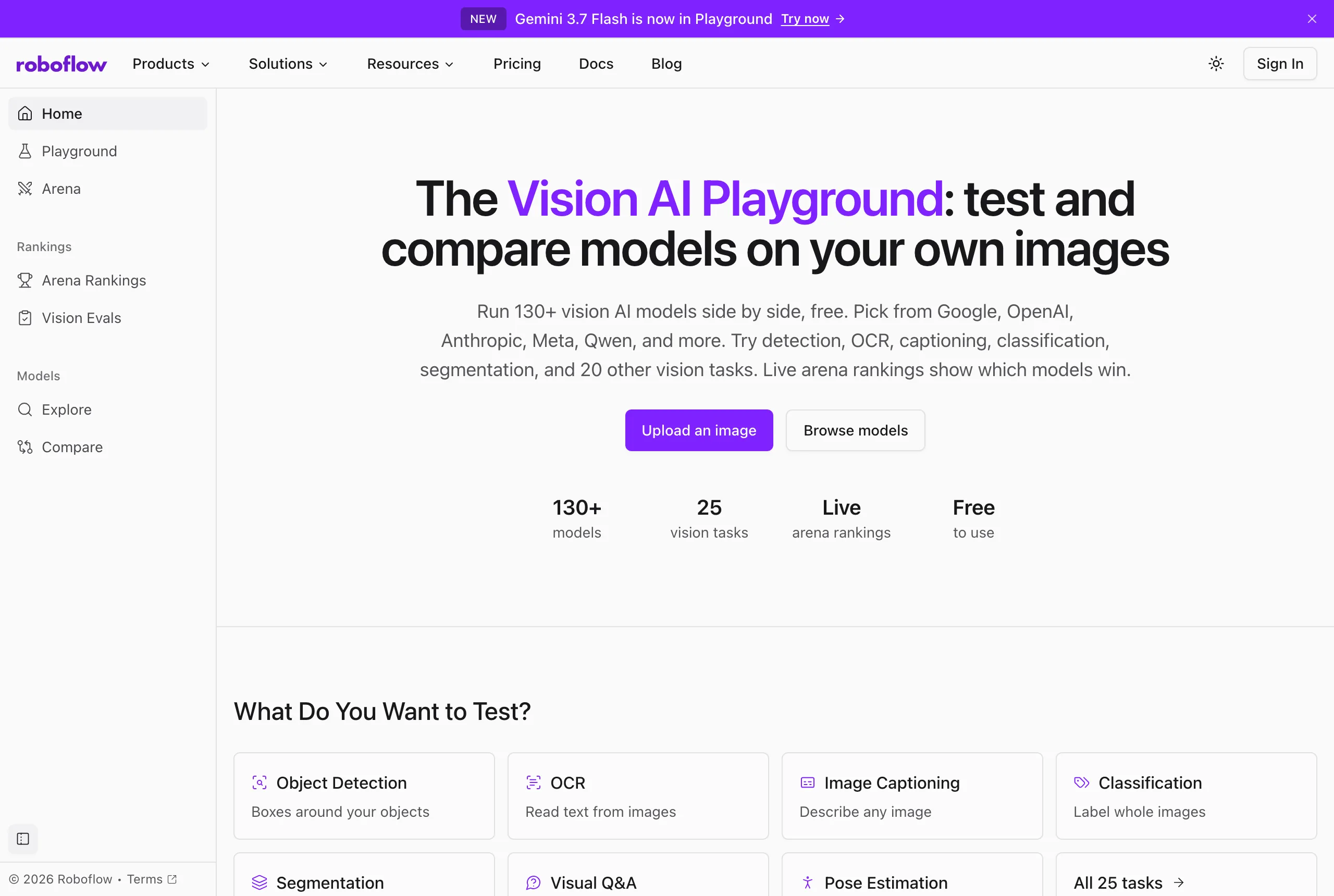
Roboflow Playground is a free browser tool that sends one image and one prompt through several vision AI models and shows the results side by side. The home page says you do not need an API key, a notebook or a credit card. The post describes these models as zero-shot: they handle categories they were not trained on, so you describe the target in a prompt instead of preparing training examples.
Roboflow's post names three chores the tool removes: researching which new models to try, writing code to call cloud APIs, and setting up servers for open-weight models. The post adds that a new model is often out before that work ends.
Roboflow's blog post of Aug 27, 2026 and the Playground home page as of Oct 11, 2026 give different figures in places. Wherever a figure differs, it appears below with the date of its source.
"Roboflow Playground is a free evaluation environment to test and compare models on your own images."/"Researching the latest models to try, writing the code to call cloud APIs, provisioning infrastructure for open weight models"View official source →
"You don't need an API key, a notebook, or a credit card to find your model."View official source →
The vision AI models in the Model Directory
The Model Directory lists 134 models in the Aug 27, 2026 post and 140+ on the Oct 11, 2026 page, newest first. The models come from Google, OpenAI, Anthropic, Meta, Qwen and other labs, and you can filter the list by modality, organization, license and task. The post counts three kinds of model:
- Open-source models: 87, with downloadable Apache 2.0 or MIT weights
- Proprietary API models: 47, priced per million tokens for input, output and cached input
- Specialized single-task models: 49, such as YOLO26 and RF-DETR
The kinds overlap, so the three counts add up to more than 134 and should not be summed. Among the open-source models, 37 run live in Playground through hosted APIs, which makes self-hosting optional for that group. Each model page offers a live demo, a licensing breakdown, 30-day usage numbers and code snippets in Python, JavaScript and cURL.
"The Model Directory indexes 134 models across 25 vision tasks. You filter by modality, organization, license, or specific task capabilities."/"Open-source models: 87 models with downloadable Apache 2.0 or MIT weights"/"Thirty-seven run live in Playground via hosted APIs, so self-hosting is optional."/"Proprietary APIs: 47 frontier vision models listed with transparent input, output, and cached pricing per million tokens."/"Specialized CV models: 49 single-task models like YOLO26 and RF-DETR built specifically for high frame rates and production accuracy."View official source →
"Browse 140+ vision AI models from every major lab, newest first."View official source →
Which task you pick decides which models appear
Playground offers 25 vision tasks, and the model list filters by the one you choose. "The 25 tasks on the Playground page, grouped by output" groups the tasks on the page by what each one returns.
The 25 tasks on the Playground page, grouped by output
| Group | Tasks on the page |
|---|---|
| Boxes and masks | Object Detection, Open Vocabulary Object Detection, Phrase Grounding, Region Proposal, Instance Segmentation, Semantic Segmentation, Promptable Concept Segmentation, Zero Shot Segmentation |
| Text and documents | OCR, Document Question Answering, Chart Question Answering |
| Descriptions and questions | Captioning, Image Tagging, Classification, Multi-Label Classification, Visual Question Answering, Vision Language |
| Geometry and video | 3D Reconstruction, Depth Estimation, Keypoint Detection, Pose Estimation, Video Classification, Video Object Tracking |
| Embeddings | Image Embedding, Image Similarity |
Vision Language is the task for vision-language models, which read an image together with a text prompt and answer in text. The post gives an example: Gemini 3.6 Flash and SAM 3 both support object detection, but SAM 3 cannot answer open questions about an image because it does not support visual question answering. If a model you expected is missing, change the task first.
"The models available depend on the chosen task type."/"you can use Gemini 3.6 Flash and SAM 3 for object detection because both models support object detection"View official source →
"Try detection, OCR, captioning, classification, segmentation, and 20 other vision tasks."/"3D Reconstruction"/"Captioning"/"Chart Question Answering"/"Classification"/"Depth Estimation"/"Document Question Answering"/"Image Embedding"/"Image Similarity"/"Image Tagging"/"Instance Segmentation"/"Keypoint Detection"/"Multi-Label Classification"/"Object Detection"/"OCR"/"Open Vocabulary Object Detection"/"Phrase Grounding"/"Pose Estimation"/"Promptable Concept Segmentation"/"Region Proposal"/"Semantic Segmentation"/"Video Classification"/"Video Object Tracking"/"Vision Language"/"Visual Question Answering"/"Zero Shot Segmentation"View official source →
Comparing object detection models on your own image
The post walks through one object detection run. It goes like this:
- Choose Object detection from the task dropdown.
- Upload an image and set the prompt. The post uses a photo of a book and a coffee cup with the prompt "glass mug".
- Run it.
Playground draws each model's bounding boxes and labels over the image. A raw JSON option shows the exact coordinates. Speed and cost update with every run, which lets you weigh a paid model such as Qwen3.8 Max against a free open model such as SAM 3.
A shareable URL saves the setup, the classes and the results. For vision-language models, a settings popover sets the thinking level and the maximum output tokens. The post's example moves the slider so GPT-5.6 Sol uses its full 128,000-token output window.
Preparing the photo is optional. Compressing the image or resizing it before upload keeps a large file manageable.
"Playground overlays bounding boxes and labels directly on your image. If you need to inspect the details, choose the raw JSON option to check exact coordinates."/"Real-time speed and cost metrics update with every run, making it easy to weigh paid options (like Qwen3.8 Max) against free open models (like SAM 3)."/"You can also open the settings popover on vision-language models to adjust the thinking level and maximum output tokens."View official source →
Why the blog post says five models and the page says four
The two Roboflow sources give different limits, and no source explains why. The post of Aug 27, 2026 says up to five models per run, while the home page as of Oct 11, 2026 says up to four. The next table puts both side by side.
Roboflow's own figures, by source and date
| Figure | Blog post, Aug 27, 2026 | Home page, Oct 11, 2026 |
|---|---|---|
| Models per run | Up to five | Up to four |
| Catalog size | 134 (the title says 130+) | 140+ |
| Tasks | 25 | 25 |
| Compare view | Two to four models | Two to four models |
"Roboflow's own figures, by source and date" lists the figures only as each source states them. Read the limit off the live page before you plan a test.
The Compare view shows specs, context windows, token pricing, latency and Vision Evals scores for two to four models in one view. The post says pricing syncs continuously.
"You upload an image, pick a vision task, and run up to five models at once."/"Playground hosts 134 models from Google, OpenAI, Anthropic, Meta, and Qwen."/"Pick two to four models, and the tool compares their specs, context windows, token pricing, latency, and Vision Evals scores in one view."View official source →
"Run 140+ vision AI models side by side, free."/"Upload one of your own images, pick your task, and run up to four models on it at once, free."/"Compare Models — See specs and tasks for 2 to 4 models, side by side."View official source →
Arena rankings come from blind human votes
Arena mode hides which model produced an output, and the user votes for the one that performed best. The post says every fifth query in Playground runs such a blind comparison to collect human preference data. Those votes feed the live arena rankings.
The home page says live ELO rankings and Vision Evals show how each model scores. ELO is a rating number that moves with head-to-head results, and the page ties its live rankings to the arena you can vote in.
The post also names their limit: human votes are a useful signal, but production requires objective truth and certainty. Vision Evals, covered next, supplies that ground truth.
"Arena mode allows the user to vote on the best performing model without knowing its identity to remove all bias."/"Every fifth query in Playground runs a blind comparison to gather human preference data. This feeds directly into our live arena rankings."/"Human votes provide a useful signal, but production requires objective truth and certainty."View official source →
"Live arena rankings show which models win."/"Live ELO rankings and vision evals show how each model scores."View official source →
Vision Evals scores models against ground truth
Vision Evals tests 34 vision-language models on six tasks with known correct answers: Object Detection, Counting, Identification, OCR, Data Extraction and Visual Reasoning. Object detection is scored with mAP@50, OCR with text similarity, and the other four tasks by exact match. Every model runs at low reasoning effort so scores stay comparable, and reasoning is also tested at high effort side by side.
Token counts come from API responses, and costs multiply the measured usage by current per-million-token pricing. Scores update as providers release new model weights. The Vision Evals page has four parts:
- A leaderboard table that ranks all 34 models by overall score, with average accuracy, tokens per sample, estimated cost per sample and average inference speed
- A scatter plot of score against cost, with a toggle for speed; the upper-left corner means high accuracy at low cost
- Cards for each of the six tasks, listing the top three models
- A per-task heatmap, with dark green at 75 percent or higher, light green from 40 to 74, and yellow below 40
The two ranking systems answer different questions. "Arena ELO and Vision Evals compared" sets them side by side.
Arena ELO and Vision Evals compared
| Arena ELO | Vision Evals | |
|---|---|---|
| Evidence | Blind votes from people | Scores against ground truth |
| Scope | Any image users upload | Six fixed tasks, 34 models |
| Updates | As votes come in | As new model weights are released |
On the home page as of Oct 11, 2026, GPT-6 Astra led the overall Vision Evals ranking at 83.4%. The list changes as models are added, so the current ranking is on the page.
"Roboflow Vision Evals evaluates 34 frontier vision-language models across six standardized ground-truth tasks: Object Detection, Counting, Identification, OCR, Data Extraction, and Visual Reasoning."/"object detection uses mAP@50, OCR uses text similarity, and the other four tasks use exact match."/"Every model runs at low reasoning effort so scores stay comparable, with reasoning additionally tested at high effort side by side."/"Color-coded cells indicate performance tiers (dark green for scores 75 percent or higher, light green for 40 to 74 percent, and yellow for under 40 percent)."View official source →
"Top models on Vision Evals by overall score"/"GPT-6 Astra 83.4%"View official source →
From Playground to production: off-the-shelf or custom
Vision-language models suit exploration while the requirements are still changing. Once the classes are fixed and the volume of images grows, the post advises validating the requirements with a vision-language model and then training a specialized model such as RF-DETR on your own annotated data. It says that model runs faster and cheaper.
Roboflow Workflows can chain both kinds. In the post's example, a specialized detector finds a defect on a conveyor belt and crops that region, and the vision-language model reads only the crop. The pipeline deploys to cloud APIs or edge hardware, and Roboflow Agent can build one from a plain-language prompt.
If you are still choosing among vision AI models, start with a free comparison on your own image and read the arena and Vision Evals numbers as two different kinds of evidence. Training your own model comes later, once the classes are fixed and the volume of images grows.
"Vision-language models excel at zero-shot exploration when requirements are fluid."/"When your classes are fixed and your inference volume grows, validate requirements with a vision-language model, then train a specialized model like RF-DETR on your own annotated data. It will run faster and cheaper."/"A specialized detector localizes a defect on a conveyor belt and dynamically crops the region of interest. The vision-language model reads only the crop."/"Roboflow Agent constructs the pipeline for you."View official source →
"Every model here runs in Roboflow Workflows: chain detection, OCR, and VLMs with logic, then deploy to cloud or edge. When general models fall short, train a model on your own data."View official source →
FAQ
- Is Roboflow Playground free to use?
- Yes. Roboflow's post and its home page both call the tool free. The page says you do not need an API key, a notebook, or a credit card. Upload one of your own images, pick a task, and run it through several models at once.
- How many vision AI models can I compare at once?
- It depends on the source. Roboflow's post of Aug 27, 2026 says up to five models per run, and the home page as of Oct 11, 2026 says up to four. Neither source explains the difference, so read the limit off the live page. In both sources, the Compare view lines up two to four models.
- Does it handle tasks other than object detection?
- Yes. The page lists 25 vision tasks. Detection, OCR, captioning, classification and segmentation are the examples it gives. The full index also includes depth estimation, pose estimation, video object tracking, document question answering and image embedding.
- Who decides the arena rankings?
- People voting blind. In arena mode a user votes for the best-performing model without knowing which model it is, and every fifth query in Playground runs such a comparison. The votes feed the live arena rankings. Vision Evals is separate and scores models against ground truth.
- Can I take the model I picked into production?
- Yes. The page says every model runs in Roboflow Workflows, where you chain detection, OCR and vision-language models with logic and deploy to the cloud or to edge hardware. If general models fall short, Roboflow's advice is to train a model on your own data.
Related articles
 Mistral OCR 4: Bounding Boxes, Pricing and APIMistral OCR 4 returns bounding boxes, block types and confidence scores in 170 languages. It costs $4 per 1,000 pages, $2 in Batch and $5 for Document AI.
 PaddleOCR PP-OCRv6: one model, 50 languagesPaddleOCR PP-OCRv6 reads 50 languages with one model and claims to beat VLMs thousands of times larger. See whose benchmark backs it and what to test.
 Claude Fable 5.2: 20% price cut, up to 30% fasterAnthropic released Claude Fable 5.2 on November 9, 2026. API prices fall 20% to $8/$40 per million tokens, and output is up to 30% faster than Fable 5.1.
 PayPay security and passkeys in 10 Japan pay appsPayPay security compared with 9 other Japanese payment apps: passkeys, extra checks to send or pay, and fraud compensation deadlines.