Proton cancels the AI re-interviews but keeps the AI push
Proton dropped re-interviews that could have cost people their jobs, yet Andy Yen said he will keep pushing AI, and the company apologized and promised to publish how it uses AI. Proton is a Swiss company known for privacy products such as Proton Mail, Proton VPN and the Lumo AI assistant (related: Proton Lumo 2.0: Privacy Design and What Changed).
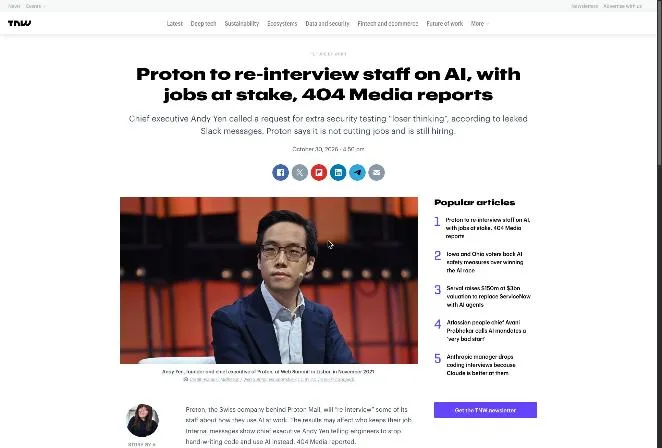
Yen admits a communication failure at an all-hands
Yen told staff the failure was in how he communicated, not in the push itself, which he said will continue. He announced the cancellation at an all-hands meeting of about two hours on Friday, October 30, according to 404 Media, which spoke to six current employees and obtained audio of the call.
Near the start, Yen said there had been a communication failure on his part and that many things should have been said differently. Leadership had discussed the re-interviews over the previous days and spoken to Proton's board, which he said is closely monitoring the situation. He then said the re-interviews had already served their purpose, since employees were now talking about AI and learning to use it.
Yen also announced a reorganization for next month that moves people between teams, with "no loss of jobs from AI." CTO Bart Butler told staff that the leadership team knew it had made mistakes. One employee said leadership plans to fold what the re-interviews would have measured into performance reviews.
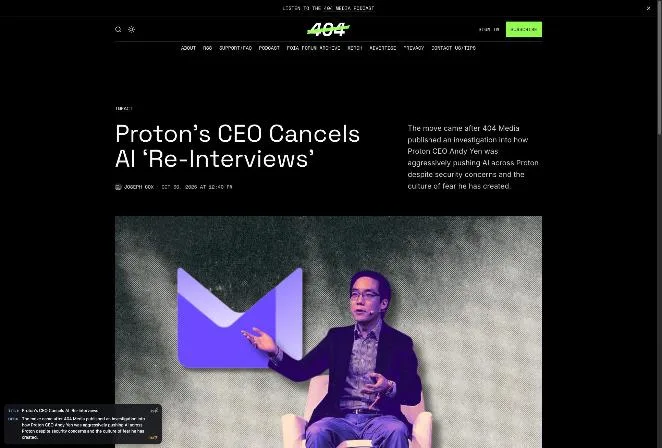
"I want to acknowledge myself, personally, that there was a communication failure on my part" / "Going forward, I'm still going to push," / "but there will be no loss of jobs from AI."View official source →
Proton apologizes and promises to show how it uses AI
Proton said it will open source internal tools and publish its code review process and AI policy so users can see how its code is made. The company posted the statement on its official X account on October 30, saying it had heard concerns about its AI strategy and culture. It listed three things it plans to publish:
- Several internal tools, released as open source, including more capable versions of Lumo that have never been offered outside the company
- How code reviews and security reviews are done at Proton
- Its AI policy, covering where AI is allowed, where it is not, and why
Until now, outsiders could only inspect the finished open-source code. Proton says users will also be able to see how that code was produced. The statement added that Proton is not re-interviewing staff about AI use and that no one will lose a job over the re-interviews, then apologized for falling short of the standard users expect.
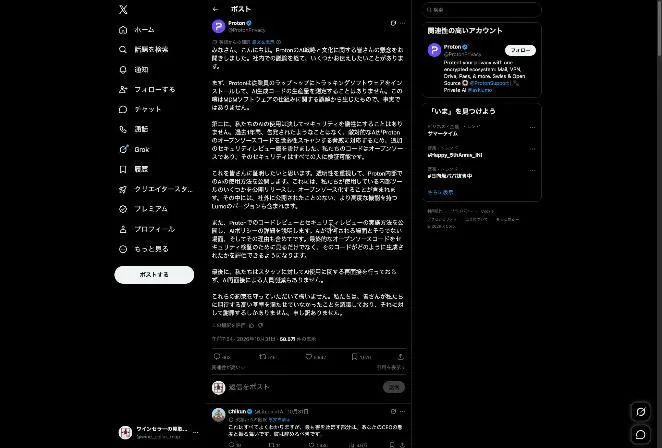
"we will lift the hood on how we use AI internally at Proton." / "Lastly, we are not re-interviewing our staff about AI usage, and there are no job losses due to AI re-interviews." / "we are sorry."View official source →
What 404 Media reported about Proton's AI push
404 Media described a company that went from banning AI to demanding it within months, where staff were afraid to raise security concerns. Reporter Joseph Cox broke the news of the re-interview plan on October 26 and followed it on October 29 with a longer piece. For the second story he interviewed nine people, eight still at Proton and one who had left, and reviewed Slack messages, recorded meetings and the CTO's AI manifesto.
Yen called a request to pentest new code loser thinking
When an employee asked for a few days to test new code before release, Yen dismissed the idea and told staff to use AI more. The exchange took place at the end of August in Proton's security Slack channel. An employee urged the company to take at least a few days to pentest newly written code, meaning to attack it on purpose to find weak spots, before pushing it live.
Yen replied that speed and security can go together and told staff to think about how to be faster, not slower. He also told the team to stop handcrafting code and lean on AI. In the following months he set up an email address where staff could report anything slowing AI adoption.
Employees told 404 Media they hesitate to raise concerns about security, or about building security products with AI, because they fear being rebuked in front of colleagues or losing their jobs. One source described the CEO as being in "full AI psychosis."
"Of course it’s possible to be fast and secure," / "stop lovingly handcrafting all our code and use AI more." / "ruthlessly smash everything that stands in the way of AI velocity"View official source →
AI wrote 90% of Proton's code in October, the CTO said
Employees said they wrote most of that code with Anthropic's Claude, and Yen told staff this is the last year Proton will hire engineers. Proton once barred staff from using AI at work, but changed course in August 2026. In a meeting recording obtained by 404 Media, CTO Bart Butler said AI wrote 90% of the code produced at Proton in October.
Yen wrote in the same Slack channel that Proton would stop hiring engineers after this year. Going forward, he said, the company would hire people to build products with AI instead.
An internal document links the rush to the business. According to that document, slow development means Proton will likely miss this year's goal for annual recurring revenue, the subscription income that renews every year. A Proton spokesperson did not dispute the reporting and said the company had sometimes been "too blunt or too slow" in explaining itself to staff.
"AI wrote 90% of Proton’s code in October, chief technology officer Bart Butler said in a meeting." / "Employees said they wrote much of it with Anthropic’s Claude." / "Proton is not on track to hit its annual recurring revenue target this year, an internal document says."View official source →
Staff were told the re-interviews were consequential
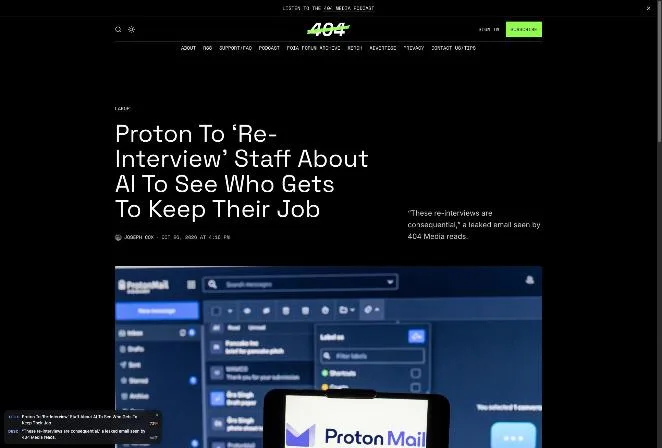
An Oct 26 email warned that how staff described their AI use could decide whether they kept their jobs. Proton told staff on Monday, October 26, that it would re-interview people across the company about how they use AI at work. The email said the results could affect roles and continued employment.
The interviews were scheduled for November 4 to 11. Not everyone would be called in, and each interviewer would come from outside the employee's own team. Yen had already interviewed more than 40 senior leaders in engineering and product.
After the plan leaked, Proton said on Reddit that it was not cutting jobs under cover of AI. It said it faces a talent shortage and is still hiring.
"These re-interviews are consequential," / "continued employment,"View official source →
Users threaten to cancel and call for Yen to resign
The reports set off a user backlash, and Proton moved quickly to deny parts of them. Proton sells itself as the careful, privacy-first alternative to big tech. After the October 29 report, criticism spread on Reddit and social media, and Proton issued its statement the next day.
Yen's Reddit reply drew more than 1,200 downvotes
Yen's reply on Reddit was downvoted more than 1,200 times as users said they were cancelling paid plans and some called for him to resign. Yen posted the reply after the October 29 investigation came out.
Employees were split as well. Some saw the cancellation as progress. Others pointed out that the re-interviews were dropped only after the story became public, and one said that as a Proton user, hearing the direction had not changed was not reassuring.
"Users downvoted his response more than 1,200 times." / "Many Proton users on social media said they were cancelling their paid Proton plans." / "the re-interviews weren’t cancelled until this became public despite concerns raised by many of us."View official source →
Proton denies installing AI tracking software
Proton denied putting software on staff laptops to measure AI-written code and said the rumor came from a misunderstanding about MDM. 404 Media had reported that Proton installed software on workers' computers to track how much code AI generates. In its statement, Proton said no such software exists and that the claim grew out of a misunderstanding of MDM, the software companies use to manage their laptops and phones.
Proton also said AI will never come at the expense of security. Over the past year, it added more layers of security review to guard against attackers who use AI to scan its open-source code for flaws.
Because the code is public, Proton argues, anyone can verify its security. For now, there is no outside evidence that settles whether the report or the denial is right.
"Proton does not install tracking software on employees' laptops to measure how much AI-generated code they produce." / "additional layers of security review have been added" / "Our code is open source, and its security remains open for all to verify."View official source →
Can outsiders check how Proton uses AI?
Proton's code is already open source, and the company has promised to publish its review process and AI policy, but it has not said when. 404 Media's account rests on employee interviews and meeting audio, while Proton disputes parts of it, such as the tracking software. Users cannot see inside Proton's meetings or Slack.
The documents Proton promised are the first thing outsiders could use to test its claims. Once the review process is public, users can compare it with the open-source code and see where human review happens on AI-written changes. Until then, the only checkable piece is the code itself.
FAQ
- Did Proton go ahead with the AI re-interviews?
- No. They were planned for November 4 to 11, but CEO Andy Yen cancelled them at an all-hands meeting on October 30. Proton's statement on X the same day said it is not re-interviewing staff about AI use.
- Which AI does Proton use to write code?
- Employees said much of Proton's code is written with Anthropic's Claude. CTO Bart Butler said AI wrote 90% of the company's code in October.
- Will Proton publish its AI policy?
- Proton has promised to. It says it will open source several internal tools, including more capable versions of Lumo, publish how code and security reviews are done, and explain where AI is and is not allowed. It has not given a date.
Related articles
 Epic Games delays Disney shooter, goes AI firstBloomberg reports Epic Games told its Marvel and Star Wars shooter team to stop hand-writing code and use AI. The March 2027 release is off with no new date.
 Claude Code hooks: 5 types and the node spawn costClaude Code hooks come in five types, from command to agent. As command hooks, one Edit launched 17 node processes, and hooks drove 47–87% of node launches.
 Grok Build on Every Plan: App Builder, Not the CLISince August 19, Grok Build runs on every plan, on web and mobile. It turns a chat prompt into an app with a grok.me link. The CLI is a different product.
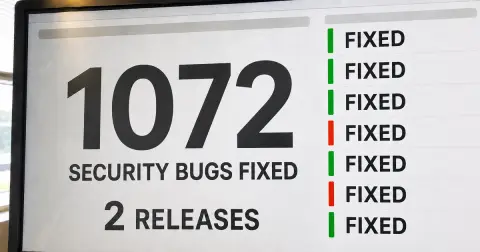 Chrome vulnerability: AI helped fix 1,072 bugsChrome vulnerability work now uses AI: Google says AI helped fix 1,072 security bugs in Chrome 149 and 150, from finding and triage to the patch.