Gemini Robotics 2 model: a VLA that controls the whole body
Gemini Robotics 2 is the model that lets a robot use its whole body, and DeepMind announced it together with two companion models on July 30, 2026. In the announcement, Google DeepMind calls it the intelligence layer for the next generation of adaptable robots.
DeepMind starts from two gaps in conventional robots. Most are pre-programmed or teleoperated (steered by a person) for narrow, repetitive task sequences, so they cannot learn or adapt on their own. A skill learned on one robot body is also very hard to move to another body (an embodiment is one particular robot body).
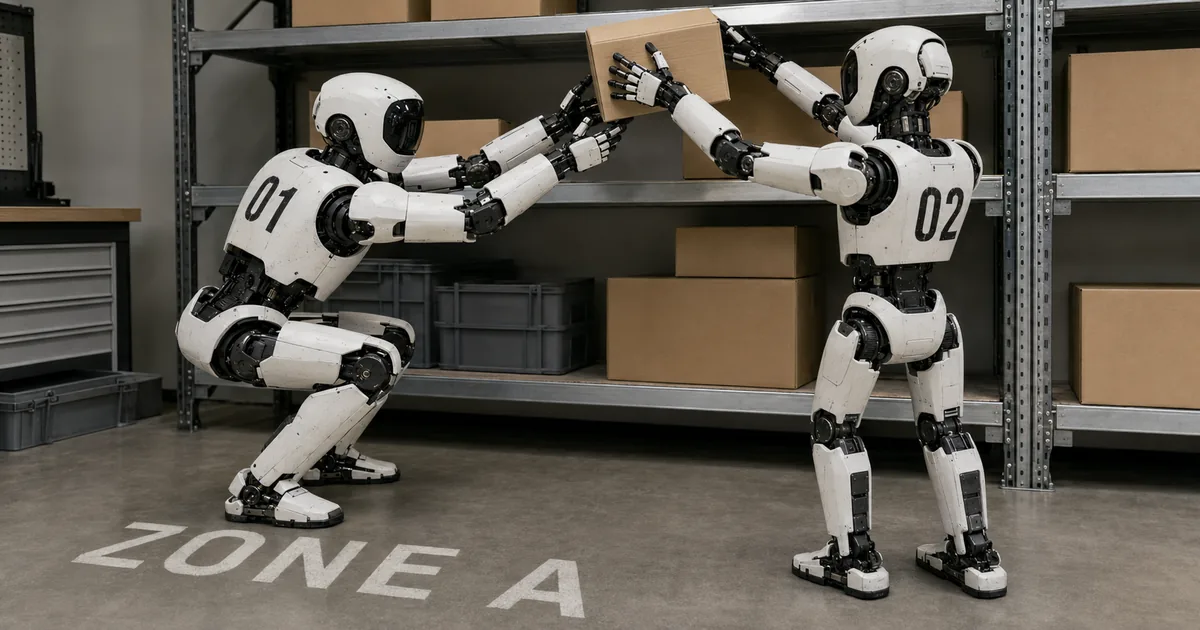
The model itself is a VLA, short for vision-language-action. It takes vision and language input, such as camera images plus a spoken or written instruction, and outputs motor control, so it produces the next movement where a chatbot produces the next word. DeepMind says it can control full humanoids from feet to fingertips, along with other bi-arm robots (robots with two arms).
The upper-body to whole-body change is the headline. Earlier Gemini Robotics models controlled a humanoid's upper body for table-top tasks, and this release adds walking and crouching to the same instruction. DeepMind says that for the first time its model can control entire humanoid robots.
In the demo, Apptronik's Apollo 2 humanoid gets an instruction to move the watering can to the green bin on the lowest shelf. After walking to the table and lifting the can, the robot crosses to the shelves in a few steps and sets it in the bin. DeepMind's chart then runs one model checkpoint (a saved state of a trained model) on three setups: Apollo 2 with SharpaWave hands, Apollo 2 with Inspire hands, and a Franka Duo with a Robotiq gripper.
Most robots are pre-programmed or teleoperated for narrow, repetitive task sequences. They lack the ability to truly learn for themselves or adapt to unpredictable environments. Moreover, transferring learned skills from one robot body to another remains incredibly difficult. / Gemini Robotics 2: Our most advanced vision-language-action model (VLA) that converts vision and language input into motor control, enabling a robot to take action. This model is capable of controlling full humanoids, from feet to fingertips, and other bi-arm robots. / While our previous models controlled the humanoid's upper-body to achieve table-top tasks, Gemini Robotics 2 expands physical AI into whole-body motions. / Gemini Robotics 2 controlling three different embodiments, using the same model checkpoint — the Apptronik Apollo 2 robot with SharpaWave hands, the Apollo 2 robot with Inspire hands, and the Franka Duo with the Robotiq gripper — From the passages on conventional robots, the VLA definition, the expanded control range and the results chart captionView official source →
Three Gemini Robotics models: VLA, ER 2 and On-Device 2
The announcement is three models with separate jobs, so "Gemini Robotics 2" can mean the VLA alone or the whole set. The table lists which model does what before the detail sections.
The three Gemini Robotics 2 models and what each handles, per the DeepMind announcement
| Model | Type | Job |
|---|---|---|
| Gemini Robotics 2 | VLA | Turns vision and language into motor control and moves the body |
| Gemini Robotics ER 2 | Embodied reasoning model (a vision language model) | Talks with people, understands the physical world, plans multi-step tasks |
| Gemini Robotics On-Device 2 | VLA | Runs locally on the robot and adapts to new robot bodies |
The split matters for what can be tried today. The planner and the body controller are separate models, and they are available to different groups.
Gemini Robotics ER 2: Our most capable embodied reasoning (ER) model. It is a vision language model (VLM) that acts as our agent, enabling robots to communicate with humans, understand the physical world and plan multi-step tasks lasting several minutes. / Gemini Robotics On-Device 2: Our most efficient vision-language-action model (VLA) optimized to run locally on robotic devices. — From the descriptions of ER 2 and On-Device 2View official source →
Gemini Robotics ER 2 model plans multi-robot tasks
ER 2 is the planning model: it reads the scene, breaks a job into steps and coordinates with the VLA to carry them out. ER stands for embodied reasoning, meaning reasoning about the physical world the robot works in.
In DeepMind's description, ER 2 takes the user's instruction, talks with people, observes the room, works out the steps, coordinates with the VLA to carry them out and tracks progress until the task is done. DeepMind says this setup lets a robot correct itself when a step fails and handle situations and goals it has not seen before.
The task length is the other change. DeepMind says robots can now run longer sequences, lasting several minutes and involving hundreds of decisions. ER 2 also understands when a task begins and ends and can pinpoint the moment a key event occurs.
Multi-robot collaboration is new in this release. Different types of robots communicate and share a workflow that a single robot could not finish alone.
It observes the room, reasons about the steps needed to complete the task, coordinates with the VLA to carry out the actions, and tracks progress until the task is done. This setup allows robots to execute complex multi-step tasks, self-correct if a step fails, and generalize to novel situations and goals. / In this update, we are enabling robots to more reliably execute longer task sequences, lasting several minutes and involving hundreds of decisions. / Furthermore, we are introducing multi-robot collaboration. This enables different types of robots to communicate and work together to solve complex workflows a single robot could not do alone. — From the role of ER 2, the task length and the multi-robot collaboration passageView official source →
Gemini Robotics 1.5 motion transfer in the On-Device 2 VLA
On-Device 2 is the VLA built to run locally on the robot, and it carries over the motion transfer technique from Gemini Robotics 1.5. DeepMind says many robot applications must work without network latency or internet connectivity, which is the case this model is built for.
DeepMind also calls the model natively multi-embodiment (built for several robot bodies from the start). It adapts to a new bi-arm robot in a few hours, typically with fewer than 200 examples.
The adaptation holds even when the new body differs a lot in shape, sensors and degrees of freedom (the number of directions its joints can move). DeepMind shows tasks run on the Dexmate, SO101 and Trossen platforms.
The Gemini Robotics line spans four steps. The announcement's related-posts list names the original release in March 2025, version 1.5 in September 2025, ER 1.6 in April 2026 and a separate July 2026 post on ER 2.
Many robotic applications need to operate without network latency or internet connectivity. / This model is natively multi-embodiment and inherits our advanced "motion transfer" techniques from Gemini Robotics 1.5. We can now adapt to new bi-arm robot embodiments with just a few hours of adaptation time, typically with less than 200 examples. This works even with new embodiments with drastically different shapes, sensors and degrees of freedom, as shown below with a diverse set of tasks being performed by the Dexmate, SO101, and Trossen platforms. — From the passages on offline operation and on adaptation to new robot bodiesView official source →
Limits of the Gemini Robotics demo that DeepMind states
The announcement shows demos, and it also names what they do not show: multi-finger dexterity and movement speed. The caption under the results chart comes first, because it is the one place where the success rate is described.
The caption says the model reaches a medium to high success rate on whole-body and gripper-based dexterous tasks. It then adds that multi-finger dexterous manipulation remains challenging. DeepMind publishes no success-rate figures, and the two limits below come from the same post.
Each bar represents the average success rate over multiple tasks within the same skill category. For multifinger tasks we show individual task performance. While Gemini Robotics 2 achieves a medium to high success rate for whole-body and gripper-based dexterous tasks, the multi-finger dexterous manipulation remains challenging. — From the results chart captionView official source →
Multi-finger dexterity and speed limits in the demo model
DeepMind lists both multi-finger manipulation and movement speed as work still ahead. The hand it shows is the SharpaWave hand on Apollo 2, which has five fingers and 22 degrees of freedom. The model controls it to tie knots and seal a ziplock bag.
The same model also operates standard two-fingered parallel grippers on a Franka Duo platform, with tight packing as one example task. The chart separates the two cases: gripper tasks are summarized per skill category, while multi-finger tasks are shown one task at a time.
Speed comes up right after the watering-can demo. DeepMind says its robots have more to advance in movement speed, and calls the result an important step toward real-world tasks that need whole-body coordination. It adds that it is continuing to advance precision and speed toward human-level dexterity.
The model can now control the five-fingered, 22 degree-of-freedom SharpaWave hand on the Apollo 2 robot to complete delicate actions like tying knots or sealing a ziplock bag. It can also operate standard two-fingered parallel grippers on a Franka Duo platform to perform complex dexterous tasks (e.g. tight packing). We are continuing to advance the level of precision and speed to achieve human-level dexterity. / While our robots have more to advance in movement speed, this is an important step towards the skills needed to complete more complex, real-world tasks that require whole-body coordination. — From the dexterity passage and the movement-speed caveatView official source →
ASIMOV-Agentic: the ER model refuses unsafe VLA calls
ASIMOV-Agentic is a new benchmark that tests whether the reasoning model can say no to the body-control model. The VLA makes the tool calls in this benchmark. The benchmark measures the ER agent's ability to refuse unsafe tool calls from a VLA.
It also measures two further abilities. The agent should predict whether a task is possible, and it should ask a human for help on its own when it is unsure.
On the ER 2 result, DeepMind calls it its safest robotics model to date on safety constraint following and human proximity benchmarks. ER 2 is better at noticing when people are close, and it can call safety tools and bring the robot to a safe stop if someone gets too near. DeepMind says this is a key requirement in collaborative safety standards, and it points to the Gemini Robotics 2 Safety Technical Report for details.
We’re introducing ASIMOV-Agentic , a new benchmark for agentic safety orchestration and uncertainty resolution. For example, it measures the embodied reasoning agent’s ability to refuse unsafe tool calls from a VLA.It also measures the agent’s ability to predict whether a task is possible and to proactively request human intervention when uncertain. / Additionally, with enhanced embodied reasoning, Gemini Robotics ER 2 is our safest robotics model to date in safety constraint following and human proximity benchmarks. It can better detect when humans are nearby, trigger safety tool calls and bring the robot to a safe stop if someone approaches too closely. This is a key requirement in collaborative safety standards. — From the ASIMOV-Agentic description and the ER 2 human-proximity resultView official source →
Gemini Robotics ER 2 model access in Google AI Studio
As of the July 30, 2026 announcement, only ER 2 is available outside early-access partners. Announced and available are separate states here, and the three models sit in different ones.
ER 2 can be used in Google AI Studio, and Gemini Enterprise Agent Platform offers it as a private preview. A developer who already uses Gemini models in AI Studio can reach it from the same place.
The Gemini Robotics 2 VLA and On-Device 2 are available to early-access partners. Teams outside that partner group cannot use them yet, according to the announcement.
DeepMind lists a Trusted Tester Program sign-up, model cards for ER 2 and On-Device 2, and a Developer blog post on bringing the models to your own hardware. The source states no price and no date for wider release of the VLA or On-Device 2. The announcement also thanks Apptronik, Boston Dynamics and Agile Robots as partners.
Gemini Robotics ER 2, our reasoning model, is now available on Google AI Studio and in private preview on Gemini Enterprise Agent Platform. Our VLA and On-Device models are available to early-access partners. Read how to bring these models to your hardware on our Developer blog . — From the statement of availability for the three modelsView official source →
Summary: one checkpoint across three robot bodies
Gemini Robotics 2 puts whole-body control, planning and local adaptation into three models, and the central fact in the announcement is one checkpoint driving three robot setups. The setups are Apollo 2 with SharpaWave hands, Apollo 2 with Inspire hands and a Franka Duo with a Robotiq gripper. On-Device 2 adapts to a new bi-arm robot in a few hours, typically with fewer than 200 examples.
DeepMind names two limits in its own post. Multi-finger dexterous manipulation remains challenging, and movement speed has more to advance. DeepMind does not publish the success-rate figures behind the chart.
On access, ER 2 can be used in Google AI Studio and is offered as a private preview on Gemini Enterprise Agent Platform, while the VLA and On-Device 2 are for early-access partners. DeepMind has not announced pricing for any of the three models.
FAQ
- What is Gemini Robotics 2?
- Gemini Robotics 2 is a set of three AI models for controlling robots, announced by Google DeepMind on July 30, 2026. The model it is named after is a VLA (vision-language-action) model that turns vision and language input into motor control, and DeepMind says it can drive a full humanoid from feet to fingertips.
- How is Gemini Robotics 2 different from the previous Gemini Robotics models?
- The main difference is how much of the body it controls. Earlier models drove a humanoid's upper body for table-top work, while Gemini Robotics 2 extends to whole-body motion such as walking, crouching and reaching.
- Can I use Gemini Robotics 2 right now?
- Only the reasoning model, Gemini Robotics ER 2, can be reached outside early-access partners. It is in Google AI Studio and in private preview on Gemini Enterprise Agent Platform. The VLA model that drives the motors and the On-Device model are limited to early-access partners.
- What can Gemini Robotics 2 not do yet?
- DeepMind states it in the caption of its own results chart: whole-body and gripper-based dexterous tasks reach a medium to high success rate, but multi-finger dexterous manipulation remains challenging. It also says its robots have more to advance in movement speed.
Related articles
 AI fact check: only 40% of cited stats hold upAI fact check: Trakkr traced 1,285 stats cited by ChatGPT, Perplexity, Gemini, Claude and AI Overviews. Only 40% led to a matching study. How to check one.
 Gemini create files: edit PDFs and docs in chatGemini create files: docs, PDFs, slides and sheets now open in the chat as previews you can edit. Phones edit only PDFs; the web handles the rest.
 Chrome enhanced autofill and Gmail: turn it offChrome enhanced autofill now suggests order numbers, tracking info, and flight bookings from Gmail. Who gets it, and how to turn it off or remove suggestions.
 Gemini 4 Carbon vs Argon: Pricing and AccessGemini 4 Carbon vs Argon: Carbon opened to paid API developers, businesses and Google AI Ultra on Nov 10, at the same $2/$10 per 1M token price as Argon.