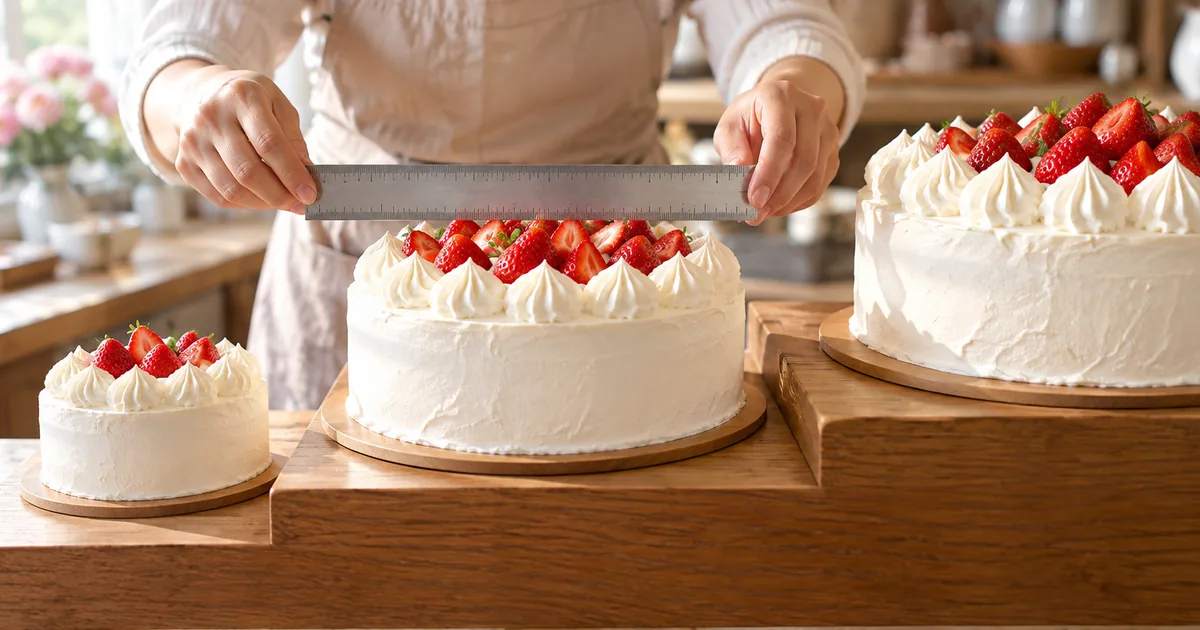
You have a pan size and a guest list, and the two do not obviously connect. A cake serving chart is meant to settle it, but the same cake shows up with two different numbers depending on which chart column you read. The reason is simple: the chart is counting slices, and slices come in more than one size.
A cake serving chart counts slices, not cake
A serving chart never measures the cake. It measures how many pieces of a given size fit into it. Change the piece and the number changes, even though nothing about the cake moved.
That is why two charts can disagree about a 10 inch round without either being wrong. One is cutting narrow slices, the other is cutting wider ones. Before you compare numbers between sources, find out what slice each one assumed.
It also means the number is arithmetic rather than a property of the cake. Nothing stops you from cutting more or fewer pieces than the chart says.
Party slices and wedding slices are different sizes
Wilton publishes both, side by side, for every pan on its chart. Party servings assume slices about 1 1/2 by 2 inches. Wedding servings assume slices about 1 by 2 inches, which is narrower, so the same pan divides into more of them.
Check which column you are reading before anything else. If you take the wedding number to a birthday party and cut party-sized slices, you will run out well before the guest list does.
Pick the column that matches how you will actually cut. Formal, plated dessert after a full meal fits the smaller slice. A cake that is the main event does not.
"Wedding servings are based on slices that measure about 1 x 2 inches in size." / "Remember that number of servings are intended as a guide only. Actual results may vary." — from Wilton's own cake baking and serving guideView official source →
Between 3 and 6 inches tall, height does not change the count
Height feels like it should matter, and for how full people get, it does. For the count on the chart, it does not.
Wilton states that cakes measuring 3 to 6 inches high, baked in the same pan, yield the same number of servings, because they are cut the same way. A 6 inch round that stands 6 inches tall gives you the same count as one that stands 3 inches tall. What changes is how substantial each slice is, not how many you get.
The exception is at the bottom of the range. Below 3 inches, the count halves. A single thin layer is cut into the same grid but each piece is small enough that the chart stops treating it as a full serving.
"Cakes that measure 3 to 6 inches high, baked in the same size pan, would yield the same number of servings because they follow the same pattern of cutting." / "Cakes that are shorter than 3 inches would yield half the number of servings indicated for that pan." — from Wilton's own cake baking and serving guideView official source →
The numbers come from one company's test kitchen
Wilton's chart gets quoted so widely that it reads like a standard. The page itself is more modest. The figures come from the company's own test kitchen, and it says outright that the serving numbers are a guide and that actual results vary.
That matters when you find a bakery quoting different numbers for the same pan. They are not contradicting a standard, because there is no standard to contradict. They are cutting differently, or counting a slice as a portion where Wilton counts it as half.
So use the chart as a starting point and let the person actually cutting the cake adjust it. If you are ordering rather than baking, ask the bakery what slice size their number assumes.
Work back from the slice you will actually cut
The chart is easier to use backward. Instead of asking how many a pan feeds, decide the slice first and see what pan delivers it.
Start with the width you want at the outside edge. A generous dessert slice runs around 1 1/2 inches, the width Wilton uses for party servings; a plated slice after dinner can sit closer to 1 inch. Multiply that by your guest count and you have the cutting length you need.
From there, the chart row that matches your pan tells you whether the arithmetic works. If you land between two rows, take the larger pan.
Leftover cake keeps for a day; a short cake does not stretch. If a bigger pan means scaling the recipe as well, How many grams in a tablespoon? Sugar 12.6 g helps when you weigh the scaled ingredients instead of spooning them.
Pan size and slice size decide every chart
A serving chart answers one question: how many pieces of a stated size fit into a given pan. Wilton names two sizes, so it publishes two answers for every pan, and reading the wrong column is how people end up short.
Height does not move the count between 3 and 6 inches, and the whole chart is a guide from one test kitchen rather than a standard. Decide your slice, take the larger pan when you land between rows, and let whoever cuts the cake make the final call.
FAQ
- How many people does a serving chart say a cake feeds?
- It depends on which slice size the chart uses. Wilton publishes two: party servings, based on slices about 1 1/2 by 2 inches, and wedding servings, based on slices about 1 by 2 inches. The same pan yields two different numbers.
- Why do wedding servings come out higher than party servings?
- Because the slices are narrower. A wedding slice is about 1 by 2 inches against roughly 1 1/2 by 2 inches for a party slice, so the same cake divides into more pieces.
- Does a taller cake feed more people?
- Not between 3 and 6 inches. Wilton states that cakes from 3 to 6 inches high baked in the same pan yield the same number of servings, because they are cut the same way. Below 3 inches the count halves.
- Is the Wilton chart an industry standard?
- No. The page says the numbers come from Wilton's own test kitchen and are intended as a guide only. Treat them as one company's recommendation rather than a rule everyone follows.
- How do I work out servings for a pan that is not on the chart?
- Start from the slice you will actually cut rather than the pan. Decide the slice width, divide the cake's cutting area by it, and compare the result against the chart row closest to your pan.
Related articles
 Claude Fable 5.2: 20% price cut, up to 30% fasterAnthropic released Claude Fable 5.2 on November 9, 2026. API prices fall 20% to $8/$40 per million tokens, and output is up to 30% faster than Fable 5.1.
 PayPay security and passkeys in 10 Japan pay appsPayPay security compared with 9 other Japanese payment apps: passkeys, extra checks to send or pay, and fraud compensation deadlines.
 AI fact check: only 40% of cited stats hold upAI fact check: Trakkr traced 1,285 stats cited by ChatGPT, Perplexity, Gemini, Claude and AI Overviews. Only 40% led to a matching study. How to check one.
 Akamai: online scams double and overtake phishingAkamai's fraud report says online scams doubled to about 6.4 million and passed phishing in Q1 2026, while phishing sites now last 22 days instead of 48.