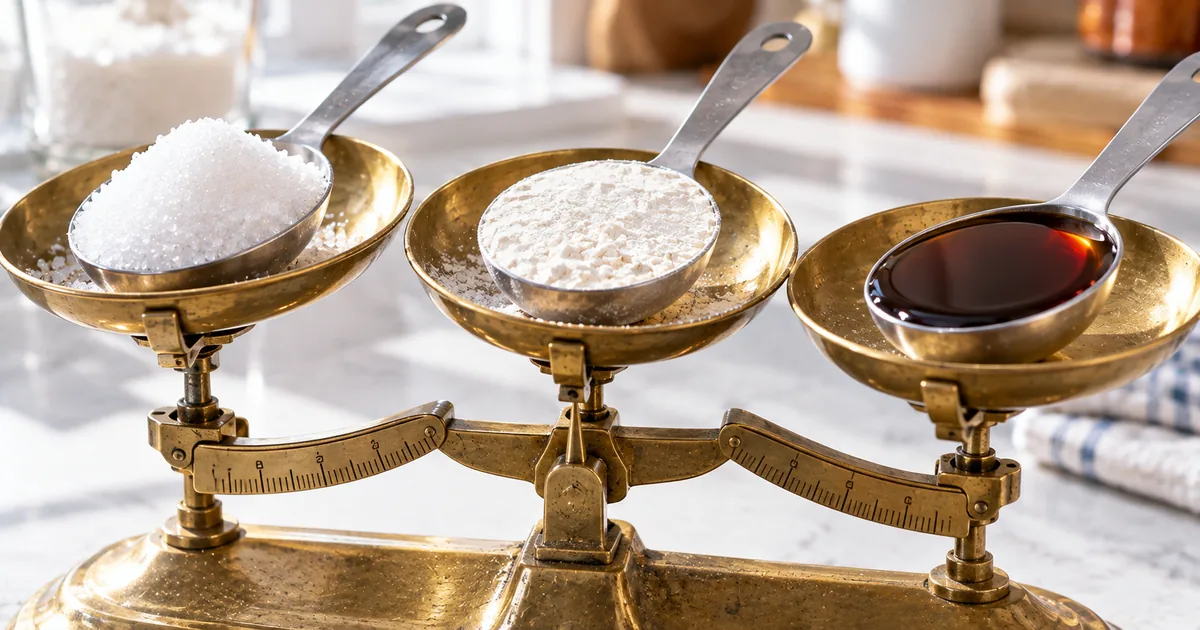
A tablespoon holds about 12.6 g of granulated sugar, 14.2 g of butter or 18 g of table salt. The spoon is the same size in every case, so the only thing that changes is what you put in it. The figures below are read from the US government's own portion data rather than copied between recipe sites.
How many grams in a tablespoon, by ingredient
Start here and go back to your recipe. Every figure is either read directly from USDA FoodData Central or worked out from a USDA figure by the arithmetic set out further down.
Sugar and salt
| Ingredient | 1 tsp | 1 Tbsp | 1 US cup |
|---|---|---|---|
| Granulated sugar | 4.2 g | 12.6 g | 200 g |
| Table salt | 6 g | 18 g | 292 g |
Sugar and salt look alike in the spoon and behave nothing alike on the scale. A tablespoon of salt outweighs a tablespoon of sugar by almost half again, which is why a recipe that confuses the two fails in a way nobody misses.
One caution on the salt row: the figure is for table salt, which is the salt USDA measures. A recipe that names a coarser salt is one to weigh rather than convert, because grain size changes how much salt fits in the spoon.
Fats and syrups
| Ingredient | 1 tsp | 1 Tbsp | 1 US cup |
|---|---|---|---|
| Butter | 4.7 g | 14.2 g | 227 g |
| Olive oil | 4.5 g | 13.5 g | 216 g |
| Honey | 7 g | 21 g | 339 g |
Butter is worth memorizing a second way. A US stick is 113 g and is scored into eight tablespoons, so the wrapper works out to 14.1 g per tablespoon before you open a chart — near enough to USDA's 14.2 g that either will do.
Honey is the heaviest thing most kitchens measure by the spoon. At 21 g it outweighs the same spoon of sugar by two thirds, so swapping honey for sugar spoon for spoon changes the weight of the batch and not only its sweetness.
Flour
| Ingredient | 1 tsp | 1 Tbsp | 1 US cup |
|---|---|---|---|
| All-purpose flour | 2.6 g | 7.8 g | 125 g |
Flour is the one ingredient here that USDA does not measure by the spoon at all. It publishes the cup, 125 g, and the spoon figures come from dividing that down — which is also the reason flour is the ingredient most worth weighing rather than scooping.
All six ingredients above trace to USDA's SR Legacy records, read on 2026-09-05 — directly where USDA gives a spoon figure, and through the cup where it does not. The butter record states the stick and the spoon in the same line.
1 stick = 113g / 1 cup = 227g / 1 tbsp = 14.2gView official source →
The spoon is 15 mL. The cup is where charts go wrong
The volumes themselves are not in dispute. Federal regulation fixes them for nutrition labeling, and they are the same figures your measuring spoons are manufactured to.
What the regulation actually fixes
A teaspoon is 5 mL, a tablespoon is 15 mL, and a cup is 240 mL. The first two match Japan and the UK, which is why a tablespoon figure written for either of those kitchens is safe to use on American spoons.
"For nutrition labeling purposes, a teaspoon means 5 milliliters (mL), a tablespoon means 15 mL, a cup means 240 mL, 1 fl oz means 30 mL, and 1 oz in weight means 28 g."View official source →
The cup is not the same figure
The agreement stops at the cup. A Japanese cup is 200 mL, and conversion charts translated out of Japanese carry that cup into English without ever saying so.
Hold the ingredient still and change only the cup, and the size of the problem shows up on its own. Granulated sugar is the fairest test, because it is the ingredient people measure by the cup most often.
| Same granulated sugar, different cup | Weight |
|---|---|
| US cup, 240 mL | 200 g |
| Japanese cup, 200 mL | 167 g |
What makes a chart like that hard to catch is that it is not wrong everywhere. Its tablespoon column is correct, because the tablespoon is 15 mL on both sides of the Pacific, and only the cup column comes up short.
You can test any chart in one glance. If its cup row for sugar is near 200 g it is built on the US cup, and if it is nearer 167 g it is built on the Japanese one.
How many grams in a teaspoon
A teaspoon is one third of a tablespoon, exactly and by definition, so every row in the table above divides by three. Granulated sugar is 4.2 g, table salt 6 g, olive oil 4.5 g.
For those three USDA publishes the teaspoon itself, so they are measurements rather than arithmetic — which matters when a recipe calls for a teaspoon of something and you are working on a scale. For everything else, divide the tablespoon figure and you are done.
Half and quarter spoons
Half a tablespoon is 7.5 mL and a quarter is 3.75 mL, but weighing beats splitting a spoonful by eye. Half a tablespoon of butter is 7.1 g, which a kitchen scale reads directly and a knife edge only approximates.
Why the same spoon weighs different amounts
The spoon measures volume and the scale measures mass. Density is the bridge between them, and density is the only thing that changes from row to row in the table above.
The one formula
Multiply density in grams per milliliter by 15 and you have grams per tablespoon. Water sits at 1.0 g/mL, so a tablespoon of water is 15 g, and every ingredient in the table is that same spoonful scaled up or down. Granulated sugar works out at 0.833 g/mL, which puts a spoonful at 12.5 g — close enough to the 12.6 g that USDA's teaspoon figure gives to show the two methods agree.
Working out an ingredient that is not in the table
Take the cup weight of the ingredient, then divide by 240 and multiply by 15. All-purpose flour is 125 g per cup, so 125 ÷ 240 × 15 = 7.8 g per tablespoon, which is exactly how the flour row above was built.
How many tablespoons is 50 grams
Divide the grams by the grams per tablespoon. The three most-asked ingredients land here.
| 50 g of | Tablespoons |
|---|---|
| Granulated sugar | 50 ÷ 12.6 ≈ 4 Tbsp |
| Butter | 50 ÷ 14.2 ≈ 3.5 Tbsp |
| All-purpose flour | 50 ÷ 7.8 ≈ 6.4 Tbsp |
Butter has a shortcut here too. Half a stick is 56.5 g, so 50 g is a little under half a stick and you can cut it against the tablespoon marks printed on the wrapper.
Summary
- A tablespoon is 15 mL and a teaspoon is 5 mL, fixed by federal regulation and shared with most of the world
- A US cup is 240 mL, and this is the figure that imported charts get wrong
- Per tablespoon: granulated sugar 12.6 g, table salt 18 g, butter 14.2 g, olive oil 13.5 g, honey 21 g, all-purpose flour 7.8 g
- A stick of butter is 113 g in 8 tablespoons, so the wrapper is itself a measuring tool
- For anything not listed here: density in g/mL × 15 = grams per tablespoon
FAQ
- How many grams is a tablespoon of sugar?
- A tablespoon of granulated sugar is about 12.6 g. USDA measures a teaspoon at 4.2 g, and a tablespoon is three teaspoons. If a chart tells you 9 g, it is measuring a Japanese sugar called jōhakutō rather than the granulated sugar sold in American supermarkets.
- How many grams is a tablespoon of butter?
- 14.2 g. The easier number to remember is the stick: a US stick of butter is 113 g and is scored into eight tablespoons, which works out to 14.1 g — near enough to call it the same. Charts that file butter with the cooking oils at 12 g are about 15 percent light.
- How many grams is a teaspoon?
- One third of whatever the tablespoon weighs, because a tablespoon is exactly three teaspoons. Granulated sugar is 4.2 g, table salt 6 g, olive oil 4.5 g.
- Is a cup 200 mL or 240 mL?
- In the United States a cup is 240 mL, and the figure is written into federal regulation. A 200 mL cup is the Japanese one, so any chart built on it is short by one sixth on every cup row while its tablespoon rows stay correct.
- Why does the same tablespoon weigh different amounts?
- Because the spoon measures volume and the scale measures mass, and the bridge between them is density. Multiply the ingredient's density in grams per milliliter by 15 and you have its grams per tablespoon.
Related articles
 Japanese envelope sizes: chou 3, chou 4, kaku 2Japanese envelope sizes in millimeters: chou 3 is 120 × 235 mm and posts as standard mail at 110 yen, plus the four conditions that actually decide the price.
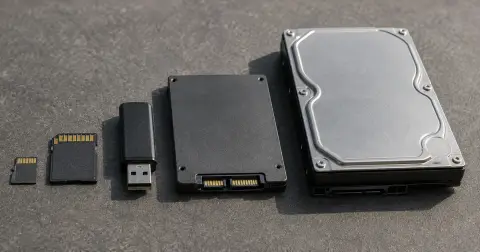 File size units explained: how many GB in a TB?File size units run B, KB, MB, GB and TB, each 1,024 times the one below. A terabyte is 1,024GB in binary and 1,000GB in decimal, so a 1TB drive reads 931GB.
 Claude Fable 5.2: 20% price cut, up to 30% fasterAnthropic released Claude Fable 5.2 on November 9, 2026. API prices fall 20% to $8/$40 per million tokens, and output is up to 30% faster than Fable 5.1.
 PayPay security and passkeys in 10 Japan pay appsPayPay security compared with 9 other Japanese payment apps: passkeys, extra checks to send or pay, and fraud compensation deadlines.